


TL;DR:
- Understanding competitive products involves three main types: direct, indirect, and replacement competitors, each requiring a unique strategic approach. Companies succeed by analyzing these categories continuously, focusing on customer jobs-to-be-done and differentiating on measurable dimensions like price or experience. Ongoing monitoring and structured frameworks enable businesses to identify market gaps and develop resilient, data-driven strategies.
Competitive products are defined as distinct offerings that target the same customer need, whether through direct similarity, alternative categories, or substitute solutions. Understanding these three types — direct, indirect, and replacement — is the foundation of any serious competitor product analysis. The Apple iPad versus Amazon Fire, McDonald’s versus Burger King, and Tesla Model Y versus Xiaomi YU7 are not just famous rivalries. They are textbooks on positioning, pricing, and differentiation. If you are an entrepreneur or product manager trying to sharpen your market strategy, these examples of competing products are where you start.
1. What are competitive products examples?
A competitive product is any offering that competes for the same customers in a target market. Competitive products span physical goods, digital products, live experiences, and professional services. The term “competitive products” is the everyday shorthand, but the recognized industry term is competitive alternatives, which includes every option a customer might choose instead of yours.
The three categories that matter for strategy are:
- Direct competitors: Same product category, similar price, same target customer. Think Honda Civic versus Toyota Corolla.
- Indirect competitors: Different product category, same underlying customer need. Think pharmaceuticals versus naturopathy for pain management.
- Replacement (substitute) competitors: Entirely different solution to the same job-to-be-done. Think a Starbucks packaged meal versus a sit-down restaurant for a hungry commuter.
Most business leaders obsess over direct competitors and ignore the other two. That is a strategic blind spot. Indirect and replacement competitors can erode your market share just as fast, and they are far harder to spot until the damage is done.
2. Direct competitive products: the most visible rivalry
Direct competitive products offer similar experiences at comparable price points to the same target customer. The fast food sector is the clearest illustration: McDonald’s, Burger King, and Wendy’s all compete for the same hungry, time-pressed consumer with roughly equivalent menus and price tiers. Each brand has spent decades finding micro-differentiators — Burger King’s flame-grilling, Wendy’s fresh beef positioning — because the core product is nearly identical.
In automotive, the Honda Civic versus Toyota Corolla rivalry has defined the compact sedan segment for 40 years. Both cars target reliability-focused buyers in the $22,000 to $28,000 range. The differentiation comes down to ride feel, dealer experience, and brand loyalty rather than fundamental product differences.

The most instructive current example is the EV market. Xiaomi’s YU7 Standard Edition undercuts the Tesla Model Y by $4,350 while delivering 50 km more range. That is a textbook direct competitor move: match the category leader on core specs, beat them on price, and force a response. Tesla now has to justify its premium on software, brand, and charging network rather than hardware alone.
Key characteristics of direct competitive products:
- Comparable price points within the same market segment
- Similar feature sets targeting the same use cases
- Shared target personas and purchase triggers
- Differentiation driven by brand, UX, or marginal feature advantages
Pro Tip: When you map your direct competitors, go beyond feature checklists. Document their pricing trajectory over 12 months. A competitor dropping price 15% signals either cost advantages you need to understand or margin pressure you can exploit.
3. Indirect competitive products and why they blindside companies
Indirect competitors solve the same customer problem through a fundamentally different product category. The distinction sounds academic until you watch a market shift underneath you. Pharmaceuticals and naturopathy both address chronic pain. Gym memberships and fitness apps both address the desire to get fit. The customer need is identical; the delivery mechanism is not.
The strategic danger of indirect competition is that it rarely shows up in standard market analysis. Competitive analysis must assess market share, strengths, weaknesses, and indirect competitors to create sustainable revenue. Most companies skip the last item on that list.
Consider how packaged meal kits from brands like HelloFresh and Home Chef compete indirectly with grocery stores. The customer need is “feed my family a decent dinner.” The grocery store and the meal kit company are not in the same product category, but they are absolutely competing for the same wallet and the same decision.
Indirect competition examples worth studying:
- Pharmaceuticals vs. naturopathy: Both address health management, but through entirely different mechanisms and belief systems.
- Corporate training software vs. executive coaching: Both develop leadership capability, but one scales at near-zero marginal cost.
- Streaming services vs. social media: Both compete for leisure screen time, even though one is subscription video and the other is user-generated content.
The opportunity in indirect competition is differentiation through category framing. If you can articulate why your approach to the customer’s problem is superior to the alternative category, not just the direct competitor, you own a more defensible position. That is where the real white space lives.
4. Replacement products: competing on the job-to-be-done
Replacement products compete by offering a completely different solution to the same underlying job. The concept comes from Jobs-to-be-Done theory, and it reframes competition in a way that most product roadmaps ignore entirely.
A hungry customer choosing a Starbucks packaged meal over a sit-down dining experience is not comparing menus. They are solving the job “I need to eat something satisfying in the next 15 minutes” through two completely different product categories. The sit-down restaurant never saw Starbucks as a competitor. That is exactly the problem.
Replacement product examples across industries:
- Videoconferencing vs. business travel: Both fulfill the job of “connect with a client in another city.” Zoom did not just compete with other conferencing tools. It replaced an entire travel budget category.
- E-books vs. audiobooks: Both fulfill the job of “consume a book.” They compete for the same reading time even though the format is entirely different.
- Chatbots vs. customer service call centers: Both fulfill the job of “resolve my issue quickly.” The replacement is happening in real time across industries.
The strategic implication is significant. When you identify replacement competitors, you can reposition on the dimensions that matter most to the job: speed, convenience, cost, or emotional satisfaction. Starbucks wins on convenience. The sit-down restaurant wins on experience. Neither is wrong. Both need to know the other exists.
5. How to use competitive products examples in business strategy
The real value of studying competitive products examples is not the examples themselves. It is the frameworks they validate. Competitor analysis involves identifying competitors, evaluating value propositions, analyzing marketing, and following customer journeys using SWOT analysis. That process only produces useful output when you feed it with specific, well-categorized examples.
Three frameworks that work in practice:
SWOT analysis applied to competitors: Map each direct, indirect, and replacement competitor against strengths, weaknesses, opportunities, and threats. The Xiaomi YU7 versus Tesla Model Y example is instructive here. Xiaomi’s strength is price and range. Tesla’s strength is software, Supercharger network, and brand trust. A product manager at either company who ignores the other’s SWOT is flying blind.
Feature comparison matrices: Productboard advises focusing on feature, UX, technical comparisons, target personas, and messaging to identify differentiation opportunities without copying. A feature matrix forces you to be specific. “They have better UX” is not a finding. “Their onboarding flow requires three fewer steps and integrates with Slack natively” is a finding you can act on.
Positioning maps: Plot competitors on two axes that matter to your target customer, typically price versus quality or convenience versus customization. The Apple iPad versus Amazon Fire map is simple: Apple owns the premium, productivity-focused quadrant; Amazon Fire owns the budget, media-consumption quadrant. Both are tablets. Neither is trying to be the other.
| Competitive pair | Key differentiator | Strategic implication |
|---|---|---|
| Tesla Model Y vs. Xiaomi YU7 | Price and range vs. software ecosystem | Tesla must defend on experience; Xiaomi must build trust |
| Apple iPad vs. Amazon Fire | Premium UX vs. budget accessibility | Separate target personas reduce direct price pressure |
| McDonald’s vs. Burger King | Scale and consistency vs. flame-grilled positioning | Differentiation on process, not just product |
| Pharmaceuticals vs. naturopathy | Clinical evidence vs. holistic approach | Indirect competition requires category-level messaging |
Pro Tip: Do not run a competitor analysis once and file it. Ongoing competitor monitoring reveals shifts in target segments, positioning, and investment that a quarterly snapshot will always miss. Set a monthly cadence and track changes, not just current states.
6. Comparing top competitive products across industries
The best way to internalize competitive product strategy is to study real pairs across different sectors. Each example below illustrates a distinct competitive dynamic.
McDonald’s vs. Burger King is the definitive direct competition case study. Both chains target the same value-conscious, convenience-driven consumer. McDonald’s wins on scale, consistency, and breakfast. Burger King wins on flame-grilled differentiation and, increasingly, on value promotions. The lesson: in a direct competition pair, the challenger must own a specific attribute the leader cannot credibly claim.
Apple iPad vs. Amazon Fire demonstrates how two products in the same category can avoid head-to-head price competition through deliberate positioning. Apple targets professionals, students, and creative users willing to pay $329 and up. Amazon Fire targets budget-conscious households and media consumers at $99 and below. The Total Addressable Market overlaps, but the primary personas do not. That is intentional.
Tesla Model Y vs. Xiaomi YU7 is the freshest and most instructive example in 2026. Xiaomi entered a category Tesla defined and immediately attacked on the two dimensions most visible to consumers: price and range. Competitive advantage comes from leveraging identified product features, pricing tactics, and customer segmentation based on competitor research. Xiaomi did exactly that. The response from Tesla will define whether brand and ecosystem are enough to hold premium pricing against a hardware-superior challenger.
Across all three pairs, the pattern is consistent. The market leader owns the category definition. The challenger wins by being better on one or two measurable dimensions that matter to a specific customer segment. Understanding this pattern is how you build a data-driven competitive strategy rather than reacting to whatever your competitors announce next quarter.
Key takeaways
Competitive products fall into three distinct types, and misidentifying which type you are facing leads to the wrong strategic response every time.
| Point | Details |
|---|---|
| Three types of competition | Direct, indirect, and replacement competitors each require a different strategic response. |
| Direct competitor strategy | Beat direct rivals on one measurable dimension: price, range, UX, or a specific feature. |
| Indirect competition risk | Indirect competitors erode market share quietly; include them in every competitive audit. |
| Replacement product threat | Identify the job-to-be-done your product fulfills, then map every alternative solution. |
| Ongoing analysis wins | A single competitor snapshot is outdated within weeks; continuous monitoring is the standard. |
Why most competitive analysis misses the point
I have reviewed hundreds of competitive analyses from founders and product teams, and the pattern is almost always the same. The document lists five direct competitors, compares their pricing tiers, and concludes with “we are differentiated because of our superior customer service.” That is not a strategy. That is a gut feeling dressed up in a spreadsheet.
The companies that actually use competitive product examples well do something different. They start with the customer’s job-to-be-done, map every solution that fulfills that job across all three competitor types, and then ask a harder question: where is the gap between what customers are tolerating and what they actually want? That gap is where positioning lives.
The Xiaomi YU7 example is a masterclass in this approach. Xiaomi did not just copy Tesla. They studied what Tesla customers complained about, identified price as the primary barrier to adoption in key markets, and built a product that removed that barrier while matching or exceeding the core specs. That is competitive intelligence for SMEs applied at scale.
My honest observation after working with dozens of product teams is this: the companies that treat competitor analysis as a one-time deliverable always get surprised. The ones that treat it as a continuous intelligence function rarely do. The market does not pause while you update your slide deck.
— Colin Bowdery
Stay ahead with Blue Prysm’s competitive intelligence tools
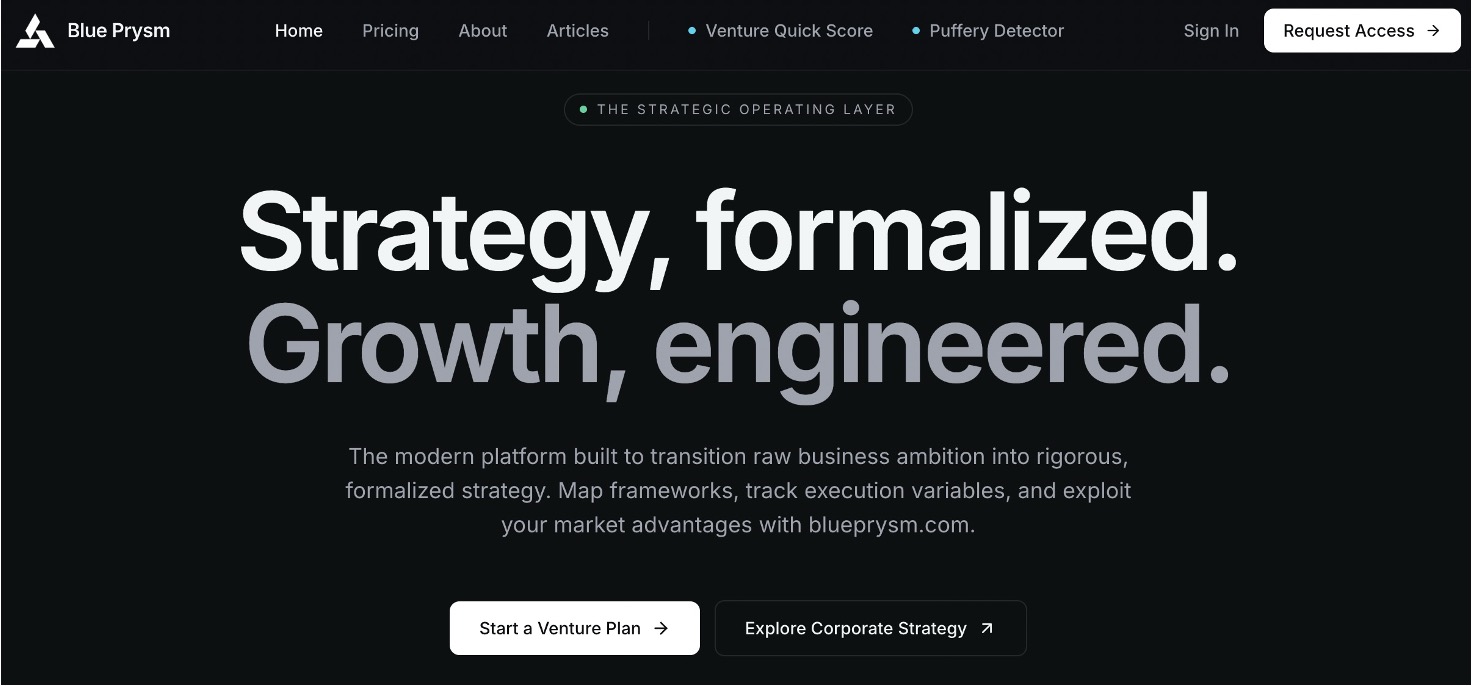
Studying competitive products examples is only useful if you can act on what you find. Blue Prysm gives entrepreneurs and product managers the AI-powered intelligence infrastructure to do exactly that. Daily market briefings, continuous competitor monitoring, and structured positioning frameworks replace the expensive consulting retainer with a platform built for decision-makers who move fast. Whether you are tracking a direct rival’s pricing moves or scanning for indirect threats before they become problems, Blue Prysm’s platform puts Fortune 100-grade competitive analysis within reach of any team. See how it works and start making decisions with real data behind them.
FAQ
What are the three types of competitive products?
Competitive products fall into three categories: direct competitors (same product, same market), indirect competitors (different product, same customer need), and replacement competitors (different solution to the same job-to-be-done). Each type requires a distinct strategic response.
What is a real-world example of direct competitive products?
The Tesla Model Y versus Xiaomi YU7 is a current direct competition example. Xiaomi undercuts Tesla’s price by $4,350 while offering greater range, forcing Tesla to defend its premium on software and brand rather than hardware specs.
How do indirect competitors differ from direct ones?
Indirect competitors solve the same customer problem through a different product category. Pharmaceuticals and naturopathy both address health management, but through entirely different mechanisms, making them indirect competitors rather than direct rivals.
How often should you run a competitor product analysis?
Competitor product analysis should be continuous, not periodic. Productboard notes that ongoing analysis reveals shifts in target segments and positioning that quarterly snapshots miss entirely.
What framework works best for analyzing competitive products?
SWOT analysis combined with feature comparison matrices and positioning maps gives the most complete picture. The U.S. Small Business Administration recommends assessing market share, strengths, weaknesses, and indirect competitors together to build a sustainable competitive position.