


Choosing strategic intelligence software that combines AI-driven insights with formal frameworks and governed access is complicated by confusing pricing models and limited deployment flexibility. Many current platforms force teams to commit before trying features or lack robust governance and integration options for enterprise environments. This side-by-side comparison details how each solution covers AI analysis, free trials, security, and integration so you can match one to your workflow and compliance needs.
Table of Contents
Blue Prysm
At a Glance
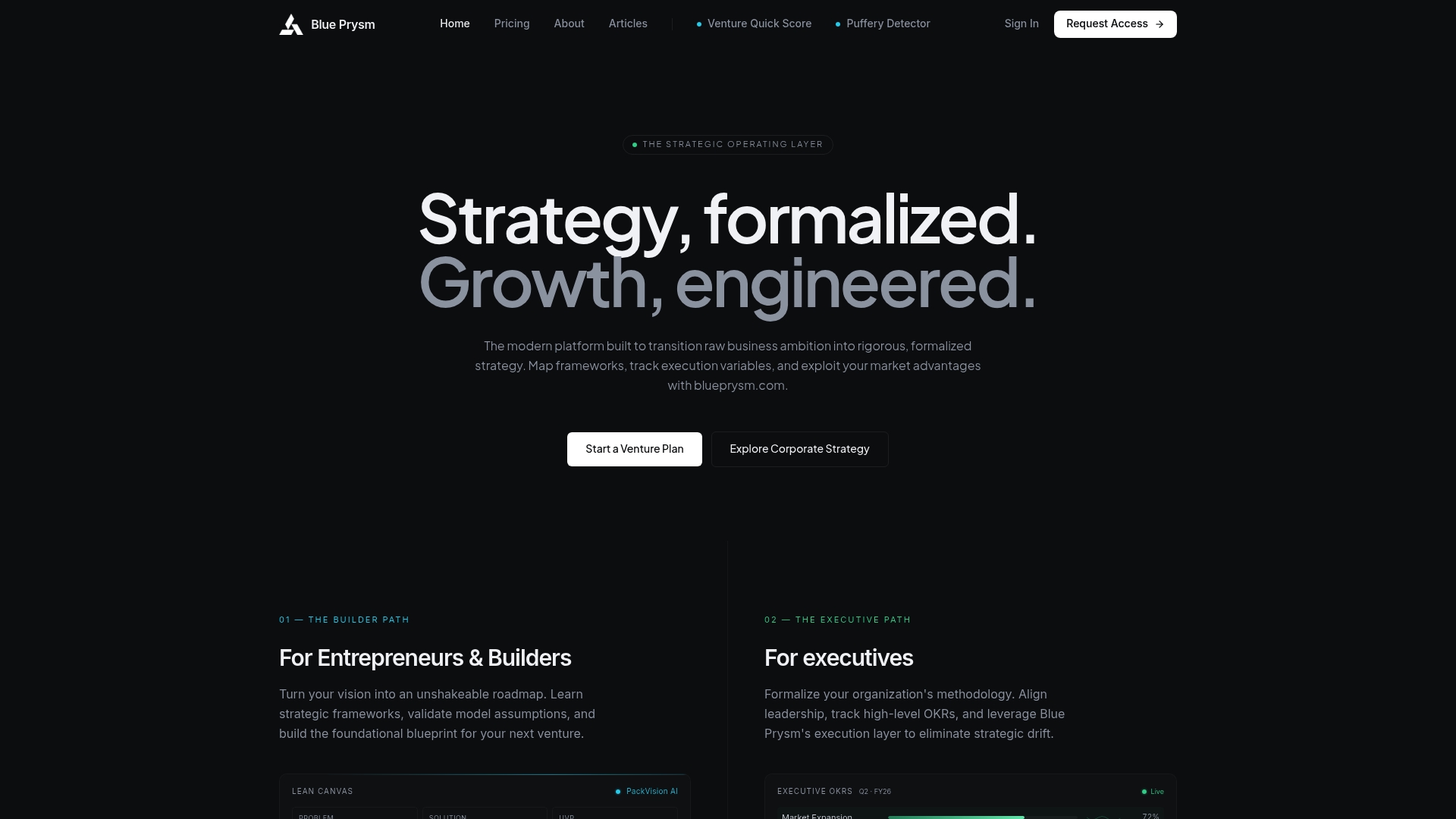
Blue Prysm offers multiple standalone tools that can be used without signup and a 30-day free trial for every plan. The platform combines AI assessments with strategic frameworks to help teams formalize strategy, validate assumptions, and track execution.
Core Features
-
Formal strategy frameworks: Templates and exercises to formalize venture blueprints and organizational methodologies.
-
Performance tracking: OKR and KPI tracking tied to strategic roadmaps for measurable execution.
-
Market and competitor analysis: Market mapping and competitor profiling powered by AI to highlight gaps and threats.
-
Idea validation: Tools to build and validate venture ideas with automated scoring.
-
Credibility checks: A puffery detection tool that flags overstated claims during research and sourcing.
Key Differentiator
Blue Prysm pairs AI-driven scoring with institutional strategy frameworks so entrepreneurs and executives operate from the same playbook. That coupling focuses work on explicit decision points instead of scattered notes and slide decks.
Pros
-
Deep framework coverage speeds translation from strategic intent to measurable plans. Templates reduce the time spent debating formats and get teams tracking KPIs quickly.
-
AI-driven assessments pull signal from market data and surface likely gaps in assumptions, which makes early validation less manual.
-
The platform is pitched for both founders and corporate strategists, so small teams and exec suites can use the same artifacts and language for handoffs.
-
Security posture is emphasized; the product data references SOC 2 and zero data retention as part of its privacy stance.
-
Several standalone tools are accessible without sign-up, which lets stakeholders trial specific capabilities before committing to a full workflow.
Cons
- Integration scope is unclear. The available content provides limited detail on how Blue Prysm connects to existing enterprise tools, which may force manual exports or custom work for some teams.
Who It’s For
Ambitious founders, startup leadership, and corporate strategists who want a disciplined operating layer for strategy rather than ad hoc slide decks. Good for teams that must justify decisions with scored evidence and repeatable frameworks.
Unique Value Proposition
Multiple standalone tools work without signup and every plan includes a 30-day free trial, so you can validate workflows before purchase. That product design lowers the upfront friction for proof of concept and lets teams test whether the AI scoring and templates match their fiscal and governance needs.
Real World Use Case
A founder builds a venture blueprint, runs the AI-driven market gap analysis, and uses the puffery detector to vet partner claims. The same artifacts become the board packet and the team’s quarterly OKR tracker, reducing rework between fundraising and execution.
Pricing
Plans start at $25 per month for founders and $49 per month for startups. Team and enterprise tiers are available and all plans include the 30-day free trial noted above.
Website: https://blueprysm.com
Metabase
At a Glance
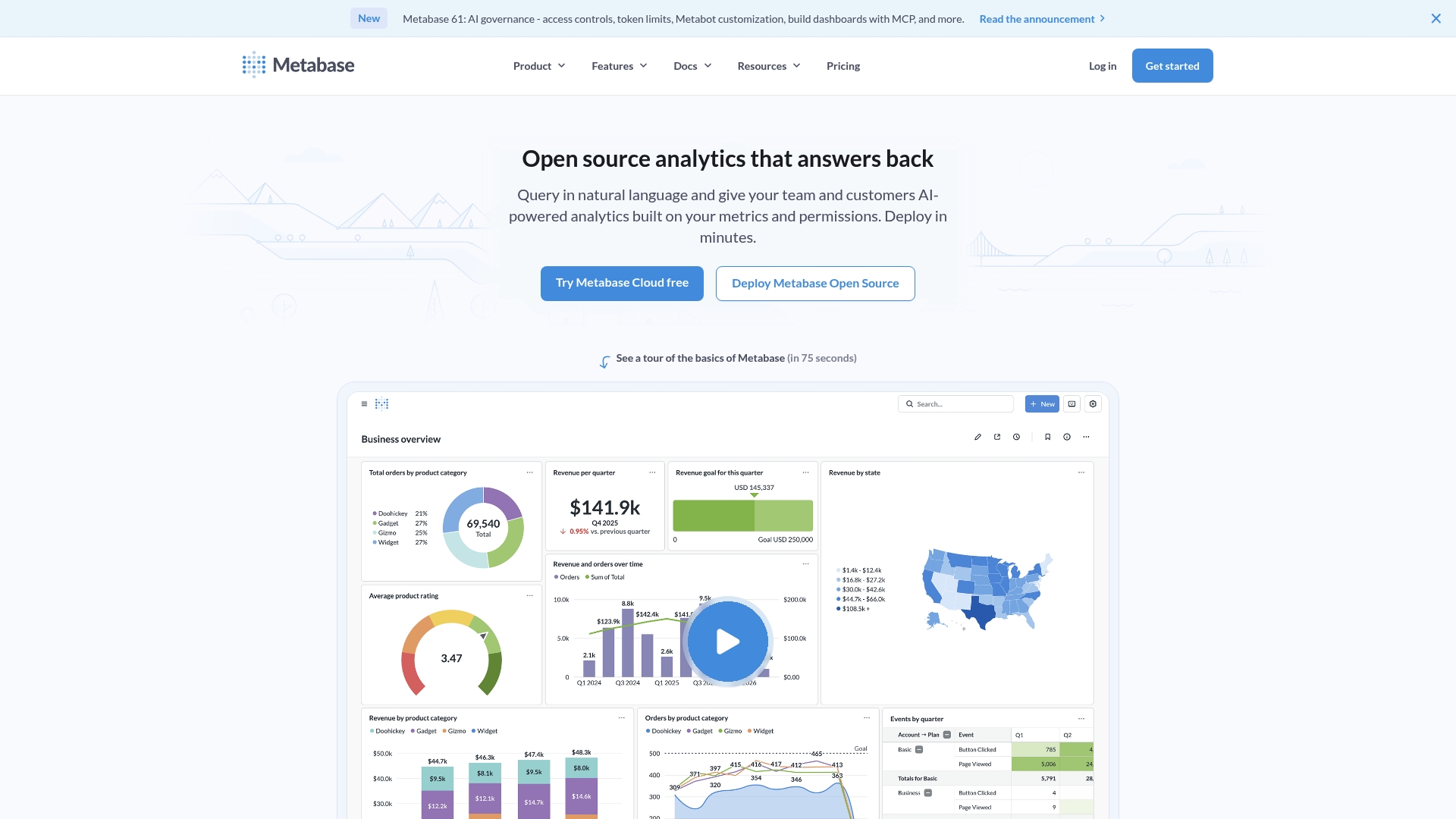
Metabase ships as an open-source BI option that supports both self-hosted and cloud deployments while offering AI natural language queries and embeddable dashboards for SaaS products. That combination makes it easy to give non-technical teams direct access to data without engineering handoffs.
Core Features
- Self-service analytics with a visual query builder and SQL editor for mixed technical levels.
- Natural language query support backed by AI integration to turn plain questions into results.
- Dashboard creation and reporting tools with basic embedding for product experiences.
- Granular data permissions and access control with compliance notes for SOC2, GDPR, CCPA.
- Flexible deployment: self-hosted option or managed cloud offering for different operational needs.
Key Differentiator
The standout is Metabase’s open-source footing paired with AI-assisted querying. Teams can fork or self-host the stack while non-technical users ask questions in plain English and get charts. Embedding capabilities mean you can surface those visualizations inside a product without heavy engineering.
Pros
- Intuitive interface makes it possible for marketing or product teams to run queries without constant help from engineers. New users tend to pick up the basics quickly.
- Cost-effective compared with many commercial BI tools, especially when you self-host and avoid per-seat pricing.
- Granular permissions let security-minded teams restrict tables, rows, and dashboards for compliance and audit workflows.
- Flexible deployment choices mean teams with strict data residency or security needs can self-host, while others choose the managed cloud.
- Wide set of supported data sources and a short setup path for common databases, which shortens time to first dashboard.
Cons
- The interface design feels dated compared with modern BI competitors, which can frustrate teams that expect more polished visualization controls.
- Performance can degrade on very large datasets or complex queries; heavy aggregation jobs often need a data warehouse or query optimization.
- Dashboard customization options are limited if you need detailed styling or interactive widgets beyond the built-in palette.
- Self-hosting requires operational know-how; teams without a devops resource will face setup and maintenance overhead.
When It May Not Fit
If your organization needs highly polished, pixel-perfect dashboards for executive reporting or real-time analytics on massive tables, Metabase may feel constrained. Also avoid self-hosting Metabase if you cannot commit an engineer to maintain backups, schema migrations, and performance tuning.
Who It’s For
Startups, SMBs, and product teams that want to democratize reporting without a large BI budget. It fits teams that value open-source control and who can tolerate a more utilitarian UI in exchange for flexibility and embedding options.
Real World Use Case
A startup uses Metabase self-hosted to let marketing and product teams build funnels and retention charts. Engineers create a handful of curated models, then non-technical staff produce weekly dashboards and embed selected views inside the product for customers.
Website: https://metabase.com
Wren AI
At a Glance
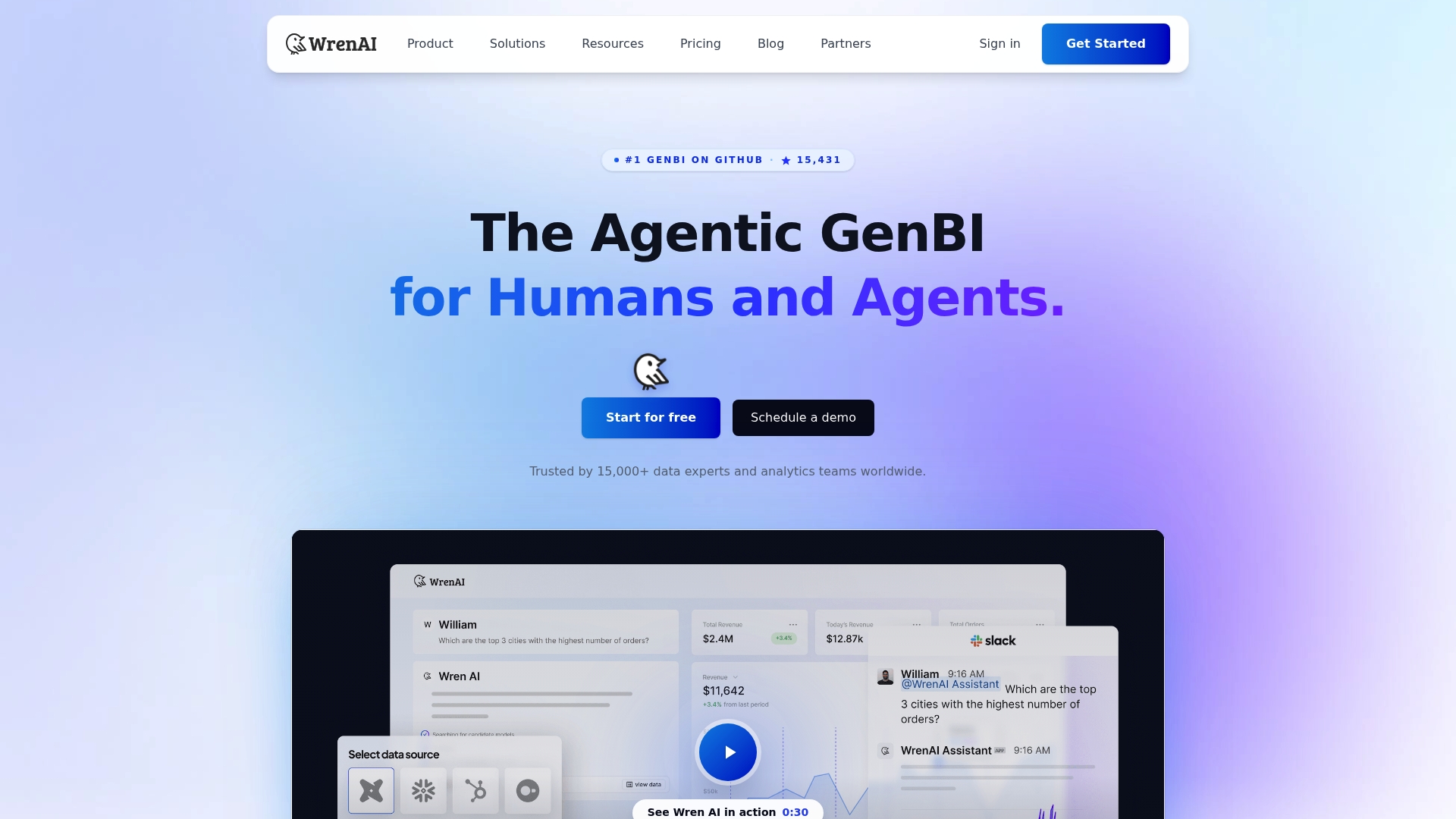
Wren AI ships an open-source option for grounded, governed SQL that lets you reuse the same business logic across multiple data sources. The product pairs a contextual layer with Agentic Generative BI to let humans and agents query structured data conversationally while preserving traceability. It targets enterprise teams that need governed natural language analytics rather than casual self-service reporting.
Core Features
Wren AI centers a context layer architecture that maintains shared meaning between users and agents. It supports multi-step agent reasoning with tool integrations and full traceability of agent actions. The platform stores reusable workflows and institutional knowledge via Skills & Memory. Developers write metrics once with Semantic Modeling Language (MDL) so metrics and relationships stay consistent across queries and agents.
Key Differentiator
What sets Wren AI apart is its focus on agent-first, sandboxed reasoning combined with governed access. The system is built to let automated agents perform multi-step analysis while enforcing fine-grained policy at query time. That design treats agents as first-class consumers of the metric layer rather than as add-ons to a classic BI tool.
Pros
- Flexible deployment. The platform supports cloud, self-hosted, and an open-source option, which helps teams align operations and compliance with internal policy.
- Broad connector set. Wren AI reports integrations with over 20 data sources including major warehouses, making it practical for heterogeneous data estates.
- Governed access at query time. The product offers fine-grained row level and column level security controls so queries reflect policy and data entitlements.
- Agent-agnostic design. It integrates with multiple AI agent clients and internal copilots so you can plug the tooling your organization already prefers.
- Enterprise security features. The vendor advertises support for SOC 2, LDAP/AD, OIDC, and custom governance policies, which matters for audit and compliance workflows.
Cons
- Sparse independent validation. There are no substantive third-party user reviews on major review platforms, which limits externally verifiable evidence of day-to-day user experience.
- Steep technical surface. The feature set targets enterprise and technical users, so expect engineering effort for MDL modeling, policy configuration, and agent orchestration.
- Limited public case material. Publicly available case studies and detailed vendor benchmarks are few, making proof-of-concept work more important before wide rollout.
Who It’s For
Data teams, analytics managers, and enterprise IT groups who must combine natural language access with governance, auditing, and integration into existing identity and security stacks. Best for organizations with dedicated engineers able to model metrics and operationalize agent workflows.
Real World Use Case
A multinational manufacturing firm used Wren AI to let operations and supply chain teams query ERP and MES systems in plain language. Queries respected role-based access rules and the audit trail captured agent steps, cutting reliance on specialized BI reports while preserving governance and traceability.
Pricing
Wren AI offers a free tier alongside Essential and Enterprise plans with monthly or annual billing. The vendor also applies additional usage-based pricing for certain workloads and deployments, so expect to model consumption during proof of concept.
Website: https://getwren.ai
Strategic Intelligence Software Comparison
Compare these strategic intelligence platforms based on their features, best uses, and limitations to identify the most suitable option for your needs.
| Product | Key Features | Best For | Pricing | Notable Limitation |
|---|---|---|---|---|
| Blue Prysm | AI-enhanced strategy frameworks, KPI tracking | Founders and strategists | $25/mo for founders, $49/mo for startups | Integration scope details unclear |
| Metabase | Visual query builder, natural language queries | Non-technical analytics | Not disclosed | Performance issues with complex queries |
| Wren AI | Context layer, reusable workflows | Enterprise IT and data teams | Free tier, enterprise plans available | Steep technical learning curve |
Consider Blue Prysm as a Looker.com Alternative for Strategic Clarity
Choosing the right analytics and strategy platform can feel overwhelming, especially when you seek more than just data visualization. This article on looker.com alternatives highlights the challenge of aligning strategic planning with AI-driven insights without getting lost in complex BI tools. Blue Prysm meets that need by blending formal strategy frameworks with market and competitor analysis powered by AI, helping you reduce guesswork, validate ideas, and track execution all in one place.
Blue Prysm empowers founders and corporate strategists to:
- Formalize strategy with proven frameworks
- Detect overstated claims using its puffery detection tool
- Monitor KPIs tied to strategic goals
- Access standalone tools with no signup required
Explore how Blue Prysm simplifies strategic intelligence for your team. Don’t wait to cut through the noise—build your venture blueprint, validate market gaps with AI, and transform your strategy into actionable metrics. Visit Blue Prysm and start your 30-day free trial to see measurable planning in under a minute.
Frequently Asked Questions
What are the primary capabilities of Blue Prysm?
Blue Prysm offers formal strategy frameworks and performance tracking, which helps teams formalize strategies and track execution effectively. The platform includes OKR and KPI tracking tied to strategic roadmaps, enabling measurable execution. Consider utilizing these features to enhance your strategic planning and monitoring.
How does Blue Prysm compare to Metabase for self-service analytics?
Metabase provides an intuitive interface for non-technical users to run queries without constant engineering support, making it ideal for teams looking for straightforward analytics access. In contrast, Blue Prysm integrates AI-driven assessments that validate assumptions, which can be beneficial for teams needing structured strategic frameworks. Evaluate your team’s technical capabilities to choose the right fit.
Which platform is better for deep market analysis, Blue Prysm or Wren AI?
Wren AI excels with its contextual layer architecture that supports multi-step analyses and fine-grained policy enforcement, making it suitable for complex enterprise needs. Meanwhile, Blue Prysm stands out with its automated scoring and idea validation tools. Choose Blue Prysm if your primary focus is on effectively validating venture ideas and market gaps.
Can Blue Prysm’s features be integrated with existing enterprise tools?
The details about how Blue Prysm connects with other enterprise tools are unclear, which may necessitate custom work for some teams. It’s advisable to evaluate whether this integration can support your existing systems before fully committing.
What is the pricing structure for Blue Prysm?
Plans for Blue Prysm start at $25 per month for founders and $49 per month for startups, with all tiers including a 30-day free trial. This pricing structure allows you to test the platform’s capabilities before making a long-term commitment. Consider starting with the trial to see how well it meets your needs.