


TL;DR:
- A comprehensive competitive landscape includes all rivals, substitutes, and market forces that influence your business. Regularly updating and mapping competitors across four tiers and macro frameworks enables better strategic decisions and growth opportunities. Treat your analysis as a living system that informs positioning, resource allocation, and cross-team coordination for sustained success.
A competitive landscape is defined as a structured map of every rival product, substitute solution, and market force that affects your business’s position and growth opportunities. Most strategy teams think they know their competition. They track the two or three names that come up in sales calls and call it done. That gut feeling approach is exactly how companies get blindsided. A real market landscape analysis covers direct competitors, indirect alternatives, potential new entrants, and substitutes like manual workflows or spreadsheets. Miss any tier and you are working with an incomplete picture.
What are the key components of a competitive landscape?
Competitive landscape mapping requires classifying rivals into four distinct tiers. Each tier represents a different kind of threat, and each demands a different strategic response.
- Direct competitors sell the same product to the same customer. They show up in every deal you lose.
- Indirect competitors solve the same problem through a different approach. A project management platform competes indirectly with a custom-built internal tool.
- Potential entrants are companies that could enter your market without significant barriers. A large platform adding a feature is a classic example.
- Substitutes are the sneaky ones. Ignoring substitutes like manual processes or spreadsheets means missing what customers actually compare during buying decisions. A buyer choosing between your SaaS tool and a well-organized Excel sheet is a real competitive scenario.
Beyond these four tiers, macro forces shape the entire playing field. Regulations, technology shifts, and capital barriers all affect competitive viability in ways that no feature comparison chart will capture. Porter’s Five Forces exists precisely to surface these pressures.
Pro Tip: When you build your first competitor list, include at least two substitutes. Ask your sales team what prospects say they will do if they do not buy from you. The answers will surprise you.
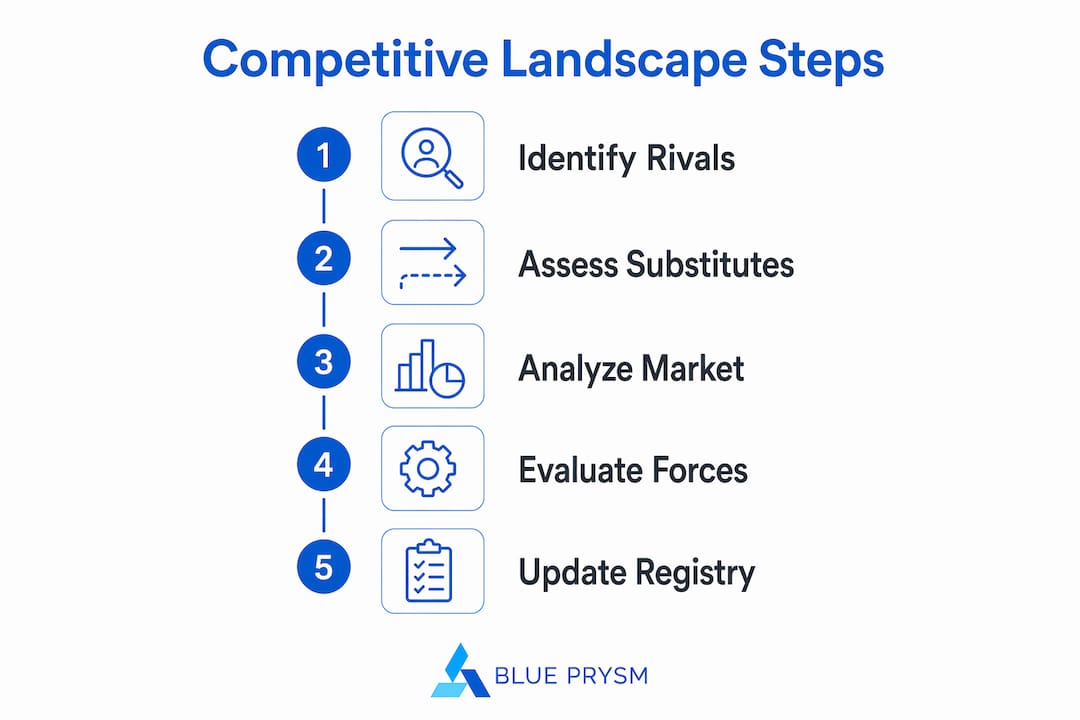
How do you build and map a competitive landscape?
A structured workflow separates a useful market landscape analysis from a slide deck that collects dust. Follow these steps to build something that actually drives decisions.
-
Build a competitive registry. A competitive registry is a live document listing every competitor across all four tiers, with profile data including company size, funding, pricing, and positioning. It is not a presentation. It is a working database updated as new information arrives.
-
Choose your axes carefully. Common analytical axes include price point versus breadth of capability, SMB versus enterprise focus, and incumbent versus AI-native positioning. Selecting dimensions that reflect real buyer decisions makes your map actionable rather than decorative.
-
Plot your positioning map. Place every competitor on a 2×2 chart using your chosen axes. This is your competitive landscape chart. Clusters reveal where the market is crowded. Empty spaces reveal where it is not.
-
Read the white space. Empty spaces on a map indicate underserved customer segments. They represent either a genuine growth opportunity or a market no one wants. Your job is to figure out which.
-
Layer in supporting frameworks. SWOT, PEST, and Porter’s Five Forces each address different strategic questions. SWOT surfaces internal gaps. PEST captures macro shifts. Porter’s quantifies structural pressure. Use all three to stress-test your map.
| Framework | Primary Question | Best Used For |
|---|---|---|
| SWOT | Where are we strong or exposed? | Internal positioning review |
| PEST | What macro forces are shifting? | Market entry and timing decisions |
| Porter’s Five Forces | How much structural pressure exists? | Industry attractiveness assessment |
Pro Tip: Update your competitive registry every time you lose a deal. Win/loss data is the most honest signal you will get about how buyers actually perceive your position.
What are the most common pitfalls in competitive analysis?
Most competitive landscape analysis fails not because of bad data, but because of bad habits. Here are the traps that derail even experienced strategy teams.
- Treating the analysis as a one-time report. A living, structured system feeds real decisions. A static PDF filed after a quarterly review feeds nothing. The moment you stop updating it, it starts misleading you.
- Tracking only direct competitors. Most organizations miss 60–70% of competitive threats by ignoring indirect rivals, potential entrants, and substitutes. That is not a minor oversight. It is a revenue risk.
- Ignoring macro forces. A competitor analysis that focuses only on product features will miss a regulatory change that reshapes your entire category overnight.
- Failing to translate findings into decisions. Analysis that does not inform positioning, product roadmaps, or sales messaging is wasted effort. Full stop.
“The most dangerous competitive blind spot is not the rival you track obsessively. It is the substitute solution your prospects are quietly using instead of buying from anyone.”
The fix is structural. Build your analysis workflow so that every update triggers a specific output, whether that is a revised battlecard, a repositioned value proposition, or a flagged product gap. If the analysis does not change something, question why you ran it.
How do competitive insights actually drive strategy?
Converting a market landscape analysis into real decisions is where most teams stall. The map is built. The frameworks are applied. Then the deck gets presented and nothing changes. Here is how to break that cycle.

White space drives positioning. The most valuable output of any competitive landscape assessment is identifying gaps no current competitor serves well. That white space is where you build your differentiation story. A product roadmap aligned to competitive gaps is far more defensible than one built on internal assumptions alone.
Sales teams need battlecards, not briefings. Competitive insights only reach the front line when they are translated into specific, usable tools. A battlecard tells a rep exactly how to position against a named competitor in a live deal. It is not a summary of the competitor’s features. It is a script for winning.
Resource allocation improves with updated maps. Regularly updated landscapes help teams avoid misallocating effort and getting blindsided by competitor moves. When your map reflects current market reality, your investment decisions reflect it too.
Pro Tip: Integrate your market research workflow with your competitive registry. Market signals like funding rounds, executive hires, and product launches are early warnings. Catch them before they show up in your pipeline.
Connecting product, marketing, and sales around a shared competitive view is the real goal. When all three teams work from the same map, your GTM strategy stops being a collection of departmental opinions and starts being a coordinated response to real market conditions.
Key takeaways
A competitive landscape is only as useful as the decisions it drives. Treat it as a living system, not a deliverable.
| Point | Details |
|---|---|
| Use all four competitor tiers | Track direct, indirect, potential entrants, and substitutes to avoid missing 60–70% of threats. |
| Build a live competitive registry | Maintain a regularly updated database of competitor profiles across all tiers, not just a slide deck. |
| Map with meaningful axes | Choose dimensions like price versus capability or SMB versus enterprise to reveal real market gaps. |
| Translate findings into decisions | Every analysis update should produce a concrete output: a battlecard, a repositioned message, or a flagged product gap. |
| Integrate macro forces | Use PEST and Porter’s Five Forces alongside your map to catch regulatory and technology shifts early. |
The map is not the territory, but it is the best tool you have
I have sat in enough strategy sessions to know the pattern. Someone builds a beautiful competitive landscape chart. It gets presented. Everyone nods. Then it gets saved to a shared drive and never opened again.
The problem is not the analysis. The problem is that we treat it like a finished product instead of a decision-making instrument. The teams that actually use their competitive maps well do one thing differently: they assign ownership. Someone is responsible for updating the registry. Someone is responsible for turning new intelligence into revised messaging. Without that accountability, the map becomes a historical document within 90 days.
The other thing I have learned is that white space is almost always more valuable than competitive comparison. Knowing that your top three rivals all ignore the mid-market segment is worth more than knowing their exact pricing tiers. That gap is where you build. That gap is where you win.
Finally, stop keeping competitive intelligence siloed in the strategy team. Your sales reps are gathering real-time data on every call. Your product team hears feature requests that reveal what competitors are missing. Build a system where that information flows back into the registry. The AI-powered competitive mapping tools available now make this far easier than it was even two years ago. Use them.
— Colin Bowdery
How blue prysm keeps your competitive intelligence current
Building a competitive landscape once is hard enough. Keeping it current while running a business is where most teams fall short.
Blue Prysm’s competitive intelligence software tracks competitors automatically, surfacing funding rounds, product launches, and positioning shifts before they reach your pipeline. The platform pairs that tracking with AI-powered market research tools that connect macro market signals to your specific competitive context. For strategy teams at small to mid-sized businesses who need elite-level insight without a consulting retainer, Blue Prysm delivers the structured intelligence that turns a map into a decision engine. Request a sample briefing and see what your competitive picture actually looks like.
FAQ
What does competitive landscape mean in business?
A competitive landscape is a structured overview of all rivals, substitutes, and market forces affecting a business’s strategic position. It includes direct competitors, indirect alternatives, potential entrants, and macro forces like regulation and technology.
How often should a competitive landscape analysis be updated?
A competitive landscape analysis should be updated continuously, not quarterly. Deal data, funding announcements, and product launches are all signals that warrant immediate registry updates.
What is a competitive landscape chart?
A competitive landscape chart is a 2×2 positioning map that plots competitors along two market-relevant axes, such as price versus capability, to reveal clusters and underserved market gaps.
What frameworks support competitive landscape analysis?
SWOT, PEST, and Porter’s Five Forces each address different strategic questions within a competitive landscape analysis. SWOT covers internal positioning, PEST captures macro shifts, and Porter’s measures structural industry pressure.
Why do most competitive analyses fail to drive decisions?
Most competitive analyses fail because they are treated as static reports rather than living systems. When findings do not connect to positioning updates, product roadmaps, or sales battlecards, the analysis produces no measurable outcome.