


TL;DR:
- Effective AI-assisted strategic planning for SMBs involves six steps: defining measurable outcomes, analyzing with AI, modeling scenarios, prioritizing initiatives, building a roadmap with OKRs, and implementing iteratively. Leaders should start with one pilot, assign clear ownership, and schedule a 4–8 week observation period to build organizational insight. Success depends on disciplined sequencing, documenting outcomes, and maintaining governance, not on adopting tools alone.
Effective AI-assisted strategic planning for SMBs follows six steps: define outcomes, run AI-assisted analysis, model scenarios, prioritize initiatives, build a roadmap with OKRs, then implement and iterate. Start this week by completing these three actions:
- Name one strategic owner who holds accountability for the first pilot.
- Pull one dataset that reflects your highest-friction workflow (CRM data, churn log, or margin report).
- Schedule a 4–8 week pilot window with a clear go/pivot/stop date on the calendar.
Pro Tip: Sequence one initiative at a time. Running two pilots simultaneously splits your team’s attention and makes it nearly impossible to attribute results. One pilot, observed for 4–8 weeks, gives you real performance data and builds organizational muscle before you scale.
What does step-by-step business planning actually look like?
Most SMB leaders treat strategic planning as an annual event. That is the trap. AI compresses planning cycles by modeling multiple scenario outcomes in hours instead of weeks, which means your planning cadence needs to match that speed. The six-step framework below is designed to run continuously, not once a year.
The six steps at a glance:
- Step 1 — Define outcomes and scope: Translate ambition into numeric success metrics and a contained pilot scope.
- Step 2 — AI-assisted market and competitor analysis: Feed structured inputs into AI to generate fast, validated market signals.
- Step 3 — Scenario planning: Model 3–5 plausible outcomes and attach contingency actions to each.
- Step 4 — Prioritize and score initiatives: Use an impact × effort filter and dollarized ROI to pick the first pilot.
- Step 5 — Roadmap, OKRs, and resource allocation: Convert the chosen initiative into a timeboxed plan with measurable outcomes.
- Step 6 — Implement, monitor, and iterate: Run a sprint cadence, track a live dashboard, and decide go/pivot/stop at the 4–8 week gate.
AI accelerates Steps 2, 3, and 4 significantly. Human governance is non-negotiable at Steps 1, 4, and 6, where judgment calls about risk, scope, and resource commitment cannot be delegated to a model.
Immediate outputs to produce this cycle:
- One-page strategy memo (problem, baseline metric, target, owner, timeline, kill criteria)
- One pilot brief (workflow, user group, data source, review date)
- Baseline metrics snapshot before the pilot launches
Step 1: How do you define outcomes that are actually measurable?
Vague goals kill pilots before they start. “Improve customer experience” is not a strategic outcome. “Reduce average resolution time from 48 hours to 24 hours by end of Q3” is. The difference is a number, a baseline, and a deadline.
Choose outcomes from four categories:
- Revenue: new ARR, upsell rate, conversion lift
- Retention: churn rate, NPS movement, renewal rate
- Margin: cost per acquisition, gross margin by product line
- Time-to-value: onboarding time, cycle time, resolution time
Scope is equally critical. Contain the pilot to one workflow, one system, and one user group. A pilot that touches three departments and two platforms is not a pilot; it is a project, and projects take quarters to show results.
Stakeholder map:
| Role | Responsibility |
|---|---|
| Owner | Accountable for results; makes go/pivot/stop call |
| Sponsor | Provides budget and organizational air cover |
| Operator | Runs the day-to-day workflow being tested |
| Reviewer | Validates outputs and flags quality issues |

One-page decision memo fields: problem statement, baseline metric, target metric, owner name, timeline, and kill criteria (the number below which you stop).
Pro Tip: Write the kill criteria before the pilot starts. Teams that define “we stop if X” in advance make faster, less emotional decisions at the review gate.
Step 2: How does AI-assisted market analysis speed up your decisions?
The honest answer: AI does not replace your judgment. It removes the three-week research lag that used to precede it. SMEs that adopt AI report average productivity gains in the range of 15–25% within 12 months, and the primary driver is speed-to-decision, not automation of complex tasks.
Structure your AI inputs before you run queries. Feed it: recent customer feedback exports, CRM win/loss data, public competitor pricing pages, and relevant industry reports. Unstructured prompts produce fluffy outputs. Structured inputs produce signals you can act on.
Competitor signal extraction checklist:
- What pricing changes has this competitor made in the last 90 days?
- What customer complaints appear repeatedly in their public reviews?
- What product features are they promoting most heavily right now?
- Where does their messaging differ from ours?
Validate every AI output with a 15-minute human review. Check for hallucinated citations, outdated data, and conclusions that contradict your own CRM signals. The advantages of AI in strategy come from speed plus human verification, not speed alone. The output of this step feeds directly into your scenario variables in Step 3.
Pro Tip: Confusing tool adoption with AI strategy is the most expensive mistake SMB leaders make. Buying a market intelligence tool is not a strategy. A strategy is a prioritized list of problems, sequenced by dollarized ROI, with baselines and review dates attached.
Step 3: How do you model scenarios without a data science team?
You do not need a data science team. You need three to five plausible variables and a structured template. Blue Prysm’s scenario planning library provides repeatable templates that help leaders model outcomes quickly without building models from scratch.
| Scenario | Key Variable | Modeled Outcome | Confidence |
|---|---|---|---|
| Base case | Current conversion rate holds | Revenue flat, margin stable | High |
| Demand surge (+20%) | Volume increase, capacity strain | Revenue up, fulfillment costs rise | Medium |
| Price pressure (−10%) | Competitor undercuts | Margin compression, churn risk | Medium |
| Churn spike (+5 pts) | Retention drops | ARR decline, CAC payback extends | Low–Medium |
For each scenario, write one contingency action: if this happens, we do this. That is the entire output. AI-powered scenario testing lets you iterate these models in hours rather than weeks, which means you can revisit them monthly rather than annually.
Pro Tip: Do not model more than five scenarios. Beyond five, the cognitive load outweighs the strategic value and teams stop using the output.
Step 4: How do you pick the one initiative worth running first?
Score every candidate initiative on four dimensions: estimated annual value, scope complexity, data readiness, and risk to customers. The initiative with the highest value, lowest complexity, cleanest data, and lowest customer risk goes first. Every time.
Scoring card fields:
- Estimated annual value (dollarized: hours saved × hourly rate × 52 weeks, or revenue impact)
- Scope complexity (1 = one workflow, one team; 5 = cross-functional, multiple systems)
- Data readiness (1 = data is clean and accessible; 5 = data is siloed or incomplete)
- Customer risk (1 = internal only; 5 = customer-facing with compliance exposure)
Kill/scale decision gates at 4–8 weeks:
- Did the pilot hit 80% of its target metric?
- Did the team adopt the workflow without workarounds?
- Did data quality hold throughout the observation period?
- Is the ROI case stronger or weaker than the original estimate?
Documented AI strategies tend to have a significantly higher likelihood of reporting strong ROI compared to opportunistic tool adoption. The scoring card is what makes your strategy documented rather than intuitive.
Step 5: How do you build a roadmap that your team will actually follow?
A roadmap nobody reviews is a document. A roadmap with named owners, milestone dates, and OKRs tied to budget is a commitment. Keep it to one page for the first initiative.
Writing outcome-centered OKRs:
- Objective: Reduce customer onboarding time by 40% in Q3.
- Key Result 1 (efficiency): Average onboarding cycle drops from 10 days to 6 days.
- Key Result 2 (outcome): 90-day retention rate for new customers improves from 72% to 80%.
Resource allocation table for SMB pilots:
| Resource | Typical Range | Notes |
|---|---|---|
| Internal staff time | 5–10 hrs/week | Owner + operator; not full-time |
| SaaS platform subscription | — | Varies by platform tier |
| Consultant hours (optional) | 10–20 hrs total | Scoping and setup only |
| Contingency budget | 15–20% of total | For data cleanup or integration work |
Milestone cadence:
- Week 1–2: Data audit complete, baseline metrics locked
- Week 3–4: Pilot workflow live, operator trained
- Week 5–8: Observation period, weekly check-ins
- Week 8: Review gate — go/pivot/stop decision
Pro Tip: Gate approvals belong to the sponsor, not the operator. Operators are too close to the workflow to make unbiased scale decisions. The sponsor sees the budget and the business case.
Step 6: What does a healthy implementation cadence look like?
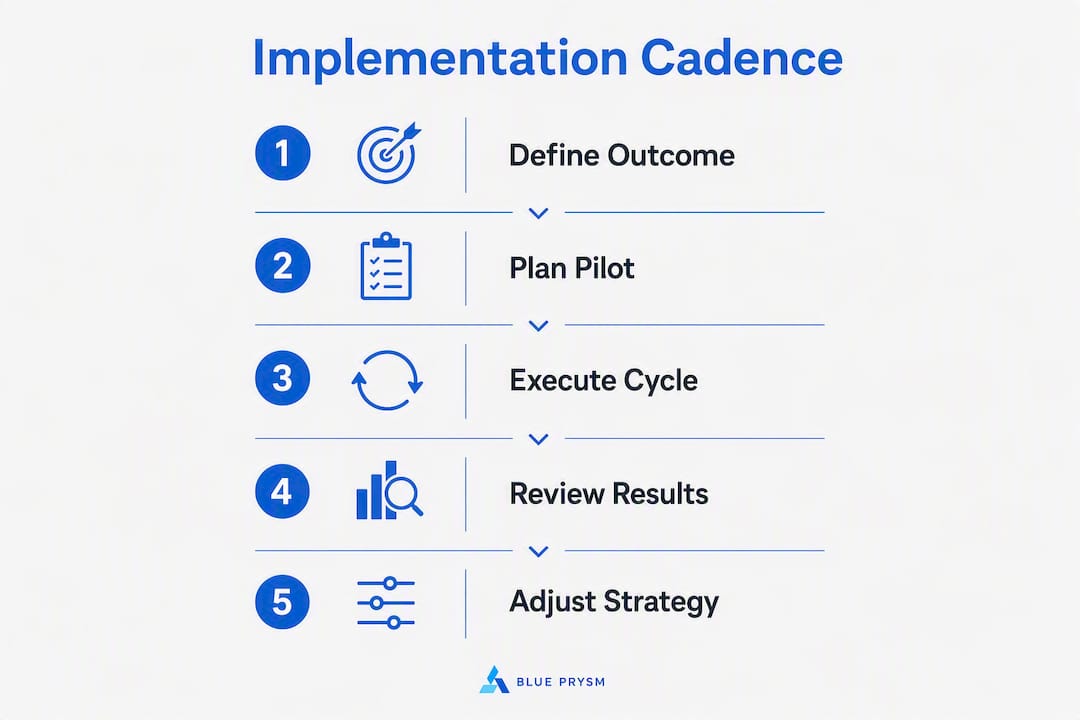
Successful practitioners implement one initiative at a time and observe for 4–8 weeks before committing more budget. The sprint rhythm that supports this is simple: two-week sprints, a 15-minute daily check-in for the operator, and a 30-minute weekly review for the owner and sponsor.
Dashboard essentials:
- Baseline metric (locked before launch)
- Real-time performance signal (updated at least weekly)
- Error and edge-case tracker (flag anomalies immediately)
- Adoption metric (are operators actually using the workflow?)
- Decision gate marker (countdown to review date)
Four questions for the 4–8 week review:
- Did we hit the target metric, and by how much?
- What did the error tracker surface that we did not anticipate?
- Is adoption genuine or are operators working around the tool?
- What would we do differently in the next pilot?
Pro Tip: Record the review answers in writing. Teams that document their pilot reviews build institutional memory. Teams that do not repeat the same mistakes in the next initiative.
What governance controls do SMBs actually need?
SMB leaders often confuse buying AI tools with having an AI strategy. An AI strategy is a one-page prioritized problems list with dollarized ROI, baselines, and review dates. Governance is what keeps that strategy honest.
Minimum governance checklist:
- Data access rules: who can query which datasets, and are customer records anonymized?
- Human review points: which AI outputs require sign-off before action?
- Drift monitoring: is the model’s accuracy degrading over time?
- Role-based permissions: operators see outputs; only owners and sponsors change parameters.
Change management essentials:
- Train operators on the workflow, not the technology.
- Document every parameter change with a date and a reason.
- Maintain an audit log for any AI output that influenced a financial or customer decision.
- Assign one person to own the AI oversight and risk management function, even part-time.
What should an SMB budget for the first planning cycle?
Treat strategy creation as a distinct, low-effort business analysis task: 2–4 hours of focused work by the owner and one analyst. Implementation is the technical job and carries the real cost. SMB-focused pilots typically run 4–10 weeks to produce a measurable result.
Cost bands:
- Low (SaaS + internal time): $500–$1,500 total. One platform subscription, internal staff running the pilot, no external consultants. Works when data is clean and scope is tight.
- Medium (SaaS + consultant): $3,000–$8,000 total. Platform plus 10–20 consultant hours for scoping, data audit, and review facilitation.
- High (custom build): $15,000+. Custom integrations, dedicated data engineering, enterprise governance. Rarely justified for a first pilot.
Most SMBs running their first AI-assisted planning cycle land in the low-to-medium band. The goal of the first cycle is a decision, not a transformation.
What deliverables should your team produce this cycle?
| Deliverable | Owner | Due | Success Metric |
|---|---|---|---|
| One-page strategy memo | Strategic owner | Week 1 | Approved by sponsor |
| Data audit checklist | Operator | Week 2 | All data sources mapped |
| Pilot brief | Owner | Week 2 | Scope, user group, timeline confirmed |
| Scoring card | Owner | Week 2 | Top initiative selected |
| Roadmap with OKRs | Owner + sponsor | Week 3 | Milestones and budget approved |
| Monitoring dashboard | Operator | Week 4 | Baseline metrics locked |
| Pilot runbook | Operator | Week 4 | Step-by-step workflow documented |
Pro Tip: Download Blue Prysm’s strategy framework library to adapt these templates for your specific initiative. The library includes 50+ frameworks covering SWOT, OKR, scenario planning, and competitive analysis formats.
Key Takeaways
AI-assisted strategic planning works when SMBs sequence one contained pilot at a time, document outcomes before launch, and make a go/pivot/stop decision at the 4–8 week gate.
| Point | Details |
|---|---|
| Sequence one pilot at a time | Running multiple initiatives simultaneously tends to split attention and makes it challenging to determine which variable drove results. |
| Document before you launch | A one-page strategy memo with kill criteria makes the review gate faster and less emotional. |
| Pilots run 4–10 weeks | Many SMB AI pilots produce measurable results within a few months when the project scope is well contained. |
| Governance is a one-pager | A minimum governance checklist (data access, human review, drift monitoring) is enough for a first cycle. |
| Blue Prysm maps to all six steps | Blue Prysm covers market analysis, scenario testing, OKR tracking, and execution dashboards in one platform. |
The part most strategy guides skip entirely
Here is what nobody tells you about AI-assisted planning: the technology is the easy part. The hard part is getting a leadership team to agree on one problem worth solving before they start buying tools.
Most SMB strategy failures I have seen follow the same pattern. The team gets excited about an AI platform, spins up three use cases simultaneously, and six months later has three half-built workflows, no clean baseline data, and no way to tell whether anything worked. The problem was never the tools. It was the sequencing.
The six-step framework in this guide is deliberately sequential because sequence is where discipline lives. Defining outcomes before selecting tools is not a bureaucratic formality. It is the only way to know whether the tool you chose was the right one. Skipping the data audit because it feels slow is how you end up with a platform that cannot access your proprietary data after you have already paid for three months of subscription.
Leadership needs to own the strategy, not IT. The moment strategy becomes an IT project, it loses the business context that makes it worth executing. And treat the strategy memo as a living document reviewed quarterly, not a deliverable you file and forget.
One more thing: AI outputs are only as trustworthy as the human review process behind them. Build that review into the workflow from day one, not as an afterthought when something goes wrong.
Blue Prysm gives you the platform to run this framework now
The six-step process above requires real-time market signals, scenario modeling, OKR tracking, and a live execution dashboard. Building those capabilities from scratch takes months. Blue Prysm has them ready on day one.
Blue Prysm’s market research tools feed Step 2 directly, pulling competitor signals and market data without manual research overhead. The scenario planning and scoring modules handle Steps 3 and 4. The roadmap and OKR tracker cover Step 5. The execution dashboard gives your team the live monitoring view Step 6 requires. All of it sits inside one platform built specifically for SMB strategy teams, not enterprise IT departments.
What an SMB gets on day one:
- 50+ strategy framework templates, including one-page strategy memo and pilot brief formats
- Automated competitive intelligence briefings updated in real time
- Scenario modeling without a data science team
- OKR and KPI tracking tied to your roadmap milestones
Book a pilot discovery session or start a trial at blueprysm.com and run your first planning cycle this quarter.
Sources and further reading
| Source | Best used for |
|---|---|
| P3 Adaptive — AI for Strategic Planning | Speed-to-decision evidence and scenario planning methodology |
| Builts.ai — AI Strategy for Small Business | One-page strategy format, ROI documentation, sequential pilot approach |
| Up North Media — AI Implementation Roadmap | Data audit process, pilot structure, 4–10 week timeline guidance |
| Hyperion Consulting — AI for SMEs Guide | SME productivity data, pilot checklist, 90-day rhythm |
| NeuralCoreTech — SMB AI Strategy Blueprint | Tool vs. strategy distinction, agentic AI context for SMBs |
| Blue Prysm — How It Works | Platform feature mapping to the six-step framework |
| Blue Prysm — Scenario Planning Guide | Repeatable scenario templates for SMB leaders |
FAQ
What is the first step in AI-assisted strategic planning for SMBs?
Define a measurable business outcome and a contained pilot scope before selecting any tool. A numeric target, a named owner, and a kill criteria written in advance are the minimum requirements.
How long does a first SMB planning cycle take?
Strategy creation takes 2–4 hours. The pilot itself runs 4–10 weeks to produce a measurable result, with a go/pivot/stop decision at the end of that window.
How is a strategic plan different from a business plan?
A strategic plan defines multi-year direction and prioritized initiatives. A business plan describes how a specific initiative operates and earns. For ongoing AI-assisted planning, the strategic plan is the governing document.
Does Blue Prysm support the full six-step framework?
Yes. Blue Prysm covers market analysis, competitor tracking, scenario modeling, OKR and KPI tracking, and execution dashboards in one platform designed for SMB strategy teams.
What is the biggest mistake SMBs make in strategic planning?
Starting multiple pilots simultaneously. Successful practitioners run one initiative at a time and observe for 4–8 weeks before committing additional budget, which produces cleaner data and faster organizational learning.