


Why businesses must prioritize data security right now
Data security is not a background IT function. It is the foundation your entire business strategy rests on, and in 2026, that foundation is under more pressure than ever. Here is the short version of why it matters:
- A single breach now costs businesses an average of $4.4 million globally.
- Regulatory frameworks like GDPR, HIPAA, and the Colorado Privacy Act carry real financial penalties for noncompliance.
- Customer trust, once lost after a breach, rarely comes back fully.
- Secure data handling is what makes safe adoption of Agentic AI possible.
- Competitive advantage increasingly belongs to companies that treat data protection as a business priority, not a compliance checkbox.
If you are making decisions for your organization, data security is your problem. Not just your IT team’s.
How data breaches damage your business operations and finances
The financial hit from a breach is immediate and compounding. The $4.4 million global average covers direct costs like forensic investigation, regulatory fines, and customer notification. It does not fully capture the revenue lost when customers leave or the months of productivity your team burns on recovery instead of growth.
Breaches also trigger operational paralysis. Systems go offline, workflows stall, and leadership attention shifts entirely to damage control. For small and mid-sized businesses, that kind of disruption can be existential.
- Downtime from a breach disrupts fulfillment, payroll, and customer service simultaneously.
- Legal exposure from class-action suits and regulatory investigations adds costs that stretch years beyond the incident.
- Investor confidence drops when a breach becomes public, often reflected in valuation and funding conversations.
Pro Tip: The FTC’s five-step data security framework, which covers taking stock, scaling down, locking data, disposing of it properly, and planning for incidents, gives any business a practical starting point that costs very little to implement.
How strong data security builds customer trust and brand reputation

Customers have gotten smarter about data. They read breach headlines, they notice privacy policies, and they make purchasing decisions based on how much they trust a company with their information. Data privacy as a competitive differentiator is no longer a niche concern for tech companies. It applies to every business that collects a name, an email address, or a credit card number.
Poor security damages brand reputation in ways that advertising cannot fix. A breach tells your customers that you were not careful with something they trusted you to protect. Transparency during an incident matters, but it does not erase the damage.
- Proactively communicating your data protection practices builds confidence before a crisis occurs.
- Incident response plans that include timely customer notification signal accountability, which preserves more trust than silence does.
- Businesses that treat privacy as core to their brand attract customers who are willing to pay a premium for that assurance.
What the regulatory landscape actually requires from you
Compliance is not optional, and the rules keep expanding. GDPR governs how you handle data for EU residents regardless of where your business is based. HIPAA protects electronic health records. SOX governs financial reporting controls. The Colorado Privacy Act requires covered entities to implement technical and organizational data security safeguards and notify affected residents within 30 days of a breach affecting their information.
The pattern across all of these frameworks is consistent: document your practices, train your people, vet your vendors, and have an incident response plan ready before you need it.
- Noncompliance fines under GDPR can reach tens of millions of dollars depending on the severity and scope of the violation.
- The Colorado Privacy Act requires contractual data security obligations between businesses and the vendors who process personal information on their behalf.
- Zero Trust architecture is increasingly embedded in regulatory guidance as the standard for modern access control.
Regulatory pressure is not going to ease. The smarter move is building compliance into your operations now, so it becomes a process rather than a crisis response.
Competitive advantages that come from taking data security seriously
Companies that treat data security as a strategic asset gain advantages that go beyond avoiding fines. They close enterprise deals faster because procurement teams now routinely audit vendor security posture. They attract better partners because strong cyber hygiene signals operational maturity. And they can adopt emerging technologies like Agentic AI with confidence, because their data governance is already in order.
Businesses that treat data-driven decisions as core to their strategy understand that those decisions are only as reliable as the data behind them. Compromised or poorly governed data produces bad analysis, which produces bad strategy.
- Secure data handling enables safe use of AI tools that require access to sensitive business and customer information.
- Demonstrating strong security posture attracts institutional investors who assess operational risk before committing capital.
- A culture of security internally reduces employee-driven incidents and builds a workforce that treats data responsibly by default.
The CIA triad and Zero Trust: what modern data security actually looks like
The CIA triad is the foundational framework for data security: Confidentiality (only authorized users access data), Integrity (data is accurate and unaltered), and Availability (data is accessible when needed). Every security control you implement maps back to one or more of these three goals.
But the CIA triad alone is not enough in 2026. The traditional security perimeter, a firewall around your network, dissolved years ago. Cloud platforms, remote work, IoT devices, and Agentic AI agents all operate outside that perimeter. Zero Trust architecture addresses this by treating every access request as untrusted until verified, regardless of where it originates.
By 2025, 45% of companies worldwide faced attacks on their software supply chains, a threefold increase since 2021. That trajectory makes perimeter-only defenses look dangerously naive.
- Encryption, access controls, and real-time monitoring form the technical backbone of any serious security program.
- Employee training is not a soft skill. Phishing and social engineering remain among the most frequent breach causes.
- The principle of least privilege limits each employee’s data access to only what their role requires, shrinking your exposure surface significantly.
- AI cybersecurity best practices now include Zero Trust as a baseline requirement for teams deploying AI tools in production environments.
Secure data enables innovation, not just protection
There is a common misconception that security slows innovation. The opposite is true. When your data governance is solid, your teams can move faster because they are not second-guessing what they can safely use or share. Secure data is the prerequisite for responsible AI adoption, advanced analytics, and real-time market intelligence.
Data minimization is a good example of this. Actively disposing of data you no longer need reduces your attack surface and also makes your data sets cleaner and more useful. Less noise, less risk, better analysis. Businesses that treat privacy as core to innovation, rather than a constraint on it, are better positioned to thrive as Agentic AI reshapes how decisions get made.

Long-term cost savings from preventing breaches
Prevention is cheaper than recovery, by a wide margin. The $4.4 million average breach cost does not include the softer losses: customer churn, brand repair campaigns, and the leadership bandwidth consumed by crisis management. Investing in encryption, access controls, and employee training costs a fraction of that.
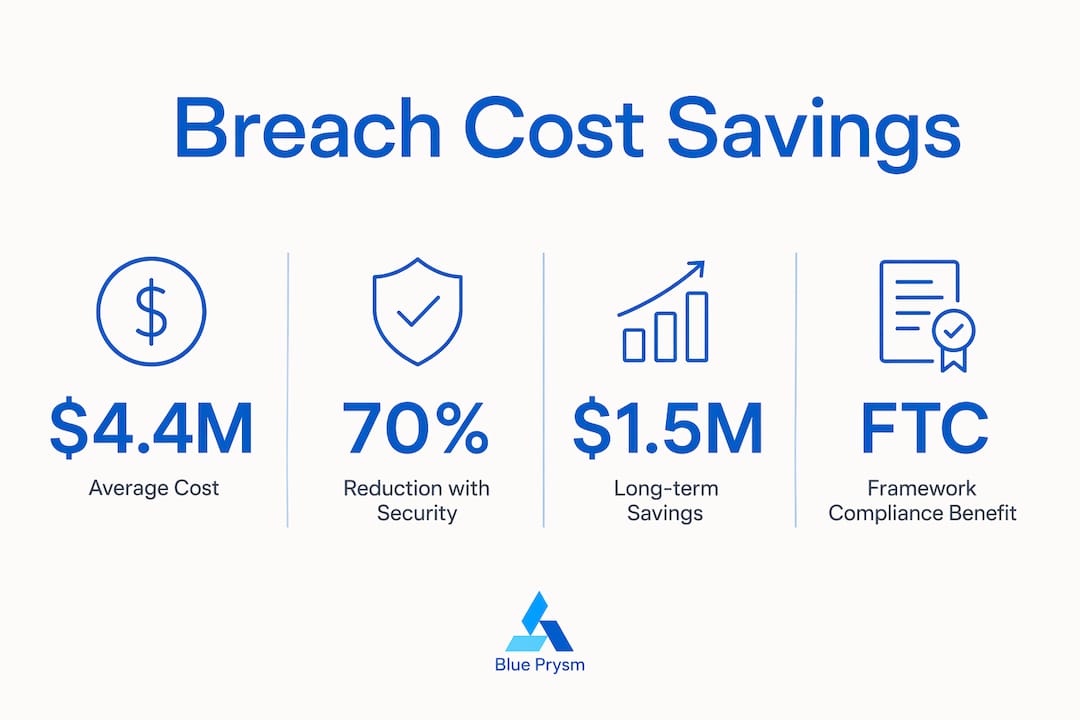
The FTC makes this point directly: it is cheaper in the long run to invest in better data security than to lose customer goodwill, defend against legal actions, and absorb the other consequences of a breach. Security spending is not overhead. It is risk-adjusted return on investment.
Risk management strategies that actually reduce your exposure
Effective risk management in data security is not about buying the most expensive tools. It is about knowing what data you have, who can access it, and what happens if it is compromised.
Third-party vendor risk is one of the most underestimated exposure points. Contracts with vendors who process your data must include security requirements, audit rights, and incident response obligations. The Colorado Privacy Act now mandates this for covered entities. Vendor security hygiene is your responsibility, not just theirs.
Data minimization reduces risk at the source. If sensitive data is not in your system, it cannot be stolen. Regular reviews of what you collect, how long you keep it, and who can reach it are among the highest-leverage security activities any business can run.
How data security affects investor confidence and stakeholder relations
Investors and board members now ask about cybersecurity posture as part of standard due diligence. A breach that goes public during a funding round or acquisition process can kill the deal. Conversely, demonstrating mature data governance signals that your leadership team understands operational risk, which is exactly what institutional investors want to see.
Stakeholder confidence extends beyond investors. Enterprise customers, regulated-industry partners, and government contractors all evaluate your security posture before signing agreements. Competitive intelligence built on secure, well-governed data gives your leadership team the credibility to operate at that level.
How Blue Prysm helps you build strategy on secure data
Blue Prysm’s market analysis platform is built for business leaders who need real-time intelligence without the operational risk of poorly governed data. Every insight your team acts on comes from a system designed with data protection built in, not bolted on afterward. If your strategy depends on data, the security of that data is part of the strategy.
Key Takeaways
Data security is a 2026 strategic imperative: businesses that embed it into operations protect revenue, build trust, and unlock safe AI adoption.
| Point | Details |
|---|---|
| Breach costs are concrete | The global average cost of a data breach reached $4.4 million in 2025, covering fines, remediation, and lost productivity. |
| Compliance is expanding | GDPR, HIPAA, SOX, and the Colorado Privacy Act all require documented safeguards, vendor contracts, and breach notification plans. |
| CIA triad is the foundation | Confidentiality, Integrity, and Availability define every security control your organization should implement. |
| Zero Trust replaces perimeter defense | Modern environments require verifying every access request, especially as Agentic AI and cloud platforms expand your attack surface. |
| Prevention beats recovery | Investing in training, access controls, and data minimization costs far less than responding to a breach after the fact. |
FAQ
What are the three goals of data security?
The three goals are Confidentiality, Integrity, and Availability, collectively known as the CIA triad. Every security control an organization implements maps back to one or more of these principles.
How do you decide what to prioritize in data security?
Start by identifying what sensitive data you hold, who can access it, and what the consequences of exposure would be. Prioritize controls around your highest-risk data first, applying the principle of least privilege and data minimization to reduce your overall exposure.
What is the main focus of data security for businesses?
The main focus is protecting sensitive information from unauthorized access, corruption, or theft across its entire lifecycle, while keeping that data available and accurate for legitimate business use.
Why does data security matter for investor and stakeholder relations?
Investors and enterprise partners now evaluate cybersecurity posture as part of standard due diligence. A documented, mature security program signals operational discipline and reduces the perceived risk of doing business with your organization.
How does data security connect to Agentic AI adoption?
Agentic AI systems require access to sensitive business and customer data to function. Without solid data governance and access controls already in place, deploying these tools creates significant exposure. Security is the prerequisite for safe AI adoption, not an afterthought.