


Four events stand out for U.S. marketing leaders who want real strategic frameworks, not just inspiration: Gartner Marketing Symposium/Xpo (best for CMOs needing analyst access and executive peer networks), Content Marketing World (best for content and activation teams who want 100+ practical sessions), Reuters Strategic Marketing (best for cross-industry strategists focused on CX, measurement, and brand governance), and Marketing Strategy Meets Wall Street (MSMW) (best for finance-partnered executives and research-minded practitioners at the marketing–finance interface).
Quick orientation before you book:
- Gartner Marketing Symposium/Xpo: Invitation-only CMO Circle tracks, analyst briefings, and executive-only programming. Ticket tiers run from standard conference passes to premium packages; hybrid access is typically available.
- Content Marketing World: Large-scale practitioner event with workshops, keynotes, and a content-focused speaker roster. Virtual passes are offered alongside in-person attendance.
- Reuters Strategic Marketing: Cross-industry strategic sessions with a senior practitioner audience. In-person format; check the Reuters Events site for virtual options each year.
- MSMW 2026: Hosted by UTSA on March 27–28, 2026, this academic-practitioner forum is free or low-cost to attend and entirely in-person.
Key Takeaways
The right marketing strategy conference matches your role, your top strategic question, and the networking format that actually moves the needle for you — not the biggest name or the most sessions.
| Point | Details |
|---|---|
| Match event to role | CMOs: Gartner Symposium. Content teams: Content Marketing World. Finance-partnered execs: MSMW (March 27–28, 2026, UTSA). |
| Prioritize curated networking | Braindates and CMO circles deliver more strategic value than open receptions; book them 2–4 weeks in advance. |
| Convert learnings in 30 days | Map top three conference recommendations to OKRs within five business days; assign owners and 30-day milestones. |
| Watch for red flags | No detailed agenda within six weeks, vendor-heavy keynotes, and no executive tracks are signs to skip the event. |
| Blue Prysm accelerates synthesis | Blue Prysm’s Agentic AI at agentsente.blueprysm.com converts session notes into prioritized tasks and KPI dashboards automatically. |
Which marketing strategy conference fits your role at a glance?
| Conference | Next Date & Location | Best For | Core Topics | Format | Networking | Virtual Option |
|---|---|---|---|---|---|---|
| Gartner Marketing Symposium/Xpo | 2026, US (check Gartner site) | CMOs, VPs, senior strategy leaders | AI governance, martech, brand, measurement | Keynotes, analyst sessions, CMO Circle | CMO Circle, curated 1:1s | Hybrid available |
| Content Marketing World | Fall 2026, US city TBC | Content teams, brand strategists, activation leads | Content strategy, creative, SEO, distribution | 100+ sessions, workshops, keynotes | Open networking, workshops | Virtual pass available |
| Reuters Strategic Marketing | 2026, US (check Reuters Events) | Senior marketers, CX leads, brand directors | CX, brand governance, measurement, growth | Panels, case studies, roundtables | Curated roundtables | Limited; check site |
| MSMW 2026 | March 27–28, 2026, San Antonio, TX | Finance-partnered execs, academic practitioners | Marketing–finance interface, ROI, strategy research | Academic-practitioner panels, workshops | Small-group academic networking | In-person only |
How to weigh these columns for your role: A CMO prioritizing peer benchmarking should weight the networking column heavily. A martech lead evaluating vendor-neutral case studies should focus on core topics and format. A content director with a tight budget should check virtual availability first.
Red flags to watch on any event page:
- No detailed session agenda published within 8 weeks of the event
- Speaker list dominated by vendors rather than practitioners or analysts
- No executive-only track or CMO-level programming
- Missing information on session recordings or slide deck access after the event
Organizer reputation matters: events run by Gartner, Reuters, university hosts, and established associations more consistently deliver documented learning outcomes and curated executive access.
How do you choose the right conference for your goals?
Start with role and outcome mapping, not the event’s marketing copy.
CMO or VP of Marketing: You need strategic frameworks, cross-functional alignment tools, and peer problem-solving. Prioritize events with invitation-only executive tracks, analyst access, and structured peer cohorts. Gartner frames marketing strategy as proactive work that connects long-term vision to daily execution — the events that reinforce that discipline are worth the premium ticket price.
Head of Content or Brand: You need session depth, tactical workshops, and a practitioner-heavy speaker roster. Content Marketing World’s 100+ sessions give you the volume to build a full-year content roadmap in three days.
Martech Lead or CX Director: Look for vendor-neutral case studies, governance workshops, and AI adoption tracks. The ANA’s 2026 AI and Technology for Marketers Conference explicitly foregrounds “AI adoption with accountability,” covering governance, martech simplification, and moving pilots to production.
Finance-partnered Strategist or Academic Practitioner: MSMW is purpose-built for you.
Questions to ask before you buy a ticket:
- What is the typical seniority mix of attendees? (Ask the event team directly.)
- Is there a CMO track or invitation-only executive program, and how do I apply?
- Will session recordings and slide decks be available after the event?
- Are workshops included in the base ticket, or priced separately?
- What continuing education or professional development credits does the event offer?
Pro Tip: Ask the event’s registration team for last year’s attendee seniority breakdown. If they can’t share it, that tells you something about how seriously they track audience quality.
Hard stops — do not buy if:
- The agenda is still “coming soon” within six weeks of the event
- Keynote speakers are primarily vendor executives with no independent practitioners
- There is no clear mechanism for peer networking beyond open receptions
- The organizer has no track record of publishing post-event resources
What should you expect at each featured event?
Gartner Marketing Symposium/Xpo
Gartner’s event is the most executive-dense marketing strategy conference in the U.S. The CMO Circle is an invitation-only peer problem-solving format where senior leaders work through live strategic challenges together — not a panel, not a keynote. Analyst access is built into the programming, which means you can pressure-test your roadmap against Gartner benchmarks in real time.
Core themes rotate around AI governance, martech portfolio rationalization, brand measurement, and organizational design. Ticket tiers range from standard conference passes to premium packages that include private analyst briefings. Budget for travel and hotel on top; the venue is typically a resort property. Hybrid access is usually available for those who cannot attend in person.
Unique value for strategists: You leave with a benchmarked view of where your peers are on AI adoption and martech maturity — not anecdotes, but structured analyst data.

Pro Tip: Apply for the CMO Circle the moment registration opens. Spots fill fast and the application requires a brief on your current strategic challenge — write it before you register, not after.
Content Marketing World
Content Marketing World is the largest practitioner-focused content strategy event in the U.S., with 100+ sessions across multiple tracks covering content strategy, SEO, distribution, creative production, and measurement. The audience skews toward content directors, brand managers, and marketing generalists rather than C-suite executives.
Workshops run alongside keynotes, so you can spend a half-day in a hands-on session building a content framework rather than just listening to one. Virtual passes are available, making this the most accessible event on this list for teams with travel budget constraints. Additional costs to plan for: optional pre-conference workshops carry separate fees, and hotel blocks near the venue sell out early.
Unique value for strategists: The sheer session volume means you can build a 12-month content calendar and a measurement framework in a single trip.
Pro Tip: Download the session app as soon as it launches and block your schedule before you arrive. The most useful workshops cap attendance at 40–60 people and fill within hours of opening.
Reuters Strategic Marketing
Reuters Strategic Marketing draws a senior cross-industry audience — brand directors, CX leads, and growth strategists from sectors outside pure tech. The format leans toward case-study panels and roundtables rather than large keynotes, which means the conversation density per hour is higher than at most events this size.
Core themes typically cover brand governance, customer experience measurement, growth strategy, and the intersection of data and creative. The roundtable format gives you direct access to peers solving the same problems in different industries — a perspective that’s genuinely hard to replicate in a sector-specific event.
Unique value for strategists: Cross-industry exposure breaks you out of your category’s echo chamber. A retail CMO learning how a financial services brand rebuilt its CX measurement stack is often more useful than another session from within retail.
Pro Tip: Request a roundtable seat assignment in advance. Open seating at roundtables means the most useful conversations go to the people who planned for them.
Marketing Strategy Meets Wall Street (MSMW) 2026
MSMW 2026 runs March 27–28, 2026, at the University of Texas at San Antonio. The event sits at the marketing–finance interface: academic researchers and senior practitioners present work on marketing ROI, brand valuation, and the financial accountability of marketing investment. It is the only event on this list where both a CFO and a CMO are equally at home.
The format is academic-practitioner panels and workshops, with a small-group networking dynamic that makes it easy to have substantive conversations. Attendance and ticket costs are significantly lower than commercial conferences, making it accessible for teams with constrained budgets. Travel and hotel in San Antonio are straightforward and affordable relative to major conference cities.
Unique value for strategists: If your board asks you to justify marketing spend in financial terms, MSMW gives you the frameworks and the peer network to answer that question credibly.
Pro Tip: Bring a live business case — a real marketing investment decision you’re facing. The academic-practitioner format means you can get structured feedback from researchers who study exactly that problem.
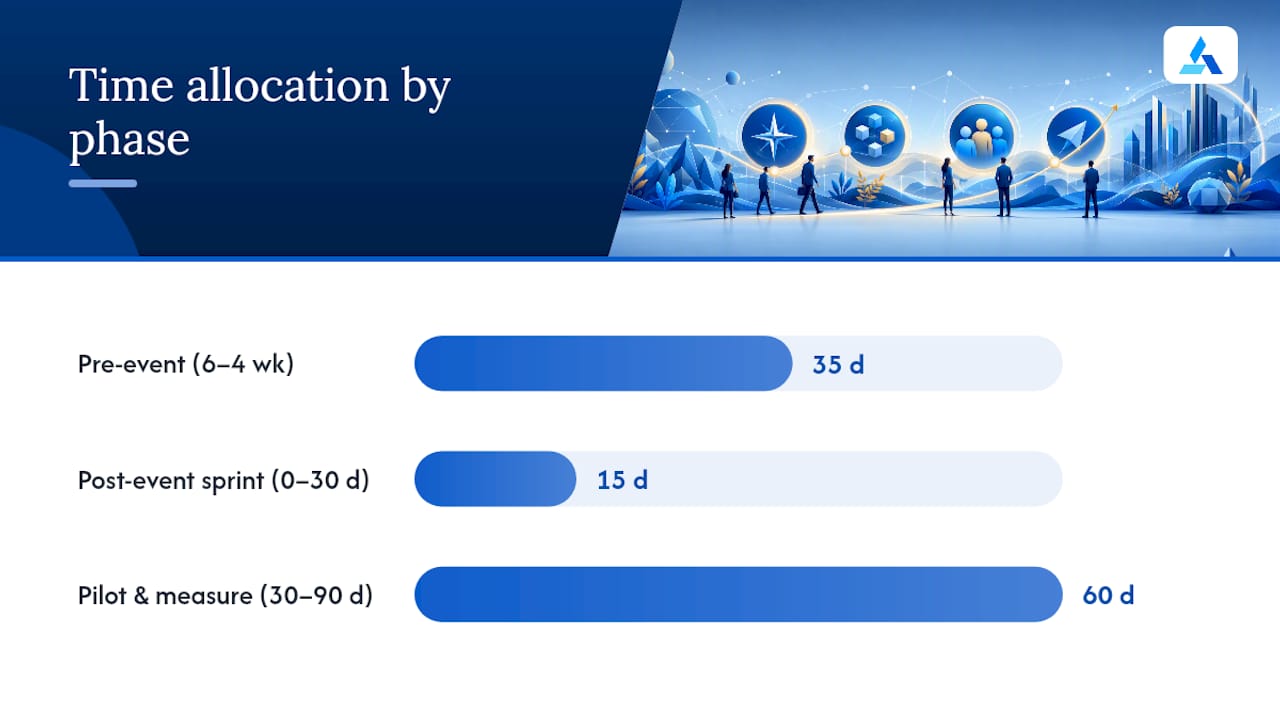
How do you turn conference attendance into a 90-day strategy?
Most conference ROI evaporates within two weeks if you don’t have a structured synthesis process. Here’s a timed plan that doesn’t.
Pre-event (6–4 weeks out):
- Define your top three objectives for attending — specific questions you need answered, not vague goals like “learn about AI.”
- Schedule braindates or 1:1 meeting requests with target speakers or attendees at least two weeks before the event. Curated micro-meetings booked in advance consistently outperform ad-hoc networking for senior leaders.
- Request speaker slide access or session recording subscriptions at registration.
- Brief your team on what you’re attending and what you’ll bring back.
Onsite:
- Block your session schedule before day one — prioritize workshops and executive tracks over general keynotes.
- Use a rapid capture template: for each session, note one insight, one question it raises, and one potential action.
- Follow up on every meaningful conversation within 24 hours, not at the end of the event.
Post-event, 0–30 days:
- Run a stakeholder debrief within five business days — share your top three recommendations, not a full session recap.
- Map each recommendation to an existing OKR or KPI using a framework like the AMA’s step-by-step marketing strategy guide or HubSpot’s synthesis framework.
- Assign an owner and a 30-day milestone to each initiative.
Post-event, 30–90 days:
- Pilot one initiative with a defined success metric.
- Measure early signals at day 30 and adjust.
- Use Blue Prysm’s Agentic AI at Agentsente to automate note synthesis into prioritized tasks and KPI dashboards — turning a folder of session notes into a structured 90-day roadmap takes minutes, not a weekend.
| Phase | Timeframe | Key Action |
|---|---|---|
| Pre-event | 6–4 weeks out | Define objectives, book braindates, request recordings |
| Onsite | Event days | Prioritize workshops, rapid capture, same-day follow-up |
| Post-event sprint | 0–30 days | Stakeholder debrief, map to OKRs, assign owners |
| Pilot and measure | 30–90 days | Run one initiative, track signals, iterate |
Pro Tip: The strategy frameworks in Blue Prysm’s library — 95+ templates including SWOT, Porter’s Five Forces, and the Business Model Canvas — give you a ready structure for mapping conference insights to an executable plan the same week you return.
Where are marketing strategy events actually headed?
The conference circuit is sorting itself into two tiers, and the gap between them is widening. On one side: large-format events that sell inspiration and brand exposure. On the other: tighter, outcome-focused gatherings where the real work happens in CMO circles, invitation-only dinners, and pre-scheduled braindates rather than keynote halls.
The shift that matters most right now is the move from “AI curiosity” to AI adoption with accountability. Governance, martech simplification, and organizational readiness are no longer fringe topics — they’re the main agenda at the events worth attending in 2026. If a conference is still running “AI: the future of marketing” panels without governance or measurement tracks, it’s behind the curve.
The other trend worth watching: the rising premium on curated peer networks over general networking. A CMO who spends 45 minutes in a structured problem-solving session with five peers from non-competing industries will get more strategic value than three hours at an open reception. The events that understand this are building those formats into their core programming. The ones that don’t are selling you a badge and a tote bag.
My honest advice: pick one event per year that genuinely challenges your current thinking, not one that confirms it. The AI strategies that build real competitive advantage rarely come from sessions where everyone already agrees on the answer.
What Blue Prysm’s Agentic AI does that a conference ticket can’t
Conferences give you frameworks and peer exposure. What they don’t give you is a system that keeps working after you land back home.
Blue Prysm’s market analysis platform picks up where your conference notes leave off. Feed in your session insights and the Agentic AI at Agentsente synthesizes them into prioritized tasks, maps them to your OKRs, and generates competitive intelligence briefs — automatically. No weekend spent reformatting notes into a deck. No three-week lag before your team sees the output.
For teams watching their budget, this matters: a single conference ticket plus travel can run several thousand dollars before you’ve booked a hotel. Blue Prysm’s platform gives you ongoing strategic intelligence, 50+ strategy frameworks, and automated competitor tracking on a subscription that costs a fraction of one event. It’s not a replacement for the peer network you build in person — it’s what makes that network’s output stick.
Start with the market analysis platform or explore the strategy library to see how your conference takeaways map to a structured 90-day roadmap.
Sources
- 2026 ANA AI and Technology for Marketers Conference | ANA National Industry Conferences | ANA
- Marketing Strategy Meets Wall Street (MSMW) 2026
- Develop a Winning Marketing Strategy: Step-by-Step Guide (AMA)
- How to create a complete marketing strategy data + expert tips (HubSpot)
FAQ
Which marketing strategy conference is best for CMOs?
Gartner Marketing Symposium/Xpo is the strongest choice for CMOs, offering analyst access, executive-only programming, and the invitation-only CMO Circle for peer problem-solving.
How much does a marketing strategy conference typically cost?
Ticket prices vary widely: MSMW is low-cost as a university-hosted academic event, while commercial conferences like Gartner’s Symposium carry premium pricing. Budget for travel and hotel on top of the ticket, which can significantly add to total costs for major events.
What is the best way to get ROI from a conference?
Define three specific objectives before you attend, book curated networking slots 2–4 weeks in advance, and run a stakeholder debrief within five business days of returning. Map your top recommendations to existing OKRs and assign owners immediately.
Can I attend these conferences virtually?
Gartner Marketing Symposium/Xpo and Content Marketing World typically offer hybrid or virtual passes. Reuters Strategic Marketing and MSMW are primarily in-person; check each event’s official page for the most current options.
How does Blue Prysm help after a conference?
Blue Prysm’s Agentic AI at agentsente.blueprysm.com synthesizes session notes into prioritized tasks and KPI dashboards, and the strategy library provides 95+ frameworks for structuring your post-conference 90-day plan.