


An AI opportunity audit service gives you a prioritized, ROI-scored register of AI use cases plus an action roadmap you can start funding in 30 to 60 days. It’s built for executives who are tired of vague AI advice and want ranked, feasible projects tied to real numbers. Done right, it draws on the same assurance thinking PwC applies to enterprise AI governance, scaled down to something an SMB team can actually execute.
TL;DR:
- An AI opportunity audit provides a prioritized project list with ROI estimates based on impact and feasibility, often delivered within a few weeks.
- The audit includes a data and governance review to identify readiness issues, with major delays coming from data access approvals and stakeholder coordination.
- Credible ROI modeling relies on assumptions about hours saved, error reductions, revenue uplift, and headcount redeployments, all stress-tested across scenarios.
- Successful audits are led by cross-functional teams with real implementation experience, and sample deliverables should include an opportunity register and clear action roadmap.
- The audit findings feed into a live decision model, enabling ongoing scenario testing and continuous evaluation rather than a one-time static report.
What Does an AI Opportunity Audit Include?
Most vendors throw around the term “AI audit” without defining what lands on your desk at the end. A real one produces four concrete deliverables, not a slide deck full of buzzwords.
- Executive summary: A two-to-three page brief written for the board, not the engineering team, translating findings into business language.
- Opportunity register or matrix: Every viable use case plotted by impact versus feasibility, each with a rough ROI projection attached.
- Data readiness and risk checklist: An honest look at whether your data can actually support the AI use cases you want, plus a governance review flagging compliance exposure before you build anything.
- Prioritized action roadmap: Use cases sorted into quick wins, medium-term bets, and strategic plays, so you know what to fund first.
That last piece matters more than most buyers realize. A readiness assessment across defined pillars like strategy, governance, data foundations, and infrastructure lets auditors compare opportunities on a level playing field instead of ranking them off gut feeling. Without that structure, “AI opportunity” becomes whatever the loudest department head pushes for. The data readiness check alone often surfaces the real bottleneck: not a lack of AI ideas, but data too scattered or too dirty to feed any of them.
How Long Does an AI Opportunity Audit Take?
The audit runs in a predictable sequence, and knowing the stages helps you plan who needs to show up and when.
- Scoping: The audit team defines which departments, workflows, and data sources are in bounds. This alone can take a few days if ownership is unclear.
- Mapping and interviews: Analysts walk through current workflows with the people who actually run them, not just the executives who think they know how the work happens.
- Data and technology review: A technical pass over your systems, data pipelines, and existing tools to see what’s usable versus what’s aspirational.
- Scoring: Every candidate use case gets rated on impact, effort, and feasibility, then ranked.
- Synthesis and roadmap delivery: Findings get compiled into the opportunity register and presented with a funding sequence attached.
Timelines vary by scope. A light, single-department audit can run in a focused week. A typical full audit spanning several functions usually takes a few weeks. Deep, cross-departmental engagements covering data infrastructure and governance can take over a month. The biggest delay isn’t the analysis, it’s you: data access approvals and stakeholder calendars are the two things that blow past every projected timeline.
What Kind of ROI Should You Expect?
Every audit proposal you’ll see promises “ROI.” Few explain how they get there, which is exactly where buyers get burned.
Credible ROI modeling traces back to four measurable drivers: hours saved on manual tasks, direct revenue uplift, reduction in error rates, and headcount that gets redeployed instead of replaced. A rigorous auditor builds conservative assumptions into every projection and shows you the math, not just the output. If a proposal hands you a single ROI number with no breakdown of the assumptions behind it, that’s your first red flag.
Pro Tip: Ask any auditor to show you the low, mid, and high scenario for their top three ROI projections. If they can only give you one number, they haven’t stress-tested the model.
Pricing follows a few common patterns in the market:
- A short free or low-cost intro assessment that produces a lightweight opportunity summary.
- A fixed-price audit scoped to one or two departments, typically delivered over two to four weeks.
- A multi-week, cross-functional engagement priced by scope and team size.
- Implementation credits that some consultancies apply toward the first build if you continue past the audit.
PwC’s approach to AI assurance underscores why boards increasingly want evidence behind ROI claims, not vendor promises. Treat that as your benchmark when comparing proposals.
Is an AI Opportunity Audit Right for Your Business?
Not every company needs this. Knowing where you fall saves you money and time.
- You’re a good fit if: your team runs repeated manual workflows, you’ve got product or ops leaders arguing over which AI project to fund first, or nobody can agree where your usable data actually lives.
- Watch for these signals: recurring manual data entry, error rates that keep creeping up, KPIs that mean different things in different departments, or a customer support queue that escalates the same issues weekly.
- Skip it if: you already run a mature AI program with continuous internal evaluation, or your data pipelines are clean and well documented. An audit repeating what you already know is a wasted engagement.
How Do You Choose the Right Audit Provider?
Most of the differentiation between providers shows up before you sign anything, in how they answer your questions on the discovery call.
- Check the team composition. You want a data scientist, a domain expert, and a delivery lead in the room, not a single generalist consultant wearing three hats. Cross-functional teams consistently produce recommendations that are actually buildable, not just theoretically sound.
- Ask what the deliverable actually looks like. Request a sample opportunity register or a redacted roadmap from a past engagement. If they can’t show you one, they may not have a repeatable methodology.
- Probe the data and governance review. A provider that skips technical data assessment is guessing at feasibility, not evaluating it. The IIA’s AI auditing framework is a useful reference point for what a governance-literate audit should cover.
- Watch for red flags. Vague ROI language, no sample deliverables, and no technical data review are the three most common signs of an audit that will produce a nice-looking deck and nothing you can execute.
Pro Tip: During the discovery call, ask who on the team has actually built something from a past audit’s roadmap. An audit team with zero implementation experience tends to produce recommendations that look great and die in engineering.
Where Does This Playbook Come From?
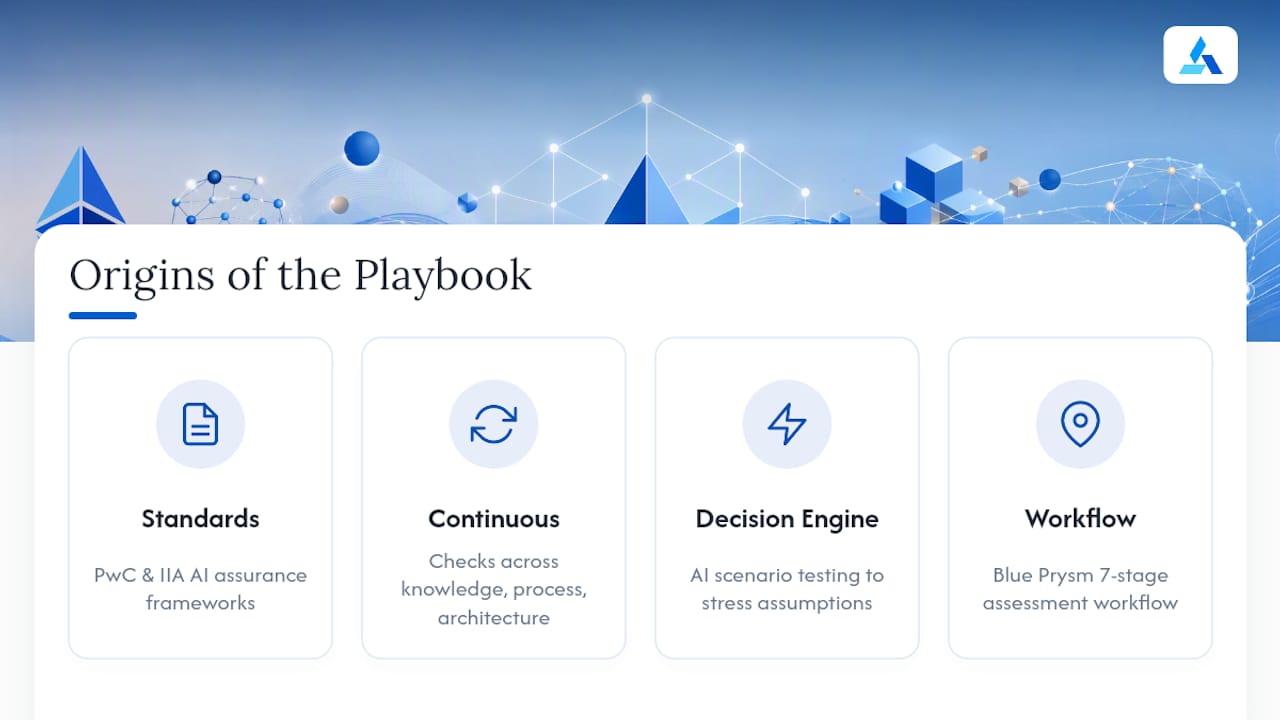
None of this is invented from scratch. Boards are asking for the same kind of demonstrable evidence PwC recommends for AI assurance, and internal audit functions are leaning on the IIA’s framework to evaluate governance and controls before signing off on new AI spend.
There’s also a shift toward continuous evaluation instead of one-time audits. AuditMAI’s continuous auditing framework argues that ongoing checks across knowledge, process, and architecture reduce manual audit effort while catching safety and compliance issues earlier. A one-time audit is a snapshot; a good provider builds in a mechanism for revisiting the findings.
Blue Prysm’s Market Opportunity Assessment Workflow maps directly onto this thinking. Its seven stages take audit findings and run them through a Decision Engine that stress-tests assumptions with AI-powered scenario testing before you commit budget, rather than handing you a static report and walking away.
An Editorial Take on ROI-First AI Audits
Here’s what the industry playbooks get right and where most vendor pitches quietly cheat: assurance frameworks like PwC’s and audit standards like the IIA’s exist because AI decisions are too expensive to run on gut feeling, yet most SMB-facing “AI audits” borrow the language of enterprise governance without the substance behind it.
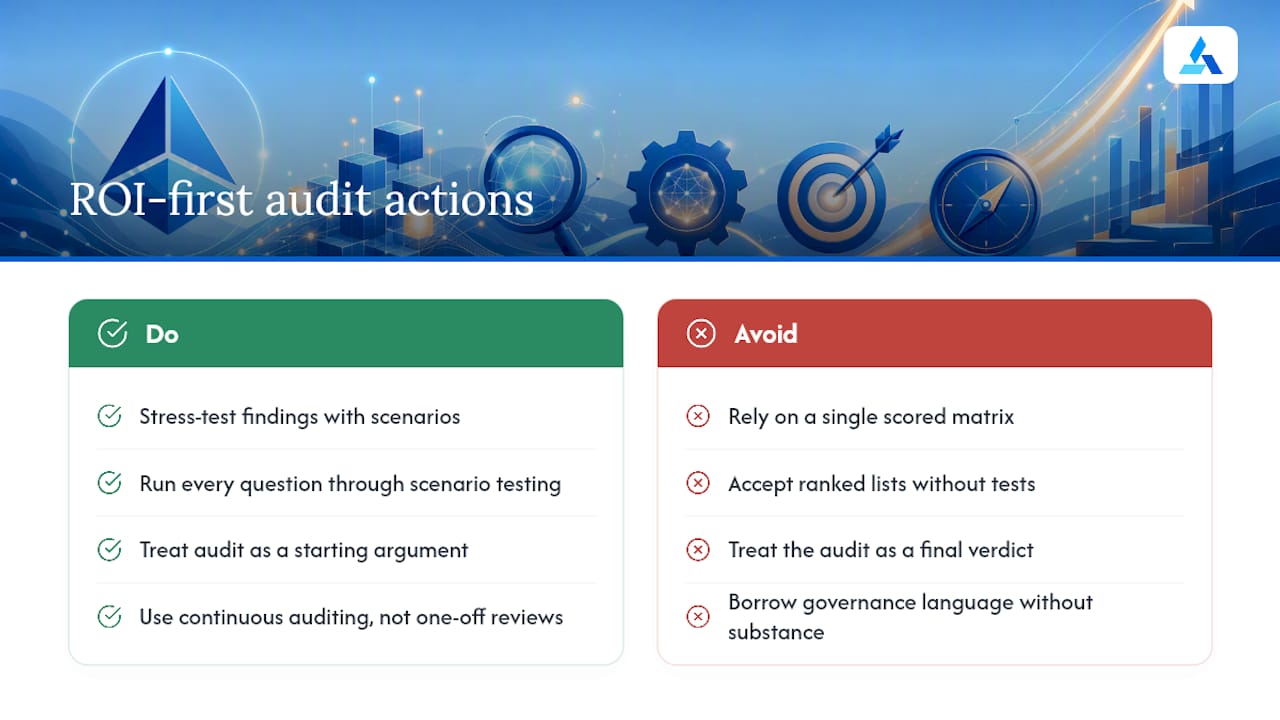
The overrated part of this whole category is the opportunity register itself. A ranked list of use cases feels like progress, but a list you can’t stress-test is just an organized guess. That’s the gap AuditMAI’s continuous-auditing argument exposes: a single scored matrix delivered once and never revisited is barely better than the gut-feeling planning it’s supposed to replace.
What actually matters is whether findings get tested against scenarios before money moves. Run every “would this work” question from your audit through some form of scenario testing before you fund it. Treat the audit as the starting argument, not the final verdict.
— Colin Bowdery
Getting Started with a Blue Prysm AI Opportunity Audit
If everything above sounds right but you don’t want to chase down a data scientist, a domain expert, and a delivery lead separately, that’s exactly the gap Blue Prysm was built to close. The engagement runs through scoping, a full opportunity assessment, an opportunity register scored on impact and feasibility, and a funded roadmap, with optional implementation support if you want to keep the same team past the audit.
What makes this different from a static consulting deck is the Market Analysis Platform behind it: audit findings feed directly into scenario testing, so your top three opportunities get pressure tested against market shifts before you commit budget. If you’re comparing this against broader AI use cases across departments, Blue Prysm’s advantage is that the audit output isn’t a report you file away, it’s a live model you keep using.
Start with the market research tools page to see the workflow, then book a scoping call and bring a short list of the stakeholders who actually run your day-to-day operations. That list alone usually saves a week of back-and-forth once the audit begins.
Sources
- PwC — assurance approach to AI
- Microsoft AI Readiness Assessment
- AuditMAI: Towards An Infrastructure for Continuous AI Auditing
- IIA AI Auditing Framework (2024 update)
FAQ
How long does a typical AI opportunity audit take?
A focused single-department audit can run in about a week, while a full cross-functional audit typically takes two to four weeks depending on data access and stakeholder availability.
What data do we need to prepare before an audit starts?
You need access to your current workflow documentation, existing data sources, and the systems you want evaluated; the data readiness check happens during the audit, not before it.
Can we trust the ROI numbers an audit produces?
Trust the number only if the auditor shows you the underlying assumptions and a range of scenarios, not a single figure with no methodology attached, since credible models trace ROI to specific drivers like time saved and error reduction.
Should we run this audit internally or hire an outside provider?
Outside providers bring cross-functional expertise, data scientists, domain experts, and delivery leads working together, which internal teams rarely have available at once, and they avoid the internal bias of ranking pet projects too highly.
Does an AI opportunity audit lock us into one vendor for implementation?
No credible audit should require that; Blue Prysm’s audit produces a standalone roadmap and opportunity register you can act on with any implementation partner, with optional continued support if you choose to stay.