


TL;DR:
- AI-driven insights enable faster, more accurate decision-making and enhance operational efficiency across industries.
- Strategic clarity, workflow redesign, and outcome-based governance are essential to sustain value from AI investments.
AI-driven insights are defined as automated, intelligent analysis of complex data sets that surface patterns, predictions, and recommendations faster than any human analyst can. The competitive case is already settled: 88% of enterprise leaders say AI increased annual revenue, with 30% reporting gains above 10%. That number comes from NVIDIA’s 2026 State of AI report, and it reflects a shift from AI as an experiment to AI as a core operating advantage. The question for business leaders is no longer whether to adopt AI-driven analytics. It is how to extract the full value from them before your competitors do.
1. How AI-driven insights improve decision-making speed and accuracy
Decision speed is a competitive weapon. When your team can answer a business question in five minutes instead of ninety, you respond to market shifts before rivals even finish their morning briefing. Amazon QuickSight’s Dataset Q&A feature demonstrates exactly this: it cuts analysis time from 90 minutes to under 5 minutes using natural language queries. That is not a marginal improvement. That is a structural change in how fast strategy can move.
The accuracy gains are equally significant. The same system improved query accuracy by 48% and pushed query success rates from 80 to 85 percent up to over 95 percent through semantic grounding. Semantic grounding means the AI understands the business meaning of your data, not just its structure. Fewer failed queries means fewer decisions made on bad data.
The practical implication for your leadership team is this: AI-powered analytics close the gap between formal dashboards and ad hoc questions. Your CFO no longer waits two days for a custom report. Your operations lead gets an answer during the meeting, not after it.
Pro Tip: Before deploying any AI analytics tool, map the five questions your team asks most often but waits longest to answer. Those are your highest-value targets for AI query automation.
2. What operational efficiencies AI-driven insights unlock
Operational efficiency is where AI-driven data benefits show up most visibly on the income statement. The NVIDIA 2026 report documents a 20% throughput increase alongside 10 to 15 percent capital expenditure reductions in organizations that have embedded AI into core workflows. Those are not projections. They are reported outcomes from companies already running AI at scale.

The mechanism is straightforward. AI identifies inefficiencies in real time and flags them before they compound. A logistics firm using AI-driven monitoring can reallocate trucks mid-route based on live demand signals. A manufacturer can adjust production scheduling within hours of a demand shift rather than waiting for the weekly planning cycle.
The human impact is equally measurable. In healthcare, AI medical assistant tools reduced documentation errors by 68 percent and cut perceived workload by 33% among clinical staff. That freed time flows directly into patient care. The same logic applies in any service business: when AI handles repetitive cognitive tasks, your people focus on judgment-intensive work that actually requires them.
Pro Tip: Track efficiency gains at the task level, not just the department level. If AI saves your analysts four hours a week, document exactly what they do with those four hours. That data becomes your ROI story for the next budget cycle.
3. Why strategic clarity matters more than better AI tools
Here is the finding that most leaders miss. According to BCG’s 2026 AI at Work research, strategic clarity improves AI impact by 25 percentage points. Upgrading to better AI tools alone delivers only 5 points of improvement. The gap between 5 and 25 points is not a technology problem. It is a leadership problem.
Strategic clarity means your team knows exactly what business outcome each AI deployment is meant to drive, who owns the decision it informs, and how success is measured. Without that clarity, AI becomes an expensive dashboard nobody acts on.
The workforce data reinforces this hard truth. 42% of frontline workers save roughly a full workday per week through AI tools. Yet 66 percent of them receive no guidance on how to use that recovered time. Value leaks out of the organization not because the AI failed, but because leadership did not redesign the workflow around it.
“The organizations winning with AI are not the ones with the most sophisticated models. They are the ones with the clearest answers to the question: what decision does this insight change?” — BCG, AI at Work 2026
The fix requires treating AI governance as an ongoing process, not a launch event. That means quarterly reviews of AI-driven workflow performance, explicit reinvestment plans for recovered time, and AI strategy alignment built into your planning cycle.
4. How AI insights generate measurable revenue growth and cost reduction
The financial case for AI-driven insights is no longer theoretical. The NVIDIA 2026 survey reports that 87% of companies using AI report cost reductions, with some sectors exceeding 10 percent decreases. Retail and consumer packaged goods lead that group, where AI-driven demand forecasting and inventory optimization directly reduce carrying costs and waste.
Revenue growth follows a parallel track. The same 88 percent of enterprise leaders reporting revenue gains points to AI’s role in pricing optimization, customer segmentation, and product recommendation engines. Amazon’s own recommendation system, a well-documented AI application, drives a significant portion of its total revenue. That is not a coincidence. It is the value of AI analysis applied to purchase behavior at scale.
The key variable separating high-ROI deployments from low-ROI ones is specificity. Tailored AI solutions built for distinct business challenges consistently outperform generic deployments. A specialized model trained on your customer churn data outperforms a general-purpose model every time. Open-source frameworks like Meta’s LLaMA and fine-tuning platforms now make this level of customization accessible to mid-market companies, not just enterprises with nine-figure technology budgets.
5. Practical steps to sustain competitive advantage from AI insights
Sustained advantage from AI-driven insights requires a different operating model than most companies currently run. Most organizations measure AI success by adoption rates: how many users logged in, how many queries were run. That is the wrong metric. Measuring AI by adoption rather than outcomes undermines the incentive to redesign workflows and sustain benefits.
Here is what the evidence-backed operating model looks like in practice:
- Set outcome metrics before deployment. Define the specific business result each AI tool is meant to improve, whether that is forecast accuracy, customer response time, or cost per acquisition. Measure it before and after.
- Redesign workflows, not just tools. AI does not slot into existing processes. It requires rethinking who does what and when. Involve the people doing the work in that redesign.
- Govern continuously. Schedule quarterly reviews of AI model performance and business impact. Models drift. Business conditions change. Static deployments decay.
- Invest in upskilling alongside technology. Employees who understand how to interpret and act on AI outputs deliver more value than those who simply receive them. Pair every AI deployment with a targeted training program.
- Use specialized models where specificity matters. For decisions tied to your specific customer base, supply chain, or pricing structure, fine-tuned models outperform general tools. The AI insights for SMEs playbook is increasingly accessible and cost-effective.
Pro Tip: Build a simple one-page AI impact scorecard for each deployment. List the target metric, the baseline, the current reading, and the owner. Review it monthly. If the metric is not moving, the workflow redesign is incomplete.
Key takeaways
The advantages of AI-driven insights are only realized when strategic clarity, workflow redesign, and outcome-based governance operate together alongside the technology itself.
| Point | Details |
|---|---|
| Speed and accuracy gains are immediate | AI query tools cut analysis time from 90 minutes to under 5 and improve accuracy by 48%. |
| Operational ROI is documented | AI adoption delivers 20% throughput gains and up to 15% capital expense reductions across industries. |
| Strategy beats tools | Strategic clarity adds 25 percentage points of AI impact versus only 5 from better tools alone. |
| Revenue and cost results are broad | 88% of enterprise leaders report revenue growth; 87% report cost reductions from AI. |
| Governance sustains the gains | Measuring outcomes rather than adoption, and redesigning workflows continuously, prevents value leakage. |
The uncomfortable truth about AI and leadership
I have watched a lot of leadership teams get excited about AI dashboards and then quietly stop using them six months later. The technology was fine. The strategy was not. What I have found, consistently, is that the organizations extracting real value from AI-driven insights are the ones where a senior leader owns the outcome, not just the tool. They ask hard questions: Did this insight change a decision? Did that decision improve a result?
The “joy paradox” finding from recent workforce research captures something real. AI genuinely increases job satisfaction for many employees. It also increases cognitive load when it is poorly integrated. That tension is a leadership signal, not a technology problem. When your team feels overwhelmed by AI outputs rather than empowered by them, the workflow design is wrong.
My honest recommendation: treat your AI deployment like a new hire, not a software license. Onboard it properly. Give it clear objectives. Review its performance. And if it is not delivering, do not blame the model. Look at the process around it. The AI-powered decision making discipline is learnable. Most leaders just have not been taught it yet.
— Colin Bowdery
How Blue Prysm puts AI insights to work for your strategy
Business leaders at small and mid-sized companies face a specific version of this challenge. You need elite-level intelligence without the consulting fees, and you need it fast enough to actually influence decisions.
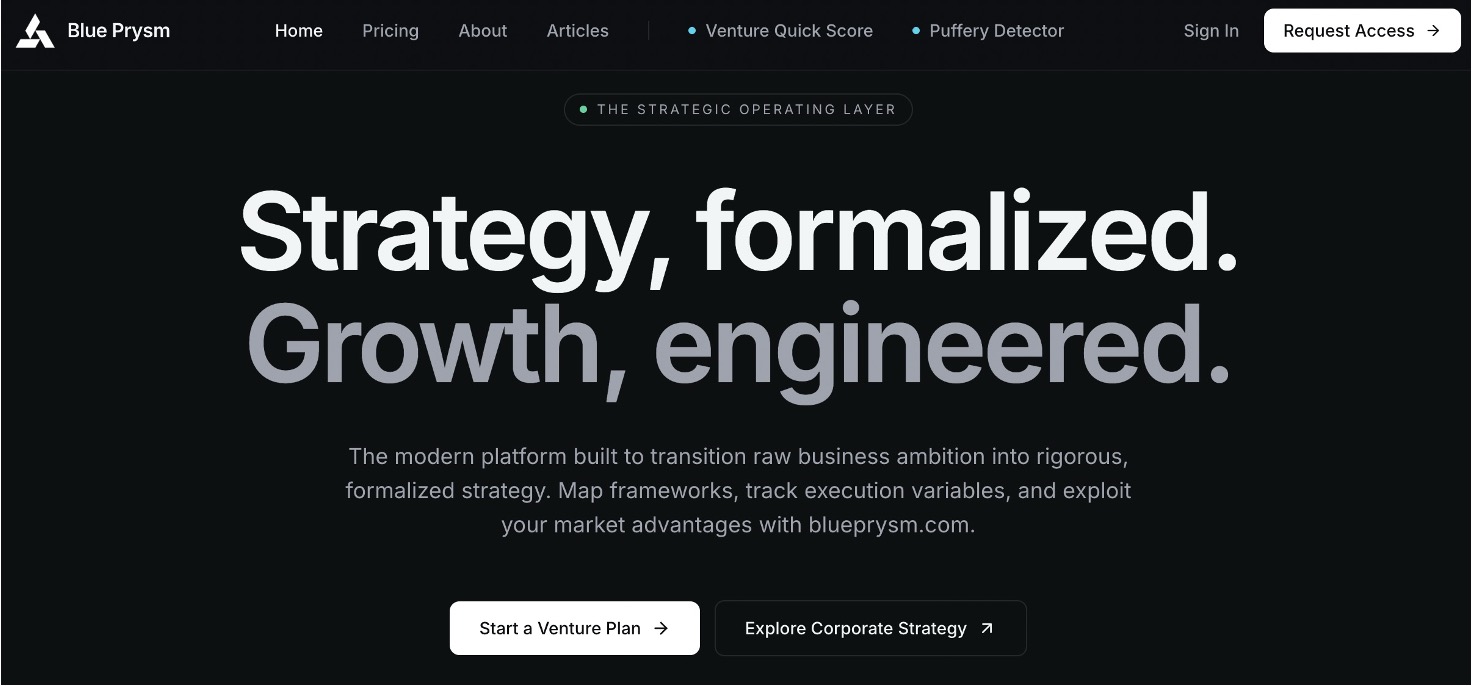
Blue Prysm is built for exactly that. The platform delivers real-time market briefings, competitor monitoring, and structured strategy frameworks that translate AI-driven data into decisions your team can act on today. No data science team required. No six-month implementation. If you want to see how it works in practice, the Blue Prysm platform overview walks through the full capability set and shows how leaders are using it to reduce strategic risk and improve competitive positioning right now.
FAQ
What are the main advantages of AI-driven insights for business?
AI-driven insights improve decision speed, accuracy, operational efficiency, and financial performance. NVIDIA’s 2026 data shows 88% of enterprise leaders report revenue gains and 87% report cost reductions after AI adoption.
How does AI improve decision-making accuracy?
AI tools like Amazon QuickSight’s Dataset Q&A raise query success rates from 80 to 85 percent up to over 95 percent through semantic grounding, reducing decisions made on incomplete or failed data queries.
Why do many AI deployments fail to deliver sustained value?
Most organizations measure AI success by adoption rather than outcomes. BCG research shows 66% of workers who save time through AI receive no guidance on reinvesting it, causing value to leak before it reaches the bottom line.
How much does strategic clarity actually matter for AI ROI?
According to BCG’s 2026 AI at Work study, strategic clarity improves AI impact by 25 percentage points compared to only 5 points gained from upgrading to better AI tools.
Can smaller businesses realistically benefit from AI-driven insights?
Yes. Open-source models and specialized AI platforms now make fine-tuned, outcome-specific AI accessible to mid-market companies. The key is targeting AI at specific business challenges rather than deploying general-purpose tools without a defined use case.