


You can build a working business strategy in six focused steps: define your purpose, diagnose your position, forecast alternatives, choose where and how to compete, design initiatives with KPIs, then commit through resource allocation and a monitoring cadence. Done right, the output is a roadmap anchored to several strategic objectives and multiple measurable KPIs your team can actually track. Here is what that looks like in practice.
Your 48-hour starter checklist:
- Schedule a 90-minute session with your leadership team to agree on scope and the decisions you need to make
- Pull your last 12 months of revenue, margin, and customer-retention data
- List your top three competitors and note one thing each does better than you
- Draft a one-sentence purpose statement: “We help [customer] achieve [outcome] by [method]”
- Identify the single biggest constraint on growth right now (capital, talent, market access, or product)
Why a clear business strategy changes your outcomes
Most businesses that stall do not stall because of a bad product. They stall because every decision gets made on gut feeling, and gut feeling does not scale. Without a strategy, you are essentially running a series of disconnected experiments with no hypothesis and no way to know which ones worked.
The McKinsey building-blocks model frames strategy as a sequence: frame, diagnose, forecast, search, choose, commit, and evolve. Teams that skip the middle steps, jumping from “we need to grow” straight to “let’s launch a new product,” routinely misallocate budget and burn out their people on initiatives that were never stress-tested.
Two scenarios where strategy changes the result:
Scenario A — Pivoting to a new segment. A regional staffing firm was chasing enterprise contracts it could not win on price. A focused diagnosis revealed that mid-market manufacturing clients had a significantly faster sales cycle and noticeably higher retention. Redirecting sales effort took six weeks. Without the diagnosis, the firm would have kept losing to larger competitors on deals it was never going to close.
Scenario B — Avoiding wasted spend. A SaaS founder planned a $200K paid-acquisition push before validating unit economics. A strategy review surfaced that customer lifetime value was below acquisition cost in two of three channels. The push was paused, the pricing model was adjusted, and the budget was redeployed to content and referral, which had positive payback periods.
What are the core components of a business strategy framework?
A solid strategy has seven components. Miss one and the whole structure gets wobbly.
- Purpose and vision — why the business exists and where it is headed in three to five years
- Market diagnosis — where you create or destroy value today, and why
- Competitive positioning — the specific customers you serve, the needs you meet, and the trade-offs you make deliberately
- Strategic objectives — three to five long-term goals that are purpose-driven and measurable
- Initiatives — the projects and programs that move the objectives
- KPIs — the metrics that tell you whether the initiatives are working
- Governance — who reviews progress, how often, and what triggers a course correction
Which frameworks actually help?
The HBS value-stick approach is the clearest starting point for entrepreneurs: center every strategic choice on how you increase willingness to pay for customers or reduce costs for suppliers, while protecting your margin. It cuts through the fluffy mission-statement exercises and forces concrete trade-offs.
Beyond that, use frameworks for the job they are built for:
- SWOT for a fast internal/external diagnosis at the start of a cycle
- Porter’s Five Forces to understand structural pressure in your market
- Business Model Canvas to design or redesign how you create and capture value
- OKRs (Objectives and Key Results) to cascade strategy into quarterly team targets
Pro Tip: If you are an early-stage startup, run a lean one-page strategy canvas first. A full strategic planning cycle is a six-to-twelve week investment. Save the immersive rebuild for when you have product-market fit and are scaling. Refresh the full strategy annually; revisit KPIs quarterly.
For small businesses specifically, Shopify’s competitive strategy guidance makes a point worth internalizing: cost leadership is rarely viable for SMEs because you cannot out-scale a larger competitor on unit economics. Differentiation and focused positioning are where smaller firms actually win. A curated list of strategy models for 2026 can help you find the right framework for your stage.
Steps to develop business strategy: the operational playbook
This is the process, expanded into concrete sub-steps with outputs and roles.
Step 1: Frame scope and agree on decisions
Before any analysis, get alignment on what you are deciding. Who is in the room? What is the time horizon? What constraints are non-negotiable (budget ceiling, geographic scope, product lines in or out)? A 60-minute framing session prevents weeks of misaligned work downstream.

Step 2: Diagnose your starting position
Pull together four data streams: internal value drivers (revenue by segment, margin by product, customer retention), customer insights (interviews, NPS, churn reasons), competitor signals (pricing, positioning, recent moves), and financials (cash runway, cost structure). The McKinsey model calls this the diagnostic starting point: where does the company create or destroy value right now?
Step 3: Forecast and explore alternatives
Generate three to five genuine options for how to win. Not variations on the same theme — real alternatives. “Expand geographically,” “go deeper with existing customers,” “launch an adjacent product,” “exit a low-margin segment,” and “partner to access a new channel” are five distinct strategic options. Forecast the revenue and margin implications of each over 24 months.

Step 4: Choose where and how to compete
Apply Porter’s four tests before committing: internal consistency (do the choices reinforce each other?), environmental fit (does the strategy match market conditions?), resource fit (do you have or can you build the capabilities needed?), and implementation feasibility. The choice that passes all four tests is your strategy. The one that fails two or more is a wish.
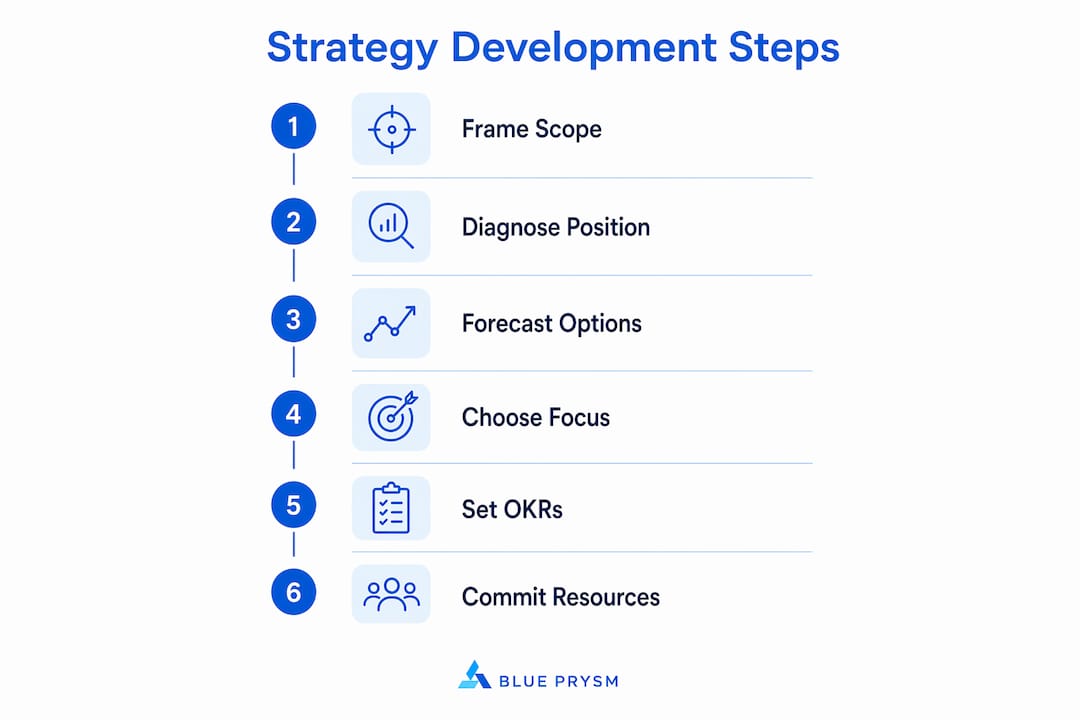
Step 5: Design initiatives and set OKRs
Map every initiative to one of your three to five strategic objectives. Each objective gets two KPIs: a leading indicator (activity or input) and a lagging indicator (outcome). Assign a single owner to each initiative. No owner, no initiative.
Step 6: Commit — resources, cadence, and pilots
Allocate budget and headcount. Set a 90-day pilot for your highest-risk initiative before full rollout. Establish a monthly review cadence for KPIs and a quarterly review for strategic assumptions.
Roles and responsibilities
| Role | Responsibility |
|---|---|
| Senior sponsor | Approves scope, resources, and final strategic choices |
| Strategy lead | Runs the process, synthesizes data, facilitates workshops |
| Data owner | Pulls and validates internal and market data |
| Delivery owner | Translates strategy into initiative plans and tracks execution |
Example 3-month timeline
| Month | Milestone |
|---|---|
| Month 1 | Frame, diagnose, and complete competitive analysis |
| Month 2 | Forecast alternatives, choose, and design initiatives |
| Month 3 | Launch pilot, set KPI dashboard, establish review cadence |
How do you turn strategy into day-to-day execution?
Strategy that lives in a slide deck is not a strategy. It is a presentation. The translation from choice to execution happens through KPIs, roadmaps, and resource allocation.
KPI examples mapped to strategic objectives:
- Customer objective (grow retention): KPI — monthly net revenue retention %, leading indicator — customer health score
- Financial objective (improve margin): KPI — gross margin by product line, leading indicator — cost per unit produced
- Operational objective (reduce time-to-market): KPI — average sprint cycle time, leading indicator — backlog completion rate
- Capability objective (build sales capacity): KPI — quota attainment %, leading indicator — pipeline coverage ratio
30/90/180-day roadmap template:
- Day 1–30: Complete diagnosis, finalize strategic choices, assign initiative owners, launch pilot
- Day 31–90: Run pilot, collect KPI data, hold first monthly review, adjust resourcing
- Day 91–180: Scale initiatives that passed pilot, retire or redesign those that did not, update 12-month roadmap
Resource allocation rules of thumb:
- Allocate the majority of discretionary budget to your primary strategic objective, a smaller portion to secondary initiatives, and a minimal amount to exploratory experiments. Size pilots as a modest fraction of the full initiative budget before committing the rest.
- Prefer contractors for time-bound diagnostic work; hire full-time for capabilities that are core to your competitive position
Which templates and tools speed up the strategy process?
The templates you need are not complicated. The discipline to use them consistently is the hard part.
Templates to build or download:
- One-page strategy brief (purpose, diagnosis summary, strategic choices, three objectives, six KPIs)
- SWOT worksheet with a scoring column for each factor
- Decision matrix for evaluating strategic options against your four stress-test criteria
- KPI dashboard template with leading and lagging indicators per objective
- 90-day roadmap with owners, milestones, and budget line
Tool categories that matter for small strategy teams:
- Market research: Google Trends, Statista, and industry-specific databases for sizing and trend data
- Competitive intelligence: Automated competitor tracking tools that surface pricing and positioning changes in real time (Blue Prysm’s competitive intelligence platform does this continuously)
- Roadmap and OKR trackers: Notion, Asana, or dedicated OKR platforms for cascading objectives to teams
- BI and KPI dashboards: Looker Studio or Power BI for connecting data sources to your KPI template
- Agentic AI assistants: Tools that run autonomous workflows for rapid market scans, hypothesis testing, and scenario simulation
When evaluating strategic planning AI tools, prioritize four things: data connectors (can it pull from your actual sources?), scenario simulation, collaboration features, and explainability of suggestions. A tool that gives you a recommendation without showing its reasoning is a black box, not a strategy partner.
Agentic AI helps most in three places: generating a first-pass market-scan summary in hours instead of weeks, running scenario simulations across your strategic options, and flagging competitor moves automatically so your assumptions stay current. The AI market opportunity analysis guide from Swipe Credit AI covers how small teams are using these workflows to compress the diagnosis phase significantly. The key is using AI as decision support, not as the decision-maker.
What mistakes kill a strategy before it launches?
Most strategy failures are not analytical failures. They are process and governance failures. Here are the traps we see most often.
Common pitfalls:
- Treating strategy as a budget exercise (allocating resources without making explicit choices about where not to compete)
- Unclear ownership — initiatives with two owners effectively have zero owners
- Mismatched incentives — asking managers to execute a strategy while their bonuses reward the opposite behavior
- Skipping stress tests and going straight from “we chose this” to “let’s build it”
- Underinvesting in pilots — running a full rollout before validating assumptions at small scale
Porter’s four stress-test checklist:
- [ ] Internal consistency: do all strategic choices reinforce each other, or do they pull in opposite directions?
- [ ] Environmental fit: does the strategy account for current and likely future market conditions?
- [ ] Resource fit: do you have the capital, talent, and capabilities to execute, or a credible plan to build them?
- [ ] Implementation feasibility: can middle managers translate this into concrete operational changes within 90 days?
How to design a minimum viable strategy test:
Pick your highest-risk assumption. Design the smallest experiment that would prove or disprove it in 30–60 days. If the assumption is “enterprise clients will pay a 30% premium for our new service tier,” run a five-client pilot at that price before building the delivery infrastructure. The implementation stress-test principle is clear: get middle managers to translate strategy into proximate operational changes first, then pilot them.
Red flags that should pause rollout:
- Two KPIs in your dashboard are pointing in opposite directions with no explanation
- No single named person owns a critical initiative
- Pilot unit economics are persistently negative after two adjustment cycles
- The team cannot articulate the strategy in one sentence
Pro Tip: Run a “pre-mortem” before launch. Ask the team: “It’s 12 months from now and this strategy failed. What went wrong?” The answers surface implementation risks that stress tests miss.
Key Takeaways
A business strategy is only as good as the process that built it and the governance that keeps it alive. Skipping diagnosis, skipping stress tests, or skipping pilots does not save time — it just moves the failure later and makes it more expensive.
| Point | Details |
|---|---|
| Start with diagnosis | Map where you create and destroy value before choosing any direction. |
| Use frameworks for their job | SWOT for diagnosis, Porter’s tests for validation, OKRs for execution. |
| Pilot before you scale | Test your highest-risk assumption at 10–15% of full budget before committing. |
| Assign single owners | Every initiative needs one named owner; shared ownership is no ownership. |
| Blue Prysm accelerates the cycle | Blue Prysm’s platform compresses market scanning, competitor tracking, and roadmap generation for small strategy teams. |
30/90/180-day checklist:
- 30 days: Complete diagnosis, choose strategic direction, assign owners, launch one pilot
- 90 days: Review pilot KPIs, scale what works, redesign what does not, hold first strategic review
- 180 days: Update 12-month roadmap, reallocate budget based on results, reset quarterly OKRs
Set a quarterly cadence to review your strategic assumptions. Markets shift, competitors move, and a strategy built on last year’s data is already behind.
The part nobody tells you about running this process in a real business
The frameworks are the easy part. The hard part is getting a team of twelve people who are already stretched thin to care about a strategy exercise that feels abstract to them.
What actually works is making the strategy feel proximate. Instead of presenting “Strategic Objective 3: Improve operational efficiency,” translate it for the ops manager into “We are going to cut order fulfillment time from five days to three days by September, and here is your specific role in that.” Proximate goals, as the implementation research consistently shows, drive execution in ways that abstract objectives simply do not.
The other constraint nobody budgets for is data quality. You cannot diagnose accurately with bad data. Before you run a strategy workshop, spend two weeks cleaning your customer segmentation data and reconciling your margin figures by product line. The workshop will be twice as productive.
And on time: a realistic strategy development cycle for a 20–50 person business is eight to twelve weeks of focused effort, not a two-day offsite. The offsite is useful for alignment and decision-making. The analytical work happens before and after it.
What Blue Prysm does for strategy teams that are short on time
Most small strategy teams do not have a dedicated analyst. They have a founder or a VP of Strategy who is also running three other things. That is exactly where Blue Prysm’s AI-powered market research tools change the math.
Blue Prysm compresses the diagnosis phase from weeks to days by running automated market scans, surfacing real-time competitor signals, and generating a first-pass scenario analysis your team can pressure-test rather than build from scratch. The strategy framework library gives you 95+ canvases, SWOT worksheets, and decision matrices ready to use. The market analysis platform keeps your competitive assumptions current after launch, so your quarterly reviews are based on live data, not memory.
If you want to see what a completed analysis looks like before committing, the sample venture analysis at blueprysm.com shows the actual output. Book a demo at blueprysm.com and bring your current strategic question. The team will show you exactly where agentic AI fits into your process and where it does not.
Useful sources for deeper reading
- How to Develop a Business Strategy: 6 Steps — HBS Online’s value-stick framework and step-by-step overview
- Mastering the Building Blocks of Strategy — McKinsey’s seven-stage model with governance guidance
- Write Your Business Plan — U.S. Small Business Administration’s practical guide to plan structure and format
- Competitive Strategy for Small Businesses — Shopify’s breakdown of differentiation and focus strategies for SMEs
- How to Formulate Effective Competitive Strategy — Porter’s four stress tests explained for practitioners
- How to Write a Business Plan in 10 Steps — Shopify’s guide to lean vs. traditional plan formats
- Blue Prysm Strategy Framework Library — 95+ downloadable canvases, SWOT worksheets, and decision matrices
- AI-Driven Business Insights for SME Strategy — Case-oriented guidance on using AI to prioritize initiatives
FAQ
What are the main types of business strategy?
Most frameworks converge on four: cost leadership, differentiation, focused cost leadership, and focused differentiation. A fifth, often added in practice, is a platform or ecosystem strategy for businesses that create value by connecting multiple user groups.
What are the 5 P’s of business strategy?
The 5 P’s, from Henry Mintzberg, are Plan, Pattern, Position, Perspective, and Ploy. They describe strategy as more than a document: it is also the pattern of decisions a company actually makes, the position it holds in the market, and the perspective that shapes how leaders see opportunities.
How long does it take to develop a business strategy?
For a 20–50 person business, a realistic strategy development cycle runs over several weeks, with time allocated to diagnosis, option selection, and initiative design before launching pilots.
What is the difference between a business plan and a business strategy?
A business strategy defines where and how you compete. A business plan documents the operational and financial detail needed to execute it, and is typically required for external funding. Strategy comes first; the plan operationalizes it.
How do you know if your strategy is working?
Track two KPIs per strategic objective: one leading indicator (an input or activity metric) and one lagging indicator (an outcome metric). If both are moving in the right direction after 90 days, the strategy is working. If they diverge, you have a diagnosis problem, not an execution problem.