

AI in SMBs is a strategic shift, not just a productivity hack
77% of U.S. small and midsize businesses now use AI regularly. That number alone tells you something important: this is no longer a “wait and see” conversation. The role of AI in SMBs has crossed from novelty into necessity, and the businesses treating it as a simple task-accelerator are already falling behind the ones using it to think differently.
The real shift is strategic. AI is changing what SMB leaders pay attention to, how they make decisions, and which competitive moves are even possible at their scale. Here is what that actually looks like in practice:
- Strategic decision-making: AI surfaces pricing signals, competitor moves, and demand patterns that no five-person team could track manually.
- Market insight: Real-time data analysis replaces the quarterly gut-check with something closer to continuous market intelligence.
- Operational redesign: AI does not just speed up existing workflows. It makes entirely new workflows possible.
- Capacity multiplication: One person with the right AI tools can now cover ground that previously required a department.
- Competitive leveling: SMBs can now access analytical horsepower that was previously reserved for enterprises with dedicated research teams.
83% of growing SMBs use AI compared to 55% of declining ones. That 28-percentage-point gap is not a coincidence. It is the clearest signal we have that AI adoption has become the defining growth indicator for small businesses right now.
How AI reshapes the way SMB leaders actually make decisions
Most SMB owners are running on incomplete information. They know their own numbers, they have a rough sense of the market, and they rely heavily on experience to fill the gaps. That worked when markets moved slowly. It is a liability now.

AI changes this by doing something human attention cannot: it processes signals from massive datasets simultaneously, without fatigue, and without the cognitive bias that makes us overweight recent events. Grant Freedman, President of Thryv, put it plainly: “Closing the gap between AI adoption and capability will be critical for Main Street success.”
The concept Grant Freedman and industry practitioners describe as Strategic Edge Architecture (SEA) captures this well. SEA is the idea that AI does not just answer questions you already know to ask. It detects weak signals, the early tremors before a market shift, that you would never have spotted by reading a monthly report. For SMBs, that translates directly into better pricing decisions, smarter market-entry timing, and fewer expensive surprises.
Sujay Saha, Founder and CEO of Cortico-X and former leader of PwC’s Digital and Customer Strategy practice, frames it this way: small businesses may actually be better positioned than larger competitors to act on AI-generated insight, precisely because they are not slowed down by legacy systems and approval layers.
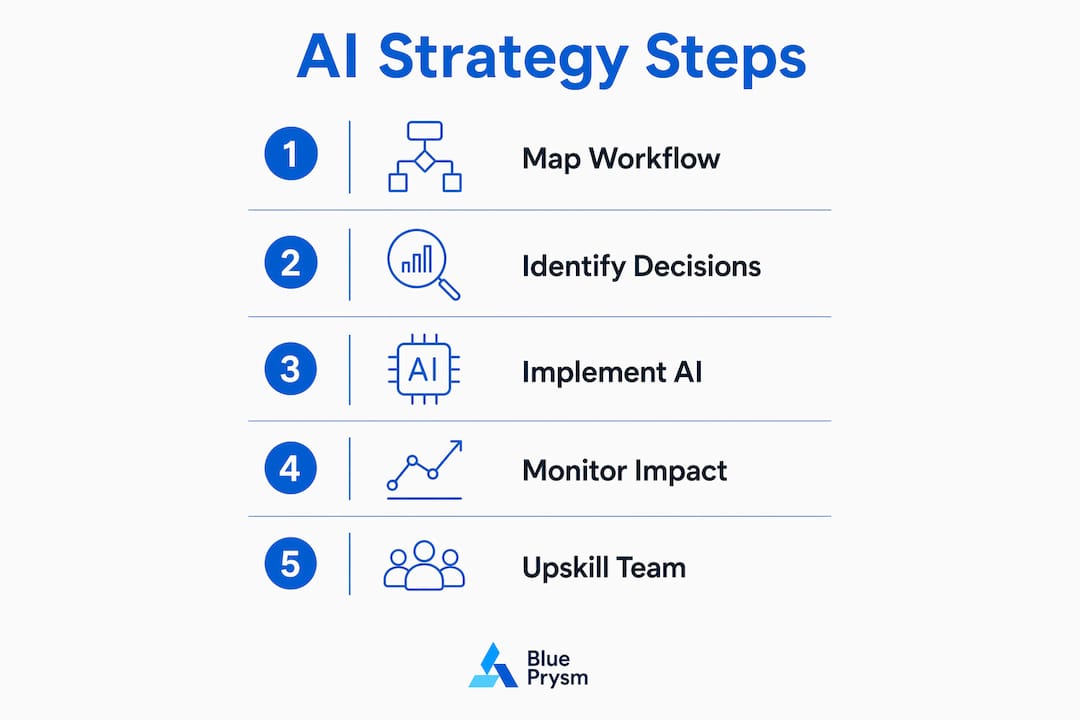
Pro Tip: Map your current decision workflow before you add any AI tool. Identify the three decisions that most affect revenue, then ask which of those currently relies on incomplete or delayed data. That is where AI-driven insight pays off fastest. Blue Prysm’s decision intelligence resources are a practical starting point.
Why “doing things faster” is the wrong goal for most SMBs
Here is the trap most small businesses fall into: they find an AI tool, they plug it into an existing process, and they celebrate the time savings. Faster invoicing. Faster email responses. Faster social posts. And then, six months later, they wonder why nothing has fundamentally changed.
Saha calls efficiency gains a “zero-sum game.” Speed up a broken process and you get a faster broken process. The businesses pulling ahead are the ones using AI to redesign the process entirely, not just accelerate it.
SMBs have a genuine structural advantage here. Unlike a large enterprise with years of legacy infrastructure and committees that must approve every change, a 20-person company can rebuild an entire customer onboarding workflow in a week. That flexibility is the competitive edge, and AI is what makes the redesign possible at speed.
Strategies to avoid the efficiency trap and actually use AI for competitive advantage:
- Audit the full journey first. Map the customer experience end to end before touching a single tool. Friction usually hides in the handoffs, not the tasks.
- Pick one “no-regret” area. Saha recommends starting with a clearly underperforming area rather than overhauling everything at once.
- Rebuild the workflow, not just the step. Swapping AI into one existing step is a patch. Redesigning the whole flow is a competitive move.
- Apply the same lens to employees. Customer journey redesign without employee journey redesign creates internal friction that cancels out the gains.
- Measure experience outcomes, not just speed. Track customer satisfaction and retention, not just task completion time.
The human-AI partnership: upskilling beats replacing
Let’s address the fear directly: most SMB owners are not trying to replace their people with AI. The data backs that up.
A substantial proportion of SMB owners say they would choose AI software over a new hire if both could perform the same task equally well, reflecting growing confidence in AI capabilities. But read that carefully: it is about equivalent task performance, not about eliminating the humans already on the team.
79% of SMB AI users expect to save between 11 and 60 hours per month via AI automation, according to Thryv’s 2026 AI and Small Business Adoption Survey.
What are those hours going toward? Strategic work. Relationship-building. The high-judgment calls that AI cannot make alone. A third of small business owners say AI lets them do more with fewer employees, but 55% hired the same number of people as planned over the past year. The story is not replacement. It is reallocation.
The skills gap is real, though. 70% of SMB owners admit they need more training to use AI effectively, a finding that aligns with a Goldman Sachs survey showing 73% of small businesses feel the same way. Upskilling is not optional. It is the difference between an AI investment that compounds and one that stalls.
How SMBs can put AI-powered strategic planning to work with Blue Prysm
Practical AI adoption for SMBs is not about buying the most sophisticated tool. It is about sequencing correctly.
| Capability | Traditional Method | AI-Powered Approach |
|---|---|---|
| Market analysis | Quarterly reports, manual research | Real-time signals, continuous monitoring |
| Competitor tracking | Periodic manual checks | Automated alerts on pricing and positioning shifts |
| Strategic planning | Consultant-led, infrequent | Ongoing, data-informed, team-accessible |
| Decision support | Experience and gut feel | Pattern recognition across large datasets |
| Workflow design | Process maps, static SOPs | Dynamic redesign informed by performance data |
Blue Prysm’s platform is built specifically for this sequencing challenge. It gives SMB leaders real-time market analysis and competitor tracking without requiring a dedicated analyst, plus a strategy library with 95+ frameworks to structure the decisions that AI surfaces.
Tips for SMBs starting AI-powered strategic planning:
- Start with data hygiene. AI outputs are only as reliable as the data going in. Clean your CRM and financial records before connecting any AI tool.
- Prioritize workflows with measurable ROI. Do not automate for automation’s sake. Pick the processes where a 20% improvement has a dollar value you can calculate.
- Set spending controls immediately. Unexpected AI running costs catch SMBs off guard. Hard daily API limits prevent token-burning from becoming a budget problem.
- Keep humans in the loop on high-stakes calls. Pricing, capital allocation, and hiring decisions need human judgment layered over AI output.
- Use a strategy framework, not just a chatbot. Blue Prysm’s strategy library gives structure to what AI surfaces, so insights become decisions rather than noise.
Colin Bowdery and the Blue Prysm team emphasize that the goal is not AI for its own sake. It is AI-enabled clarity: knowing where your market is moving before your competitors do, and having the frameworks to act on that knowledge fast.
What real SMB AI adoption looks like in practice
Audra Nasser, founder of Dinner Done, a Tampa-area prepared-meal company with about 15 employees, started using AI for social media captions. Within months, it became her de facto legal, HR, marketing, and strategic planning department. “All of a sudden, I felt like I had expert advice at my fingertips at 2 o’clock in the morning,” she said. That is not an efficiency story. That is a capability story.
Julio Fuentes, President and CEO of the Florida Hispanic Chamber, described the same dynamic: a two- or three-person shop using AI to perform the administrative, research, and communications work that a 40-person back office would handle at a larger competitor. The playing field is leveling, but only for the SMBs that actually deploy the tools with intention.
Challenges SMBs face when implementing AI and how to get past them
The barriers are real, and pretending otherwise does not help anyone.
The skills gap is the most cited obstacle. Seventy percent of SMB owners need more training, yet most are patching that gap with YouTube videos and ChatGPT prompts. That works for basic tasks. It does not work for strategic AI deployment. Structured upskilling, even a few hours per quarter, compounds faster than ad hoc learning.
Data readiness is the silent killer of AI projects. An AI tool connected to inconsistent, incomplete, or siloed data will produce confident-sounding wrong answers. Before any AI investment, audit what data you actually have and whether it is clean enough to trust.
Cost unpredictability trips up SMBs that do not set guardrails. Automated processes can generate thousands of unwanted outputs without spending controls, turning a $50/month tool into a $500 surprise. Set hard daily limits from day one.
Conflating tool adoption with strategy is perhaps the most expensive mistake. Buying five AI subscriptions is not an AI strategy. Sequenced planning that prioritizes workflows with measurable ROI and maintains human oversight is.
Ethical AI use is not a compliance checkbox for SMBs
Small businesses have something large enterprises often lose: direct relationships with their customers. That proximity makes ethical AI use both more personal and more consequential.
Nasser’s experience at Dinner Done illustrates this well. When an intern raised concerns about AI-generated content alienating younger customers, Nasser listened and established clear limits around AI-generated images and videos. The business decision was not about ethics in the abstract. It was about trust, and trust is a revenue variable.
For SMBs, responsible AI use means three concrete things. First, human oversight on any output that touches a customer relationship or a high-stakes decision. Second, transparency with your team about where and how AI is being used. Third, data privacy practices that match what your customers actually expect, not just what the minimum legal standard requires.
Ken Cook of The Prepared Group said it plainly: “The biggest mistake small businesses can make is blindly trusting AI. Use it only for tasks you already understand.”
Future AI trends SMBs need to prepare for now
Agentic AI is the next wave, and it is already here. Where current AI tools respond to prompts, agentic AI systems take sequences of actions autonomously, researching, drafting, scheduling, and executing across multiple platforms without a human triggering each step. Blue Prysm’s agentic capabilities at agentsente.blueprysm.com represent exactly this direction: AI that does not wait to be asked.
New U.S. business applications hit 5.6 million in 2025, up 24% since ChatGPT launched, according to Citadel Securities. AI is lowering the minimum viable scale of a business, meaning the revenue threshold at which hiring a specialist becomes economical is falling. SMBs that build AI fluency now will be positioned to operate at a scale that was previously impossible without significantly more headcount.
The SMBs that will win are the ones treating AI literacy as a core business competency today, not a future project.
Blue Prysm gives SMB leaders a real strategic edge
Most SMB owners do not need another subscription that promises to “transform” their business. They need something specific: a way to know what their market is doing, where competitors are moving, and which strategic bets are worth making, without hiring a team of analysts to find out.
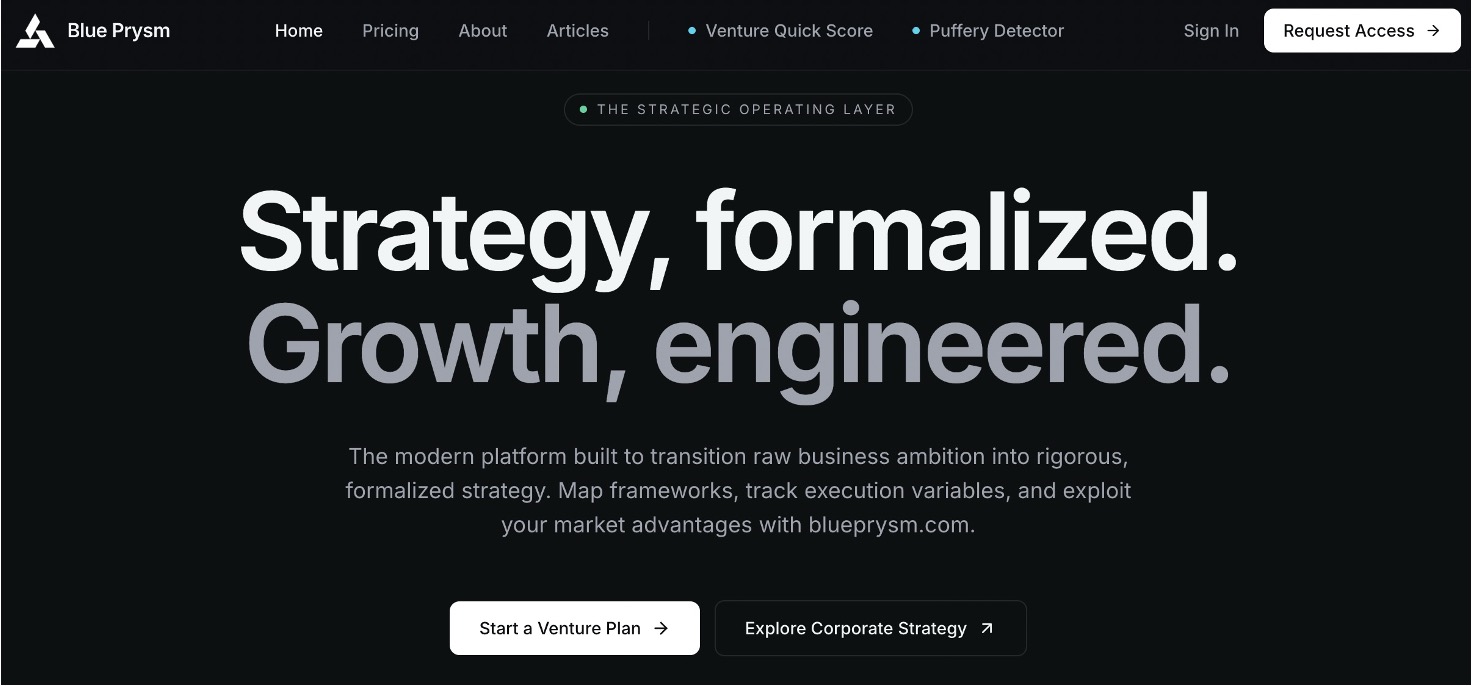
Blue Prysm is built for exactly that. The platform delivers real-time market research tools and competitive intelligence without the consulting retainer, giving founders and executives the kind of continuous market visibility that used to require a dedicated strategy function. The strategy library covers 95+ frameworks, so when AI surfaces an insight, you have the structure to act on it rather than just file it away. For SMBs that are serious about using AI for growth rather than just efficiency, the next step is straightforward: explore what Blue Prysm’s platform does for your specific market at blueprysm.com/market-analysis-platform.
FAQ
How does AI benefit small businesses beyond saving time?
AI helps SMBs make better strategic decisions by surfacing market signals, competitor moves, and pricing patterns that manual research would miss. AI helps SMBs make better strategic decisions by surfacing market signals, competitor moves, and pricing patterns that manual research would miss.
Will AI replace employees at small businesses?
The data says no, at least not at scale. Most SMBs are using AI to handle repetitive tasks so existing staff can focus on higher-value work, and 55% hired the same number of employees as planned over the past year despite increased AI use.
What is the biggest mistake SMBs make with AI?
Blindly trusting AI outputs and conflating tool adoption with actual strategy. AI works best when humans stay in the loop on high-stakes decisions and when adoption is sequenced around workflows with measurable ROI.
How can Blue Prysm help with AI-powered strategic planning?
Blue Prysm provides real-time market analysis, competitor tracking, and a 95+ framework strategy library, giving SMB leaders the market intelligence and decision structure that previously required a dedicated analyst or consulting firm.
How much should an SMB budget for AI tools?
Setting a hard daily spending limit is important to prevent automated processes from generating unexpected costs. The more important number is setting a hard daily spending limit to prevent automated processes from generating unexpected costs.
Key Takeaways
AI’s role in SMBs is fundamentally strategic: the 28-percentage-point gap in AI adoption between growing and declining SMBs confirms that treating AI as a core capability, not a convenience, is now the clearest predictor of small business growth.
| Point | Details |
|---|---|
| Growth correlation is stark | 83% of growing SMBs use AI versus 55% of declining ones, a 28-point gap that signals strategic necessity. |
| Upskilling beats replacing | 70% of SMB owners need more AI training; investing in skills compounds faster than adding subscriptions. |
| Efficiency traps are real | Automating a broken process just makes it break faster; redesign the full customer and employee journey instead. |
| Human oversight is non-negotiable | For pricing, capital allocation, and customer-facing decisions, AI output needs human judgment layered on top. |
| Blue Prysm for strategic clarity | Blue Prysm’s platform gives SMBs real-time market insight and competitive intelligence without a consulting budget. |
Recommended
- Gain a competitive advantage: Real-world AI examples for SMEs – Articles & Blogs
- AI strategies that actually build competitive advantage – Blue Prysm – Articles & Blogs
- AI-driven business insights for SME strategy and growth – Articles & Blogs
- Master the business decision making process for smarter growth – Articles & Blogs