

TL;DR:
- Win loss analysis involves studying recently closed deals through buyer interviews to uncover true decision criteria. Structured interviews and cross-functional ownership help turn insights into strategic actions that drive revenue growth. Relying solely on CRM data or limited interviews often leads to misinformed conclusions and missed opportunities.
Win loss analysis is defined as the systematic study of recently closed deals to uncover the real decision criteria buyers used, collected through structured interviews rather than CRM assumptions or rep gut feelings. Most sales teams think they know why they lose. They are usually wrong. Internal loss codes say “price” when buyers actually walked away over trust, product fit, or timing. The gap between what your team believes and what buyers actually experienced is where revenue leaks. This guide gives you the framework to close that gap, using structured buyer interviews, quantitative metrics, and cross-functional ownership to turn scattered feedback into decisions that stick.
What metrics drive win loss analysis results?
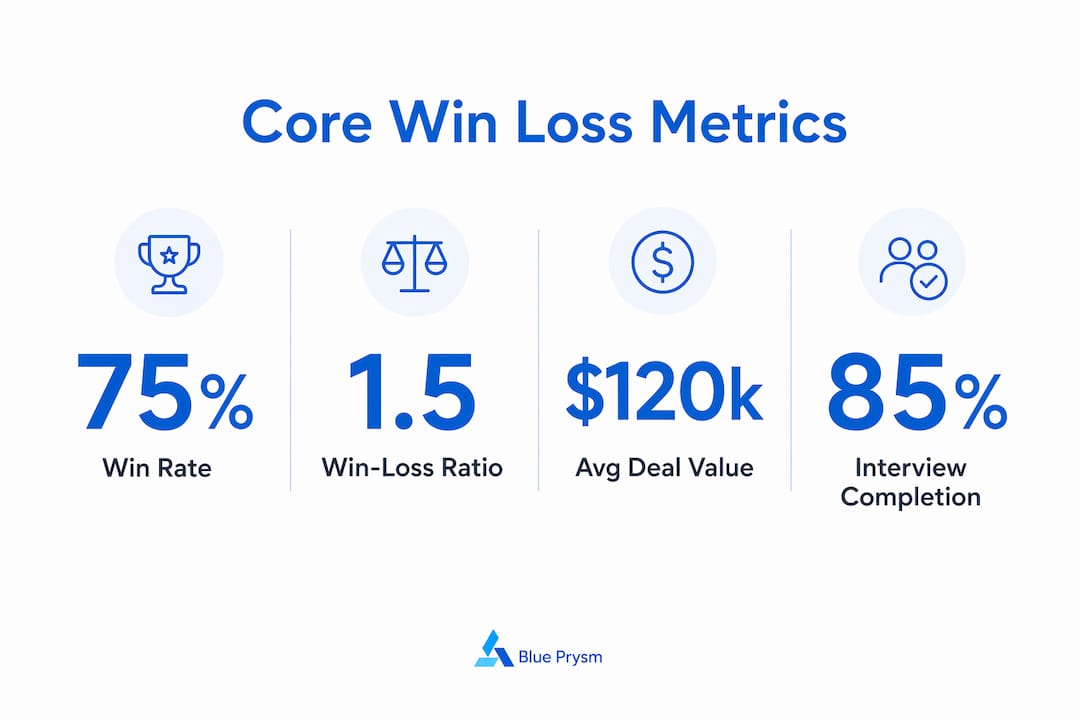
Three core metrics form the quantitative backbone of any serious win loss program: win rate, win-loss ratio, and deal velocity. Win rate measures overall conversion efficiency across your pipeline. Win-loss ratio compares your head-to-head performance against specific competitors. Deal velocity tracks how fast opportunities move from first contact to close, and slower velocity often signals friction that kills deals before pricing ever enters the conversation.
These numbers only tell you what happened. Buyer interviews tell you why.
The real power comes from segmenting these metrics across multiple dimensions:
- By rep: Identify whether low win rates reflect individual skill gaps or systemic product issues.
- By product line: Surface which offerings are genuinely competitive versus which need roadmap attention.
- By geography or segment: Reveal whether a messaging problem is regional or company-wide.
| Metric | What It Measures | What It Reveals |
|---|---|---|
| Win Rate | Overall pipeline conversion | Baseline sales efficiency |
| Win-Loss Ratio | Head-to-head vs. specific competitors | Competitive positioning gaps |
| Deal Velocity | Speed from first touch to close | Pipeline friction and process bottlenecks |
| Loss Reason Distribution | Coded categories from closed deals | Where CRM data diverges from buyer reality |
When you layer qualitative interview findings on top of these numbers, patterns emerge that no dashboard alone can surface. A rep with a low win rate against one competitor but strong overall numbers is a coaching opportunity, not a performance problem.
How do you conduct win loss interviews that actually work?
Effective buyer interviews last 20–30 minutes and must be conducted within 30–60 days post-close. Memory degrades fast. A buyer interviewed at day 90 gives you a reconstructed story. A buyer interviewed at day 20 gives you the actual decision.
Here is a proven structure for running these calls:
- Set context (3–5 minutes). Ask the buyer to walk you through their evaluation process from the beginning. Let them tell the story before you ask any directed questions.
- Explore vendor evaluation (10–12 minutes). Ask which vendors they considered, what criteria mattered most, and how they weighted those criteria. Never lead with your company.
- Identify the decision tipping point (8–10 minutes). Ask directly: “What was the single moment or factor that finalized your decision?” This is the most valuable question in the entire interview.
- Close with reflection (2–3 minutes). Ask what you could have done differently and whether they would consider you in a future evaluation.
A minimum of 15–20 completed interviews per quarter, balanced between wins and losses, produces statistically reliable patterns. Fewer than that and you are working with anecdotes, not data. Balance matters because interviewing only losses creates a distorted picture of what your best customers actually value.
Pro Tip: Tag every interview across at least four dimensions: competitor named, deal stage where momentum shifted, primary decision driver, and buyer role. Consistent tagging turns individual stories into comparable data patterns that guide coaching and battlecard updates.

Pricing issues may appear dominant in your CRM, but buyer interviews frequently reveal that product fit, implementation risk, or trust in the sales team were the actual tipping points. That distinction changes everything about how you respond.
What are the biggest pitfalls in win loss programs?
The most common failure mode is treating win loss analysis as a sales team reporting exercise. Relying solely on CRM loss codes or rep feedback produces misleading conclusions. Reps rationalize losses. Buyers tell you what actually happened.
Watch for these specific traps:
- Single-team ownership. When only sales owns the program, findings rarely reach product or marketing. Cross-functional ownership across sales, marketing, product, and enablement is the difference between insights that sit in a deck and insights that change behavior.
- Unstructured interviews. Open-ended conversations without a consistent framework produce anecdotes, not patterns. You cannot code what you cannot compare.
- Ignoring CRM discrepancies. When buyer feedback contradicts your internal loss reason codes, that is not noise. Those disagreements signal a taxonomy calibration problem, which means your battlecards and training materials are built on a flawed foundation.
- Slow feedback loops. Insights that take six months to reach the field are useless. The standard program timeline runs interviews between days 15–30, completes pattern analysis by day 60, and delivers team briefings before day 90.
Pro Tip: Assign a named owner for every insight category before the program launches. If no one owns “product gap findings,” those findings will never reach your product roadmap.
How do win loss findings translate into strategy?
Routing findings to clear owners in product, marketing, and sales leadership within 30 days is the single most important operational discipline in a win loss program. Unrouted insights rarely get acted on. The program loses credibility, and participation drops.
Here is how findings map to functional owners:
| Finding Type | Owner | Action |
|---|---|---|
| Competitor positioning gap | Marketing | Update battlecards and messaging |
| Product feature objection | Product | Prioritize roadmap item or build FAQ |
| Sales process friction | Sales Leadership | Update playbook and run coaching session |
| Pricing perception issue | Revenue Operations | Revisit packaging or sales narrative |
Quarterly reviews that incorporate win loss patterns keep your GTM strategy aligned with market realities rather than last year’s assumptions. Sales messaging drifts. Competitors evolve. A quarterly cadence forces recalibration before the drift becomes a revenue problem.
For ongoing competitive monitoring between interview cycles, tools like Blue Prysm’s competitive intelligence platform surface real-time competitor moves so your battlecards stay current without waiting for the next interview round. You can also use Blue Prysm’s market analysis platform to layer market signals on top of your buyer interview data, giving your strategy team a fuller picture of where the market is heading.
For teams building out their competitive battle cards, connecting interview-coded tipping points directly to card content is the fastest way to make those cards useful in the field rather than decorative.
Key takeaways
A disciplined win loss program requires structured buyer interviews, consistent data tagging, and cross-functional ownership to convert closed-deal feedback into decisions that improve revenue.
| Point | Details |
|---|---|
| Interview timing is critical | Conduct buyer interviews within 30–60 days post-close to preserve accurate recall. |
| Metrics need qualitative context | Win rate and deal velocity reveal what happened; buyer interviews explain why. |
| CRM data alone misleads | Internal loss codes frequently contradict buyer feedback, signaling broken taxonomies. |
| Cross-functional ownership drives action | Insights stall without named owners in product, marketing, and sales leadership. |
| Quarterly reviews prevent drift | Regular cycles keep sales messaging and competitive positioning aligned with market reality. |
Why most win loss programs fail before they start
I have seen this play out more times than I care to count. A sales leader commissions a win loss study, the team runs a handful of interviews, and a polished deck lands in the quarterly business review. Everyone nods. Nothing changes. Six months later, the same objections are killing the same deals.
The problem is not the data. The problem is that the program was designed as a reporting exercise instead of a decision-making system. The moment you treat win loss analysis as a one-team deliverable, you have already lost. The insights that matter most to your product team never leave the sales deck. The coaching opportunities that could fix your weakest reps never reach the enablement team.
What actually works is treating every tagged interview as a shared asset. When product, marketing, sales, and enablement all have access to the same coded buyer stories, the conversation shifts from “here is what we found” to “here is what we are changing.” That shift is the whole point.
The other thing I have learned: do not wait for a perfect sample size before acting. Ten well-tagged interviews with a consistent tipping-point question will tell you more than 50 unstructured conversations. Start small, tag consistently, and let the patterns accumulate. The step-by-step competitor benchmarking discipline applies here too. Rigor compounds over time.
— Colin Bowdery
Build a smarter win loss program with blue prysm
Running a disciplined win loss program means more than scheduling interviews. You need continuous competitive monitoring, a place to synthesize buyer patterns, and a way to share findings across your team without losing signal in translation.
Blue Prysm gives sales leaders and strategy teams the tools to do exactly that. The competitive intelligence software tracks competitor moves automatically, so your battlecards reflect current market reality between interview cycles. The market research tools help you synthesize buyer interview data into patterns your whole team can act on. If you are ready to turn closed-deal feedback into a repeatable strategic advantage, Blue Prysm is built for that work.
FAQ
What is win loss analysis in b2b sales?
Win loss analysis is the practice of interviewing buyers after deal closure to identify the real decision criteria behind wins and losses. It combines quantitative metrics like win rate with qualitative buyer feedback to improve sales strategy and competitive positioning.
How many interviews do you need for reliable results?
A minimum of 15–20 completed interviews per quarter, balanced between wins and losses, produces statistically reliable patterns. Fewer interviews produce anecdotes rather than actionable data.
How soon after a deal closes should you interview the buyer?
Interviews should be conducted within 30–60 days post-close. Buyer recall degrades quickly, and interviews conducted after 90 days produce reconstructed narratives rather than accurate decision stories.
Who should own the win loss analysis program?
No single team should own it exclusively. Cross-functional ownership across sales, marketing, product, and enablement is required to move insights from a report into actual strategic and coaching changes.
How does win loss analysis differ from a standard sales performance review?
A sales performance review measures rep activity and pipeline metrics. Win loss analysis goes deeper by capturing the buyer’s perspective on why a decision was made, surfacing competitive gaps and product objections that internal data cannot reveal.