


TL;DR:
- Strategic planning is a continuous cycle that transforms organizational vision into measurable priorities and accountability. Most plans fail quickly because companies treat strategy as an annual event rather than an ongoing process with regular reviews, resource adjustments, and correction points. Successful organizations focus on mission clarity, grounded analyses, limited priorities, aligned resource allocation, and disciplined quarterly evaluations to sustain strategic momentum.
Strategic planning is defined as a systematic process that converts organizational vision into measurable priorities, accountable owners, and a continuous execution rhythm. Most executives treat it as an annual retreat. That is the trap. Strategic planning works as a continuous cycle, not a calendar event, and the difference between those two approaches determines whether your plan survives contact with reality. This guide walks you through the strategic planning step by step process that actually holds up across quarters, using frameworks like SWOT, PESTLE, and OKRs to keep strategy grounded in data and connected to daily work.
What does strategic planning step by step actually look like?
The standard industry term for this process is strategic management, and it has five core phases: define direction, assess position, set priorities, execute with accountability, and revise with performance data. Each phase feeds the next. Skip one and the whole structure weakens.
The most common mistake we see is executives jumping straight from vision to execution. That gap is where plans die. A five-step continuous cycle outperforms the annual offsite model because it builds in correction points before problems compound. Think of it less like a project and more like a management operating system you run year-round.
How do you define mission, vision, and values as your foundation?
Your mission answers one question: why does this organization exist? Your vision answers a different one: where are we going in the next three to five years? Values answer a third: how do we make decisions when things get hard?
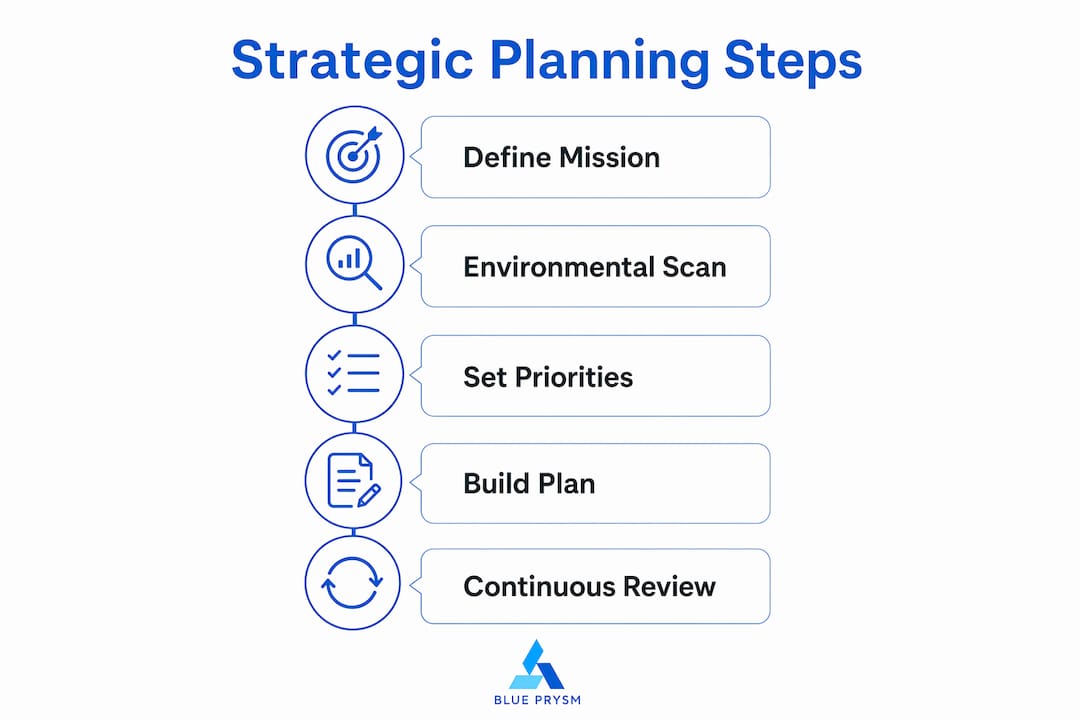
Mission and vision frame decision criteria and are critical for strategic agility. When your team faces a fork in the road, a clear mission eliminates half the options immediately. Without it, every decision becomes a debate.
Getting this right requires more than a leadership offsite. Run alignment sessions with your senior team, then pressure-test the outputs with frontline managers. If your mission statement cannot be explained in one sentence without a slide deck, rewrite it.
- Mission: defines organizational purpose in the present tense
- Vision: describes the future state you are building toward
- Values: set the behavioral standards that govern how you operate
Pro Tip: Write your mission statement, then ask three people outside your leadership team to explain it back to you. If their versions diverge, the statement is doing too much work.
How do SWOT and PESTLE work together in an environmental scan?
An environmental scan is the honest audit that sits between your mission and your priorities. It combines internal analysis (SWOT) with external analysis (PESTLE) to give you a complete picture of where you actually stand.
Expert frameworks recommend running both analyses before setting a single strategic priority. Here is how each component breaks down:
- Strengths: capabilities and assets you own that competitors cannot easily replicate
- Weaknesses: internal gaps, resource constraints, or process failures that limit performance
- Opportunities: market shifts, regulatory changes, or customer behavior trends you can exploit
- Threats: competitive moves, economic headwinds, or technology disruptions that could erode your position
- Political: government policy, trade rules, and regulatory shifts affecting your sector
- Economic: interest rates, inflation, consumer spending, and GDP trajectory for 2026
- Social: demographic shifts, workforce expectations, and changing buyer behavior
- Technological: AI adoption curves, automation risk, and platform disruption
- Legal: compliance requirements, data privacy laws, and employment regulation
- Environmental: supply chain sustainability pressures and climate-related operational risk
Pair your SWOT and PESTLE findings with current economic outlook data. A scan built on last year’s assumptions produces last year’s strategy.
| Analysis type | Focus | Primary output |
|---|---|---|
| SWOT | Internal and external factors | Prioritized capability gaps and market opportunities |
| PESTLE | Macro-environment | Risk-adjusted assumptions for planning |
| Combined | Full picture | Realistic strategic priorities grounded in evidence |
How do you set strategic priorities and translate them into goals?
Limiting strategic pillars to five is not a suggestion. It is a discipline. Common 2026 pillars include market expansion, customer retention, operational excellence, technology integration, and leadership development. Your five will differ based on your scan results.
Once you have your pillars, translate each one into goals using two complementary frameworks:
- SMART goals define what success looks like: Specific, Measurable, Achievable, Relevant, and Time-bound. Example: grow recurring revenue by 20% by Q4 2026.
- OKRs (Objectives and Key Results) break SMART goals into quarterly commitments with named owners and measurable key results.
| Framework | Best used for | Cadence |
|---|---|---|
| SMART goals | Annual strategic targets | Yearly, reviewed quarterly |
| OKRs | Quarterly execution commitments | 90-day cycles with weekly check-ins |
Every goal needs one owner. Not a team. One person whose name is attached to the outcome. Accountability without a named owner is just a wish list.

Pro Tip: If your leadership team cannot agree on five pillars, you have a prioritization problem, not a planning problem. Resolve it before you write a single goal.
How do you build and execute a plan that sticks?
Skipping resource allocation causes most strategic plan failures. Executives set ambitious goals and then leave budget and headcount decisions to the normal annual cycle. The two processes never connect. Your priorities must drive your budget, not the other way around.
Build tactical action plans that cascade from each strategic goal. Each action plan needs a budget line, a timeline, a named owner, and a definition of done. Without those four elements, it is not a plan. It is a good intention.
- Align headcount decisions to your five pillars before the fiscal year begins
- Use stage-gate governance to approve resource releases at defined milestones
- Connect each tactical action to a specific OKR so daily work traces back to strategy
- Review IT resource allocation alongside strategic priorities for technology-dependent goals
Pro Tip: Run a “strategy tax” check each quarter. Ask every team lead what percentage of their week goes toward the five pillars. If the answer is below 50%, your operations are running the strategy, not the other way around.
How do you monitor and revise your plan through continuous review?
Strategic plans often fail within 90 days when execution loses alignment with the original intent. A formal review rhythm prevents that collapse.
- Weekly: team leads check OKR progress and flag blockers
- Monthly: department heads review KPI dashboards and resource burn rates
- Quarterly: leadership scores each strategic pillar, revises assumptions, and resets OKRs for the next 90 days
The review cadence must match market volatility. A business in a fast-moving sector needs tighter loops than one in a stable industry. The goal is not just metric tracking. It is assumption testing. When the market shifts, your plan should shift with it, not wait for next year’s offsite.
Pro Tip: Score each pillar on a simple red/yellow/green system at every quarterly review. Red means the pillar needs a resource decision, not just a conversation.
Key takeaways
Effective strategic planning is a continuous management discipline, not an annual document, and it requires clear mission alignment, a grounded environmental scan, focused priorities, explicit resource allocation, and a structured review rhythm to succeed.
| Point | Details |
|---|---|
| Mission anchors decisions | Write a one-sentence mission that eliminates ambiguity when teams face hard choices. |
| SWOT plus PESTLE together | Run both analyses before setting priorities to avoid planning on outdated assumptions. |
| Five pillars maximum | Limiting focus to five strategic pillars prevents dilution and keeps teams accountable. |
| Resource allocation first | Align budget and headcount to priorities before execution begins, not after. |
| Quarterly review rhythm | Score each pillar every 90 days and revise assumptions based on real performance data. |
Why most strategic plans are dead before spring
I have sat in enough planning sessions to know the pattern. The leadership team spends two days at an offsite, fills a whiteboard with ambitious goals, and leaves energized. By march, the plan is a PDF no one opens.
The problem is not ambition. It is that we treat planning as a deliverable instead of a practice. The executives who get this right do one thing differently: they make the quarterly review non-negotiable. Not a check-in. Not a status update. A real governance meeting where assumptions get challenged and resources get reallocated.
The other thing I have learned is that accountability without consequence is theater. If a named owner misses a key result for two consecutive quarters and nothing changes, your OKR system is decorative. Leadership has to be willing to make the uncomfortable call.
The best strategic planning guides all say the same thing in different ways: strategy is a verb, not a noun. The organizations that win are the ones that treat it that way every week, not just in january.
— Colin Bowdery
How Blue Prysm supports your planning process
Running a complete environmental scan, tracking five strategic pillars, and maintaining a quarterly review rhythm takes real infrastructure. Most small and mid-sized businesses do not have a dedicated strategy team to build that infrastructure from scratch.
Blue Prysm gives executives and entrepreneurs access to AI-powered market research tools and competitive intelligence that feed directly into SWOT and PESTLE analyses. The platform’s strategy library includes 95+ frameworks, from Porter’s Five Forces to the Business Model Canvas, so you are not building from a blank page. Real-time market briefings keep your assumptions current between quarterly reviews. If you want to see how it fits your planning process, the sample intelligence briefing is a good starting point.
FAQ
What is the first step in strategic planning?
The first step is defining your mission, vision, and values. These statements anchor every subsequent decision and prevent strategic drift as priorities shift.
How many strategic priorities should a plan have?
Expert frameworks recommend a maximum of five strategic pillars. More than five dilutes focus and makes accountability nearly impossible to maintain.
How often should you review a strategic plan?
A formal review rhythm should include weekly OKR check-ins, monthly KPI reviews, and quarterly leadership scoring sessions that reassess assumptions and reset priorities.
What is the difference between SMART goals and OKRs?
SMART goals define annual strategic targets with clear success criteria. OKRs break those targets into 90-day commitments with named owners and measurable key results tracked weekly.
Why do most strategic plans fail?
Plans most often fail within 90 days because resource allocation is not tied to priorities and there is no formal review rhythm to catch misalignment before it compounds.