


Pricing strategy frameworks are structured methods for setting and adjusting what you charge, built around five levers: value-based, cost-plus, competitive, dynamic, and tiered/usage models. The right choice isn’t the most sophisticated one. It’s the one that matches how your customers perceive value, what your market signals are telling you, and what your operations can actually support without breaking.
TL;DR:
- Pricing frameworks must align with customer willingness-to-pay and operational capabilities, not just be the most complex or popular option.
- Value-based pricing suits products that solve measurable business problems and where buyers can articulate their ROI clearly.
- Dynamic and usage-based pricing models work best in volatile markets or for products with unpredictable consumption patterns, but require real-time data infrastructure.
- Selecting a framework depends on the market characteristics shaped by the 5 C’s: Costs, Customers, Competition, Channels, and Company objectives.
- Implementing a pricing strategy effectively requires structured research, tiered packaging, clear governance, and ongoing measurement rather than one-time changes.
What Are the Main Pricing Strategy Frameworks?
Most product managers treat pricing as a single decision. It isn’t. It’s a stack of frameworks, and picking the wrong one for your context is how you end up discounting your way to a mediocre year. Here’s what each actually does, and where it earns its keep.
Value-based pricing starts with what the customer would pay if you never told them your costs. You estimate willingness-to-pay through interviews, conjoint analysis, or Van Westendorp surveys, then price against the value delivered, not the effort spent building it. This works best when your product solves a quantifiable business problem (time saved, revenue generated, risk avoided) and worst when buyers can’t articulate that value themselves.

Cost-plus pricing takes your unit cost and adds a margin. It’s fast, defensible in a boardroom, and almost always leaves money on the table because it ignores what customers are actually willing to pay. It’s pragmatic for commoditized goods or regulated industries where margin caps exist, but it’s a poor default for software or services with differentiated value.
Competitive or market-based pricing benchmarks against rivals and positions relative to them. It keeps you from pricing yourself out of consideration, but over-rotating on competitor prices is how entire categories race to the bottom together.
Dynamic pricing adjusts in real time based on demand, inventory, or timing. It requires real data infrastructure and, done carelessly, reads as exploitative. Framing changes as dynamic discounting, where variable pricing looks like a discount off a stable anchor rather than a surcharge, preserves trust far better than raw surge pricing.
Beyond these core approaches, several model variants solve specific packaging problems:
- Tiered pricing segments buyers by feature access, simplifying the sales conversation but risking awkward gaps between tiers.
- Subscription models create predictable recurring revenue but demand strong retention to justify the acquisition cost.
- Usage-based pricing aligns cost with consumption, which buyers love until usage spikes unpredictably and budgeting gets hard.
- Freemium drives adoption at scale but converts a frustratingly small share of users unless the free tier is deliberately limited.
- Skimming and penetration are launch tactics: skimming captures early adopters at a premium, penetration buys market share by pricing low and raising later.
BCG’s Strategic Pricing Hexagon is a useful organizing lens here. It maps these approaches to seven distinct “pricing games”, each suited to different market characteristics, rather than treating pricing as one universal formula.
How Do You Choose the Right Pricing Framework?
Stop asking “which framework is best” and start asking “what does my market actually look like.” The answer comes from five inputs consultants call the 5 C’s of pricing: Costs, Customers, Competition, Channels, and Company objectives. Each one filters out frameworks that don’t fit.
- Costs. Know your true unit economics, including support and onboarding overhead. If margins are razor-thin, cost-plus becomes a floor even if you price above it using value signals.
- Customers. Segment by willingness-to-pay and by how easily they can articulate the value you deliver. Buyers who can quantify ROI are candidates for value-based pricing; buyers who can’t need simpler, comparison-friendly tiers.
- Competition. Map not just prices but positioning. A crowded, undifferentiated market pushes you toward market-based pricing or aggressive penetration; a category you’re defining gives you room for value-based pricing.
- Channels. Direct sales support negotiated, value-based deals. Self-serve and product-led motions need transparent, simple pricing that doesn’t require a call to explain.
- Company objectives. Growth-stage companies chasing market share often accept thinner margins through penetration pricing. Mature companies optimizing profitability lean toward value-based or tiered models that protect margin.
Run a quick market-characteristics check alongside the 5 C’s: how volatile is demand, are you capacity-constrained, how differentiated is your offering, and how price-sensitive is your buyer? BCG’s pricing games framework maps these answers to specific games: Value and Custom games fit differentiated, low-competition markets; Cost and Uniform games fit commoditized, capacity-unconstrained ones; Dynamic games fit volatile demand with strong data capability.
For B2B and SaaS specifically, a few rules of thumb hold up consistently. If your buyer is a committee, value-based framing with clear ROI math wins more deals than aggressive discounting. If your product is usage-heavy and unpredictable, usage-based pricing reduces sticker shock better than flat tiers. And if you’re underpricing early to win logos, know that raising prices later is socially costly. Every existing customer notices, and grandfathering clauses become permanent liabilities if you don’t plan for them from day one.
How Do You Implement a Pricing Framework Step by Step?
Choosing a framework is the easy part. Operationalizing it without breaking sales momentum or customer trust is where most teams stall. Here’s a sequence that works.
- Set objectives and KPIs first. Decide whether you’re optimizing revenue, margin, churn, net revenue retention, or win rate, because these can pull in opposite directions and you need a tiebreaker before you start.
- Collect your inputs. Build a real cost structure, run buyer interviews, scan competitor pricing pages, and map any channel constraints (reseller margins, marketplace fees) that limit your flexibility.
- Run structured buyer research. Van Westendorp price sensitivity surveys ask buyers at what price a product feels too cheap, a bargain, expensive, or too expensive, giving you a workable price band. Conjoint analysis goes further, isolating which features actually drive willingness-to-pay when bundled differently. Use Van Westendorp for a fast directional read; use conjoint when you’re redesigning tiers and need to know which features to bundle where.
- Design packaging and anchors. Build three tiers minimum, with a middle tier deliberately positioned as the “obvious” choice through feature framing, not just price. Anchor high with your top tier so the middle looks reasonable by comparison.
- Pilot before you roll out. Test with a holdout group and measure actual business metrics, not just conversion. Watch margin and churn alongside sign-up rate.
- Set discount policy and communicate the rollout. Define who can approve what discount level, cap maximum discretion, and give your sales team a clear script for why the price changed.
Pro Tip: Never test a new price on your entire customer base at once. Run it on new signups first, measure for at least one full sales cycle, and only migrate existing customers once you’ve confirmed the model holds up under real buying behavior, not just survey answers.
Who Owns Pricing, and How Do You Measure It?
Pricing decisions fail when nobody owns them and everyone can override them. Set a governance model where product marketing or a dedicated pricing lead owns the framework, sales leadership owns discount approval within defined guardrails, and finance signs off on floor prices. Nobody below a set threshold should have unilateral discount authority.
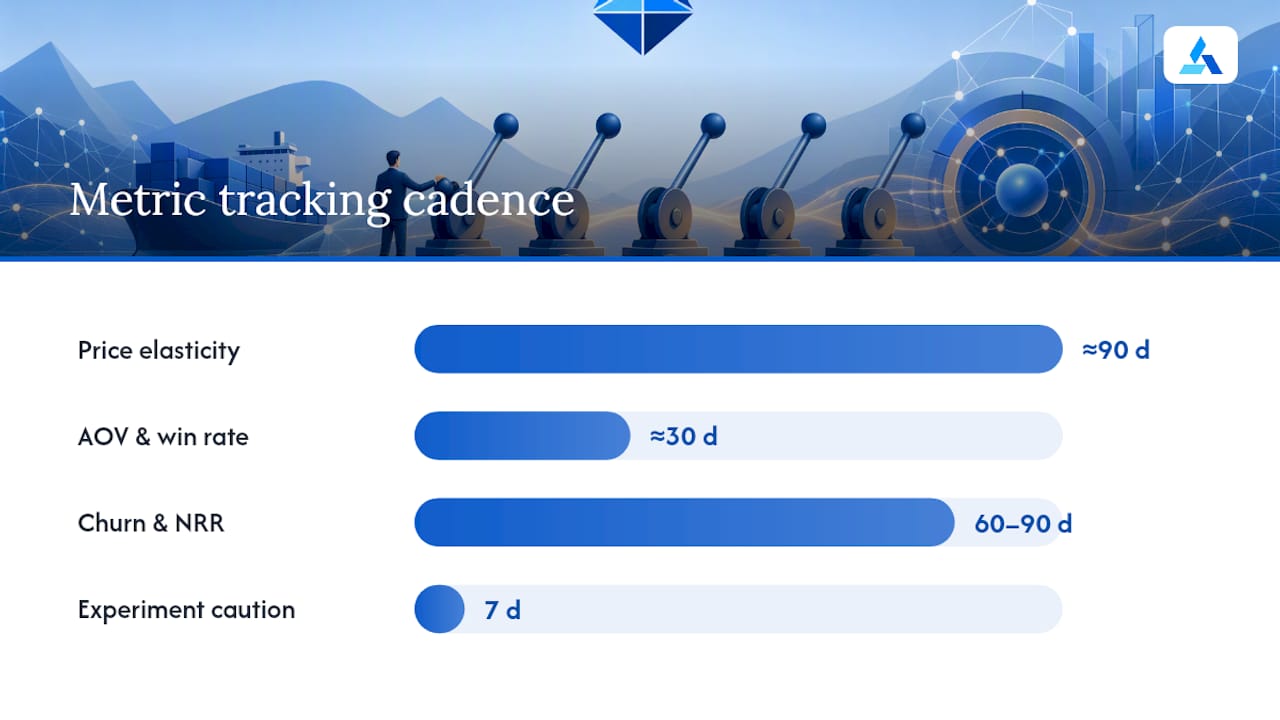
Track these metrics on a recurring cadence, not just at launch:
- Price elasticity by segment or SKU, updated quarterly as you accumulate pilot data.
- Average order value and win rate, reviewed monthly against target.
- Churn and net revenue retention, watched closely for 60 to 90 days after any pricing change.
- Gross margin by tier, to catch a popular tier that’s quietly unprofitable.
When you run a pricing experiment, use holdout groups and measure real business outcomes like revenue per account and margin, not just click-through or conversion. Shopify’s guidance on situational pricing notes that effective pilots report elasticity per segment specifically so future automation has something reliable to learn from. The most common pitfall is calling a test valid after a week of data when the sample size or seasonality hasn’t stabilized yet.
Trigger a full strategy review when a new competitor enters at a meaningfully different price point, when churn climbs for two consecutive quarters, or when a new product line no longer fits your existing tier structure.
What Technology Do You Need to Automate Pricing?
You don’t need a full stack on day one, but you should know what each layer does before you buy anything. A CPQ tool (configure, price, quote) handles quote generation and approval workflows for sales-led deals. A pricing intelligence platform tracks competitor pricing changes automatically instead of relying on manual spreadsheet checks. Dynamic repricing engines adjust prices algorithmically based on demand or inventory signals, and a BI layer ties pricing data back to margin and retention reporting.
Realistic timelines matter here. SAP’s research on pricing flexibility points to data quality and change management, not missing software, as the actual barrier most companies hit. Before automating anything, make sure your cost and usage data is clean.
If you’re building AI-driven repricing, set hard guardrails: price floors and ceilings, exclusion rules for certain accounts or products, and transparent framing so customers understand why a price moved. For most small and mid-sized teams, buying a lightweight pricing intelligence tool and integrating it with existing CRM data beats building custom infrastructure from scratch.
How Blue Prysm Supports Pricing Strategy Execution
Blue Prysm accelerates the research-heavy front half of this playbook: competitor price tracking, market signal monitoring, and scenario modeling that would otherwise take weeks of manual spreadsheet work. The strategy library includes over 95 frameworks, so pricing decisions connect to your broader positioning rather than living in isolation. Real-time market insights and transparent, published pricing mean you’re evaluating a tool built the same way it recommends you build your own pricing: openly. This article is written under Blue Prysm’s editorial standards by Colin Bowdery.
Author Perspective: Pragmatic Lessons From Implementing Pricing
The two mistakes I see most: teams pick a framework because it’s fashionable, not because it fits their buyer, and teams treat a pricing launch as a one-time event instead of an ongoing experiment. Bold pricing moves need governance underneath them, not instead of them. Run something small, measure it honestly, and let the data argue for the bigger change.
— Colin Bowdery
Get Your Pricing Research Moving This Week
If you’ve been running competitor price checks in a spreadsheet and buyer interviews on an ad hoc basis, you already know how slow that path is compared to what this playbook demands. Blue Prysm is built for exactly this gap: it turns the research and scenario-modeling steps in this article into a live workflow instead of a quarterly scramble.
The market analysis platform gives you real-time competitor pricing signals and scenario tools so you can test a value-based or tiered model before committing to a full rollout. Pair that with the competitive intelligence tracking to automate the benchmarking step from Section 2, or if you’re still deciding between tiered and usage-based packaging, the partner guide on SaaS pricing strategy for founders and PMs is a solid companion read. Start a trial and run your first pricing scenario this week.
Sources
- The unified theory of pricing — BCG
- Dynamic discounting: how to do dynamic pricing right — Wharton/Knowledge
- Dynamic pricing: the art and black magic of situational pricing — Shopify
- How to develop and optimize a B2B pricing strategy — Stratridge
FAQ
What Are the Most Common Types of Pricing Strategies?
The most common types are value-based, cost-plus, competitive/market-based, dynamic, penetration, price skimming, and freemium pricing, each suited to different combinations of differentiation and price sensitivity.
What Are the Five Major Categories of Pricing Strategies?
The five major categories are value-based, cost-based, competition-based, dynamic, and tiered or subscription pricing, which most consulting frameworks treat as the core building blocks.
What Are the Four Main Types of Pricing Strategies?
When narrowed to four, most frameworks point to value-based, cost-plus, competitive, and dynamic pricing as the foundational approaches that other models build on.
What Are the 5 C’s of Pricing?
The 5 C’s are Costs, Customers, Competition, Channels, and Company objectives, the standard inputs used to diagnose which pricing framework fits a given business.
How Does Blue Prysm Help With Pricing Research?
Blue Prysm’s market research tools automate competitor tracking and market signal monitoring, replacing manual spreadsheet work with real-time data for willingness-to-pay analysis.