

The right OKR training for managers combines a live, cohort-based certification with real workshop facilitation practice, not a slide deck you click through once. Managers who complete that combination can walk out and run a two to three hour team OKR workshop from scratch, then lead weekly check-ins with confidence scoring instead of vague status updates. A tool like Blue Prysm can pair that training with execution tracking so the habit outlives the course.
TL;DR:
- Effective manager OKR training combines live, cohort-based facilitation practice with real workshop experience to build practical facilitation skills.
- The core curriculum covers key skills like writing clear Objectives, measurable Key Results, and running weekly check-ins within a structured, testable framework.
- Choosing the right program requires focus on facilitator credentials, practical deliverables, post-course support, and avoidance of vague, marketing-heavy promises.
- Running successful workshops involves pre-work, honest review of past cycles, collaborative drafting, voting, and clear assignment of ownership with scheduled cadences.
- Certification mainly proves attendance unless it includes assessed, practical assignments, and ongoing behavior change depends on reinforcement through coaching and follow-up tools.
Training Paths For Managers: Self-Paced, Live Cohorts, Coaching, And Workshops
Most managers assume “OKR training” means one thing. It doesn’t. Four distinct paths exist, and picking the wrong one wastes budget without changing how your team actually sets goals.
- Self-paced certificates. Courses like Coursera’s OKR Certification: Leadership and Goal Setting cover writing objectives, aligning strategy, and grading cycles, and can be completed in a few days to a few weeks depending on the assignments you commit to.
- Live cohorts. Programs such as the OKR Institute’s leadership certification run multi-level sessions over several weeks, mixing e-learning with live, coached practice and an exam at the end.
- External coaching. One-on-one or small-group coaching runs on a shorter, denser schedule and works best when you already know the framework but need someone correcting your facilitation habits in real time.
- Internal train-the-trainer workshops. A single certified manager or consultant runs a session for your leadership team, producing a shared playbook in a single afternoon instead of a personal certificate.
Self-paced fits a solo manager on a tight budget who needs the vocabulary before a bigger rollout. Live cohorts fit managers responsible for leading OKR adoption across multiple teams, since the coached practice is what separates a manager who understands OKRs from one who can facilitate them. Internal workshops fit teams under 15 people who need alignment fast and don’t need individual certificates. Coaching fits managers who already ran a cycle, watched it stall, and need a second pair of eyes on why.
Core Curriculum Managers Should Expect
A credible manager-focused program is not “OKRs in an hour.” It builds toward specific, testable abilities, and you should be able to name what you produced by the end of each module.
- OKR fundamentals and history: you can explain the difference between an Objective and a Key Result without notes.
- Writing objectives: you draft a qualitative, inspiring Objective and it survives the pub test, meaning a peer understands it aloud on first hearing.
- Measurable Key Results: you attach a start value and a target value to each KR instead of a task disguised as a metric.
- Alignment and cascade: you map a team-level Objective back to a company priority and can defend the link in one sentence.
- Check-in cadence: you run a weekly confidence-scoring conversation in under 15 minutes per Objective.
- Grading and retrospectives: you score a quarter honestly, including the misses, and extract one lesson for the next cycle.
- CFRs (conversations, feedback, recognition): covered in most leadership tracks, including Coursera’s program, as the human layer that keeps OKRs from becoming a compliance exercise.
- Integration with performance reviews: you know where OKR grading should and should not touch compensation conversations.
Programs worth the money layer graded assignments and sample playbooks onto these modules rather than just lecturing through them.
Pro Tip: Ask any program for a sample deliverable before you enroll. If they can’t show you an actual filled-in OKR worksheet from a past cohort, the “practical” claim in their marketing is probably empty.
How Do You Choose The Right OKR Training Program?
Run every OKR workshop pitch you see through a basic puffery detector before you hand over a training budget: if the promise (“transform your team overnight”) has no mechanism attached, it’s marketing, not method. Use this checklist instead.
- Manager focus, not employee-onboarding filler. The syllabus should center on facilitation and coaching skills, not just personal goal-setting.
- Live practice, not just video. Ask whether you’ll draft and defend a real Objective in front of coached feedback, the way OKR Institute’s cohort model structures its sessions.
- Facilitator credentials. Ask who is teaching the live sessions and what organizations they’ve actually run OKR rollouts inside.
- Detailed syllabus. A vague “module 3: alignment” line is a red flag; you want named deliverables per module.
- Practical deliverables. Request a sample of the worksheets, playbooks, or scorecards graduates walk away with.
- Post-course support. Ask if there’s a check-in, community, or coaching add-on after the certificate, or if support ends the day you pass the exam.
- Transparent time and pricing. Get exact hours and total cost upfront; hourly cost hidden inside a “bundle” price is a sign of low confidence in the actual content.
Red flags: no named instructor, no sample deliverable available on request, and language about “revolutionizing” your goal-setting with no facilitation practice behind it.
How To Run An Effective Manager OKR Workshop
Certification teaches you the framework. A workshop is where you actually apply it with your team, and it only works if you treat it as a structured event, not a meeting.
- Send pre-work. Ask each participant to bring their team’s biggest priority for the quarter and a rough sense of last quarter’s wins and misses. Leadership should hand down the company-level priorities before the room fills up.
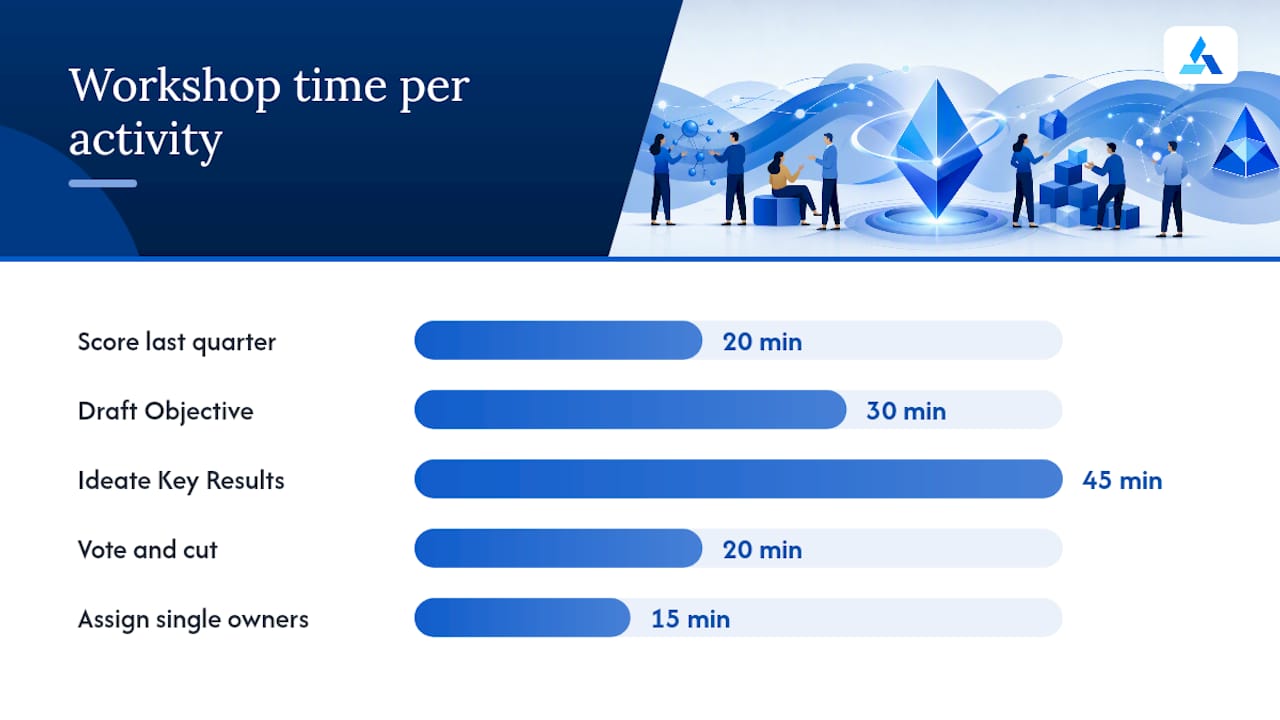
- Score last quarter (20 minutes). Grade the prior cycle’s OKRs honestly before writing new ones. Skipping this step is how teams repeat the same vague goals every quarter.
- Draft the Objective (30 minutes). Write one qualitative, inspiring statement per team and run it through the pub test: say it out loud to someone outside the room and see if they understand it immediately.
- Ideate Key Results (45 minutes). Brainstorm broadly, then narrow to roughly three KRs per Objective, each with a start value and a target value, per the step-by-step OKR workshop agenda.
- Vote and cut (20 minutes). Use dot-voting so the loudest voice in the room doesn’t automatically win; equal voice produces better KRs than seniority does.
- Assign single owners (15 minutes). Every KR gets one named owner, never a team, and that owner schedules the first check-in before anyone leaves the room.
- Publish and calendar the cadence. Post the OKRs somewhere visible and lock in weekly confidence-scoring, a formal Week 4 check-in, and an end-of-quarter retrospective.
Two to four hours covers this for a single team. Longer sessions with multiple teams need more time for cross-team alignment conversations.
Pro Tip: Schedule the Week 4 check-in before the workshop ends, not after. Teams that leave the room without a calendar invite almost always let the OKRs go quiet by week three.
What Does Certification Actually Prove?
A certificate mostly verifies attendance unless it’s paired with graded, real-world assignments. OKR Institute’s professional certification and similar programs distinguish themselves by requiring practical work, not just a passed quiz.
Judge a certificate on three things: who issued it, whether you had to complete assessed assignments to earn it, and whether employers in your industry actually recognize the name. A certificate with no practiced skill behind it carries little weight internally, no matter how polished the logo looks.
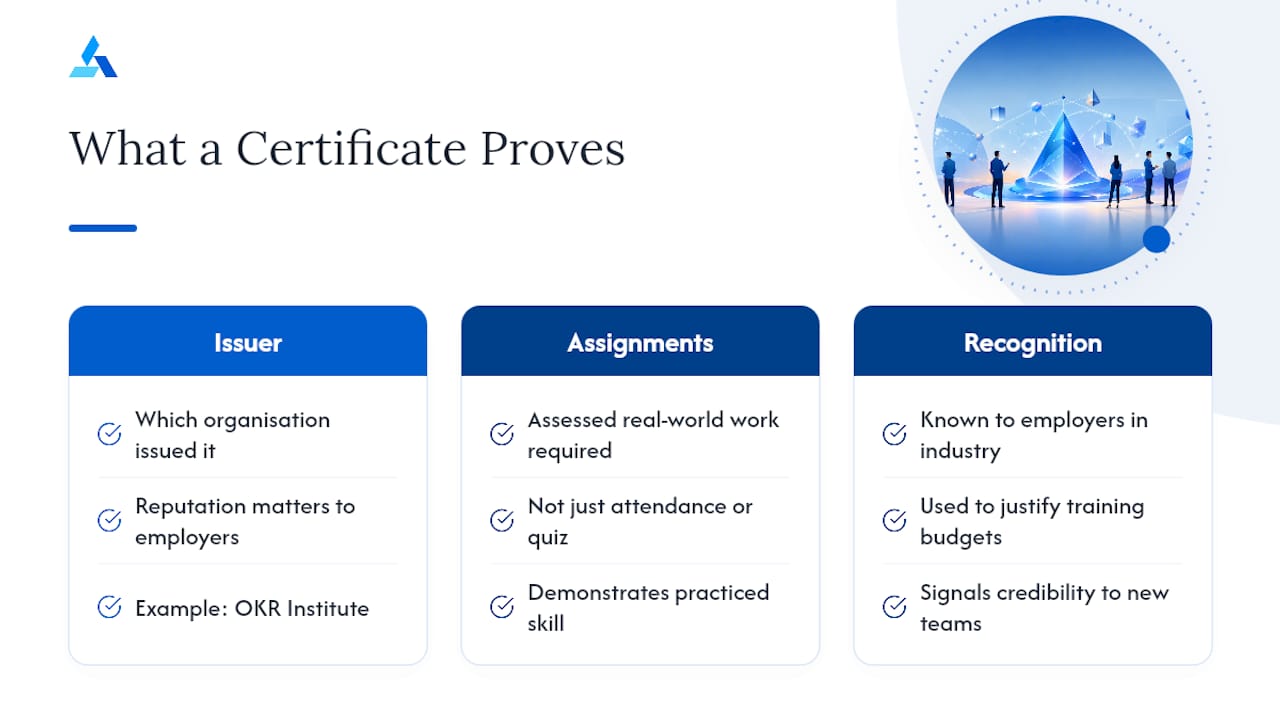
Certification matters most when you need to signal credibility to a new team or justify a training budget to your own leadership. Coaching matters more once you already have the credential and the real problem is a specific team that keeps writing task lists disguised as Key Results.
The One Change That Makes OKR Training Stick
Most OKR training fails for the same reason most gym memberships fail: the instruction was fine, but nothing forced the behavior to repeat. Slides teach vocabulary. Only coached, repeated practice, backed by a cadence that someone else enforces, turns “I understand OKRs” into “I ran four straight quarters of them without letting the process die by week six.”
Training design should live inside the manager’s actual week, supported by coaching accountability software that helps sustain the behavior rather than sitting next to it as a course they finished once. That’s the gap between a certificate on a wall and confidence scores updating every Monday. Weigh any program’s alumni outcomes and case studies against that standard before you enroll.
— Colin Bowdery
Blue Prysm: Where OKR Training Meets OKR Execution
Blue Prysm is the direct alternative to buying a certificate and a spreadsheet separately. Most managers finish OKR training with the framework in their head and no system enforcing it, which is exactly how the “set-and-forget” failure mode described earlier creeps back in by week six.
Blue Prysm’s OKR and KPI tracking sits inside the same platform as its 95+ business strategy framework library, so the objectives you draft in a workshop connect to real-time market data instead of a guess about what “aggressive but achievable” means. Execution dashboards handle the weekly confidence scoring the workshop agenda calls for, and competitive intelligence tracking feeds your Key Results with numbers pulled from the market, not from memory. Consulting engagements and cohort training round it out for managers who want live facilitation practice alongside the tooling. Start with a look at how the platform works and see where your next OKR cycle could plug in.
Sources
- OKR Certification: Leadership and Goal Setting — Coursera
- OKR LEADERSHIP CERTIFICATION (C-OKRL®) — OKR Institute
- How to run an OKR workshop: my step by step agenda | OKR Quickstart
FAQ
What Are The 5 Elements Of OKRs?
Most frameworks point to Objectives, Key Results, alignment across teams, a regular check-in cadence, and CFRs (conversations, feedback, recognition) as the core elements a manager needs to run a cycle end to end.
Are OKRs Still Relevant For Managers In 2026?
Yes. Cohort-based leadership certifications like OKR Institute’s program continue expanding specifically because managers, not just employees, need structured coaching to lead adoption.
What Training Do Managers Actually Need To Implement OKRs?
Managers need a program with live facilitation practice, not just video lectures, plus a workshop agenda with pre-work and a scheduled follow-up cadence like a Week 4 check-in.
What’s The Difference Between OKRs And KPIs?
OKRs pair a qualitative, inspiring Objective with a small set of measurable Key Results tied to a specific quarter, while KPIs are ongoing metrics that track the health of a process without an expiration date.
How Long Does OKR Training For Managers Typically Take?
Self-paced certificates can run a few days to a few weeks depending on assignments, while live cohort certifications typically span multiple weeks of scheduled sessions plus coached practice.