


Hire a strategy consultant when your leadership team faces a decision it cannot reframe from the inside, whether that is a stalled growth curve, a competitive shock, or a high-stakes bet like a merger.
TL;DR:
- Hiring a strategy consultant early can prevent structural problems from becoming ingrained and more costly to fix later.
- Cost-effective options like fixed-fee projects, short paid pilots, or platform-based tools reduce risk and improve scope clarity.
- Clear scope definition, deliverable specifications, and milestone acceptance criteria are crucial in avoiding scope creep and ensuring a successful engagement.
- A rapid diagnostic or initial paid trial can reveal whether a full engagement is necessary or justified, saving time and resources.
- Short-term digital tools can handle ongoing market analysis and roadmap updates, reserving human consultants for high-stakes judgment calls.
Key Signs It’s Time to Hire a Strategy Consultant
Most executives wait too long to bring in outside strategic help, usually because admitting you need it feels like admitting you failed. That instinct is expensive. The companies that hire strategy consulting services early tend to spend less overall, because they catch structural problems before they calcify into culture.
Here are the five situations where an outside strategist earns their fee:
- Growth has plateaued and nobody agrees why. When revenue flattens and your leadership team has three competing theories about the cause, you have a diagnosis problem, not a tactics problem.
- The market shifted faster than your internal playbook. A new competitor, a regulatory change, or a technology disruption can make last year’s positioning irrelevant almost overnight.
- Your executives disagree on priorities. If your CFO and CMO are quietly building different five-year plans in their heads, a consultant’s outside authority can force the alignment conversation your org chart cannot.
- You’re facing a high-stakes event. M&A, a major capital raise, or a pivot away from your core product are exactly the moments where an outside, unconflicted perspective pays for itself.
- You have a strategy, but execution keeps failing. Sometimes the plan is fine and the org simply cannot deliver on it. A consultant with hands-on execution experience, not just a slide deck, can diagnose the operational gap.
Clients increasingly want advisors who pair deep sector knowledge with real execution history rather than consultants who hand over a polished deck and disappear, according to Forbes’ coverage of top management consulting firms. That shift matters when you’re evaluating candidates: ask what they built, not just what they analyzed.
Engagement Models and How Consultants Charge
Once you decide to hire a strategy consultant, the next fight is usually about structure, not talent. Get the commercial model wrong and you will either overpay for flexibility you didn’t need or underpay for scope you’ll regret cutting.
Four models dominate the market:
- Project-based (fixed fee): A defined scope, defined deliverables, one price. Best when you know exactly what you want.
- Retainer: Ongoing monthly access to a consultant’s time, usually for advisory support rather than a single deliverable.
- Fractional or advisory: Part-time senior expertise, often a few days a month, filling a strategy role you don’t need full-time.
- Interim executive: A consultant temporarily occupies a leadership seat, usually during a transition or search.
Fixed fees work best when the output is well defined, a market study, a go-to-market plan, a board deck. Time-and-materials makes more sense when the scope is genuinely uncertain and will evolve. Many independent consultants prefer fixed fees for well-scoped outcomes specifically because it prevents runaway hours and keeps incentives aligned with results, according to Upwork’s guidance for hiring corporate strategy specialists.
Discovery phases with gated milestones are your best insurance policy. Pay for a two-week diagnostic first, then decide whether to fund the full engagement based on what they find.
Pro Tip: Never sign a full engagement before a paid discovery phase. If a consultant resists a short, paid diagnostic sprint before the big contract, that resistance is itself useful information.
How to Choose a Consultant: What to Ask Before You Sign
The best strategy consultants share three traits: sector fluency, a track record of execution (not just analysis), and enough seniority to actually spend real hours on your account instead of delegating it to a junior team. Boutique and independent consultants are increasingly winning mandates specifically because they offer senior attention at lower overhead than large firms, per Forbes’ reporting on top consulting firms.
Run every candidate through these questions in your first call:
- What exactly will you deliver, and in what format?
- Who on your team will actually do the work, and how many hours a week?
- Can you show me a redacted deliverable from a similar engagement?
- Can I speak with a past client in a comparable industry?
- How will we measure whether this engagement succeeded?
Watch for these red flags:
- Vague answers about deliverables (“we’ll figure it out together”)
- No references, or references who won’t discuss specifics
- Refusal to fix scope before starting
- A team that’s mostly junior analysts with a senior partner making occasional appearances
A short paid pilot, a single workshop or a two-week diagnostic, is the cheapest insurance you can buy. Independent specialists and marketplaces widely recommend free or low-cost initial consultations precisely to confirm fit before real money changes hands, according to Upwork’s marketplace guidance. If a consultant won’t do a small paid trial, ask why.
Defining Scope and Outputs Before You Sign Anything
Scope creep kills more consulting budgets than bad advice does. Before signing, get a written list of exact deliverables: a strategy deck, a five-year roadmap, a financial model, a KPI dashboard, or a phased implementation plan.
Then attach acceptance criteria to each milestone, not just a delivery date. A milestone isn’t “the roadmap is delivered.” It’s “the roadmap includes a prioritized 90-day, 6-month, and 12-month plan tied to specific revenue or margin targets, approved by the steering committee.”
Common deliverables worth naming explicitly in a contract:
- A strategic framework or positioning document
- A financial model with defined assumptions
- A prioritized roadmap with owners and dates
- KPI and OKR targets tied to the strategy
- An implementation or change-management plan
Defining scope and expected output before engagement begins is what makes fixed-fee contracting possible in the first place, and it’s the single biggest predictor of a clean engagement, according to Upwork’s advisory guidance. Prefer fixed-fee bids whenever the output can be described this precisely. If a consultant can’t tell you what “done” looks like, you’re not ready to sign.
What to Expect During a Typical Consulting Engagement
Most strategy engagements run in four phases: discovery (1 to 3 weeks), analysis (2 to 6 weeks), delivery (1 to 2 weeks), and a short handoff period where the consultant helps your team operationalize the plan.
Demand a governance rhythm from day one:
- A steering committee that meets weekly or biweekly
- Interim “synth” reviews before the final deliverable, not just a reveal at the end
- A defined handoff session where the consultant walks your team through implementation, not just the deck
Curated talent networks can now assemble a vetted shortlist of independent specialists in as little as a few days for time-sensitive mandates, which compresses the front end of this timeline considerably. Measure early ROI by checking whether interim deliverables are decision-ready, not just informative.
When an AI-Enabled Strategy Platform Beats Hiring a Consultant
Not every strategic question needs a human consultant, and pretending otherwise wastes money you could spend elsewhere. Ongoing market monitoring, repeatable roadmapping, and access to proven frameworks are jobs a platform like Blue Prysm handles continuously, at a fraction of a consulting retainer.
Use the platform-first approach when you need:
- Real-time competitor tracking that doesn’t stop when the engagement ends
- A library of strategy frameworks for recurring planning cycles
- Fast, repeatable roadmap drafts your team can iterate on internally
Combine that with a short human engagement when the stakes involve sensitive judgment, an AI transformation strategy, an M&A negotiation, a leadership realignment, or a transformation with real political weight inside the company. Sample platform-led deliverables, like a rapid venture analysis, show what this middle ground looks like in practice before you commit either budget.
An Executive’s 5-Point Checklist Before You Hire
Run this before you sign anything:
- Does this decision genuinely require outside judgment, or just better internal data?
- Is the problem a one-time event or a recurring need?
- Can I write the deliverable and acceptance criteria in one paragraph?
- Have I checked at least one real reference?
- Would a fixed-fee pilot answer 80% of my question at 20% of the cost?
Next: book a one-hour discovery call, run a small paid pilot, or trial Blue Prysm on a real question this week.
— Colin Bowdery
Run a Rapid Strategic Audit Before You Call a Consultant
There are faster, more cost-effective first moves before signing a consulting contract that provide real-time market analysis, competitor tracking, and a framework library designed for common planning problems consultants address.
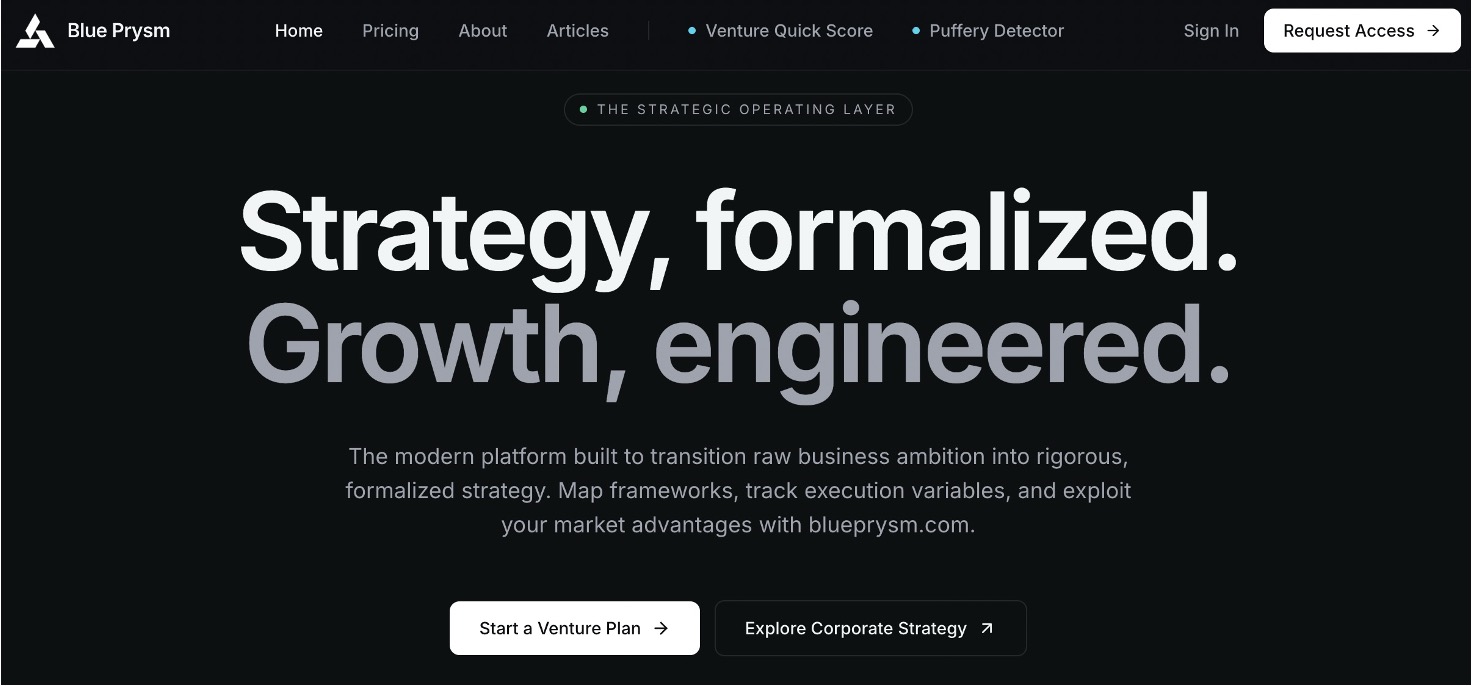
Run your business using the through the Puffery Detector and Venture Quick Score built into the platform before your next board meeting. It scores your own strategic claims and assumptions for substance, the same scrutiny a good consultant would apply, but instantly and repeatable every quarter. If your growth stall or market shift turns out to be a data problem rather than a judgment problem, you’ll know within hours, not weeks.
Start a sample strategic audit on the market analysis platform and see what a platform-led diagnostic looks like before committing to a full consulting engagement. Pair it with a short consultant sprint only if the results point to a genuinely sensitive judgment call.
Sources
- Meet The World’s Best Management Consulting Firms 2026 · Forbes
- Hire Corporate Strategy specialists · Upwork
- Best Strategy Consulting Firms · Vault
FAQ
How much does a strategy consultant charge?
Pricing varies widely by model. Fixed-fee project engagements for a defined deliverable often range from a few thousand dollars for a boutique or independent specialist to well into six figures for large-firm, multi-month mandates; retainers and fractional arrangements typically bill monthly based on days committed.
How much does a strategic plan typically cost?
A standalone strategic plan (market analysis, positioning, and a roadmap) from an independent consultant is usually priced as a fixed-fee project once scope and deliverables are locked, which is why defining scope before signing matters so much.
How much do strategy consultants get paid?
Compensation varies enormously by seniority and firm type, from independent specialists billing project or day rates to senior partners at large firms commanding significantly higher fees tied to their track record and client base.
Who are the major strategy consulting firms?
Large, brand-name strategy firms sit at the top of most industry rankings, but practice-area rankings like Vault’s also highlight sector-specialized boutique firms that outperform generalist giants on specific mandates. The right choice depends on whether your problem needs broad brand credibility or narrow sector depth.
Can a platform replace hiring a strategy consultant entirely?
For recurring needs like market monitoring, competitive tracking, and roadmap iteration, a platform like Blue Prysm often replaces the need for ongoing consulting spend; complex, judgment-heavy mandates like M&A still benefit from a short human engagement alongside it.