


A monthly business review is a one-page decision meeting: a scorecard of roughly eight metrics, sent 24 hours ahead, discussed by five to eight decision owners in 60 minutes, that ends in a logged decision with a name and a deadline attached. Skip the slide deck. If your MBR isn’t producing a decision log, you’re running a status update with better branding.
TL;DR:
- Most MBRs should focus on eight key metrics, with a clear variance threshold that triggers decision-making, to prevent information overload.
- The meeting should be limited to five to eight decision owners for an hour, avoiding status updates and staying tightly focused on flagging and resolving issues.
- Sending the scorecard 24 to 48 hours prior ensures attendees come prepared to discuss actions, not just data, streamlining decision-making.
- A decision log with specific owners, deadlines, and success conditions keeps accountability high and progress traceable between meetings.
- Automating data collection with tools like Blue Prysm can significantly reduce prep time and improve real-time insight for more effective reviews.
What Is a Monthly Business Review, and How Does It Differ From a WBR or QBR?
A monthly business review is an in month checkpoint built to catch a trend breaking early and force a decision about it before it compounds into a quarter-ending problem. It sits between two other rhythms most teams already run, and confusing the three is why so many MBRs turn into a 90-minute status readout that nobody needed.
A weekly business review (WBR) tracks execution cadence: are we shipping, are we hitting the weekly number, is anything blocked. A quarterly business review (QBR) is a strategy and resource-allocation session, the place you decide whether to fund a new initiative or kill one. The monthly business review sits in between:
- WBR: tactical, weekly, execution focused.
- MBR: trend detection and decision making, monthly, focused on variance from plan.
- QBR: strategic, quarterly, resource and roadmap decisions.
Treat the MBR as anything less than a decision meeting and it becomes the most expensive calendar block your leadership team has.
Who Should Attend, and How Long Should the Meeting Run?
Invite only people who own a metric or hold decision authority. That typically means the CEO or COO plus five to eight functional leads, a range Startups recommends specifically because a larger room slows decisions down rather than improving them.
- Every attendee owns at least one line on the scorecard or has the authority to approve a decision on the spot.
- No spectators, no “just in case” invitees, no rotating delegates who can’t commit to an answer.
- Cap the room at eight. Beyond that, discussion time balloons and decisions get deferred “to a follow-up.”
Pro Tip: If someone on your list can’t answer “what would you do about this metric” without checking with their team first, they’re not ready to be in the room yet.
Aim for 60 minutes. Give yourself a ceiling of 90. Most overruns trace back to one cause: someone is presenting data instead of a recommendation, and the room starts debating the number instead of the decision.
What Should Go in the Pre-Read, and When Should It Go Out?
Send the scorecard 24 to 48 hours before the meeting, not the morning of. High-performing MBRs are structured as decision meetings precisely because the pre-read carries the analysis so the room can carry the decision.
- The one-page scorecard as the single source of truth: actual versus target, trend direction, and a named owner for every metric.
- A one-line variance flag for anything red or yellow, written by the metric owner, not the person compiling the deck. “Pipeline dropped 12% because Q3 renewal cohort slipped” beats a red cell with no explanation.
- Status on open items from the prior MBR’s decision log: done, in progress, or blocked, with a reason if blocked.
- Nothing else. No 40-slide appendix, no supplementary charts nobody asked for. If the data isn’t on the scorecard, it waits until next month.
Skip step three and you’ve built a meeting with no memory. Every month becomes a fresh start, and nobody is ever actually held to anything.
What Belongs on the One-Page Scorecard?
Keep it to one page and roughly eight metrics. A one-page MBR scorecard built around eight core metrics across revenue, pipeline, product, and efficiency typically takes about 15 minutes to build the first time and a few minutes a month to update once your data sources are wired up.
Structure it as four categories, two metrics each:
- Revenue: Monthly recurring revenue (MRR), net revenue retention (NRR).
- Pipeline: New pipeline created, stage-to-stage conversion rate.
- Product: Feature adoption rate, time-to-value for new customers.
- Efficiency: Customer acquisition cost (CAC) payback period, gross margin.
That’s a starting template, not a rule carved in stone. Fairview’s core categories group into revenue health, pipeline health, margin and efficiency, and operational health, and some templates run 10 to 15 metrics. For a monthly cadence, fewer is almost always better; you’re optimizing for a fast scan, not a complete audit.
Set a variance threshold for each metric (say, more than 10% off target triggers a red flag) and assign one owner per metric who is accountable for explaining the number, not just reporting it. For companies in the $10 million to $100 million range, this eight-metric structure maps cleanly to P&L outcomes and cuts board prep time considerably once it’s running monthly.
What Does a 60-Minute MBR Agenda Actually Look Like?
Time-box the meeting so the room can’t drift into a status readout. Here’s a structure that holds up:
- Scorecard scan (10 to 15 minutes): Silent or fast-paced review of every metric, flags called out, no debate yet.
- Variance and decision rounds (35 to 40 minutes): Work through flagged metrics one at a time, owner leads, chair closes with a decision.
- Forward preview (10 to 15 minutes): A quick look at what’s coming next month or next board cycle, no deep dive.
- Decision log close (5 minutes): Read back every decision, owner, and deadline out loud before anyone leaves.
Prioritize by exposure, not alphabetical order: the metric most likely to blow a quarterly number goes first. Bain’s research on business performance reviews recommends spending over 70% of meeting time on the initiatives that are actually off-track rather than reviewing everything evenly, which is exactly why the scan-then-drill structure works better than a slide-by-slide walk.
Assign a chair to run the clock and call decisions, plus a scribe to keep the decision log live in real time. Nobody should be updating a spreadsheet from memory the next morning.
How Do You Run the Meeting So It Actually Produces Decisions?
Open by naming two to four decisions the meeting needs to make before anyone touches a chart. That single move reframes the room from “let’s review numbers” to “let’s resolve these.”
- Run the variance drill on a strict clock: owner speaks for two minutes, discussion runs three minutes max, chair calls the decision.
- Repeat for every flagged metric. If a metric is green, don’t discuss it. Move on.
- If every metric is green that month, don’t cancel the meeting. Use the time for one forward-looking strategic topic the CEO or COO picks.
- Park anything that needs deep analysis. “Let’s take that offline and bring a recommendation next month” is a legitimate, useful sentence.
Pro Tip: The owner notes written into the pre-read are your discussion-time insurance. A metric owner who explains the “why” in writing beforehand cuts live discussion time roughly in half, because the room isn’t discovering the problem for the first time in the meeting.
No data-wrangling in the room. If someone needs to pull a new report to answer a question, that’s next month’s agenda item, not this month’s derailment.
How Do You Document Decisions So They Actually Get Done?
A decision log is not a task list. Use a four-field format: decision, owner, deadline, and success condition, which Fairview’s approach explicitly separates from generic action items because a measurable success condition is what makes a decision auditable next month.
- Decision: What was decided, in one sentence.
- Owner: One named individual, never a team or department.
- Deadline: A specific date, not “next quarter.”
- Success condition: The measurable outcome that proves it worked.
Check active items weekly outside the MBR. Read every open decision back at the start of the next MBR before touching new business, and grade it by outcome achieved, not by whether the task got checked off.
Where Can You Get Templates, and What Does a Real Example Look Like?
Build your own version from three pieces: a one-page scorecard, a pre-read checklist, and a time-boxed agenda template. All three are worth adapting rather than reinventing from scratch.
A short walkthrough helps make it concrete. The variance drill produces three decisions: renewals lead owns a save-play pilot for the affected cohort by the 15th; sales ops owns a stage-gate audit due in two weeks; finance owns a CAC-by-channel breakdown due before next month’s MBR.
- Small teams: trim to four or five metrics rather than force-fitting eight.
- Larger orgs: run segmented scorecards by business unit, then roll up a summary page for the executive MBR.
How Does Blue Prysm Fit Into a Monthly Business Review?
Most MBR prep time gets eaten by data-hunting, not decision-making. That’s the actual bottleneck Blue Prysm’s platform is built to remove.
- Real-time market insights and automated competitor briefs keep the “what’s changing outside the business” context current without a research sprint every month.
- The strategy framework library gives you a standing set of templates instead of rebuilding your scorecard from scratch.
- Execution dashboards can hold your decision log between meetings so nothing gets lost in a spreadsheet nobody opens until next month.
How Do You Tailor an MBR to Different Departments?
An eight-metric revenue and pipeline scorecard doesn’t map cleanly onto engineering, and treating every department’s MBR identically is a common way to make the meeting feel irrelevant to half the room.
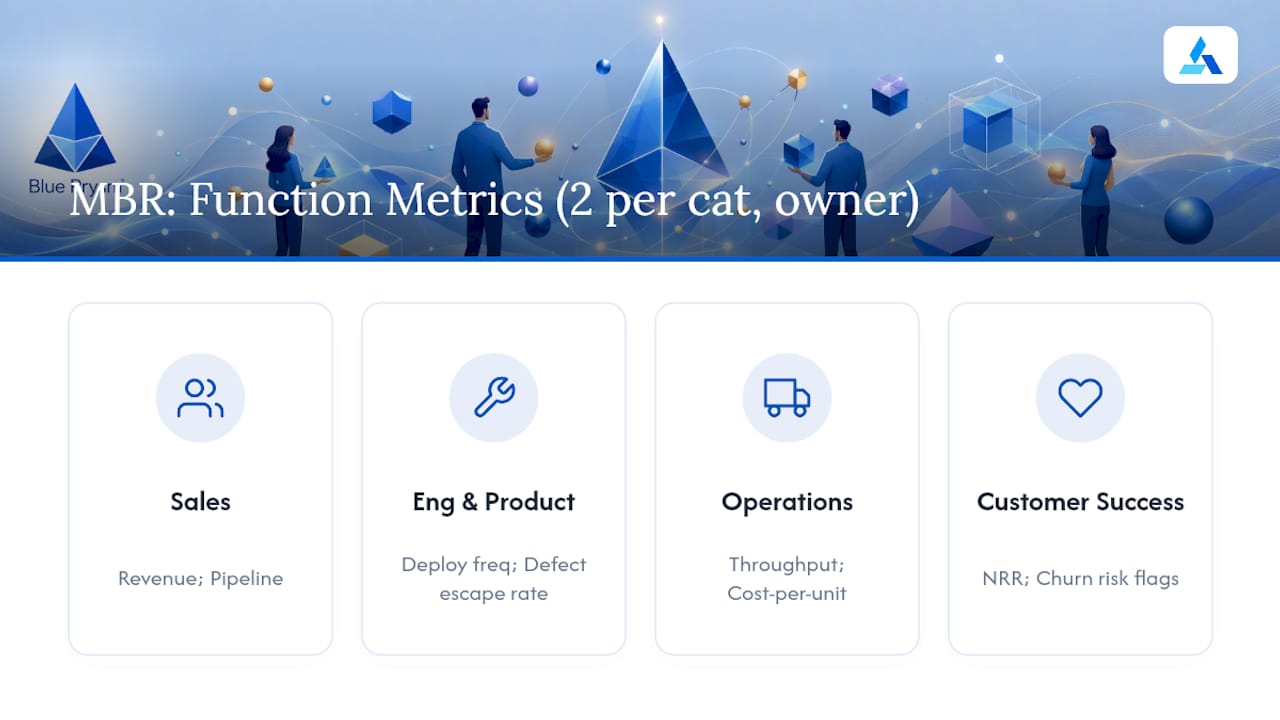
For a sales-led business, the core four categories (revenue, pipeline, product, efficiency) work almost as written. For an engineering or product-heavy MBR, swap in metrics like deployment frequency, defect escape rate, or feature adoption within 30 days of release, still capped at roughly eight, still owned by a named individual.
Operations teams should weight toward throughput and cost-per-unit metrics; customer success teams toward NRR, churn risk flags, and support ticket resolution time. The four-category, two-metrics-per-category shape holds up well as a container even when the specific metrics change entirely.
What should never change from department to department: the attendee cap, the pre-read timing, and the decision-log requirement. Those are structural disciplines, not content choices, and loosening them for “our team is different” is how the format erodes company-wide. If a department runs its MBR without a scorecard or without a decision log, it’s not actually running an MBR. It’s running a meeting that happens to occur monthly.
One practical adjustment scales by function: engineering and product MBRs often benefit from folding in a brief roadmap alignment check, tying that month’s metrics back to the quarterly planning cadence so a monthly dip doesn’t get treated as a strategic pivot signal it isn’t.
What Are the Most Common MBR Pitfalls?
The single most common failure is letting the MBR become a report-out. Someone builds 40 slides, walks through every one, and the room leaves having learned things but decided nothing. The fix isn’t more discipline in the meeting. It’s cutting the pre-read down to one page so there’s nothing left to present.
A second pitfall: too many attendees. Once a room passes eight or nine people, discussion time doesn’t just grow, it shifts. People start performing for the group instead of solving the problem, and decisions get pushed to “let’s sync separately” more often than they get made live.
A third: no decision log, or a decision log nobody rereads. Decisions made in the room evaporate by the following Tuesday if there’s no named owner, no deadline, and no moment where last month’s open items get read back before new business starts.
A fourth, more subtle problem: treating every metric equally. Bain’s guidance to spend the majority of time on off-track work is worth enforcing as an explicit agenda rule, not a nice idea.
Last, teams sometimes run the MBR even when there’s genuinely nothing to decide that month. Wharton’s guidance on business review cadence makes the point plainly: if there’s no material decision pending, skipping the meeting is a legitimate call, not a failure of discipline.
How Do You Keep People Accountable After the Meeting Ends?
Accountability lives or dies in the two weeks after the meeting, not in the meeting itself. A decision log that sits untouched until next month’s MBR is functionally the same as no decision log at all.
Set a weekly check-in cadence for every active decision item, five minutes in an existing standup is enough, where the owner reports status against the deadline and success condition already on file. This isn’t a new meeting; it’s a line item in a meeting that already exists.
At the top of the next MBR, before any new metric gets discussed, read back every open item from last month: done, in progress with a reason, or blocked with a reason. This single habit, done consistently, is what separates an MBR that changes behavior from one that just generates minutes.
Grade decisions by their success condition, not by whether the task technically got completed. A decision to “launch a save-play pilot” that launched on time but didn’t move the renewal number hasn’t succeeded, it’s just been executed. The difference matters because teams that measure task completion instead of outcome tend to keep making the same category of decision every month without ever closing the underlying problem.
How Does the MBR Feed Into Strategic Planning?
The MBR isn’t a standalone ritual. It’s the monthly input that keeps your quarterly and annual planning honest. A pattern of the same metric flagging red for two or three consecutive months is a signal that belongs on the next QBR agenda, not something to keep re-deciding at the monthly level.
Build a simple rule: any decision that gets re-logged three months running graduates automatically to the quarterly strategy conversation. That prevents your MBR from becoming a place where structural problems get patched monthly instead of fixed at the root.

The decision log itself becomes a running record of what your business actually learned this year, which metrics move fastest, which functions hit deadlines, where forecasts consistently miss. Feed that record into your annual planning process and you replace gut-feel assumptions about “what always happens” with an actual paper trail. Tools built for ongoing business planning work best when they’re fed by a live decision log rather than a once-a-year memory exercise.
This is also where continuous improvement stops being a slogan and starts being a mechanism. Every MBR that closes with a documented success condition gives you a data point on whether your own decision-making is getting sharper, whether deadlines are realistic, and whether the metrics you chose eight months ago still predict the outcomes that matter.
What Do Well-Run MBRs Look Like in Practice?
Growth-stage companies in the $10 million to $100 million range that adopt the eight-metric, one-page format report a direct benefit at board level: prep time drops because the monthly discipline already produced a clean, current view of the business, rather than the board deck being assembled from scratch each quarter.
The pattern shows up across functions differently. A sales-led SaaS business built its MBR around the NRR and pipeline-conversion pair, catching a renewal-cohort risk two months before it would have hit the quarterly number. A product-led company weighted its scorecard toward adoption and time-to-value, using the monthly cadence to catch a feature rollout that wasn’t sticking before it became a churn problem next quarter.
The common thread in every version that works isn’t the specific metrics. It’s the habit of pairing every flagged variance with a named decision, owner, and deadline, and reading that log back the following month rather than treating each MBR as a fresh start. Teams that adopt this pattern of naming a concrete decision, not a hypothesis, for every red or yellow metric report clearer accountability across quarters than teams that leave the room with a shared understanding but no logged commitment.
A Short Note on the Discipline This Actually Requires
The format only works if you treat it as a protected ritual, not a recurring calendar obligation you run regardless of whether there’s anything to decide. Skip it the month there’s nothing material on the table. That’s not laziness, it’s respect for the format.
The harder change is behavioral: enforcing read-on-arrival for the pre-read, and naming owners publicly in the room rather than letting decisions stay vague enough that nobody’s actually on the hook. Most MBRs don’t fail because the template is wrong. They fail because leadership lets the discipline slide the first time it’s inconvenient.
— Colin Bowdery
How Blue Prysm Keeps Your Scorecard Ready Before the Meeting Starts
Some platforms help avoid rebuilding your MBR pre-read by hand every month, chasing numbers from multiple sources the night before the meeting. If prep is the part of your MBR that eats the most hours, that’s the part worth automating first.
Blue Prysm’s market research tools pull real-time competitor and market data straight into your prep, so the outside-context slide isn’t something someone builds from scratch every 30 days. Pair that with the platform’s competitive intelligence tracking to keep an eye on what rivals are shipping between reviews, and the strategy framework library to standardize your scorecard and decision-log format instead of reinventing it every quarter.
Before you commit to any tool for this, check three things: whether it offers a trial period long enough to run a full MBR cycle, whether it integrates with the data sources your scorecard already pulls from, and how it handles security around your financial and competitive data. See exactly how the platform works and decide if it fits your next review cycle.
Sources
For copy-paste starting points, see Fairview’s MBR agenda and metrics template, PMGuru’s 8-metric scorecard guide, and Bain’s research on next-level performance reviews. For quick spreadsheet builds without dedicated BI tooling, Express Sheet’s guide to Excel dashboards covers the basics well.
- Monthly Business Review Template: Agenda and Metrics — Fairview
- Monthly business review (MBR) scorecard: 8 metrics, one page — PMGuru
- Building a next-level business performance review — Bain & Company
- Startups
FAQ
Does MBR Stand for Monthly Business Review?
Yes. MBR stands for monthly business review, an in-month decision meeting focused on catching performance variance and turning it into logged, owned decisions.
What Is the Difference Between an MBR and a QBR?
An MBR is a monthly, decision-focused checkpoint that catches trend breaks early, while a QBR is a quarterly session dedicated to strategy and resource allocation. Think of the MBR as course correction and the QBR as course setting.
What Is a Yearly Business Review Called?
A yearly business review is typically called an annual business review (ABR) or annual strategic review, and it’s where MBR and QBR decision logs get rolled up into longer-term planning.
What Does a Good Business Review Example Look Like?
A strong monthly business review runs on one page, flags only the metrics off target, and closes with a decision log naming an owner, a deadline, and a measurable success condition for each flagged item. Platforms like Blue Prysm can help keep that scorecard current between meetings by pulling in real-time market and competitor data automatically.
How Many Metrics Should an MBR Scorecard Include?
Cap it around eight metrics across four categories, revenue, pipeline, product, and efficiency, so the review stays a fast scan rather than a full audit.