


The Ansoff Matrix maps every growth move a company makes onto four quadrants: market penetration, product development, market development, and diversification. The examples below show Coca-Cola, Starbucks, Apple, Tesla, Amazon, and McDonald’s each occupying a different square on that grid. They illustrate the pattern that separates safe bets from the ones that torch capital. Use the moves as reference points, then test your own version before committing real budget.
TL;DR:
- Market penetration strategies focus on increasing sales within current markets using existing products, often through distribution and promotional tactics.
- Product development involves creating new products or services for existing customers, requiring shorter R&D cycles and MVP testing.
- Market development expands existing products into new geographic or demographic markets, necessitating local adaptation and strategic partnerships.
- Diversification introduces new products into entirely new markets, carrying the highest risk and requiring capability fit assessments and small-scale tests first.
- Using an AI-enabled workflow improves decision-making by providing real-time signals and automated competitor tracking, reducing the risk of unfounded diversification bets.
What the Ansoff Matrix Actually Measures
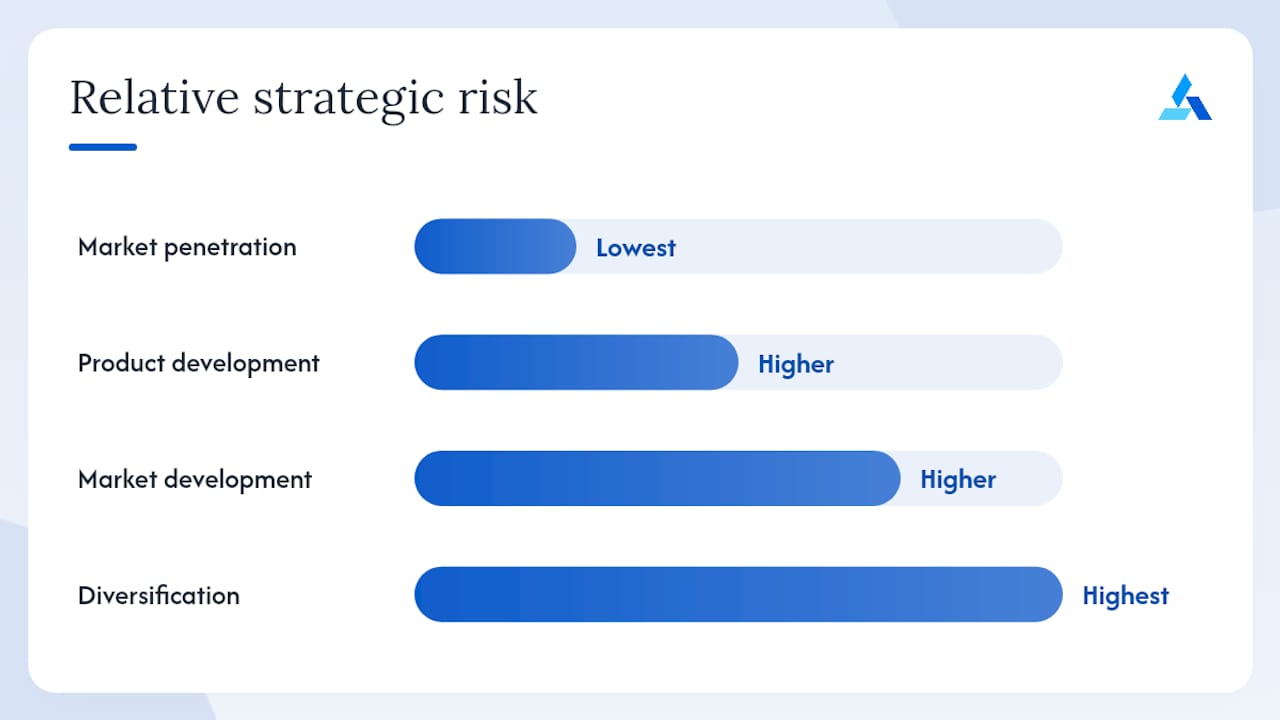
The framework, developed by Igor Ansoff in a 1957 Harvard Business Review article, plots two axes: products (existing or new) and markets (existing or new). Where a strategy lands on that grid tells you roughly how risky it is before you spend a dollar testing it.
The four quadrants break down like this:
- Market penetration — existing products, existing markets. Sell more of what you already have to people who already buy from you.
- Product development — new products, existing markets. Build something new for the customers you already understand.
- Market development — existing products, new markets. Take what works and put it in front of a different audience or region.
- Diversification — new products, new markets. Nothing familiar on either axis.
Risk climbs as you move away from the top left corner. Penetration is generally the lowest risk because you’re optimizing a known formula. Diversification is the opposite: no existing customer relationship and no proven product to lean on. That gap is exactly why so many companies misjudge it, and why the examples further down matter more than the theory.
Market Penetration: Squeezing More Out of What You Already Have
Coca-Cola runs this play through distribution density, packaging variety, and constant promotional cycling, keeping the same core product in front of the same buyers more often and in more places. Starbucks does it through store saturation and its loyalty program, which turns casual buyers into habitual ones without changing the menu.
- Coca-Cola: shelf placement, multipack pricing, seasonal promotions
- Starbucks: store density plus a rewards program that drives repeat visits
- Shared tactic: optimize the channel before you touch the product
Pro Tip: Before building anything new, audit your existing customer list for upsell and frequency gaps using the best CRM for service companies. It’s almost always cheaper than acquiring a new buyer.
Product Development: Selling Your Existing Customers Something New
Apple built an entire ecosystem around the iPhone, adding services and accessories that deepen the relationship with people who already own its hardware. Tesla does the same thing with over-the-air software features and new vehicle variants sold to owners already inside its ecosystem.
- Apple: iPhone accessories, subscription services, adjacent hardware
- Tesla: software updates and new trim levels for existing owners
- Tactical takeaway: shorten your R&D cycle and pilot ideas as MVPs before a full build
Market Development: Same Product, Different Audience
Starbucks’ expansion into China required rethinking store formats, menu localization, and pricing, not the product itself. Tesla’s push into new regional markets follows a similar script: same vehicles, different regulatory and cultural terrain.
- Starbucks: localized store formats and menus for new geographies
- Tesla: entering markets with different charging infrastructure and incentive structures
- Tactical takeaway: budget for local partnerships and compliance review before launch, not after
Diversification: Where the Real Risk Lives
Amazon’s move into AWS is the textbook diversification win. It took a new product (cloud infrastructure) into a new market (enterprise IT) and, over time, that division became Amazon’s most profitable one. Quaker’s 1994 acquisition of Snapple shows the other side of that coin.
Quaker paid $1.7 billion for Snapple and sold it 27 months later for $300 million, largely because its grocery-store distribution muscle didn’t translate to Snapple’s convenience-store channel.
- Amazon: new capability, new customer base, patient capital
- Quaker: assumed adjacency where none existed
- What to check first: capability fit, distribution overlap, and a small-scale market test before scaling spend
How to Build and Apply Your Own Ansoff Matrix
Turning the framework into something usable takes four steps, not two.
- Map your current state. List existing products and the markets they serve. This is your baseline grid.
- Brainstorm by quadrant. Generate at least two ideas per quadrant and write each as a testable hypothesis, not a slogan.
- Score before you commit. Rate each idea on fit, impact, and risk, then pick one or two pilots, never more.
- Set stage gates. Move a pilot forward only after it clears customer validation, then a small revenue or engagement test, then a capability and margin check.
| Stage | What you’re testing | Typical timeline |
|---|---|---|
| Customer validation | Do people want this? (qualitative interviews) | 2–4 weeks |
| Small-scale test | Will they pay or engage at scale? | 4–8 weeks |
| Capability and margin check | Can we deliver this profitably? | 2–4 weeks |
Most teams skip the middle gate and jump straight from interviews to full launch. That’s how a penetration-level budget ends up funding a diversification-level bet.
Where the Matrix Falls Short
The Ansoff Matrix tells you where a move sits on a grid. It doesn’t tell you whether your competitor will match your price cut in a week, or whether your team actually has the operational muscle to run a new product line.
- It ignores competitor response entirely, which is why pairing it with a competitive forces model matters for anything beyond penetration
- Adjacency gets mistaken for low risk constantly. Quaker assumed grocery distribution would carry over to Snapple’s convenience-store network. It didn’t
- Use it alongside a capability audit and a financial scenario model, not as a standalone decision tool
Running Ansoff Experiments With an AI-Enabled Workflow
The workflow that actually works looks like this: research the opportunity, score it, clear a stage gate, run the pilot, then measure. A platform built for this cuts weeks off the research step alone.
- Market development bets need live market signals, not a stale industry report from last year
- Product development ideas benefit from structured scoring before anyone writes a line of code
- Competitive intelligence briefings catch a rival’s move before it erodes your penetration play
Pro Tip: Score every quadrant idea the same way, using the same rubric, or you’ll unconsciously favor whichever idea feels most exciting rather than the one with the best risk-adjusted return.
Why Sequence Matters More Than the Quadrant You Pick
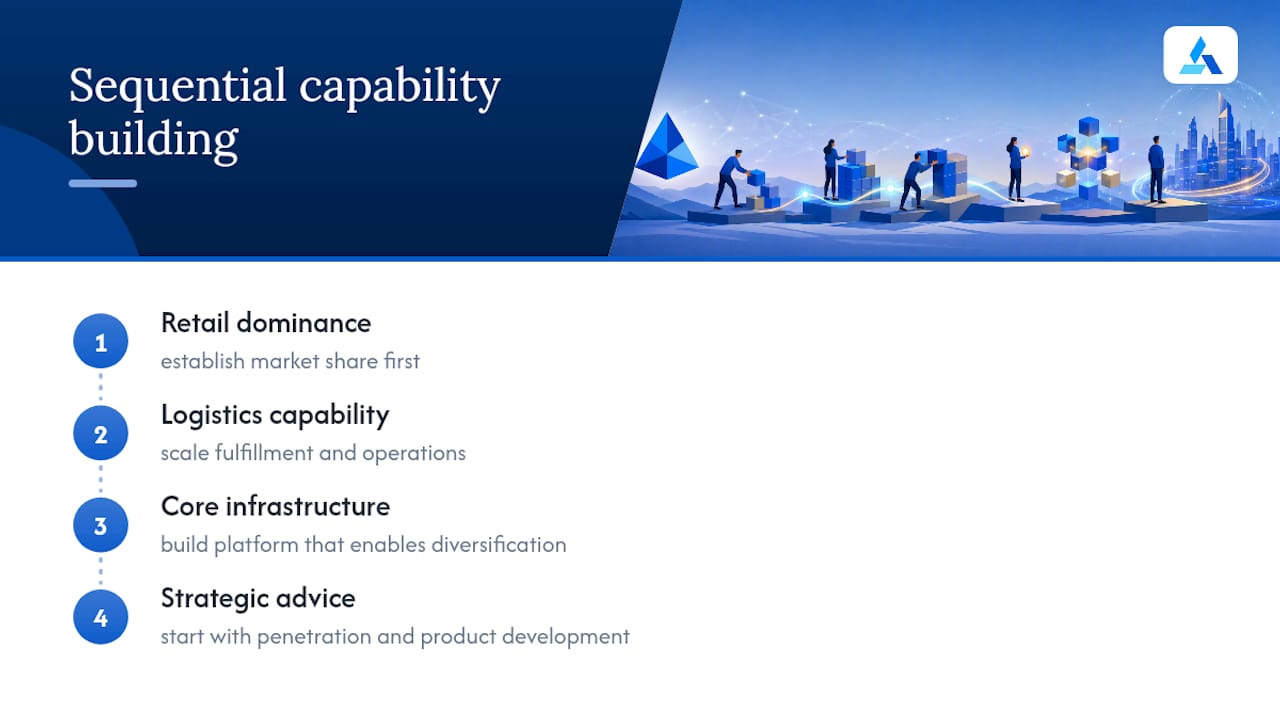
Amazon didn’t leap into AWS on day one. It built retail dominance first, then logistics capability, then the infrastructure that became AWS. That sequence built the operational muscle diversification demands.
If you’re choosing your next move, resist the pull toward the flashy diversification bet. Build capability through penetration and product development first. Earn the right to take the bigger swing.
— Colin Bowdery
Put Your Next Growth Bet Through a Real Test First
Most strategy decks run on gut feeling and a slide full of confident language that would fail a basic puffery check if anyone bothered to run it. Blue Prysm exists because that gap between what a pitch promises and what actually gets tested is where most growth budgets go to die.
The platform maps directly onto the workflow described above: real-time market insights for scoring market development bets, automated competitor tracking so you catch a penetration threat before it costs you share, and a library of over 50 frameworks including the Ansoff Matrix itself, ready to apply without building a template from scratch. Teams that want a more hands-on build can also work directly with Blue Prysm’s Corporate & Growth Strategy engagement.
Pricing starts at an affordable monthly rate for the Starter plan, or a discounted annual rate, with Pro and Enterprise tiers available for teams running multiple concurrent experiments. Check the full pricing breakdown and pick the plan that matches how many quadrant bets you’re actually running right now.
Sources
- Ansoff matrix — Wikipedia
- Ansoff Matrix: Strategies and Practical Examples 2024 — Xmind
- Ansoff Matrix with Examples A Practical Growth Guide – Remote Sparks
- 8 Ansoff Matrix Examples for Better Execution — The OKR Hub
- Ansoff matrix — Shopify blog
FAQ
What is the Ansoff Matrix in simple terms?
It’s a two-by-two grid that sorts growth moves by whether you’re using an existing or new product, and an existing or new market. The four resulting boxes, penetration, product development, market development, and diversification, run from lowest to highest risk.
Which Ansoff strategy carries the most risk?
Diversification is the riskiest quadrant because it combines a new product with a new market, leaving no existing customer relationship or proven offer to fall back on. Shopify’s guidance recommends staged testing and a capability check before committing real budget to it.
How do you create an Ansoff Matrix for your business?
Map your current products and markets first, then brainstorm at least two ideas per quadrant and write each as a testable hypothesis. Score the ideas on fit, impact, and risk, then pick one or two to pilot through structured stage gates.
What are the four elements of the Ansoff Matrix?
The four elements are market penetration, product development, market development, and diversification, arranged across two axes of products and markets. Each quadrant represents a different combination of existing versus new on both dimensions.
Can a tool help score ideas across the four quadrants?
Yes. Some platforms offer idea scoring and strategy library features that let teams rate opportunities on fit, impact, and risk using structured frameworks, rather than relying on gut feeling alone.