


A strategic narrative is the organizational throughline that converts strategy into coordinated action, tying today’s decisions to a future your team can see and want. It aligns product, sales, hiring, and pricing around one story instead of a dozen disconnected talking points, and it shifts buyer and employee choices from feature comparisons to a philosophical bet on where things are headed. The canonical shape runs five beats: the inflection that changed the game, the stakes of ignoring it, the promised land on the other side, your role as guide, and the proof that backs it up.
TL;DR:
- A strategic narrative must directly influence product, pricing, and hiring decisions by aligning them with the five-beat arc of inflection, stakes, future, guidance, and proof.
- Building the narrative collaboratively across leadership ensures operational consistency, with ownership and regular revision based on actual decision-making and behavioral signals.
- The narrative practically manifests in all daily functions, with shipped features, pricing models, recruitment language, sales decks, and KPIs traced back to the core story.
- Misalignment between promises and actions, rely solely on rhetoric, and failure to embed the narrative into decision-making processes quickly weaken its impact.
- Regular audits, real-time market intelligence, and leadership ownership are essential to keep the narrative alive, relevant, and driving measurable organizational change.
What Is a Strategic Narrative, and How Is It Different From a Slogan?
A strategic narrative is a coherent, long-term story that connects where your organization stands now with where it’s headed, and it functions as market infrastructure rather than decoration on top of a strategy deck. It lives in product roadmaps, pricing logic, hiring rubrics, and sales conversations at the same time. A slogan lives on a wall.
Three quick contrasts make the gap obvious:
- Slogan vs. narrative: a slogan is a phrase you remember; a narrative is a decision filter you apply.
- Campaign messaging vs. narrative systems: a campaign has an end date; a narrative system is designed to hold meaning across channels, personnel changes, and market shifts.
- Mission statement vs. operational throughline: a mission tells people what you value; a narrative tells them what to build next and why it matters now.
Here’s what changes when you get this right. A logistics company that reframed its story around “the last mile is the new battleground” started prioritizing route optimization features over warehouse automation, because the narrative made the tradeoff obvious. A B2B software team that named their inflection as “procurement moved from IT to finance” rewrote their entire sales deck around budget owners instead of technical buyers, and their win rate on finance-led deals climbed within two quarters.
The Five-Sentence Arc Every Leader Can Copy
Effective strategic narratives follow a specific arc: name the inflection, establish the stakes, paint the new world, and position your organization as the guide who gets people there. This structure works because it shifts the conversation from feature comparisons to a philosophical choice about which future to bet on, and that choice feels safer once someone has walked you through it — which is why partnering with AI strategy and security consulting experts in San Marcos, TX can help link your narrative to actionable operational plans.
Here’s each element and how to build it:
- The inflection. Name the one big change in your market. Verify it’s real by asking whether three unrelated data points independently confirm it. If you’re inventing the shift to justify your product, the narrative collapses on contact with a skeptical customer.
- The stakes. Show who wins and who loses under the new rules. Listing pain points is weaker than showing consequences; a customer who sees a rival winning the inflection reacts faster than one hearing a list of frustrations.
- The promised land. Make the future tangible. Describe what a Tuesday afternoon looks like for your customer once they’ve made the shift, not an abstract “efficiency gain.”
- Your role as guide. Position your organization as the credible path through the change, not the hero of the story. That distinction shapes both your messaging and your product roadmap.
- The proof. Gather evidence across architecture decisions, distribution partnerships, and customer results that back the claim.
Pro Tip: Write the arc in five sentences, no more. If you need a sixth to explain the fifth, the fourth sentence is doing too much work.
How Do You Build a Strategic Narrative With Your Team?
Building a strategic narrative works best as co-creation, not a solo writing exercise handed down from the top. Interviewing leaders individually before convening them surfaces disagreements early, and the quality of that conversation matters more than how polished the final document reads.
- Map your stakeholders first. Interview your CEO, head of sales, and one frontline manager one-on-one. Save the executive team for a joint session once you have raw material to react to.
- Run the workshop in a fixed sequence. Open by drafting the five-sentence arc as a group. Stress-test the inflection by asking “what would have to be false for this to not matter?” Then draft two audience-specific variants, one for investors and one for customers.
- Follow drafting rules that protect the narrative. Focus on stakes, not features. Make identity explicit (“you are the kind of company that…”). Ban product-first language until sentence five.
- Assign ownership and a revision trigger. One executive owns the narrative document. Revisit it quarterly, and treat a lost deal citing “we didn’t understand where you’re going” as a signal for major revision, not a sales-training problem.
Where Should the Narrative Show Up in Daily Decisions?
The narrative only counts once it’s reflected in concrete decisions, because without that reflection, it reads as marketing fluff no matter how well it’s written. Run a quarterly audit against these functions:
- Product roadmap: each shipped feature should trace back to the promised land, not just customer requests.
- Pricing: if the narrative claims a category shift, pricing should reward the new behavior, not the old one.
- Hiring: job descriptions should use the narrative’s language for what “good” looks like, not generic competency lists.
- Sales decks: the first three slides should mirror the inflection and stakes before any product screenshot appears.
- KPI framing: dashboards should track the promised land’s outcome metric, not just activity volume.
One useful adoption signal: watch how often narrative language shows up unprompted in RFPs, sales decks, and hiring briefs. If it never appears without a script, the narrative hasn’t stuck yet, and no dashboard fixes that faster than a plain conversation with the people writing those documents. Teams running workshop-first strategic roadmapping tend to catch this gap earlier because the roadmap itself gets stress-tested against the narrative before it ships.
What Do Before-and-After Narrative Shifts Actually Look Like?
Abstract frameworks earn their keep only when you can trace them through a real change. Here’s how the arc plays out in practice.
- Old world: a mid-market manufacturing firm described itself as “a supplier with fast turnaround.” Inflection: procurement teams started scoring vendors on data transparency, not just speed. Stakes: suppliers without visibility tools were getting cut from shortlists entirely. New world: the firm repositioned as “the supplier that shows you the whole chain.” Their role: guide, not hero, walking procurement teams through a transparency dashboard before competitors had one.
- Internal reframe for recruiting: a startup stopped hiring for “hustle” and started hiring for “comfort with ambiguity,” rewriting job posts around the inflection they’d identified in their own market. Applicant quality shifted noticeably within one hiring cycle.
- Adapting a public example internally: take any well-known company narrative, strip out proprietary specifics, and rebuild it as an internal brief using your own inflection, stakes, and proof. The Cornell strategic storytelling program treats this kind of transmedia adaptation as a core exercise: keep the arc identical, swap the promised land and proof to match the audience in front of you.
What Kills a Strategic Narrative, and How Do You Fix It Fast?
The most common failure mode isn’t a bad story. It’s misalignment: a narrative that promises transparency while pricing punishes it, or one that talks change while hiring criteria reward the old behavior.
- Misaligned incentives: if your comp plan rewards the opposite of your narrative, fix the comp plan before you touch the deck.
- Rhetoric without reflection: a narrative not visible in product or pricing decisions reads as spin, and customers notice faster than employees do.
- Ignoring behavioral mechanics: framing, contrast, identity, and anticipation are the levers that actually change behavior. Skip them and you’re left with a well-written paragraph nobody acts on.
- Internal alignment gaps: the sharpest diagnostic is simple. Ask three executives to explain the narrative without notes. If they can’t do it spontaneously, operationalization stalls no matter how good the document reads.
Quick remediation: run a one-hour audit of your top three roadmap items against the arc, tighten your next hiring brief’s language, and align next quarter’s roadmap to a single narrative chapter instead of five.
How Blue Prysm Turns Narrative Into Measurable Work

Treat narrative as a diagnostic system, not a poster. A useful practice is quarterly narrative audits that map roadmap items, hiring criteria, and pricing decisions against the five-sentence arc, then track how often narrative language shows up in RFPs and sales decks over time.
That’s the gap Blue Prysm’s platform is built to close:
- Real-time market intelligence and competitor tracking surface whether your “inflection” claim still holds against what competitors are actually doing.
- A strategy library with over 50 frameworks gives teams a shared vocabulary for drafting and stress-testing the arc.
- Roadmapping and execution dashboards make it visible when a shipped feature has drifted from the narrative’s promised land.
Why Leaders, Not Comms Teams, Have to Own This
Handing narrative work to comms is the most common way it dies. A story that only the marketing team can recite never makes it into a pricing meeting or a hiring rubric, and that’s exactly where narrative earns its keep or doesn’t.
Run this experiment this quarter: block 90 minutes, write your five-sentence arc as a leadership team, and then ask three people outside that room to explain it back without notes. If they can’t, you’ve found your real priority, not a communications problem. Favor that kind of adoption diagnostic over a polished paragraph every time. A rough story that survives contact with your organization beats an elegant one that never leaves the deck.
— Colin Bowdery
Ready to Operationalize Your Narrative?
Blue Prysm is the alternative to hiring a strategy consultancy just to write a story that sits in a drawer. Instead of paying for a one-time deliverable, you get real-time market analysis, automated competitive intelligence briefings, and a roadmapping tool that checks whether your product decisions still match the narrative you wrote last quarter.
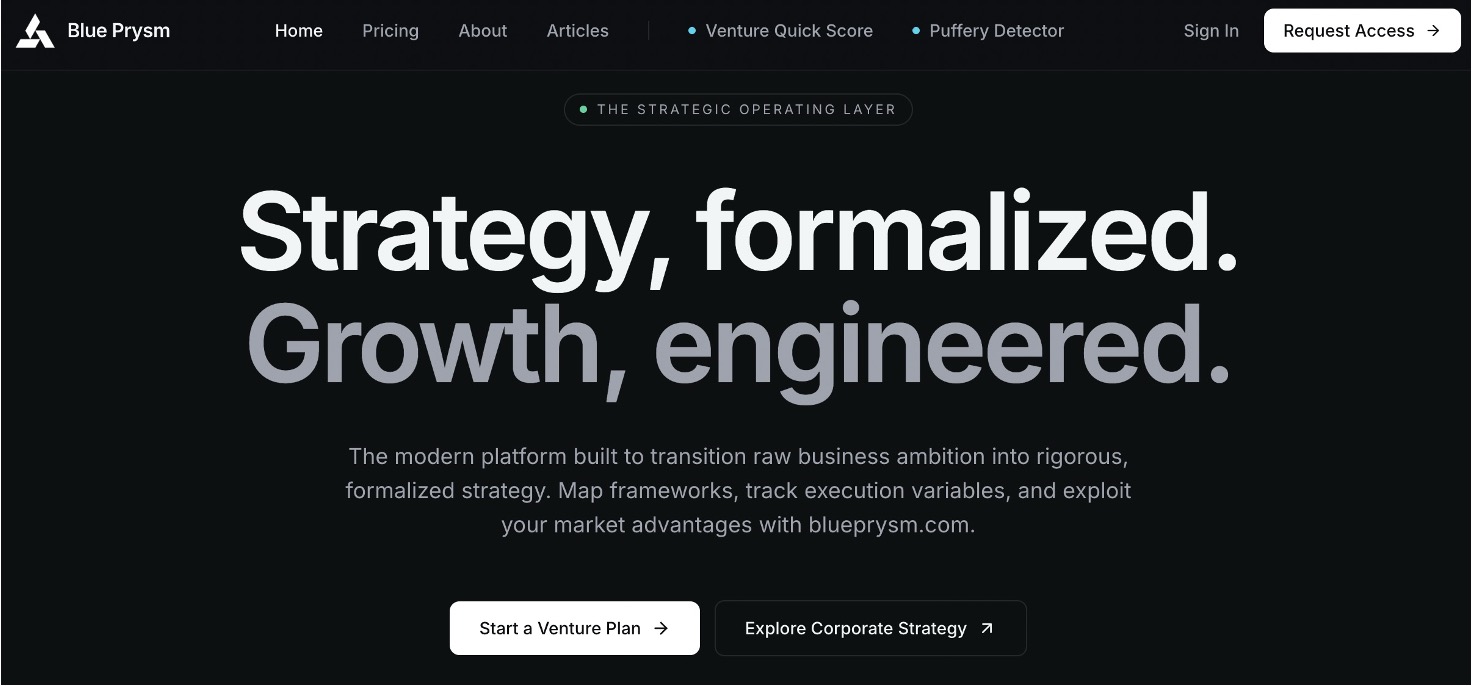
Before you commit to a platform or an advisory engagement, ask yourself three questions: Do you need ongoing market visibility, or a one-time workshop? Does your team need a shared framework vocabulary, or individual coaching? And can your roadmap tool actually flag drift from your narrative, or does it just track tickets? If you’re leaning toward hands-on help, Blue Prysm’s Corporate & Growth Strategy engagement pairs advisory work with the same intelligence tooling. If you want to run the audit yourself, the Starter plan starts at $30 per month and gives you access to the strategy library and roadmapping tools directly. Either way, a good next step is checking a sample intelligence briefing to see what narrative-linked market tracking actually looks like before you decide.
Sources
- How To Build A Strategic Narrative That Inspires And Aligns
- Narrative is market infrastructure. – by Alex Pawlowski
- How to practice strategic storytelling – Ragan Communications
Use these to run your own stress-tests and for workshop prep before your next leadership session.
FAQ
Can You Give Examples of Strategic Narratives?
A retooled logistics firm shifting from “fast turnaround” to “full chain transparency” is one working example, tracking the inflection, stakes, promised land, and proof arc described earlier in this article. Public examples from well-known companies work too, as long as you strip proprietary detail and rebuild the arc with your own inflection and evidence.
What Are Some Examples of Narrative Strategies?
Common approaches include naming a market inflection before competitors do, reframing pricing around a new behavior you want customers to adopt, and rewriting hiring criteria to reflect the future you’re building toward. Each works only when it shows up in actual decisions, not just in messaging.
What Are the Four Types of Narratives?
Definitions vary across disciplines, and there’s no single agreed-upon list of four narrative types in a business strategy context. The five-sentence arc used throughout this article (old world, inflection, stakes, new world, your role) is the more useful and widely applied structure for strategic work.
What Does “Narrative Strategy” Mean?
Narrative strategy means deliberately designing the story that connects your current state to your future ambition, then using that story as the filter for product, pricing, hiring, and sales decisions. It’s the practice side of building a strategic narrative, not a separate concept from it.