


Getting continuous, trustworthy strategic intelligence that supports both rapid decision-making and careful audit trails is harder than it should be for most strategy and product teams. Many current platforms either gate real-time monitoring behind enterprise pricing, lack signal traceability for compliance, or overload users with low-value alerts instead of prioritizing what matters. This comparison shows how top alternatives differ on pricing, data delivery, validation, and integration so you can choose strategic intelligence software to fit your team’s workflow and verification needs.
Table of Contents
- Blue Prysm
- Watchful.ai
- Gopf
- webtracker.ai
- MonitoringMonkey
- Comparative Analysis of Strategic Intelligence Platforms
Blue Prysm

At a Glance
SOC 2 certification paired with a zero data retention policy anchors Blue Prysm’s privacy posture and makes it suitable for executives who need a private place to test strategy. The platform combines strategic roadmaps, competitor monitoring, and AI scoring for claims and ideas.
Core Features
- Strategy framework mapping that helps you convert classic models into a reusable digital format for planning and review.
- OKR tracking and KPI execution tools to monitor progress against strategic roadmaps and maintain a clear line of sight to outcomes.
- Market gap analysis and competitor profiling tied to regularly updated market briefings and monitoring feeds.
- Venture Quick Score for rapid idea assessment and the Puffery Detector for credibility scoring of competitive claims.
- Standalone planning and validation tools that let founders run quick checks without creating an account.
Key Differentiator
Blue Prysm combines formal strategy frameworks with built-in AI claim scoring and venture validation tools so the same workspace supports both entrepreneur experiments and executive strategic planning. That mix is aimed at teams that need methodical frameworks plus rapid credibility checks.
Pros
-
Offers framework-first planning so executives can map strategy, assign OKRs, and trace execution back to hypotheses in one place.
-
Venture Quick Score reduces guesswork during early idea screening by turning qualitative assumptions into a repeatable score you can compare across projects.
-
SOC 2 certification and zero data retention lower compliance friction for teams handling sensitive competitive or financial inputs.
-
Standalone tools available without sign-up let founders validate ideas or check claims quickly during investor meetings or pitch prep.
Cons
- Limited integration detail is available publicly, so if you depend on a deep toolchain connection you may need to validate compatibility before committing.
Who It’s For
Business leaders, founders, and strategic teams that need structured, methodical support for planning and execution and that prioritize privacy when testing hypotheses or running competitor analysis. Good for organizations that want both planning and lightweight validation in the same place.
Unique Value Proposition
You can run a Venture Quick Score or a Puffery Detector check without creating an account and then move validated items into a private, SOC 2 certified workspace for roadmapping and OKR tracking. That workflow compresses the time from idea to tracked execution and reduces the need for separate validation tools.
Real World Use Case
A founder runs a quick Venture Quick Score during a partner call to decide whether to pursue a new vertical. Positive score moves the idea into a mapped framework, the team assigns OKRs, and progress gets traced to the initial assumptions while keeping source data off public storage.
Pricing
Free tools are available with no account required. Paid plans start at $25 per month for founders and $49 per month for startups, with discounts for annual billing. Pricing covers both standalone validation tools and the enterprise strategy workspace.
Website: https://blueprysm.com
Watchful.ai
At a Glance
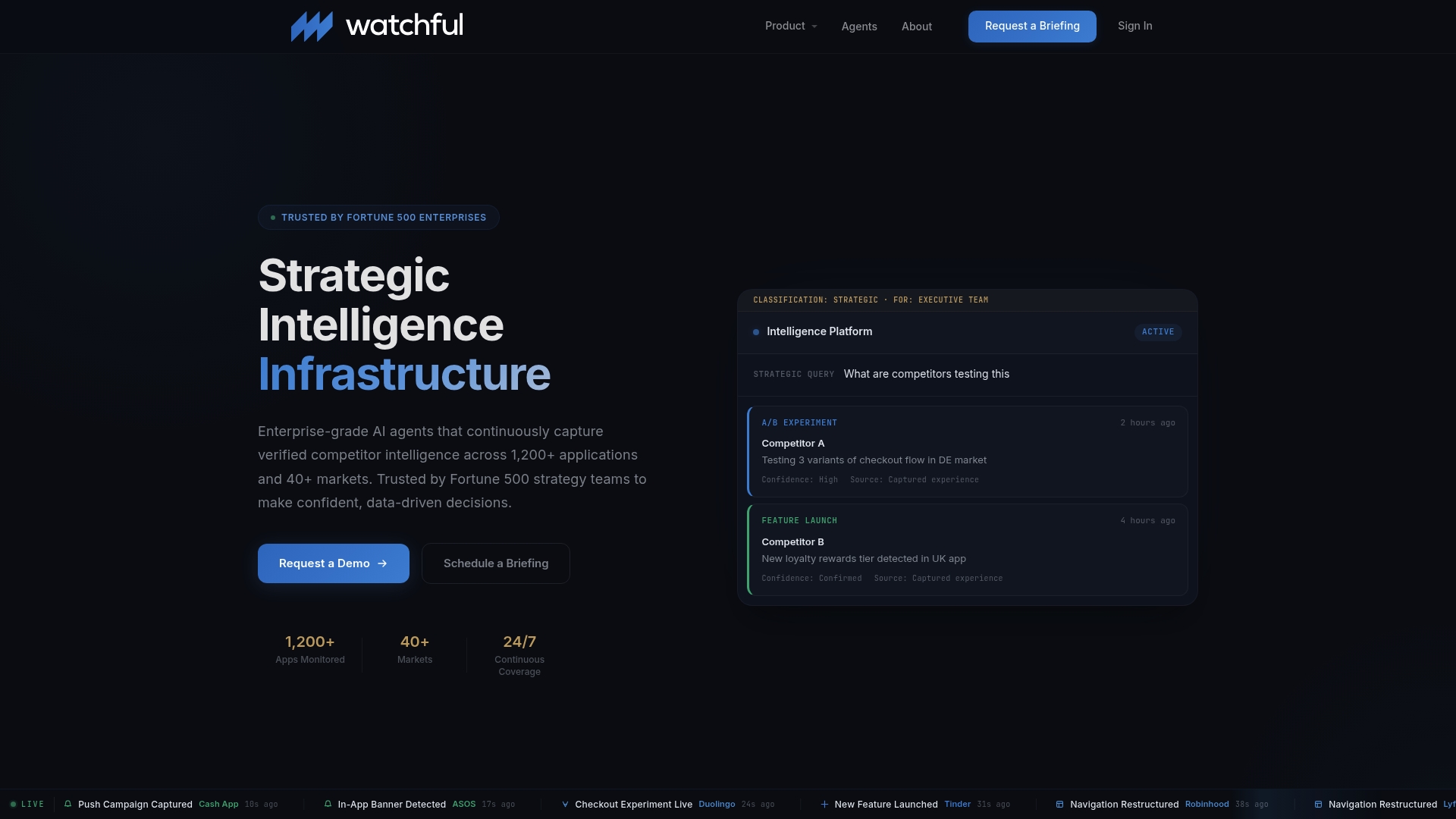
Watchful.ai’s marketing materials claim coverage across 1,200+ applications and more than 200 device panels while using autonomous in-app agents rather than web scraping. The vendor also advertises enterprise deployment in under two weeks and positions the product for large strategy teams.
Watchful.ai focuses on continuous, verified observations from real product experiences so strategy teams see changes as they happen rather than relying on intermittent manual checks.
Core Features
- Autonomous AI agents that run 24 7 to monitor competitor apps and websites across devices and markets.
- Real in-app experience capturing which extracts ground-truth signals instead of scraping public HTML.
- AI classification that tags product changes, experiments, and UX modifications for faster review.
- Real-time alerts, customizable briefings, and executive dashboards that feed into enterprise reporting.
- Broad geographic and device coverage designed to reflect regional experiments and segmented rollouts.
Key Differentiator
The single standout is the focus on validated, in-product capture rather than scraped snapshots. That approach reduces noise from rendered pages or third party caches and gives product teams a clearer record of competitor experiments and UX variations.
Pros
- Continuous monitoring reduces manual research time by replacing periodic checks with a constant watch. The monitoring claim above supports steady signal flow.
- Ground-truth captures increase confidence when you need to cite a competitor change in a roadmap review. The evidence is a recorded app interaction not a scraped page.
- Rapid enterprise deployment means strategy teams can be live inside weeks instead of months. That helps when a competitor run rate requires fast coverage.
- The platform is built to scale across markets and device panels, which matters for global product and growth teams tracking localized experiments.
- Executive dashboards and alerting integrate into enterprise workflows so stakeholders get timely briefings without extra manual summaries.
Cons
- Multiple users report frustration with billing and subscription management, including difficulty canceling and resolving payment disputes.
- Customer support after purchase has been described as inadequate in some reports, which increases friction during renewals or scope changes.
- The product is premium priced and oriented to enterprise budgets, which puts it out of reach for small teams or single-product owners.
When It May Not Fit
If your team is a small product group or a solo practitioner, the scale and price point will not match your needs. The product needs integration into existing enterprise workflows to reach full value, so teams without an integration path will see limited payoff.
Notable Integrations
- Supports integration with enterprise dashboards and reporting tools so alerts and captured evidence can feed internal BI and strategy systems.
Who It’s For
Fortune 500 product, strategy, and competitive intelligence teams that need continuous, verified monitoring of competitor app behavior across markets and devices. Best suited for organizations with dedicated CI workflows and enterprise procurement.
Real World Use Case
According to the vendor, a Fortune 100 e-commerce company used Watchful to detect a competitor checkout flow experiment two weeks before public launch, allowing the team to adjust their release strategy and experiment set.
Pricing
Pricing is not published and the vendor lists pricing as not applicable. Watchful.ai is sold through enterprise channels and pricing is provided via sales discussions and contracts.
Website: https://watchful.ai
Gopf
At a Glance
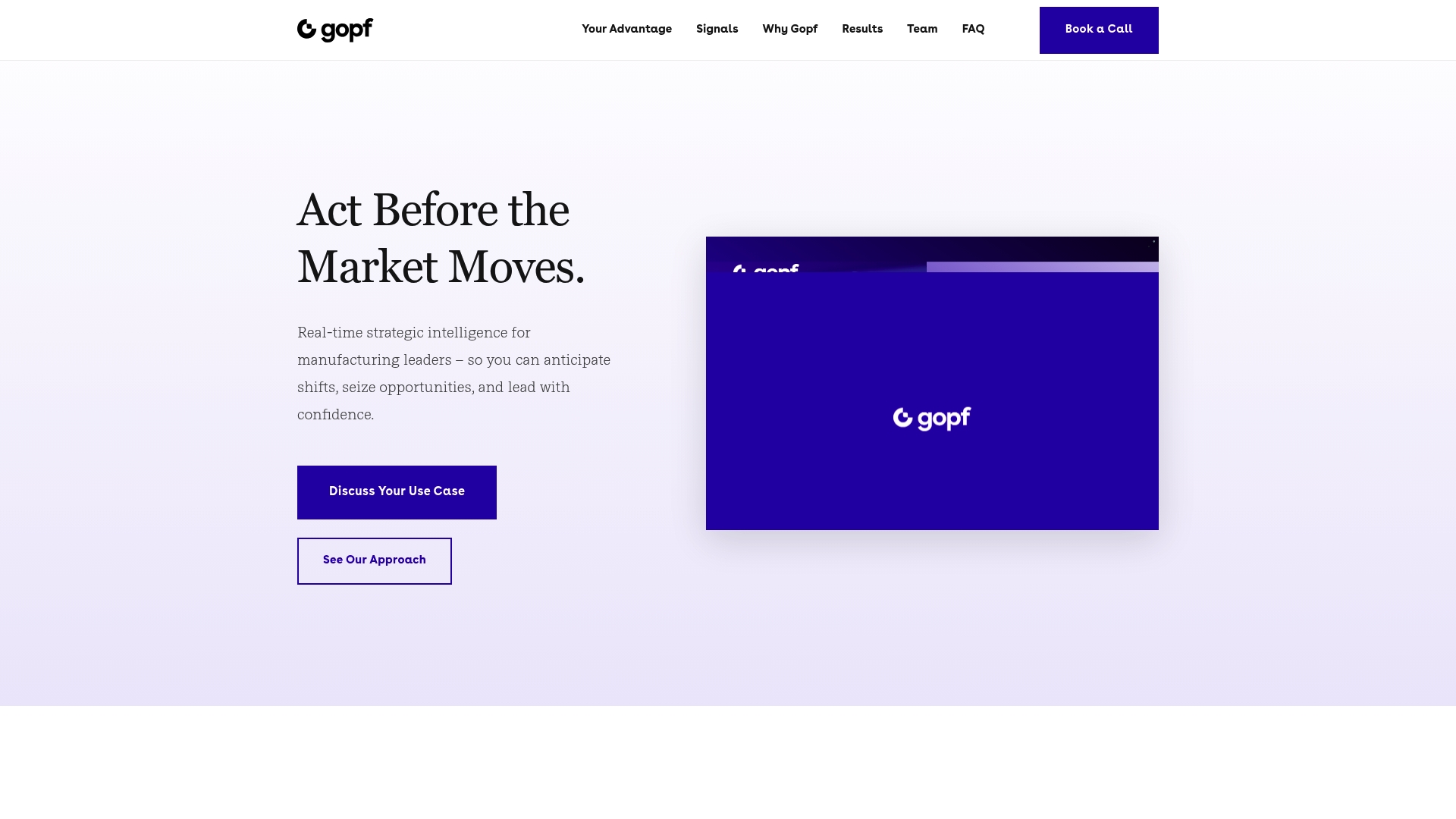
Signals arrive directly in Teams, WhatsApp, or email and include links back to original sources for verification, making rapid verification possible within existing workflows. The vendor advertises a two-week free trial and flexible licensing aimed at replacing recurring consulting costs.
Core Features
- Continuous real-time market monitoring tuned to manufacturing and industrial priorities.
- Custom data pipelines pulling trade publications, patents, filings, and regional news in multiple languages.
- Deliveries routed to Teams, WhatsApp, or email with source traceability for each signal.
- Preconfigured strategic sessions to set priorities and intelligence profiles.
- Traceable signals that link back to original documents or articles for verification.
Key Differentiator
Gopf focuses on delivering continuous, niche signals with full source traceability directly inside the comms channels executives already use. That combination removes the handoff between analysts and decision-makers and preserves an auditable trail for high-stakes decisions.
Pros
- Built by industry veterans, which translates to monitoring scopes that match manufacturing decision cycles rather than generic market noise.
- Replaces periodic consulting reports with ongoing monitoring, so strategy teams get continuous updates without repeated brief engagements.
- Traceability of each signal supports verification and audit trails when boards or procurement teams ask for source evidence.
- Integration into Teams, WhatsApp, and email reduces change management because messages land where executives already work.
- The platform targets hard-to-reach sources, such as niche trade journals and regional filings, rather than relying on high-level press coverage.
Cons
- Several users report software glitches and occasional freezes that interrupt delivery reliability and require support intervention.
- There are user reports of lifetime subscription deals being revoked; those accounts of instability create risk for long-term buyers.
- Document editing has limited font options, which affects how teams prepare polished briefings from exported material.
- Inconsistent performance across sessions can frustrate teams that need a fully predictable feed.
When It May Not Fit
If you need an enterprise-grade SLA for uninterrupted delivery, Gopf’s mixed reliability reports make it a risky primary feed. If your team requires built-in time tracking, resource allocation, or a heavy-duty analytics studio, this product’s focus on signal delivery will feel narrow.
Notable Integrations
- Microsoft Teams
Who It’s For
Industrial executives, strategy leads, and corporate planning teams in manufacturing that need continuous, sector-specific monitoring and a verifiable trail for signals informing procurement, R&D, or geopolitical planning.
Real World Use Case
A strategy team uses Gopf to monitor supplier patent filings, regional supplier news, and shipping disruptions. Alerts land in Teams with source links, enabling the team to recalibrate supplier risk scoring and reallocate R&D budget before shortages materialize.
Pricing
The vendor describes flexible licensing and a two-week trial for evaluation. Pricing specifics are not listed here; buyer diligence is recommended given user reports around lifetime subscriptions.
Website: https://gopf.com
webtracker.ai
At a Glance
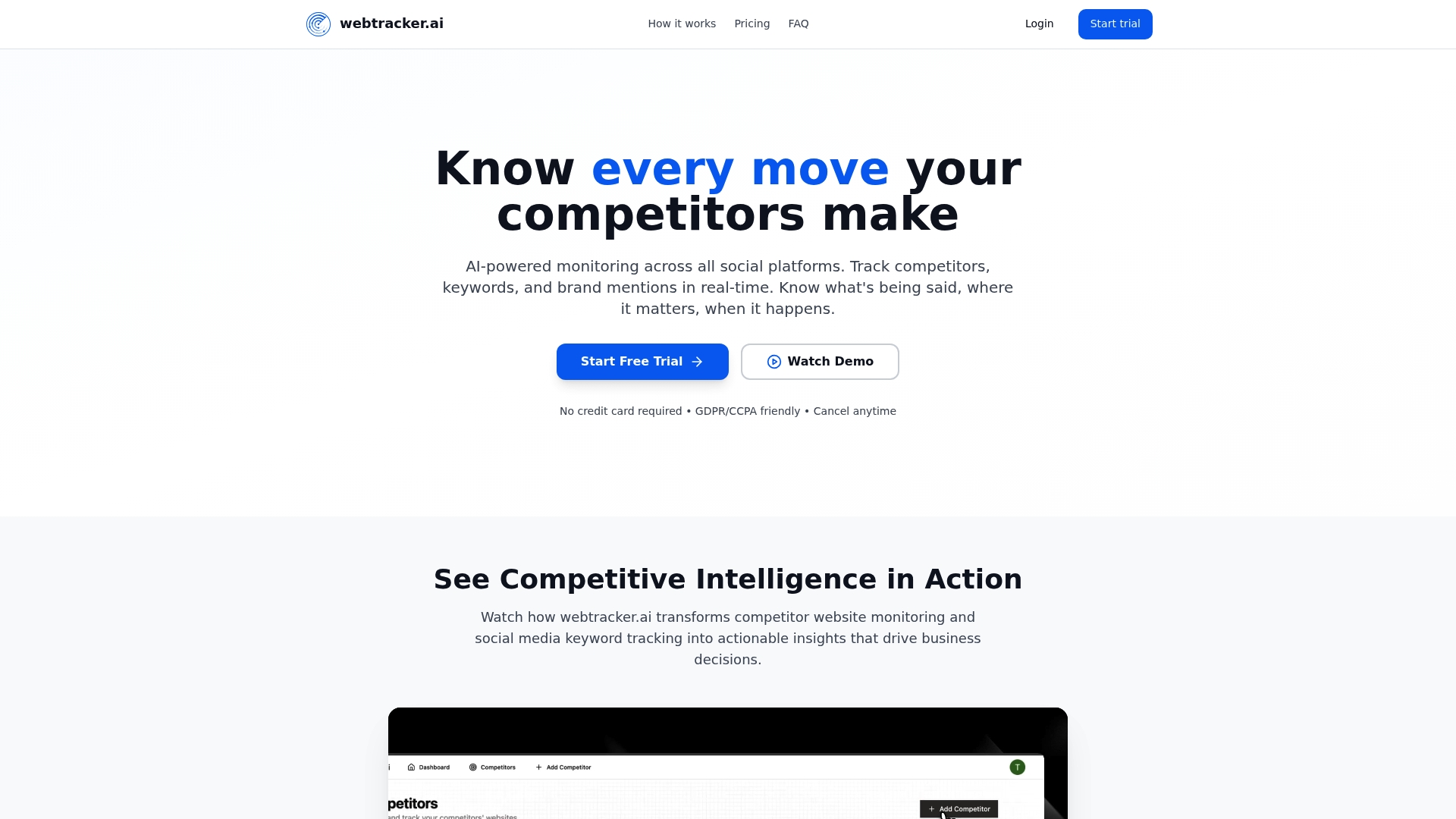
Starts at $29/month for the Starter plan, a specific entry price that makes continuous competitor tracking accessible for small teams. webtracker.ai’s marketing materials advertise an AI-powered impact scoring system that flags and ranks important web and social changes.
Core Features
- Real-time monitoring of competitor websites and social channels to catch price and content changes quickly.
- Impact-ranked alerts with short summaries so teams get fewer, higher priority notifications instead of constant noise.
- Multi-channel social tracking across Twitter, LinkedIn, and Facebook plus configurable Slack and email notifications for teams.
Key Differentiator
The product’s central claim is an impact scoring engine that ranks importance across web and social signals so you do not chase every small change. That scoring claim aims to convert raw events into prioritized alerts for marketing and product teams.
Pros
- Affordable entry pricing lowers the barrier for continuous competitive monitoring, which matters when you need always-on coverage without a large budget.
- Fast setup. Teams report getting initial alerts within minutes and being able to tune monitors without long onboarding cycles.
- AI-driven filtering reduces alert noise, letting analysts spend time on strategic interpretation rather than triage.
- Multi-channel coverage ties website updates to social reactions, helping you see whether a product change triggered conversation.
- Flexible plans that scale from single teams to larger rollouts, with enterprise customization available when needed.
Cons
- Independent reviews note limitations in advanced impact scoring at present, so complex causality may not be perfectly ranked yet.
- Extensive competitor lists and broad integrations require higher tier plans, which raises cost for heavyweight monitoring programs.
- Some configuration and fine tuning require technical familiarity, which means a developer or analyst may be needed for complex setups.
When It May Not Fit
If your program demands perfect causation analysis across dozens of signals, the current scoring approach may not provide the depth you need. Also, teams that want time tracking or deep resource planning features should look elsewhere.
Notable Integrations
- Slack for instant alerts and summaries inside existing channels.
- Email notifications for distribution to wider stakeholder lists.
- Upcoming connectors listed by the vendor include HubSpot, Shopify, Notion, and Zapier for workflow automation and CRM linking.
Who It’s For
Marketing, product, and sales teams at small to large companies that need continuous, cost conscious competitive intelligence. Suits teams that value prioritized alerts and multi-channel visibility and are prepared to tune monitors for relevance.
Real World Use Case
A marketing team monitors three direct competitors and brand mentions across social. When a rival drops prices or launches a campaign, the team receives an impact-ranked alert and a short summary in Slack so they can adjust landing pages and paid bids within hours.
Pricing
Starts at $29/month for the Starter plan with scalable options for SMBs and larger teams. Enterprise packages offer customization and broader monitoring quotas for organizations with extensive competitor lists.
Website: https://webtracker.ai
MonitoringMonkey
At a Glance
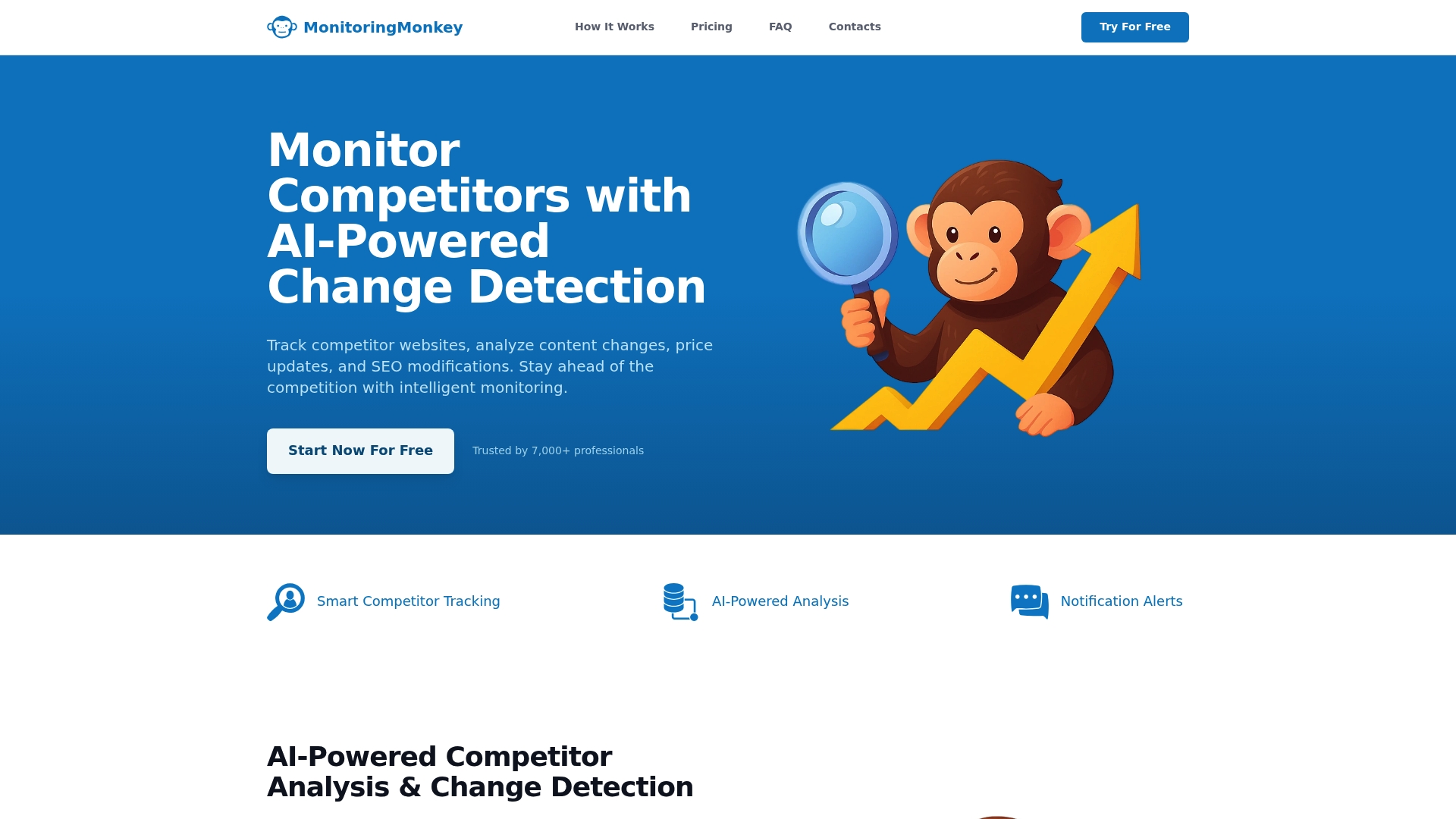
Starts at $9.99/month for basic monitoring and scales to $99.99/month for more extensive competitor tracking and AI features. The platform pairs frequent checks with AI filtering so teams see prioritized change signals instead of raw diff noise.
Core Features
- AI-powered change detection and analysis that highlights meaningful edits across pages.
- Real-time notifications via email, Slack, Microsoft Teams, or API so teams respond quickly.
- Tracking for content edits, price moves, SEO tag changes, and site redesigns.
- Trend summaries, impact notes, and scheduled CSV or JSON exports for BI workflows.
Key Differentiator
MonitoringMonkey centers on AI-powered filtering and contextual analysis that groups changes by likely business impact. Instead of delivering every HTML diff, it flags price shifts, meta tag updates, or new product pages and surfaces trend snippets. That focus reduces alert fatigue and helps analysts prioritize what to investigate first.
Pros
- The AI filter reduces noise. Reports and dashboards group related edits so you review clusters of change rather than dozens of line-by-line diffs.
- Scales to monitor many competitor sites. Dashboards keep tracked domains organised and searchable for agencies handling multiple client portfolios.
- Multiple alert channels are included. Slack and Teams hooks mean product, marketing, and analytics teams get the same signal in their base workflows.
- Export options in CSV and JSON allow you to feed raw records into BI tools or internal data lakes for deeper analysis.
- Pricing tiers suit single analysts up to team deployments, with higher plans offering faster checks and more monitored pages.
Cons
- Public pricing is brief; enterprise cost for very large monitoring volumes may be higher than some rivals.
- The vendor does not publish detailed false positive rates or precision metrics for the AI model, which leaves some uncertainty for strict audit use cases.
- Monitoring cadence is dependent on scheduled checks. For markets that require millisecond reaction times, the typical 5 to 30 minute polling window may lag.
When It May Not Fit
If you need guaranteed millisecond alerts for high frequency trading or flash promotions, this product is not the right technical fit. The model relies on periodic checks and the AI filter described above rather than continuous streaming changes.
If you operate at very large scale and want fully itemized cost forecasts, expect to engage sales for a custom quote. The public tiers start low but enterprise pricing can increase with monitored pages.
Notable Integrations
- Webhooks for pushing events into custom pipelines.
- API for data export so you can pull historical change logs into dashboards or analytics systems.
Who It’s For
Marketing teams, competitive intelligence analysts, and agencies that need organized, near real-time website monitoring without building a bespoke crawler. Works best when you want prioritized signals for SEO, pricing, or content shifts rather than every low-level HTML update.
Real World Use Case
A marketing agency configures MonitoringMonkey to watch 30 competitor stores. When a competitor launches a promotion or updates meta descriptions, the agency receives a grouped alert in Slack and a CSV summary in the morning report. That triggers rapid price checks and a content tweak plan for affected product pages.
Pricing
Public plans start at $9.99/month for basic monitoring. Mid tiers increase monitoring frequency and AI features. Top plans at $99.99/month cover extensive competitor tracking and larger page counts; enterprise quotes are available for high volume needs.
Website: https://monitoringmonkey.com
Comparative Analysis of Strategic Intelligence Platforms
Selecting a strategic intelligence platform requires evaluating features, usability, pricing, and intended user base. Below, we contrast the highlighted platforms to offer clear differentiation that aids in choosing the right fit for varied business needs.
Coverage and Updates: Weekly vs. Instant Insight
Blue Prysm excels with its combination of formal frameworks alongside AI-based tools like the Venture Quick Score and Puffery Detector while ensuring privacy compliance through SOC 2 certification. On the other hand, platforms like Watchful.ai and webtracker.ai focus on real-time monitoring with automated summarization features. Watchful.ai, for example, offers expansive in-app agent monitoring that continuously captures competitor activities. This real-time analysis contrasts Blue Prysm’s systematic approach, which might prioritize thoroughness over immediacy.
Usability Across Teams: Specialist vs. General Utility
Gopf and MonitoringMonkey both offer integration with widely-used communications platforms such as Microsoft Teams and Slack. While these platforms prioritize cross-team accessibility and the delivery of traceable signals, Blue Prysm maintains an executive-focused toolkit aimed at detailed strategic development. Businesses needing flexible licensing might lean toward Gopf, while those with strict compliance and privacy needs find distinct advantages with Blue Prysm.
Best Fit Recommendations
- For organizations requiring a planning and validation tool alongside rigorous privacy measures: Blue Prysm offers credibility scoring and traceable hypothesis tracking through its private workspace and OKR systems.
- For competitors monitoring in continuous market landscapes requiring immediate reaction speeds: Watchful.ai’s autonomous AI agents excel in providing real-time tangible insights.
- For teams in the manufacturing sector needing precise monitoring of niche markets and native comms integration: Consider Gopf, delivering sector-specific signals directly to communication channels.
- For those seeking budget-friendly simple update monitoring solutions with effective prioritization: MonitoringMonkey stands out with its AI-powered reporting targeted at smaller teams.
Our Pick: Blue Prysm
Blue Prysm stands out due to its distinct integration of experimental venture validation with structured strategy frameworks in a privacy-compliant environment. This makes it ideal for leadership teams balancing high-stakes planning with frequent innovation. While solutions like Watchful.ai offer impressive real-time coverage, Blue Prysm is better suited for methodical strategists seeking both security and precision, providing clarity amidst complex planning tasks.
Strategic Intelligence Software Compared
Determine the ideal strategic intelligence platform suited to your organizational needs and privacy preferences with the following comparison.
| Product | Core Feature | Best for | Pricing | Notable Limitation |
|---|---|---|---|---|
| Blue Prysm | Strategy frameworks and OKR tracking | Executives and strategic planners | Free tools; plans from $25/month | Limited integration details available publicly |
| Watchful.ai | Autonomous AI agents for in-app competitive monitoring | Teams with extensive professional CI needs | Not disclosed | Premium pricing excludes smaller teams |
| Gopf | Real-time niche-specific signal monitoring | Manufacturing and industrial executives | Pricing not disclosed | Reports of inconsistent software performance |
| webtracker.ai | AI-powered impact scoring for web and social signals | Marketing and product teams | Starts at $29/month | Advanced scoring features require higher-tier plans |
| MonitoringMonkey | AI-driven contextual analysis for competitor changes | Marketing agencies and CIs | Starts at $9.99/month | Lags for high-frequency or millisecond needs |
Discover a Strategic Edge Beyond trendtracker.ai Alternatives
Choosing the right competitive intelligence tool can feel challenging when faced with multiple options like those explored in the “Top 6 trendtracker.ai alternatives 2026” article. If you need a platform that balances methodical strategy frameworks with AI-powered validation and privacy controls, Blue Prysm delivers a uniquely suited solution. It helps business leaders convert market signals into clear, actionable roadmaps and supports idea validation without compromising sensitive data.
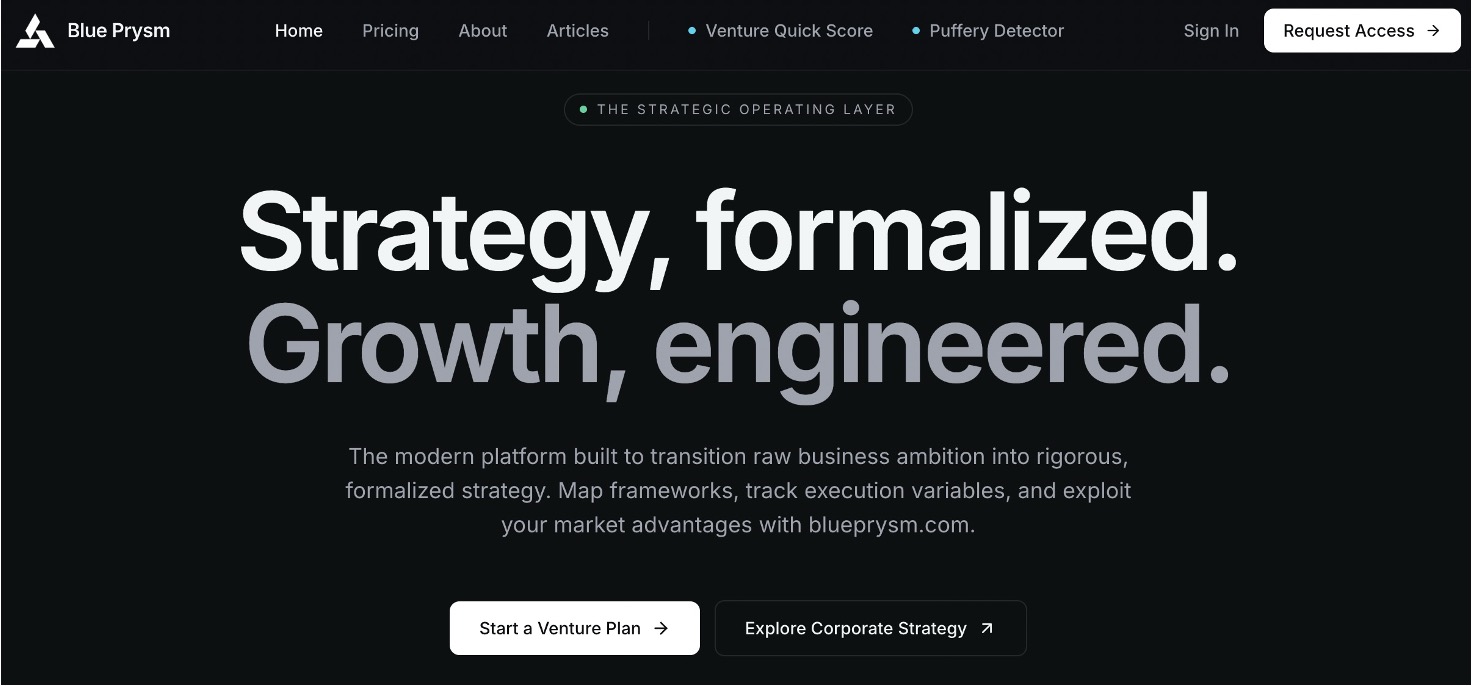
Explore how Blue Prysm’s private SOC 2 certified workspace and AI-driven scoring tools can shorten your time from idea validation to execution. Visit Blue Prysm now and bring clarity to your market monitoring and strategic planning. Start mapping your competitive edge and assign measurable objectives with confidence today.
Frequently Asked Questions
What features make Blue Prysm a suitable choice for strategic planning?
Blue Prysm offers framework-first planning to map strategy, assign OKRs, and trace execution back to hypotheses in one place. This feature allows executives to efficiently organize their planning process, ensuring alignment with strategic goals. Consider using Blue Prysm for integrated management of your strategic frameworks and execution metrics.
How does Blue Prysm’s Venture Quick Score compare to Watchful.ai?
Watchful.ai excels with its autonomous AI agents that continuously monitor competitor apps and websites across devices, providing real-time insights. Blue Prysm’s Advantage lies in its Venture Quick Score, which quantifies early idea assessments into a repeatable score, making it easier for teams to compare different projects. If you are focused on structured planning and validation, Blue Prysm is the better fit for your needs.
Can I use Blue Prysm if my organization needs independent validation tools?
Yes, Blue Prysm offers standalone tools that allow founders to validate ideas or check competitive claims without creating an account. This flexibility ensures that teams can quickly assess ideas during critical meetings without the commitment of setting up accounts. Utilize this feature for efficient, low-barrier validation in initial discussions.
What is Blue Prysm’s pricing for startups looking to implement strategic intelligence tools?
Blue Prysm’s paid plans start at $49 per month for startups, while offering free tools without account creation required. This pricing model makes Blue Prysm accessible for early-stage companies looking for strategic management capabilities. Evaluate the available features in the free plan to see how they might address your specific needs before upgrading.
How do the integration capabilities of Blue Prysm compare to Gopf?
While Gopf integrates directly into communication tools like Teams and WhatsApp for real-time alerts, Blue Prysm does not provide detailed public information on its integration capabilities. Nevertheless, Blue Prysm focuses on structured planning and validation tools, providing a powerful environment for executing strategic ideas. If deep integration is critical for your operations, assess both platforms based on your specific workflow requirements.
Recommended
- Top 6 blueprismai.com Alternatives 2026 – Blue Prysm – Articles & Blogs
- Unlocking competitive advantage with emerging AI trends – Blue Prysm – Articles & Blogs
- Top 5 Bizblueprint.info Alternatives 2026 – Blue Prysm – Articles & Blogs
- Top business decision-making trends for a competitive edge – Blue Prysm – Articles & Blogs