


TL;DR:
- Effective strategic planning aligns organizational goals with clear cause-and-effect strategies, enhancing execution. It requires collaborative processes, appropriate frameworks, and a well-defined review cadence suited to market volatility. Most plans fail in implementation due to social disconnects, not strategy flaws, making transparency and shared commitment vital.
Strategic planning is the disciplined process of defining your organization’s direction, priorities, and measurable goals to drive effective execution and continuous alignment. Most leaders know they need a plan. Far fewer build one that actually connects boardroom ambition to daily decisions. This guide walks through the full strategic planning process, from setting scope and timelines to choosing between the Balanced Scorecard, Hoshin Kanri, OKRs, and rolling planning models. If your last strategy document is gathering dust on a shared drive, this is where that changes.
What does a strategic planning guide actually cover?
A strategic planning framework is not a single document. It is a system of decisions, rhythms, and artifacts that keep your organization pointed in the same direction. The first decision is scope: are you planning for a team, a business unit, or the entire enterprise? Each level requires different inputs, different owners, and different levels of detail.
Planning horizons typically span 3 to 5 years for strategic plans, with shorter operational plans nested inside. That means your three-year vision needs to break down into annual priorities, which then break into quarterly milestones. Without that cascade, the three-year plan is just a wish list.
Review cadence is where most organizations quietly fail. Weekly check-ins suit fast-moving operational teams. Monthly reviews work for mid-level managers tracking KPIs. Quarterly reviews are the minimum for strategic-level conversations. The trap is setting a cadence and then skipping it when things get busy, which is exactly when you need it most.
Rolling planning replaces the static annual plan with a continuous quarterly cadence covering 3 to 6 quarters. This means your plan is always current, not a snapshot from last October. For SMEs operating in volatile markets, this is not a luxury. It is a survival mechanism.
- Define scope: team, unit, or enterprise
- Set a 3 to 5 year strategic horizon with annual and quarterly breakdowns
- Choose a review cadence that matches your pace of change
- Consider rolling planning if your market shifts faster than your annual cycle
Pro Tip: Balance granularity with adaptability. A plan with 47 initiatives and monthly updates for each will collapse under its own weight. Pick fewer priorities and review them more rigorously.
How to define mission, vision, values, and strategic priorities
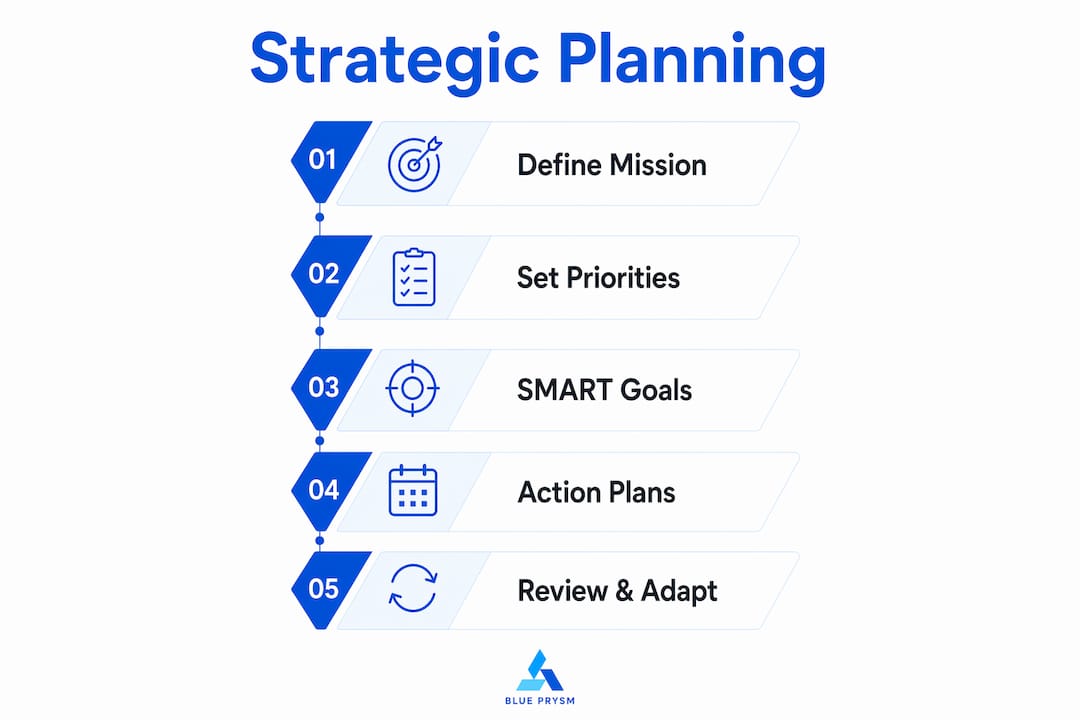
Mission, vision, and values are not decorative. They are the decision filters your managers use when the data is ambiguous and the pressure is high. Get them wrong, or leave them vague, and every strategic priority becomes a negotiation.
Here is how to build them with teeth:
- Write your mission as a constraint. “We exist to do X for Y” forces clarity. If your mission applies equally to every company in your industry, rewrite it.
- Make your vision a directional goal, not a slogan. “Be the leading provider of…” is not a vision. “Capture 20% of the mid-market by 2029” is.
- Run a SWOT analysis before finalizing priorities. Environmental scanning surfaces threats and opportunities that gut feeling misses. Tools like Blue Prysm’s real-time market briefings make this faster and more grounded in current data.
- Limit strategic priorities to three to five. More than five and you have a to-do list, not a strategy. Each priority should be specific enough that a manager can explain how their team’s work connects to it.
- Use stakeholder engagement to pressure-test priorities. When the people responsible for execution help shape the priorities, ownership follows naturally.
Pro Tip: Run a simple “so what?” test on every priority. If you cannot explain why it matters to the business in one sentence, it is not ready to be a strategic priority.
How to translate priorities into SMART goals and action plans
Broad strategic priorities become real when they are converted into specific, measurable objectives with owners and deadlines. This is where most business strategy manuals go abstract at exactly the wrong moment.
Follow this sequence:
- Define the strategic objective. Describe what success looks like in concrete terms. “Improve customer retention” becomes “Increase 12-month customer retention rate from 74% to 85% by Q4 2026.”
- Set SMART goals. Each goal needs a baseline, a target, a deadline, and a named owner. No owner means no accountability.
- Build initiatives and action plans. Each goal needs at least one initiative: a project or program with a timeline, budget, and milestones.
- Assign roles explicitly. Who decides? Who executes? Who reports? Ambiguity here is the single biggest cause of strategic drift.
- Select KPIs that match your review cadence. If you review quarterly, your KPIs must be measurable quarterly. OKR key results that cannot be measured at the review frequency make the entire review process ineffective.
The highest-leverage tool in this step is the strategy map. Strategy maps link non-financial drivers to financial outcomes through explicit cause-and-effect logic. They force you to articulate why improving employee training will eventually improve revenue, not just assume it will.
| Objective | SMART Goal Example | Owner | KPI |
|---|---|---|---|
| Grow recurring revenue | Increase MRR from $180K to $250K by Dec 2026 | VP Sales | Monthly MRR |
| Reduce customer churn | Improve retention from 74% to 85% by Q4 2026 | Head of CS | 12-month retention rate |
| Build leadership bench | Promote 3 internal managers by Q3 2026 | CHRO | Internal promotion rate |

Pro Tip: Use a goal cascade to show how team-level goals connect to company-level objectives. When people see the line from their work to the company’s direction, discretionary effort follows.
Which strategic framework fits your organization?
Four frameworks dominate serious strategic planning conversations. Each has a distinct logic, cadence, and ideal context.
| Framework | Core Logic | Review Cadence | Best For |
|---|---|---|---|
| Balanced Scorecard | Four perspectives, strategy maps | Quarterly/Annual | Established orgs with complex strategy |
| Hoshin Kanri | Catchball alignment, PDCA cycles | Annual with monthly reviews | Lean-oriented, process-driven orgs |
| OKRs | Objectives plus 2 to 5 key results | Quarterly | Fast-moving teams, tech companies |
| Rolling Planning | Continuous 3 to 6 quarter horizon | Quarterly, ongoing | Volatile markets, adaptive SMEs |
The Balanced Scorecard, developed by Kaplan and Norton, translates strategy into measures across four perspectives: financial, customer, internal process, and learning and growth. Its power is the strategy map, which makes cause-and-effect assumptions explicit and testable. Non-financial metrics predict future financial results, which means you are managing leading indicators, not just lagging ones.
Hoshin Kanri uses a process called catchball: priorities are passed up and down the organization for input before being finalized. This collaborative alignment builds ownership and surfaces execution risks before they become crises. Its PDCA (Plan-Do-Check-Act) cycles embed learning directly into the planning rhythm.
OKRs, popularized by Google and Intel, use quarterly reviews with 2 to 5 key results per objective. They are fast and transparent, but they require disciplined measurement design. If your key results cannot be tracked quarterly, the framework breaks down.
Rolling planning replaces static annual cycles with a continuous rhythm that integrates strategy and execution. It improves resource allocation and responsiveness in ways that annual planning structurally cannot. For data-driven SMEs, this model often outperforms the others in practice.
Common pitfalls that derail strategic planning
Most strategic plans do not fail because the strategy was wrong. They fail because the planning process itself was broken from the start.
- Treating planning as a form-filling exercise. Planning fails when it becomes top-down target assignment rather than collaborative alignment. The output looks like a plan. The organization does not behave like one.
- Disconnecting strategy from daily execution. If your managers cannot explain how their weekly priorities connect to the three-year plan, the strategy exists only on paper.
- Misaligning measurement cadence with review frequency. OKRs reviewed quarterly with key results that only update annually are theater, not management.
- Skipping the learning loop. Every review cycle should answer: what did we learn, what do we change, and who owns the adjustment?
Pro Tip: Use technology to maintain transparency between reviews. Blue Prysm’s competitor monitoring and real-time briefings give you the market context to make review conversations substantive, not just status updates.
Key takeaways
Effective strategic planning requires explicit cause-and-effect logic, matched review cadence, and distributed ownership to convert priorities into results.
| Point | Details |
|---|---|
| Set scope and cadence first | Define planning horizon and review frequency before selecting any framework. |
| Use strategy maps for clarity | Explicit cause-and-effect links prevent strategy drift and surface false assumptions early. |
| Match framework to context | Balanced Scorecard suits complex orgs; OKRs fit fast teams; rolling planning works best in volatile markets. |
| Design measurable key results | KPIs and OKR key results must be trackable at the same frequency as your review cycle. |
| Make planning collaborative | Distributed ownership through catchball or stakeholder engagement drives execution, not just compliance. |
Why I think most strategic plans are socially broken, not technically wrong
I have reviewed dozens of strategic plans across industries, and the pattern is consistent. The documents are often well-structured. The frameworks are correctly applied. The goals are SMART. And then nothing happens.
The problem is almost never the plan. It is the social contract around the plan. When a leadership team hands down priorities without genuine input from the people who will execute them, those people comply on paper and optimize for their own survival in practice. Hoshin Kanri’s catchball process exists precisely to solve this. It is not a nice-to-have. It is the mechanism that converts a document into a shared commitment.
The second thing I have learned is that strategy maps are underused to the point of negligence. Most organizations track KPI dashboards and call it strategy management. A dashboard tells you what happened. A strategy map tells you why it happened and what to do next. That distinction is worth more than any framework choice.
My honest recommendation: start with rolling planning if your market moves fast, layer in OKRs for team-level focus, and use a strategy map to hold the whole thing together. Tailor the combination to your organization’s maturity, not to what sounds impressive in a board presentation.
— Colin Bowdery
How Blue Prysm supports your planning process
Building a strategic plan is one thing. Keeping it alive through quarterly reviews, market shifts, and competing priorities is another problem entirely.
Blue Prysm gives business leaders the infrastructure to do both. The platform supports measurable objective tracking, KPI monitoring, and real-time market briefings that make every review cycle substantive. Whether you are running OKRs, a Balanced Scorecard, or a rolling planning model, Blue Prysm’s strategy platform connects your framework to live market intelligence, so your plan reflects reality, not last quarter’s assumptions. For SMEs that want elite-level strategic rigor without the consulting fees, this is where the process becomes practical.
FAQ
What is the ideal planning horizon for a strategic plan?
Strategic plans typically cover a 3 to 5 year horizon, with annual and quarterly breakdowns nested inside. Organizations in fast-moving markets often complement this with rolling planning that updates every quarter.
How is Hoshin Kanri different from OKRs?
Hoshin Kanri uses annual cycles with monthly reviews and a collaborative catchball process to align priorities vertically and horizontally across the organization. OKRs operate on quarterly cycles with 2 to 5 measurable key results per objective, making them faster and better suited to team-level execution.
Why do strategic plans fail in execution?
Planning fails most often when it is treated as top-down target setting rather than collaborative alignment. Distributed ownership, regular learning loops, and explicit cause-and-effect logic in strategy maps are the practical antidotes.
How many strategic priorities should an organization have?
Three to five strategic priorities is the practical limit for most organizations. More than five dilutes focus and makes it impossible for managers to explain how their work connects to the overall direction.
What makes rolling planning better than annual planning?
Rolling planning replaces a static annual snapshot with a continuous 3 to 6 quarter horizon that integrates strategy and execution. It improves responsiveness and resource allocation in ways that a once-a-year planning cycle structurally cannot match.