


TL;DR:
- Data-driven decision-making relies on analyzed data to guide business actions, reducing uncertainty and improving outcomes. Companies with mature real-time analytics achieve over 50% higher growth, but infrastructure and clear ownership are critical for success. Operational decisions benefit from automation, while strategic choices require human judgment supported by data, with governance ensuring accountability everywhere.
Data-driven decision-making (DDDM) is defined as the practice of using analyzed, reliable data insights to guide business actions rather than relying on gut feeling or guesswork. The role of data-driven decisions is to reduce uncertainty, sharpen resource allocation, and produce measurable outcomes that intuition alone cannot replicate. According to Salesforce, DDDM combines quantitative and qualitative data to deliver more consistent and accountable business results. For executives and analysts at small to mid-sized companies, this is not a philosophical shift. It is a competitive necessity.
How does data-driven decision-making improve business performance?
The performance case for DDDM is not theoretical. A MIT Sloan global study found that companies in the top quartile of real-time decision-making capability achieved over 50% higher revenue growth and net margins compared to slower peers. That gap does not come from better data alone. It comes from digitized operations, empowered employees, and governance structures that let data actually change behavior.

Research published in MDPI’s Systems journal reinforces this. Greater maturity in big data analytics, real-time processing, and data infrastructure readiness is statistically associated with higher organizational performance, with an adjusted R² of 0.69. That is a strong correlation, and it tells us that infrastructure investment is not a nice-to-have. It is the foundation that makes analytics capability worth anything.
A separate study of 366 employees in the food and beverage sector showed that DDDM mediates firm performance when digital supply chain practices are in place. In plain terms, digital tools alone do not move the needle. DDDM is the mechanism that converts digital capability into actual performance gains.
| Study | Key Finding | Performance Impact |
|---|---|---|
| MIT Sloan (real-time decision-making) | Top-quartile firms outperform peers | 50%+ higher revenue growth and net margins |
| MDPI Systems (analytics maturity) | Infrastructure readiness drives outcomes | Adjusted R² = 0.69 correlation with performance |
| ETASR (food and beverage sector) | DDDM mediates digital supply chain impact | Substantially elevated organizational outcomes |
Pro Tip: Before investing in new analytics tools, audit whether your current data infrastructure supports real-time access. A sophisticated dashboard built on stale or siloed data produces the same result as no dashboard at all.
What types of decisions benefit most from data-driven approaches?
Not every decision benefits equally from data. Understanding the types of data-driven decisions, and where human judgment still belongs, is what separates smart operators from dashboard addicts.
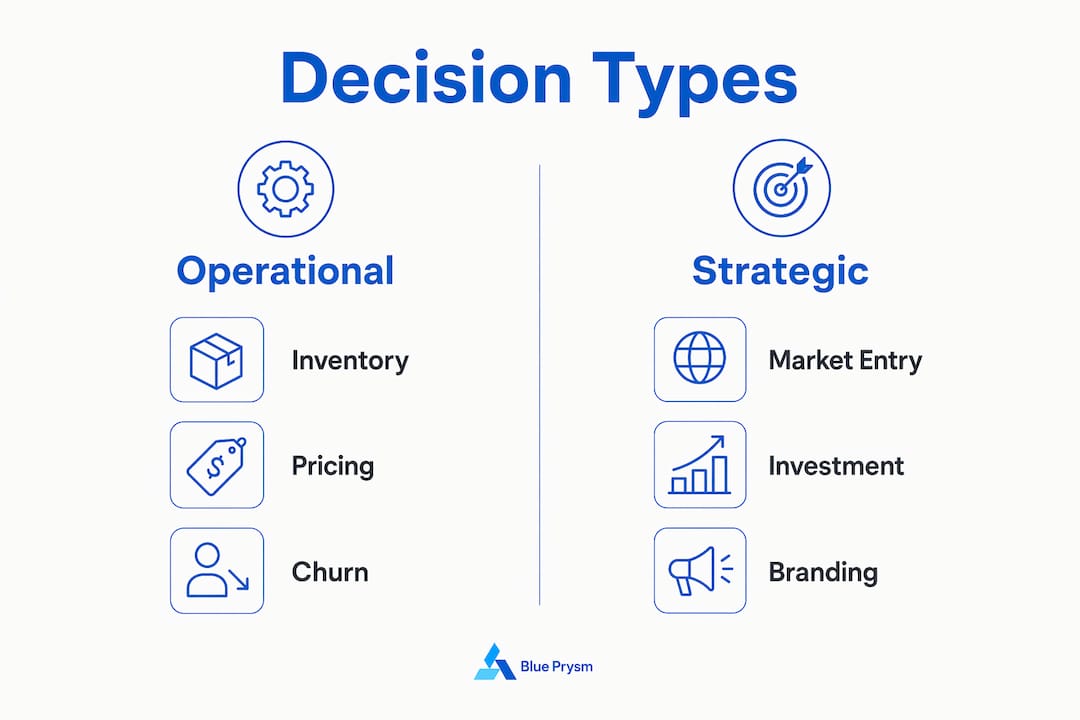
Broadly, decisions fall into two categories: operational and strategic. Operational decisions, like inventory reordering, pricing adjustments, or customer churn alerts, are high-frequency and rule-based. They are ideal candidates for data-triggered automation, where an algorithm fires an action when a threshold is crossed. Strategic decisions, like entering a new market or restructuring a product line, involve ambiguity, competitive dynamics, and long time horizons. These require data-influenced decision making, where analytics inform but do not replace human judgment.
The distinction between data-triggered and data-determined decisions matters enormously for governance. Automated algorithms require audit trails and validation controls. Human-in-the-loop analytics require clear ownership of the interpretation. Conflating the two is where organizations get into trouble.
The British Psychological Society notes that decision-making styles vary by context, and systematic approaches are not universally superior to intuitive ones. The practical implication is this: match your decision style to the decision type, not to your comfort with spreadsheets.
Here is a working breakdown of where data adds the most value:
- Operational decisions: Demand forecasting, dynamic pricing, fraud detection, inventory management
- Customer decisions: Segmentation, churn prediction, personalization, lifetime value modeling
- Financial decisions: Budget variance analysis, cash flow forecasting, unit economics tracking
- Strategic decisions: Market sizing, competitive positioning, M&A screening (data informs, judgment decides)
- Risk decisions: Compliance monitoring, supplier risk scoring, scenario planning
Does data eliminate judgment, or just move it?
Here is the uncomfortable truth most analytics vendors will not tell you. Stronger data does not remove judgment from your organization. It redistributes it to less visible places.
The LSE Business Review argued in 2026 that better analytics shift discretion to the framing of questions, the interpretation of outputs, and the timing of action. These are subtler judgment calls than the ones data was supposed to replace, and they are harder to audit. When a model flags a customer as high-risk, someone still decides what “high-risk” means in context, which threshold to act on, and when to override the model. That person carries accountability whether or not the organization acknowledges it.
This has real implications for how you design your analytics function. If judgment moves to framing and interpretation, then the analysts setting up your dashboards and defining your KPIs carry more strategic weight than their job titles suggest. Governance needs to follow judgment wherever it goes.
The organizations that handle this well treat data redistribution of judgment as an organizational design problem, not just a technology problem. They name decision owners for every key metric, define what action gets taken at each threshold, and build review cycles into their analytics workflows.
Pro Tip: Map every major dashboard metric to a named decision owner and a predefined action rule. If no one can answer “what do we do when this number hits X,” the metric is decoration, not intelligence.
What practical steps can businesses take to optimize data-driven decisions?
Knowing that data matters is not a strategy. Here is how to actually build the capability.
-
Align your data strategy with specific business goals. Start with the decision you need to make, then work backward to the data required. Collecting data without a decision context produces noise, not insight. If your goal is reducing customer acquisition cost, your data strategy should center on attribution modeling and channel performance, not vanity metrics like page views.
-
Invest in data infrastructure before analytics tools. The MDPI research is clear: analytics capability only pays off when the underlying infrastructure supports real-time processing and clean data pipelines. A Power BI dashboard fed by inconsistent CRM data will mislead you faster than no dashboard at all.
-
Embed decision rules into your analytics outputs. Dashboards improve transparency but rarely change outcomes unless metrics have named owners and predefined action thresholds. Build the “if this, then that” logic directly into your reporting layer.
-
Validate data before automating decisions. When algorithms act on data automatically, bad data creates bad actions, not just bad reports. Build validation checkpoints and audit trails into any automated decision workflow to catch stale or incorrect inputs before they cascade.
-
Connect analytics outputs to operational workflows. Analytics capability only creates performance improvements when it changes actual behavior. If your weekly sales report does not trigger a specific action by a specific person, it is a reporting exercise, not a decision support system. Integrate insights from tools like AI-powered decision platforms directly into the workflows where decisions get made.
-
Build data literacy across the organization. Real-time decision-making, as MIT Sloan found, depends on empowered employees, not just empowered executives. Front-line managers who understand their metrics and have authority to act on them are the last mile of any DDDM strategy.
Key takeaways
The role of data-driven decisions is to convert analyzed evidence into measurable business outcomes, but only when data infrastructure, decision ownership, and operational integration are all in place.
| Point | Details |
|---|---|
| Infrastructure before tools | Real-time analytics only perform when data pipelines are clean and current. |
| Decision ownership is non-negotiable | Every metric needs a named owner and a predefined action threshold to drive outcomes. |
| Judgment moves, not disappears | Data redistributes discretion to framing and interpretation, requiring governance to follow. |
| Match decision type to approach | Operational decisions suit automation; strategic decisions require data-informed human judgment. |
| Integration drives performance | Analytics connected to operational workflows produce results; standalone dashboards rarely do. |
Why I think most businesses are solving the wrong data problem
I have seen a pattern repeat itself across organizations of all sizes. Leadership invests in a new analytics platform, builds out dashboards, and then waits for performance to improve. It rarely does. The problem is not the data. It is the assumption that visibility automatically produces action.
The LSE Business Review’s 2026 argument about judgment redistribution resonated with me because it names something I have observed directly. When you give a team better data, you do not remove the hard calls. You move them. The analyst who frames the question, the manager who sets the threshold, the executive who decides when to override the model. These are all judgment calls, and they carry accountability whether or not anyone acknowledges them.
The businesses that get real value from DDDM treat it as an organizational capability, not a software purchase. They invest in big data strategy as a leadership discipline, not an IT project. They build decision ownership into their org charts. They ask “who acts on this?” before they ask “what should we measure?”
If your analytics investment is not producing decisions, the fix is not more data. It is clearer accountability and tighter integration between insight and action.
— Colin Bowdery
How Blue Prysm helps you act on data, not just collect it
Most SMEs do not have a data problem. They have a decision infrastructure problem. Blue Prysm was built specifically to close that gap, giving business leaders real-time market intelligence, competitor monitoring, and structured strategy frameworks without the consulting overhead.
Blue Prysm connects analytics outputs directly to strategic workflows, so insights from market briefings and performance data translate into decisions your team can act on immediately. If you are ready to move from reporting to deciding, the Blue Prysm platform shows exactly how the system works and what it delivers for businesses at your stage. For context on how digital transformation connects to data-driven performance, the evidence is consistent: integration is what separates insight from impact.
FAQ
What is data-driven decision-making?
Data-driven decision-making (DDDM) is the practice of using analyzed quantitative and qualitative data to guide business actions rather than relying on intuition. It reduces uncertainty and improves accountability by grounding decisions in evidence.
How does data-driven decision-making improve business performance?
Companies with mature real-time decision-making capabilities achieve over 50% higher revenue growth and net margins, according to MIT Sloan research. The gains come from combining data access with empowered employees and clear decision workflows.
What types of decisions benefit most from data?
Operational decisions like pricing, inventory, and churn detection benefit most from automated data-triggered approaches. Strategic decisions like market entry or product positioning benefit from data-influenced analysis paired with human judgment.
Does better data eliminate the need for human judgment?
No. The LSE Business Review argues that stronger analytics redistribute judgment to less visible areas like framing, interpretation, and timing rather than eliminating it. Governance and accountability structures must follow judgment wherever it moves.
Why do dashboards often fail to improve outcomes?
Dashboards improve transparency but rarely change behavior unless each metric has a named owner and a predefined action rule tied to specific thresholds. Without that structure, reporting and deciding remain disconnected activities.