


TL;DR:
- Effective data management involves organizing, securing, and governing data throughout its lifecycle to ensure accuracy and accessibility for decision-making. It requires coordination among people, processes, and technology to prevent issues like siloes, shadow IT, and technical debt. Proper governance and data quality enable faster, more reliable insights, AI readiness, and compliance.
Data management is the practice of collecting, organizing, securing, and governing data throughout its entire lifecycle to ensure accuracy, accessibility, and reliability for analytics and AI-driven decisions. According to SAP, this lifecycle spans distinct phases: creation and ingestion, organization, storage, security, usage, retention, and destruction. For business professionals and data analysts, getting this right is not optional. It is the difference between decisions grounded in fact and decisions made on gut feeling. Tools like IBM watsonx.data and Salesforce CRM have made enterprise-grade data discipline accessible to organizations of every size.
What is data management and why does it matter?
Data management is a broader organizational discipline than most professionals realize. It is not just maintaining databases. It covers governance, security, integration, and utilization across all data assets in your organization. Think of database management as one room in a house. Data management is the entire building, including the plumbing, electrical, and security system.
The core components you need to understand are:
- Data lifecycle phases: Ingestion, storage, usage, retention, and destruction. Each phase carries its own compliance and quality requirements.
- Data governance: Defines ownership, standards, and rules for data usage. Without governance, analytics efforts routinely fail to deliver business value.
- Data quality: Accuracy, completeness, and consistency across all sources.
- Architecture: The structural design that determines how data flows, integrates, and gets accessed across your systems.
Effective data management requires coordination across three pillars: people, processes, and technology. The tension between operational speed and necessary security is real. Organizations that ignore it end up with technical debt and compliance exposure.
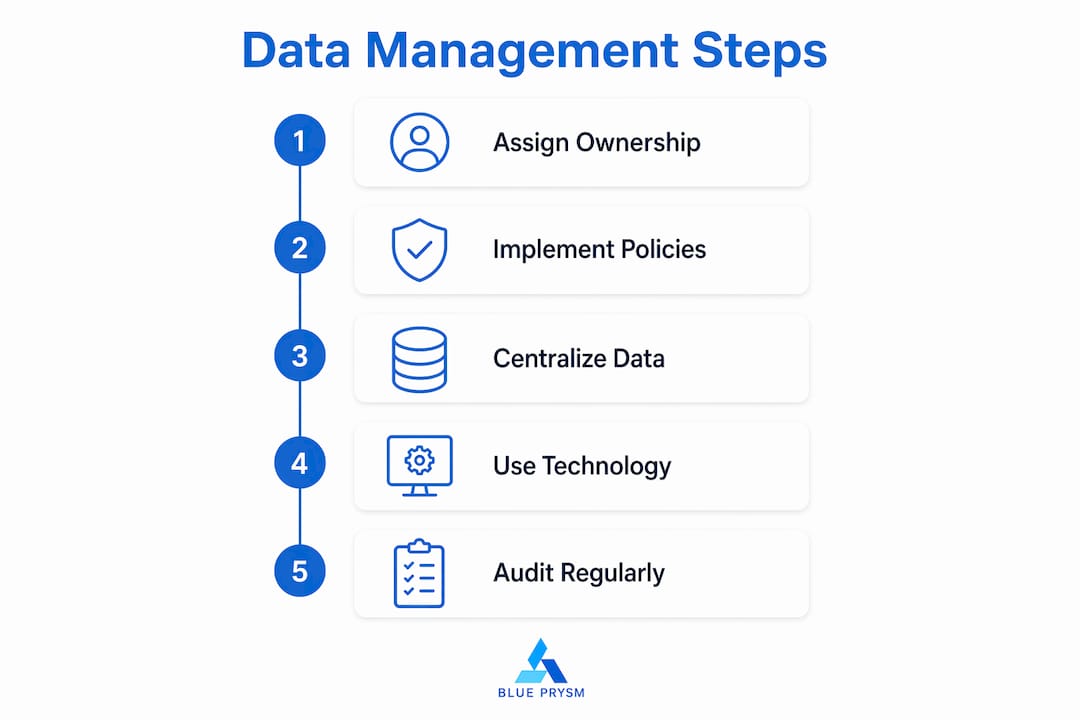
Pro Tip: Assign explicit data ownership to specific roles before you build any governance policy. Policies without owners are just documents nobody reads.

How do modern data management systems unify business data?
The market for data management software has matured significantly. The right system acts as a single source of truth, pulling fragmented data from spreadsheets, CRMs, cloud apps, and legacy tools into one governed environment.
Here is how the leading approaches compare:
| Solution | Best For | Key Strength | Governance Layer |
|---|---|---|---|
| IBM watsonx.data | Enterprise and AI-ready workloads | Unified hybrid and multi-cloud data foundation | Automated metadata and audit logging |
| Salesforce CRM | SMBs and mid-market teams | Consolidated customer and operational data | Role-based access and compliance controls |
| Databricks Unity Catalog | Data engineering and analytics teams | Converged data foundation with lineage tracking | Centralized policy enforcement across clouds |
IBM watsonx.data provides an AI-ready governed data foundation that unifies data across hybrid, multi-cloud, and on-premises environments. That architecture matters because AI models are only as trustworthy as the data feeding them. Databricks Unity Catalog takes a similar approach, using converged data foundations to unify data across environments with automated lineage tracking and role-based access.
For smaller organizations, Salesforce CRM consolidates fragmented spreadsheets and analog tools into a single platform, reducing duplicate work and lowering regulatory risk. The scalability of cloud-based solutions means you do not need an enterprise budget to operate with enterprise discipline. You can learn more about how AI-powered data frameworks unify and govern organizational data at scale.
What are the biggest data management challenges?
Most organizations do not fail at data management because the technology is too complex. They fail because of people and process problems that technology cannot fix on its own.
The most common pitfalls include:
- Siloed data: Teams using separate tools with no integration layer. Sales lives in one spreadsheet, finance in another, and nobody reconciles them.
- Shadow IT: Employees adopting unauthorized tools that create ungoverned data outside your official systems. Lack of executive sponsorship is the leading cause of shadow IT proliferation.
- Inconsistent policies: Governance frameworks that exist on paper but are never enforced. Rules without consequences are suggestions.
- Technical debt: Legacy systems that cannot integrate with modern platforms, forcing manual data transfers and creating error-prone workflows.
SMBs are particularly vulnerable to critical business data scattered across analog and fragmented digital tools. The result is duplicate work, missed opportunities, and real difficulty scaling operations. The fix is not always a new platform. Sometimes it is enforcing the policies you already have.
Pro Tip: Run a quarterly data audit. Identify every place your organization stores customer or operational data, then map which of those sources feed your actual decision-making. The gap between those two lists is your governance risk.
How does strong data management improve decision-making?
This is where the investment pays off. Unified data management reduces operational risk, speeds up decision-making, improves customer experience, and strengthens compliance posture. Those are not abstract benefits. They show up in your P&L.
Here are four concrete ways professionals use well-managed data to make better decisions:
- AI and analytics readiness: AI models require clean, governed, metadata-rich data to produce reliable outputs. Modern data architectures that power AI need unified frameworks for trust and scale. Without that foundation, your AI investment produces noise, not signal.
- Dashboarding and forecasting: When data is consistent and centralized, finance teams can build forecasts that actually reflect reality. Sales teams can track pipeline with confidence. Operations can spot bottlenecks before they become crises.
- Competitive intelligence: Real-time market data only has value if your data infrastructure can ingest, organize, and surface it quickly. Slow data pipelines mean you are always reacting, never anticipating. Pairing your data foundation with real-time AI analytics dramatically shortens that reaction time.
- Compliance and risk reduction: Regulated industries face fines and reputational damage when data governance fails. A well-structured data management system creates the audit trails and access controls that regulators require.
The professionals who treat data management as a strategic asset, not an IT function, consistently outperform those who do not. You can explore how AI-driven insights translate managed data into competitive advantage for business leaders.
Key takeaways
Effective data management requires coordinating people, processes, and technology under a governed framework, because clean and accessible data is the foundation every business decision and AI application depends on.
| Point | Details |
|---|---|
| Governance is non-negotiable | Assign data ownership and enforce policies before investing in new tools. |
| Unified systems reduce risk | Consolidating fragmented data into platforms like Salesforce or IBM watsonx.data cuts duplicate work and compliance exposure. |
| AI readiness starts with data quality | Governed, metadata-rich architectures are the prerequisite for trustworthy AI outputs. |
| People and process failures dominate | Shadow IT and unenforced policies cause more data problems than technology limitations. |
| Decision speed improves with clean data | Centralized, accurate data enables faster forecasting, dashboarding, and competitive response. |
The part most organizations get backwards
I have worked with dozens of business teams that invested in expensive data management software before they had any governance in place. The result is always the same: a sophisticated platform full of dirty, duplicated, ungoverned data. The technology becomes a liability instead of an asset.
The uncomfortable truth is that governance is boring. Nobody wants to spend a Tuesday afternoon defining data ownership rules or writing a data retention policy. But that work is what separates organizations that actually use their data from organizations that just store it.
My observation for 2026 is that the gap between AI-ready organizations and everyone else is widening fast. The difference is not which AI tool you bought. It is whether your underlying data is trustworthy enough for AI to act on. I have seen teams with modest budgets outperform well-funded competitors simply because they disciplined their data processes early.
The other thing I would push back on is the idea that data management is an IT problem. It is a leadership problem. Executive sponsorship determines whether governance policies get enforced or ignored. If your CEO does not treat data quality as a business priority, your data team is fighting uphill every single day.
Start with the audit. Map your data. Assign owners. Then buy the software.
— Colin Bowdery
How blue prysm turns managed data into strategic advantage
Good data management creates the foundation. Blue Prysm builds on it. The platform delivers real-time market briefings, competitor monitoring, and AI-driven analysis designed specifically for business professionals who need strategic intelligence without a consulting firm’s price tag.
If your data infrastructure is getting sharper, the next question is what you are doing with it. Blue Prysm’s market analysis platform connects your data discipline to live competitive intelligence, giving your team the context to act on what your data is telling you. For teams that want to go deeper, the AI-powered research tools support structured data collection, synthesis, and strategic planning at a fraction of traditional consulting costs.
FAQ
What is data management in simple terms?
Data management is the organizational practice of collecting, storing, securing, and governing data across its entire lifecycle to keep it accurate and accessible for business decisions.
How is data management different from database management?
Database management focuses on maintaining operational databases, while data management is the broader discipline covering governance, security, integration, and utilization across all organizational data.
What are the best tools for data management?
IBM watsonx.data, Salesforce CRM, and Databricks Unity Catalog are among the most widely adopted platforms, each suited to different scales and use cases from SMBs to enterprise AI workloads.
Why do data management strategies fail?
Most failures trace back to weak governance enforcement and lack of executive sponsorship, which leads to shadow IT, siloed data, and policies that exist on paper but are never followed.
How does data management support AI adoption?
AI models require clean, governed, and metadata-rich data to produce reliable outputs. Without a unified data foundation, AI investments generate inconsistent results that undermine rather than support decision-making.