


Continuous planning is an always-on, rolling-horizon process that updates forecasts and priorities monthly or quarterly instead of once a year. The primary payoff is speed: leaders reallocate capital and re-rank initiatives based on current data rather than assumptions baked in eleven months earlier. It doesn’t replace annual planning so much as keep it honest, feeding a bimodal approach where quick cycles handle change while the annual plan sets the long-term frame.
TL;DR:
- Continuous planning extends forecasts over 3 to 18 months with monthly or quarterly updates, balancing flexibility with long-term vision.
- A draft window allows for strategic drift, while a shorter published window ensures near-term execution remains stable.
- Success relies on high-quality, centralized data, clear decision rights, and focused metrics to avoid governance and data quality pitfalls.
- Start small with a 90-day pilot, selecting a single unit and a dedicated team while defining explicit roles and KPIs before scaling.
- Tools like Blue Prysm integrate market signals, strategic frameworks, and dashboards to enable real-time, responsive decision-making.
What Is Continuous Planning? Rolling Horizons Explained
Most strategic plans die the moment a competitor launches, a supply chain hiccups, or a key customer churns, because the plan was built to survive twelve months without touching it again. Continuous planning fixes that by treating the plan as a living document with a moving window instead of a fixed annual snapshot.
The mechanism is a rolling horizon, a concept thoroughly explored in Agile App Development: Build faster with less rework, which links agile execution cadences with continuous planning rhythms. Instead of planning once for the fiscal year, you maintain a forecast that always extends a set distance into the future, commonly 3 to 18 months, and you refresh that forecast on a fixed cadence, usually monthly or quarterly. Each cycle, the oldest month drops off and a new one gets added, so the organization is never staring at a plan that’s aging out of relevance.
Here’s where it gets practical: not every part of that rolling window carries the same weight. Organizations that do this well split the horizon into two zones:
- The draft window: the full forward view, a typical planning horizon, used for directional decisions like hiring plans and vendor negotiations that need lead time.
- The published window: a shorter, locked-in slice, often the next 1 to 3 months, that teams commit to and execute against without second-guessing.
Each month, you replan the draft, but you only publish a fresh, stable slice for near-term execution. This is the same logic operations teams use in workforce rostering, where a planning run drafts far enough out to avoid painting itself into a corner, then locks a shorter window so front-line teams aren’t chasing a moving target every day (a technique documented in OptaPlanner’s repeated planning guidance).
Should this replace your annual plan entirely? Rarely, and probably not yet. The organizations getting the most out of this treat it as complementary: the annual cycle still sets the multi-year vision, capital allocation guardrails, and board-level commitments, while continuous planning handles the reallocation and reprioritization that happens between those checkpoints.
Benefits and Common Hurdles of Continuous Planning
The case for continuous planning is strong, but so is the list of ways companies botch the rollout. Both deserve equal airtime.
On the upside, four benefits show up consistently across organizations that adopt this model:
- Agility: you can shift budget toward what’s working within weeks, not quarters.
- Better forecasts: shorter feedback loops catch forecasting drift before it compounds into a bad quarter.
- Alignment: a shared rolling forecast keeps finance, product, and sales looking at the same numbers instead of three separate spreadsheets.
- Faster decisions: pre-agreed decision rules mean fewer meetings just to decide who gets to decide.
The hurdles are just as real. Bad data kills continuous planning faster than anything else, since a monthly reforecast built on stale or mismatched inputs just multiplies noise. Governance fatigue is the second killer: if the monthly forum turns into a status update with no teeth, people stop showing up prepared. Political resistance follows close behind, particularly from teams used to locking in budget once a year and defending it. And plenty of companies underestimate the tooling gap between “we have a spreadsheet” and “we have a live rolling forecast.”
None of these are reasons to skip continuous planning. They’re reasons to start smaller than your ambition wants you to.
Pro Tip: Pick three to five canonical metrics before you touch a single spreadsheet. Every hurdle on this list gets worse when teams are arguing about which number is “real” instead of what to do about it.
How Continuous Planning Works: Process and Cadence
Strip away the frameworks and continuous planning boils down to a loop: sense, decide, act, repeat. What changes between organizations is how fast that loop spins and what gets produced at each turn.
- Sense: weekly signal reviews pull in pipeline data, competitor moves, and operational metrics. This is the fastest layer, and it’s where the “watch list” concept from always-on strategy work earns its keep. Nothing gets acted on yet. You’re just noticing.
- Decide: monthly forecast updates translate those signals into a revised rolling forecast and a re-ranked strategic backlog. This is where a business unit lead might argue that a competitor’s price cut justifies pulling budget forward on a retention campaign.
- Act: quarterly recalibration is where bigger structural moves happen: reallocating headcount, killing a stalled initiative, funding a new bet that emerged from three straight months of strong signal.
Each cycle should leave behind a handful of concrete artifacts, not just a meeting recap. A watch list tracks emerging risks and opportunities that haven’t yet earned a decision. A rolling forecast shows the current numeric view across the draft horizon. A strategic backlog ranks initiatives by expected value against cost, borrowing directly from how agile strategy practitioners at SEI, Carnegie Mellon manage strategic epics. And a short reforecast memo explains what changed and why, so the next cycle isn’t relitigating the last one.
The draft horizon matters more than most leaders realize. If you only plan as far out as you publish, you’ll constantly discover in month three that a decision made in month one locked you out of an option you now need. Timefold’s documentation on continuous planning makes this point in an operational context, but the principle holds for strategy too: draft wide, publish narrow.
Implementation Steps: A 90-Day Pilot Checklist
You don’t need to overhaul your entire planning function to find out if this works for your company. You need one good pilot and the discipline to measure it honestly.
- Get sponsorship first. Continuous planning without a CEO or CSO willing to defend it in month two, when the novelty wears off, dies quietly. Define what success looks like before you start, not after.
- Scope narrow. Pick one business unit or product line. Resist the urge to roll this out company-wide on day one; a contained pilot surfaces problems without putting the whole budget at risk.
- Assemble a small cross-functional team. You need finance, product, and operations represented, not a committee of ten.
- Centralize your data first. If finance, sales, and product are pulling from three different sources of truth, fix that before you add a faster cadence on top of bad inputs.
- Define a small set of key performance indicators. More than that and your monthly forum turns into a data-quality debate instead of a decision-making session.
- Choose tooling categories, not vendors, at this stage. You need something that handles rolling forecasts, something that tracks competitive and market signals, and something that visualizes execution against plan. Worry about specific platforms after the pilot proves the model.
- Run the 90-day test. Weekly signal reviews, monthly forecast updates, one quarterly recalibration at the end.
- Measure and iterate. Did decisions get made faster? Did the forecast track closer to actuals than your last annual cycle did at the same point?
- Scale deliberately. Use what the pilot taught you to formalize roles, funding rules, and the meeting cadence before expanding to a second business unit.
Pro Tip: Treat the first 90 days as a research project, not a rollout. The goal isn’t to prove continuous planning works in theory. It’s to find the three things that will break when you try it in your specific company, and fix those before you scale.
Governance Model: Who Owns Continuous Planning?
Continuous planning fails almost as often from governance chaos as from bad data. Someone has to own the cadence, and someone has to have the authority to actually reallocate money when the data says to.
The model that shows up most often in always-on strategy research from BCG puts a CEO in the sponsor seat, with day-to-day operational ownership sitting with a CSO or equivalent strategy lead. Below that sits a strategy board, typically the CEO plus functional leaders from product, finance, and operations, whose entire job is to scan the watch list, rank live strategic issues, and keep the rolling forecast honest.
The cadence that keeps this from collapsing into meeting fatigue looks like this:
- Weekly: a short signals review, thirty minutes, no decisions, just pattern recognition.
- Monthly: a half-day strategy forum where the board reviews the rolling forecast, re-ranks the strategic backlog, and makes reallocation calls within pre-agreed limits.
- Quarterly: a deeper recalibration session that revisits assumptions, kills underperforming bets, and feeds updates back into the annual plan.
Decision rights need to be explicit before the first meeting, not negotiated live. Who can move budget between initiatives without escalation, and up to what dollar threshold? Who has to sign off before an initiative gets killed? Which cross-unit conflicts get escalated to the CEO versus resolved at the board level? Write these down. The alternative is relitigating authority every single month, which is exactly the governance fatigue that kills most attempts at this.
Metrics and Tools That Support Continuous Planning
You can’t run a monthly reforecast on gut feeling, and you can’t run it on lagging indicators alone either, since by the time quarterly revenue tells you something’s wrong, you’ve already lost the quarter.
The fix is pairing leading and lagging indicators deliberately. Leading indicators, things like sales pipeline velocity, website conversion trends, or customer support ticket volume, tell you what’s about to happen. Lagging indicators, like quarterly revenue or churn, confirm what already did. BCG’s always-on framework treats both as necessary inputs into the same reforecast loop: leading indicators trigger the conversation, lagging indicators validate whether last cycle’s decision worked.
Building this out requires a handful of tool categories working together, not one monolithic system:
- A data warehouse or ETL layer that pulls finance, sales, and operational data into one place, since fragmented sources are the single fastest way to kill trust in the numbers.
- A rolling forecast engine that updates projections as new actuals come in, rather than requiring a manual rebuild each cycle.
- Scenario modeling tools that let you stress-test a reallocation decision before you commit real budget to it.
- Market intelligence feeds that surface competitor moves and market shifts, similar to what’s covered in Blue Prysm’s guide to real-time market analysis.
- Execution dashboards that show whether teams are actually delivering against the published window, not just whether the plan looks good on paper.
Get the metrics wrong and the cadence doesn’t matter. A monthly meeting reviewing the wrong, a limited number of metrics is worse than no meeting at all, because it creates false confidence.
Blue Prysm in Practice: Proof Points and Next Steps
The mechanics above only matter if you have somewhere to run them. Blue Prysm was built around this exact cadence: real-time market insights feed the sensing layer, the strategy library gives you a starting framework instead of a blank page for the strategic backlog, and execution dashboards close the loop by showing whether the published window is actually being delivered.
For teams building out the watch list piece specifically, Blue Prysm’s guide on industry monitoring tools for decision-makers walks through practical monitoring setups, and the market opportunity analysis guide breaks down how market scans translate into ranked initiatives rather than another report nobody reads.
What Leaders Get Wrong About Continuous Planning
The biggest mistake I see isn’t skipping continuous planning. It’s treating it as a replacement for the annual cycle instead of a complement to it. Companies that rip up their annual plan entirely lose the long-term guardrails that keep monthly reallocation from turning into monthly whiplash.
The second mistake is starting company-wide. A narrow pilot, one business unit, a handful of key metrics, ninety days, tells you more than a year of company-wide meetings that nobody prepares for.
Three things to do this quarter: pick your pilot unit, name a governance owner, and cut your KPI list down to a focused list of relevant performance measures before the first forum happens.
— Colin Bowdery
Put Continuous Planning to Work With Blue Prysm
Most companies trying to build this cadence end up stitching together a data warehouse, a market-intel subscription, a forecasting spreadsheet, and a dashboard tool that don’t talk to each other. Blue Prysm was built to close that gap for small and midsize teams specifically, combining real-time market feeds, competitor tracking, and execution dashboards in one platform instead of four disconnected ones.
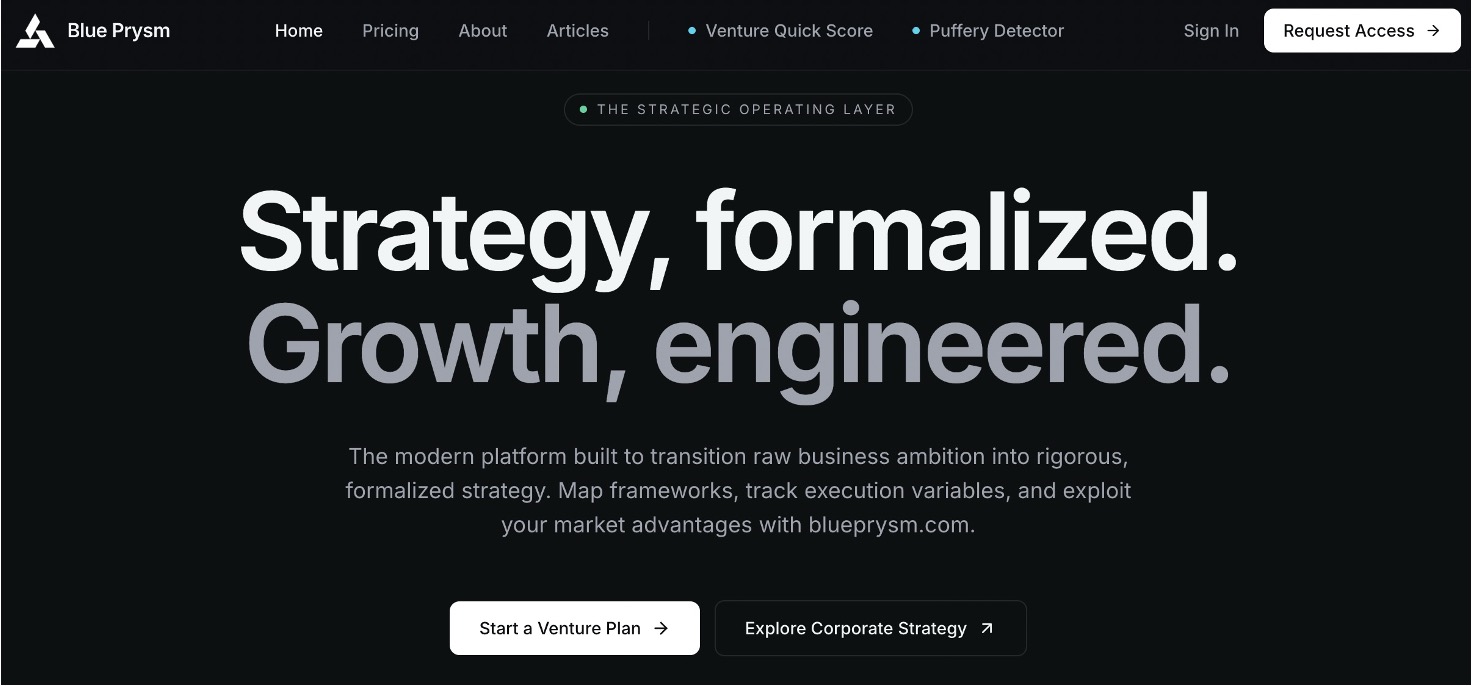
If you’re piloting the 90-day approach outlined above, Blue Prysm’s market analysis platform gives your team the live signals layer for weekly reviews, while the strategy library hands you a starting framework instead of a blank strategic backlog. Pair that with competitive intelligence tracking to automate the watch list piece your monthly forum needs. Start a trial and run your first thirty-day signal cycle before your next board meeting.
Sources
- What is Continuous Planning? — IBM
- Always-On Strategy — BCG
- Continuous planning — Timefold documentation
- Repeated planning — OptaPlanner
FAQ
What Are the Four Types of Planning?
Strategic, tactical, operational, and contingency planning are the four commonly recognized types, covering long-term direction, mid-level resource plans, day-to-day execution, and risk response respectively. Continuous planning is a methodology that can apply across strategic and tactical layers rather than a fifth separate type.
What Is Continuous Planning in Agile?
In agile contexts, continuous planning means treating strategy as a living backlog of prioritized initiatives reviewed on a short cycle, similar to how agile strategy frameworks manage strategic epics rather than a fixed annual roadmap.
What Are the Five Levels of Agile Planning?
Definitions vary across agile frameworks, but a common version includes strategy, portfolio, product roadmap, release, and iteration planning, moving from long-term vision down to short-term execution detail.
Why Is Planning Continuous Instead of Annual?
Markets, competitors, and internal performance shift faster than an annual cycle can track, so continuous planning uses monthly or quarterly rolling updates to keep forecasts and priorities current instead of locking decisions in for twelve months at a time, as outlined in IBM’s continuous planning framework.
How Does a Platform Like Blue Prysm Support Continuous Planning?
Blue Prysm combines real-time market monitoring, competitor tracking, and execution dashboards so strategy teams can run the sense, decide, and act loop without stitching together separate tools for each step.