


A strategic management audit objectively checks whether a company’s strategy still fits its market and whether the team can actually execute it, then hands leadership a prioritized roadmap to fix the gaps. Hire one when growth stalls, a big change is coming (new leadership, an acquisition, a market shock), or nobody can say with confidence why last year’s plan missed its numbers. Blue Prysm built its platform around exactly this problem: one published field guide from Strategy Management Group notes that a credible diagnostic can run in 30 to 45 days when it’s scoped tightly around the metrics that actually move revenue.
TL;DR:
- External audits provide objective insights, benchmarking, and quicker root cause identification, especially during major events like mergers or leadership changes.
- A comprehensive audit examines market trends, internal capabilities, governance, performance systems, execution, and data quality to identify concrete issues affecting strategy implementation.
- A rapid diagnostic typically takes 4 to 6 weeks, while a full audit spans 8 to 12 weeks, with frequency dictated by market volatility and organizational needs.
- Choosing the right provider requires assessing domain experience, deliverables, independence, data capabilities, and transparent stakeholder engagement processes.
- Modern platforms with AI-enabled tools can streamline environmental scanning and turn audit findings into actionable roadmaps, but leadership readiness to act on results remains crucial.
What a Strategic Management Audit Delivers
A strategic management audit is not a status update. Routine planning check-ins tell you where you are against the plan; an audit asks whether the plan itself still makes sense given what’s changed in the market and inside the company. That distinction gets lost constantly, and it’s why so many “strategy reviews” produce a nicer slide deck and zero new insight.
A real audit produces four things: a diagnostic report that names the gaps between stated strategy and actual capability, a prioritized action list ranked by impact and effort, a longer implementation roadmap with sequencing and ownership, and governance recommendations covering who should be deciding what. Firms structuring this work formally often deliver a substantial written report, sometimes running 40-plus pages, built from interviews and data review rather than assumption.
Boards commission these audits to satisfy their oversight duty. CEOs commission them when they suspect the strategy is fine but the execution isn’t. Strategy leads commission them, sometimes quietly, when they need outside validation to move a stalled initiative forward. All three are buying the same thing: an objective review that isn’t shaped by internal politics.
When Should You Bring in an External Auditor?
Some triggers practically write themselves onto the calendar: a merger or acquisition, a new CEO or CFO walking in the door, technology shifting the competitive floor under an entire category, or two straight quarters of underperformance nobody inside the building can explain. Each situation shares one problem. The people closest to the strategy are usually the least equipped to see what’s wrong with it.
External audits add value in three specific ways. They bring objectivity that internal teams structurally cannot, because nobody wants to write the memo that says their own department is the bottleneck. They bring benchmarking, comparing your resource allocation and KPI discipline against what actually works elsewhere. And they find root causes faster, since an outside team isn’t burning cycles defending prior decisions.
Internal reviews still make sense for lighter-touch, higher-frequency check-ins, quarterly OKR reviews, monthly KPI scans. Save the external audit for the moments where the stakes are higher than a routine cadence can catch.
What Does an Audit Team Actually Examine?
A useful audit engagement is not a document review. It’s a structured walk through six areas, and any provider who skips one of them is giving you half an audit.
- External market scanning: industry trends, specific competitor moves, and shifts in what customers actually need versus what the last plan assumed they need.
- Internal capability review: a rigorous SWOT, an honest look at core processes, and whether the org chart still matches how work actually flows.
- Governance and accountability: who holds decision rights, how much oversight the board genuinely exercises, and where decisions stall for lack of a clear owner.
- Performance systems: whether KPIs and OKRs are tracked consistently, and whether resources are allocated according to strategic priority or just historical habit.
- Execution mechanics: the health of the project portfolio, the operating cadence (weekly, monthly, quarterly checkpoints), and how change actually gets managed once it’s decided.
- Data and technology: data quality, and whether the organization has any continuous, AI-enabled sensing capability or is still relying on static, backward-looking reports.
That capability piece matters more than most leaders assume going in. Auditors need to evaluate whether the organization’s processes and structure genuinely support execution, not just whether the strategy document sounds good on paper. A brilliant strategy sitting on top of a broken approval process is still a broken strategy.
How Long Does a Strategic Management Audit Take?
Most strategic management audits follow a seven-step cycle, and the value comes from treating it as a loop, not a one-time event:
- Revisit vision and mission to confirm they still describe where the company is actually trying to go.
- Run an environmental scan of market, competitor, and customer shifts.
- Formulate or refine strategy based on what the scan turns up.
- Reallocate resources (budget, headcount, attention) to match the refined priorities.
- Review implementation against what was actually planned.
- Track performance through KPIs and OKRs against targets.
- Make strategic adjustments and feed them back into step one.
Coursera’s overview of the strategic management process frames this cycle as continuous rather than annual, noting that companies like Google run it on a quarterly rhythm, assigning four to six OKRs per quarter to stay focused.
Timing depends on scope. A rapid diagnostic, tightly scoped around your top KPIs and a handful of stakeholder interviews, typically runs 4 to 6 weeks. A full audit covering every checklist item above runs 8 to 12 weeks. On frequency, there’s no universal mandate. Academic treatment of audit structure ties the right cadence to how much uncertainty the business is exposed to, ranging from quarterly checkpoints for volatile markets to a single annual formal audit for stable ones, with trigger-based ad hoc audits layered on top when something breaks.
How Do You Choose the Right Audit Provider?
The wrong provider hands you a polished deck and disappears. The right one leaves you with an execution plan and a team that knows how to run it. Screen for the difference before you sign anything.
- Domain experience: have they audited companies your size, in your industry, facing your kind of problem?
- Sample deliverables: ask to see an anonymized diagnostic report, not just a proposal template.
- Governance process: how do they structure stakeholder interviews, and who signs off on findings before they reach the board?
- Independence: are they incentivized to recommend more consulting work, or to hand you a plan you can run yourselves?
- Data and AI capability: do they use continuous monitoring tools, or are they building the entire diagnostic from static, backward-looking reports?
- Pricing structure: fixed-fee diagnostic versus open-ended hourly engagement changes the incentive structure entirely.
On the intro call, ask directly: who’s on the audit team and what’s their independence from any related consulting arm? Can I see a sample diagnostic from a comparable engagement? What’s the realistic timeline, and how do you handle confidentiality around sensitive financials? What happens after the report lands, do you help with execution or is that our problem?
Pro Tip: If a provider can’t describe their stakeholder interview process in specific terms, walk away. Vague answers on engagement structure almost always predict a vague deliverable at the end.
Watch for two red flags in particular: deliverables described only in abstract terms (“comprehensive review,” no specifics), and no real plan for interviews, focus groups, or surveys. An audit that skips stakeholder engagement is an audit that will miss the real root cause, because the people who know where the bottlenecks are live never got asked.
Where AI Fits Into a Modern Strategic Audit
The audit industry has quietly moved past the once-a-year hindsight report. Large firms are building AI-enabled analytics and continuous risk sensing directly into their audit lifecycle, because a report that describes what happened six months ago is a lot less useful than one that flags a problem while you can still act on it.
That shift is exactly what Blue Prysm’s platform is built for at the SMB scale. Real-time market insights and automated competitor tracking compress the environmental scanning step from weeks of manual research into something an audit team can validate and move past quickly, testing hypotheses instead of chasing raw data. The strategy library and built-in OKR and KPI tracking then take whatever the audit surfaces and convert it into a working roadmap instead of another static slide.

Colin Bowdery has pointed out that tools like this don’t replace an audit’s independence, they extend it. A platform can hand your audit team a live competitive snapshot on day one; it still takes a human, sitting outside the org chart, to ask why nobody acted on it.
Turning Audit Findings Into Actual Planning
An audit report that sits in a shared drive after the presentation is a wasted engagement. The findings only earn their cost once they’re stitched into the planning process that runs the business day to day, and that stitching is where most organizations quietly drop the ball.
Start with the prioritized action list the audit produced and map each item onto the next planning cycle, not a separate “audit follow-up” track that competes for attention with everything else. If quarterly OKRs already drive your operating rhythm, the top three or four audit findings should show up as OKRs next quarter, with named owners, not as a general aspiration to “improve alignment.” Vague ownership is where audit recommendations go to die.
Resource allocation decisions need to reflect the audit’s findings immediately, not at the next annual budget cycle. If the audit found that a business unit is overstaffed relative to its strategic priority, that gets addressed in the next planning conversation, not filed for later review.
Governance is the other half. Whoever owns strategic oversight, board, CEO, or a dedicated strategy committee, needs a standing checkpoint to review progress against the audit’s roadmap, not just a one-time readout when the engagement ends. Treat the roadmap as a living document that gets revisited at whatever cadence the audit itself recommended, quarterly for volatile situations, annually for stable ones. An audit that’s followed by silence for the next eleven months has functionally been ignored, regardless of how good the report was.
Why Most Audits Fail Before They Even Start
The single biggest predictor of a wasted audit engagement isn’t the provider’s skill. It’s whether the organization is culturally ready to be honest with them.
An audit succeeds only when leadership commits to transparency and frames the process as diagnostic, not disciplinary. The moment staff sense the audit is really a performance judgment aimed at specific people or departments, they withhold evidence, soften their answers in interviews, and the root causes stay buried exactly where they were before anyone showed up with a clipboard. No amount of analytical rigor recovers from that.
Ownership is the second failure point. An audit can name the exact fix needed and still go nowhere if no single person is accountable for driving it. “The leadership team will address this” is not ownership, it’s a way of ensuring nobody does.
The third, and most underestimated, is implementation will. Some organizations have plenty of transparency and clear ownership, and still stall, because the appetite to actually change how work gets done simply isn’t there. Effective audits combine interviews, document review, quantitative KPI checks, and focused workshops specifically to build that ownership into the process itself, rather than delivering a plan and hoping momentum appears on its own. Handing over a polished deck with no execution mechanism attached is one of the most common ways good diagnostic work gets wasted.
If you’re preparing to commission an audit, the honest question to ask your own leadership team first isn’t “are we ready for the findings.” It’s “are we ready to act on findings we don’t like.”
How Do You Know the Audit Actually Worked?
An audit’s value is easy to overstate in the excitement right after delivery and easy to forget six months later. Measuring its real impact takes a few concrete checkpoints, not a gut feeling.
Track whether the prioritized action items from the report actually got assigned owners and deadlines within 30 days of delivery. That single metric, action items with named owners versus action items that just sit in the document, predicts more about eventual impact than almost anything else.
Watch the KPIs the audit flagged as problems. If the audit identified that a specific metric, say customer acquisition cost or pipeline conversion, was drifting from target, check that number again at 90 days and again at two quarters. Movement in the right direction is the clearest signal the diagnostic pointed at something real and the organization responded.
Governance follow-through matters too. Did the board or leadership team actually hold the standing review checkpoints the audit recommended, or did that cadence quietly evaporate after the first meeting? A strategic plan audit that produces no lasting change in how often leadership checks progress hasn’t changed the organization’s actual behavior, whatever the report itself concluded.
Finally, run a lightweight pulse check with the people who were interviewed. Ask whether they’ve seen any of their input reflected in decisions since. If the answer is a shrug, the audit’s transparency problem showed up after delivery instead of during it, and that’s worth knowing before you commission the next one.
What Legal and Ethical Lines Matter During an Audit?
Strategic audits touch sensitive material fast, financials, personnel performance data, unreleased product plans, and sometimes information that’s material to investors or acquirers. Handling that carelessly turns a diagnostic exercise into a liability.
Confidentiality agreements need to be explicit and mutual before any interview happens, not handled as an afterthought once findings start surfacing. Anyone conducting stakeholder interviews should be clear, up front, about how individual comments will and won’t be attributed in the final report; a promise of anonymity that gets broken in the deliverable destroys trust for every future audit the organization ever tries to run.
Independence carries its own ethical weight. If the audit provider also sells implementation or consulting services, the findings should be scrutinized for whether they’re genuinely objective or subtly shaped to justify a larger follow-on engagement. That’s not an accusation against any specific provider, it’s a structural conflict worth naming and asking about directly during selection.
Data handling deserves the same scrutiny as any other sensitive business process, particularly when AI-enabled tools are pulling from internal systems as part of environmental scanning or competitive tracking. Confirm what data the audit team can access, how long they retain it, and where it lives once the engagement ends.
Finally, if the audit surfaces evidence of actual regulatory noncompliance, not just strategic misalignment, that finding needs a clear escalation path to legal counsel, separate from the standard reporting process. A strategic audit is not designed to be a compliance investigation, and treating its findings as one without the right legal framework around it can create exposure nobody intended.
What Do Real Strategic Audits Actually Uncover?
The value of an audit rarely shows up as a dramatic revelation. It shows up as a specific, previously invisible gap that explains months of underperformance nobody could pin down.
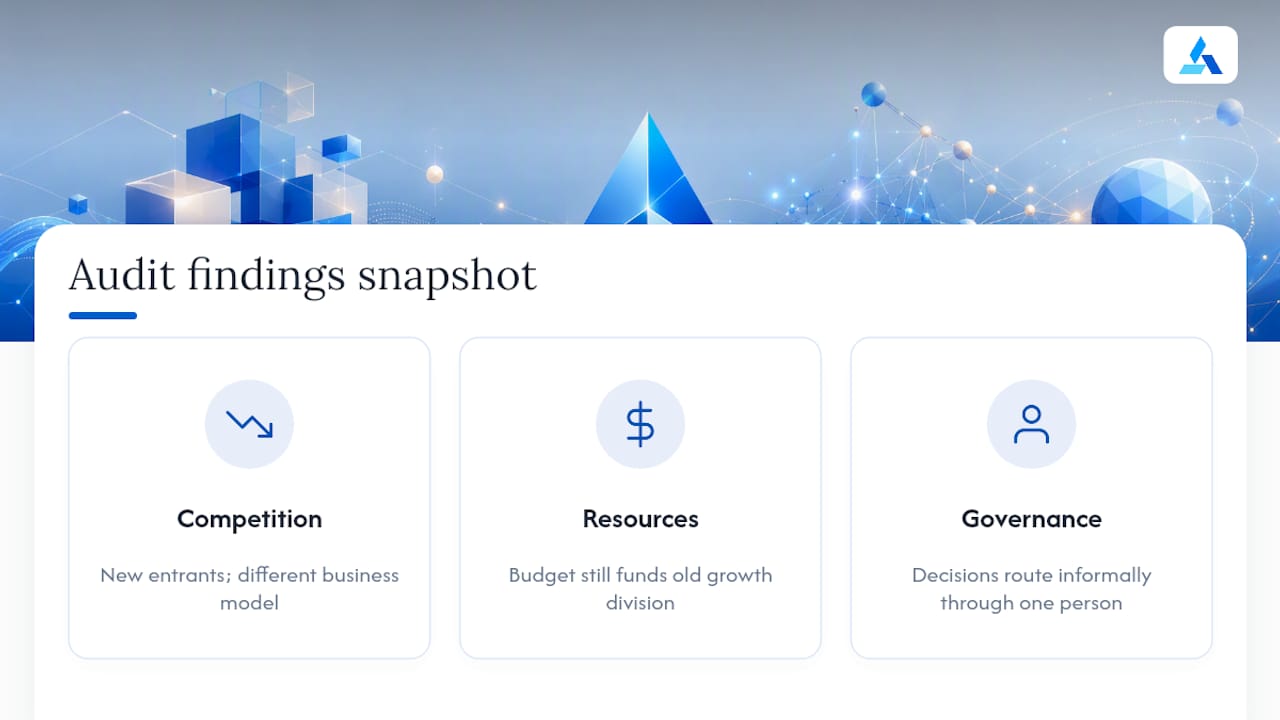
A common pattern: a mid-sized company believes its growth has stalled because of market saturation, and the audit’s environmental scan reveals the actual competitive set has shifted entirely, new entrants solving the same customer problem with a different business model that the internal team never benchmarked against. The strategy wasn’t wrong for the market it was built for. It was built for a market that no longer existed.
Another recurring finding, surfaced through the kind of KPI checks and stakeholder interviews that make up a rigorous strategic audit: resource allocation that hasn’t moved in years despite priorities shifting twice. Budget keeps flowing to the division that used to be the growth engine, while the team actually driving new revenue is understaffed and under-resourced, because nobody formally revisited the allocation after the last reorg.
A third pattern shows up in governance. Decision rights on paper say one thing; the audit’s interviews reveal that in practice, every significant call routes informally through one person regardless of the org chart, creating a bottleneck that limits how fast the company can respond to anything. The fix isn’t a new strategy. It’s a governance change that the strategy document never addressed because nobody thought to look there.
Each example shares a structure worth remembering: the audit didn’t invent a new strategic direction. It found the specific, concrete reason the existing direction wasn’t translating into results, and that specificity is what separates a useful diagnostic from an expensive restatement of the obvious.
Platform-Enabled Audits vs. Full Consulting Engagements
A platform paired with a capable internal team handles most quarterly and annual review cycles well, especially once real-time market data and competitor tracking do the environmental scanning work that used to eat weeks of analyst time. Reach for a dedicated external specialist when the stakes involve leadership change, M&A, or a persistent performance gap nobody internal can diagnose objectively.
Either way, preparation decides the outcome more than the delivery model does. Leadership needs to commit to real transparency, grant genuine data access, and put executive sponsorship behind the findings before day one, not after the report lands. Start by scoping your top five KPIs and lining up ten senior stakeholders for interviews; that alone tells you whether your organization is actually ready to hear what an audit will find.
— Colin Bowdery
How Blue Prysm Speeds Up Your Next Strategic Audit
Traditional audit consulting means paying for weeks of manual market research before anyone even starts diagnosing your real problem. Blue Prysm is built to skip that step. It gives SMB leaders the same real-time competitive visibility a Big Four audit team builds by hand, minus the multi-week discovery phase and the retainer that comes with it.
Whatever your team decides about the audit itself, internal review, external specialist, or a hybrid, the diagnostic groundwork matters just as much as who’s writing the final report. Blue Prysm’s market research tools compress the environmental scanning step into hours instead of weeks, and the market analysis platform keeps that picture current afterward, so your next quarterly check-in isn’t starting from zero. Pair that with the 95-plus strategy frameworks built into the platform, and your team has a structured way to turn audit findings into an actual roadmap instead of another slide deck nobody revisits. If you’re weighing whether your organization needs a full audit right now, start by requesting a demo of the market research tools and see what a live competitive snapshot actually surfaces about your own strategy.
Sources
- What is Strategic Management? — Coursera article
- Strategic Audit — CMOE glossary
- Strategic Plan Audits: Structure and Expected Outcomes — International Journal of Business and Management
- KPMG internal audit services — KPMG
FAQ
What Are Strategic Management Services?
Strategic management services are external or specialist offerings that help an organization define, assess, and adjust its strategy, spanning environmental scanning, capability review, performance tracking, and audits that check whether a plan still fits reality.
What Are the 7 Steps of the Strategic Management Process?
The seven-step cycle is: define vision and mission, scan the external environment, formulate strategy, allocate resources, implement, track performance, and make strategic adjustments before looping back to step one.
What Are the Main Types of Strategic Management Audits?
Audits generally split into rapid diagnostics (4 to 6 weeks, tightly scoped around top KPIs), full audits (8 to 12 weeks, covering governance, capability, and execution), and trigger-based ad hoc audits run after a major event like a leadership change or acquisition.
How Often Should a Company Run a Strategic Management Audit?
Frequency depends on how much uncertainty the business faces: high-volatility markets often warrant quarterly checkpoints, while stable businesses may run one formal annual audit supplemented by ad hoc reviews when something breaks.
Can a Platform Like Blue Prysm Replace a Full Strategic Audit?
For most SMB leaders, a platform paired with an internal team handles ongoing monitoring and quarterly reviews well; a dedicated external audit still adds the most value during major triggers like M&A, leadership change, or unexplained underperformance.