


For professionals who need credentialed, career-impacting skills, multi-module certificate programs with mentored projects deliver the strongest return, because they force you to apply methods to a real business problem before anyone hands you a credential. Short workshops make sense when you need a tactical refresh, not a resume line. Look for programs that require an applied project and offer recognized credit. Once you finish either path, using a strategic intelligence platform helps you keep applying what you learned instead of letting it fade in a slide deck.
TL;DR:
- Certificate programs with mentored projects and recognized credit better prepare professionals for long-term CI careers and produce tangible, demonstrable deliverables.
- Programs emphasizing applied projects and real-world outcomes, such as intelligence briefs and early warning indicators, lead to faster employer impact than lecture-only courses.
- Pairing formal training with operational tools like Blue Prysm’s competitor tracking and strategy library extends skill retention and turns learned frameworks into ongoing practice.
- Top programs require an applied project, verified instructor experience, and transferability of credits, avoiding courses that lack real-world application or transparent outcomes.
- Practical case exercises, such as market entry analysis or early warning simulations, are critical to developing decision-making instincts rather than just theoretical knowledge.
What Types of Competitive Intelligence Training Programs Exist?
Not every “competitive analysis course” solves the same problem, and picking the wrong format wastes both your time and your employer’s training budget.
Certificate programs run multi-module, often mentored, and typically end in an exam or a graded application project. The Institute for Competitive Intelligence’s FCCI program is a good example: nine modules, a mentored application project, and 18 ECTS credit points on completion. That structure suits someone building a long-term CI career, not just patching a skill gap.
Workshops and bootcamps compress the same core methods into a few intensive days. SCIP’s training programs run as multi-day interactive sessions built around applied exercises like early warning systems and stakeholder mapping, with continuing education credits attached.
On-demand courses let you learn at your own pace, useful for reviewing a single framework but weak on accountability. University credit-bearing programs sit at the formal end, often blended with business intelligence coursework.
- Certificate programs: several weeks to a few months, blended or live online, mentored project required
- Workshops/bootcamps: a few days, live online or in person, no long-term commitment
- On-demand courses: self-paced with variable duration, minimal instructor interaction
- University certificates: generally span one or more academic terms, credit-bearing, the heaviest time investment
What Do the Best Competitive Intelligence Courses Actually Teach?
A strong syllabus reads less like a business school lecture list and more like a job description. If a program can’t tell you what you’ll be able to produce by the end, that’s a warning sign.
Reputable programs build around a consistent core: open-source intelligence (OSINT) and elicitation techniques, analytic frameworks such as Four Corners analysis, SWOT, Porter’s Five Forces, and Analysis of Competing Hypotheses (ACH), financial statement analysis adapted for competitor benchmarking, scenario planning, and strategic early warning (SEW) systems. SCIP’s curriculum also weaves in ethical research standards and stakeholder management, since a CI function that burns trust internally doesn’t survive long regardless of how sharp its analysis is.
The deliverables matter more than the topic list. Look for programs that require:
- A written intelligence brief graded against real business criteria
- A set of early warning indicators tied to an actual market or competitor
- A mentored project outcome you can show a hiring manager or your own boss
Programs that pair classroom instruction with mentored, real-world projects produce employer-recognized impact faster than lecture-only or fully self-paced formats, largely because the applied project forces you to defend your analysis rather than just recognize the right framework on a quiz.
One curriculum shift worth watching: business intelligence skills are creeping into CI syllabi. University of Washington’s Business Intelligence & Data Integration certificate covers ETL processes, data pipeline basics, and dashboarding tools like Power BI and Tableau. Analysts who can build a live competitor dashboard, not just a static PowerPoint, are becoming the standard rather than the exception.
How Do You Choose the Right Competitive Intelligence Program?
Run every program through this checklist before you commit budget or time:
- Does it require an applied project, not just a multiple-choice exam?
- Does it carry recognized credit (ECTS, CEUs, or university transfer credit)?
- Who teaches it, and have they run actual CI functions inside companies?
- Can they show you outcomes from past cohorts, not just testimonials?
- What’s the cohort size, and how much instructor feedback does that allow?
- How rigorous is the final assessment, and does it map to real deliverables?
- Is there post-course access to instructors, alumni, or a peer network?
- Does the schedule fit your actual calendar, or will you quietly drop out by week four?
Bring these questions to a provider or your own HR department: What percentage of graduates complete the mentored project? What’s the average time from certificate to promotion or role change among alumni? Is the credit transferable to a graduate program? What happens if I miss a live session?
Red flags: no application project, no named instructors, credit claims that can’t be verified, and marketing copy heavier on adjectives than on curriculum detail.
Pro Tip: Ask a provider for a sample module outline before you pay. If they hesitate or send a glossy brochure instead of an actual syllabus, that hesitation tells you everything about the program’s substance.
What Do ECTS Credits and CEUs Actually Mean for Your Career?
Credentialing labels get thrown around loosely, so it’s worth knowing what each one actually signals. ECTS (European Credit Transfer System) points indicate academic workload and are recognized across European university systems, making them useful if you plan to stack credentials toward a graduate degree. The FCCI certificate, for instance, awards 18 ECTS for its nine modules and mentored project, a workload roughly equivalent to a short university course.
CEUs (Continuing Education Units), often issued under IACET or ANSI accreditation, are the standard currency for professional recertification rather than academic transfer.
- ECTS: best when you want credit that transfers into further formal education
- CEUs: best when you need to satisfy a professional recertification requirement
- Neither is inherently “better.” Match the credential type to what you actually need it to unlock.
How Much Does Competitive Intelligence Training Cost and How Long Does It Take?
Pricing shapes vary by format, not just provider. SCIP’s workshop model typically prices per seat for a few intensive days and includes CEUs. Certificate programs with mentored projects and ECTS credit require a bigger time investment, spread across weeks or months, and price accordingly. University-affiliated credit courses sit at the top of both cost and duration.
- Workshops: days, lowest cost, tactical skill refresh
- Certificate programs: weeks to a few months, moderate cost, career-building credential
- University credit programs: one to two semesters, highest cost, most transferable
To justify sponsorship, frame the ask around measurable outputs: employers respond better to a training proposal that names a specific deliverable, like a pilot intelligence brief or an early warning dashboard, than to a vague request for “professional development.” Ask about team-rate discounts. Most providers will negotiate for three or more seats from one organization.
How Blue Prysm Helps You Apply What You Learn
A certificate looks good on LinkedIn. It does nothing for your company until you actually run the analysis. This is where the gap between training and practice usually opens up, and where most people quietly let their new skills atrophy.
Blue Prysm’s competitor tracking gives you a live environment to practice OSINT-based monitoring instead of relying on manual searches. The strategy library, with more than 50 frameworks including SWOT and Porter’s Five Forces, lets you apply the exact models your course taught without rebuilding templates from scratch. And execution dashboards mirror the kind of measured output an early warning system module asks you to produce.
- Use competitor tracking to gather evidence for a mentored capstone project
- Build an early warning dashboard using real, current market data instead of a hypothetical case study
- Present a finished intelligence briefing using the platform’s reporting tools rather than a static deck
Pro Tip: If your certificate program ends with a graded application project, start that project inside a working platform on day one. Instructors consistently reward evidence over theory.
For a deeper walkthrough of turning coursework into a working analyst practice, see this step-by-step guide for SMBs.
Where Case Studies Show Training Actually Pays Off
The best programs don’t just lecture on Porter’s Five Forces. They hand you a case, ask for a decision, and grade the reasoning. A market entry scenario is a common one: a mentored project might ask you to assess whether a mid-sized company should enter a new regional market, using competitor financial filings, pricing signals, and public hiring data to build the case either way.
Early warning simulations are another staple. You’re given a slice of a real or realistic market, a stream of weak signals, spun-off patents, unusual executive hires, a competitor’s sudden pricing shift, and asked to flag the pattern before it becomes obvious. That kind of exercise trains the instinct that separates a CI analyst from someone who just reads news aggregators for a living.
Scenario planning modules often use historical disruptions as raw material: how established players missed early signals of a market shift, reconstructed after the fact so students can see what the warning signs looked like in real time, not in hindsight. The point isn’t memorizing the outcome. It’s practicing the discipline of taking a weak signal seriously before it’s validated by a headline.
Programs that skip this kind of applied case work tend to produce graduates who can define ACH in an interview but freeze when handed an actual messy dataset. If a provider can’t describe at least one real case exercise from their curriculum when you ask, that’s worth noting before you enroll.
What Happens After the Course Ends?
The certificate is not the finish line. Analysts who keep improving after training almost always have one thing in common: they stay connected to a peer network that keeps pushing them.
SCIP and similar professional bodies maintain ongoing member communities, regional chapters, and recurring events that function as informal continuing education long after a workshop wraps. University certificate programs sometimes include alumni access to updated course materials or repeat modules at reduced cost, useful when frameworks or tools evolve.
Look for three things when a program’s marketing goes quiet on this topic: an alumni directory or forum, access to instructors beyond the final session, and some form of recurring content, webinars, updated case studies, refresher sessions, that keeps your skills current. A program with none of these essentially hands you a snapshot of knowledge frozen at the moment you graduated, which is a weaker outcome than it sounds when methods and tools shift as fast as they do in this field.
This is also where a working platform earns its place. Course materials go stale. A tool that updates competitor data and market signals in real time doesn’t, which is part of why pairing formal training with an operational system extends the shelf life of what you learned far past the last day of class.
What Do Past Participants Say About These Programs?
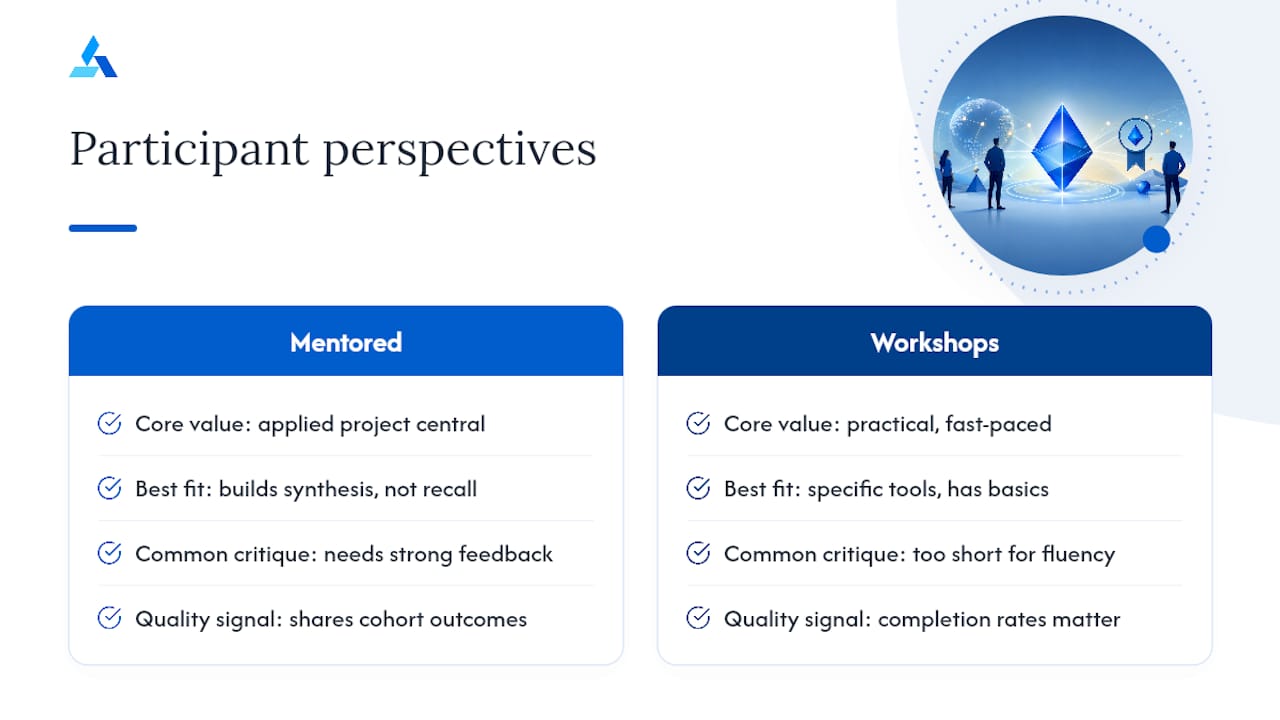
Program reviews cluster around a consistent theme: participants value applied work over lecture time, almost without exception. Reviews of mentored-project programs tend to highlight the project itself as the most valuable part of the experience, more than any individual framework taught, because it’s the part that forces synthesis rather than recall.
Workshop reviews skew toward practicality and pacing. Multi-day intensive formats get credit for covering a lot of ground quickly, but some participants note that a few days isn’t enough to build real fluency in something like ACH, which takes repetition to internalize. That’s a fair trade-off if you already have foundational knowledge and just need specific tools. It’s a weaker fit if you’re starting from zero.
A recurring critique across both formats: programs that overload lecture content but skimp on feedback loops leave participants unsure whether they actually absorbed the material or just recognized it during the session. This is why the applied-project requirement functions as a quality signal beyond just résumé value. It’s also usually the difference between glowing reviews and lukewarm ones.
If you’re evaluating a specific provider, ask directly for aggregate outcomes from recent cohorts rather than a handful of curated testimonials. A program confident in its results will share completion rates and project outcomes. One that only offers three cherry-picked quotes on its landing page probably has a reason for that.
Who Should Take Competitive Intelligence Training, and What Do They Walk Away With?
This training serves a specific band of people, not everyone with “strategy” in their title. Market research analysts, business development managers, corporate strategy staff, product marketers, and founders running lean teams without a dedicated intelligence function are the most common candidates. Experience level varies more than you’d expect: some programs assume no prior CI background, others assume you’ve already been doing informal competitor research and want to formalize the method.
Typical learning outcomes break into three tiers. Entry-level participants leave able to run structured OSINT research and apply a basic framework like SWOT without reinventing the wheel each time. Mid-career participants, often the largest group in certificate programs, walk away able to build a full intelligence brief, run ACH on a genuine strategic decision, and design early warning indicators for a specific market. Senior participants, frequently in university credit programs, tend to focus on scenario planning and stakeholder management, the skills needed to get intelligence acted on by leadership rather than filed away.
The through-line across all three tiers: the goal isn’t collecting information. It’s producing something a decision-maker can actually use, on a timeline that matters. A program that measures success by “modules completed” rather than “decisions influenced” is optimizing for the wrong outcome, and it’s worth asking providers directly which one they track.
When Certification Beats a Workshop, and When It Doesn’t
Here’s my honest read after digging through how these programs are actually structured: certification earns its cost when you’re changing career lanes, moving from marketing or research into a formal strategy or intelligence role, or when your employer needs a credential to justify a title change. The mentored project is the real value, not the certificate itself. A workshop earns its cost when you already have the role and just need a specific method, like building your first early warning dashboard, fast.
Don’t wait for a “perfect time” to raise this with your manager. Bring a concrete deliverable to the conversation, not just a request for tuition. If you finish either path and want a place to put the skills to work immediately, Blue Prysm’s market insights tools are a practical next step for applying frameworks to your own company’s competitors right away.
— Colin Bowdery
Turn Your Training Into an Actual CI Practice, Not a Certificate in a Drawer
Formal training teaches you the methods. Blue Prysm is where those methods stop being theoretical. Instead of rebuilding an ACH matrix or a Four Corners template from scratch every time a course exercise calls for one, you get 95+ business strategy frameworks already built, plus real-time competitor tracking that turns your OSINT training into an actual, current dataset instead of a stale classroom example.
That matters most in the weeks right after a certificate program ends, when motivation is highest but the mentored project is over and you’re back to a blank spreadsheet. A platform built specifically for strategic planning fills that gap: competitor tracking that runs continuously, execution dashboards that mirror what an early warning module trained you to build, and a strategy library that means you’re applying frameworks instead of just remembering them. If you’re evaluating how to operationalize what a program like FCCI or a SCIP workshop taught you, start with how Blue Prysm works and see whether it fits how your team already makes decisions.
Sources
- Market & Competitive Intelligence Training & Certification — SCIP
- Certificate in Business Intelligence & Data Integration — University of Washington PCE
FAQ
Is competitive intelligence legal?
Yes. Legitimate competitive intelligence relies on public and legally accessible information, industry reports, published financials, job postings, and interviews conducted transparently. It becomes illegal when it crosses into corporate espionage, unauthorized access to confidential systems, or misrepresentation to obtain trade secrets, which is why reputable programs teach ethical research standards as a core module.
Where can I find competitive intelligence classes?
Options range from professional-body workshops like SCIP’s training programs to university-accredited certificates such as the Institute for Competitive Intelligence’s FCCI program, plus blended business intelligence certificates through university continuing-education divisions.
What are the 5 steps of a competitive analysis?
A common sequence covers: identifying relevant competitors, gathering data through OSINT and public sources, applying an analytic framework like SWOT or Porter’s Five Forces, synthesizing findings into a brief or early warning indicators, and presenting recommendations to decision-makers. Exact steps vary somewhat by framework and provider.
What is an example of competitive intelligence?
A common example is monitoring a competitor’s job postings, patent filings, and pricing changes to infer an upcoming product launch before it’s publicly announced. Programs that teach this skill through mentored projects, and platforms like Blue Prysm’s competitive intelligence tools that track these signals continuously, turn that kind of inference into a repeatable practice rather than a one-time guess.