

Cascading OKRs speeds up coordinated launches but wrecks ownership in most organizations unless you run it as a selective, contribution-based cascade instead of a pure top-down copy exercise. The trade-off is always the same one: coordination versus ownership. If that sounds like a dodge, keep reading. The playbook below gets specific fast.
TL;DR:
- Cascading OKRs often lead to loss of ownership when objectives are simply copied down without meaningful contribution or adaptation.
- Using a hybrid model that links only crucial company outcomes with strict verticals, while others remain contributor-driven, reduces misalignment and preserves team ownership.
- Running a contribution cascade involves publishing clear company goals first, then translating objectives into team contributions with assigned key result owners, not copying goals verbatim.
- Effective governance relies on daily check-ins, named accountability, dependency mapping, and controlled visibility of sensitive metrics, not just goal visualization tools.
- Most organizations should focus on a small number of key outcomes requiring strict cascade, as overuse of top-down directives hampers agility and ownership.
What Is OKR Cascading, and How Is It Different From Alignment?

Cascading OKRs means pushing objectives and key results down through company, department, and team levels so every layer of the org has a documented goal. That’s copying, not cascading, and it’s the single fastest way to kill ownership.
Alignment is the healthier cousin. Instead of inheriting a parent’s key result as a mandate, a team writes its own objective as a contribution to that parent goal. The OKR Institute’s guidance on alignment frames this as needing two directions at once:
- Vertical alignment: your team’s OKRs visibly connect upward to company strategy.
- Horizontal alignment: your team’s OKRs don’t quietly conflict with the team next door.
Most companies obsess over vertical lines and ignore horizontal ones. That’s where the friction actually lives.
Why Does OKR Cascading Fail So Often?
Cascading fails in predictable, diagnosable ways. If your program shows two or more of these signs, you’re not running a cascade, you’re running a paperwork exercise.
- Copied key results. A department’s “objective” is just the parent’s KR restated with a different owner. No thinking happened, and no one feels responsible for it.
- Siloed ownership and perverse incentives. Teams optimize their own slice of the metric even when it actively works against a neighboring team’s goal.
- Cascade timelines that drag for weeks. By the time team OKRs are finalized, the strategic moment they were built for has already passed.
- Sensitive metrics get exposed. Full visibility into every KR at every level often surfaces numbers, like churn by account or margin by product line, that shouldn’t be broadcast org-wide.
- Horizontal dependencies break down entirely. Nobody mapped who depends on whom, so handoffs get discovered mid-quarter instead of during planning.
This isn’t a fringe problem. Field research from the OKR Institute found that copying key results, treating alignment as a one-time event, and skipping horizontal dependency mapping are the top three recurring causes of OKR breakdowns it observes across organizations. Ownership erosion isn’t a side effect of cascading. In its uncontrolled form, it’s the mechanism.
Should You Cascade, Align, or Run a Hybrid Model?
Cascading isn’t inherently wrong. It’s a design choice that fits some situations and actively hurts others. Profit makes the case that the right model depends on what you’re trying to coordinate, not on which methodology book you read last.
- Use direct cascade when you need tight coordination, like a product launch date every function must hit, or a compliance deadline with zero flexibility.
- Use contribution alignment or a network model when the work is exploratory, like a new market test or an R&D initiative where forcing a rigid KR down the chain would just produce fake precision.
- Use a hybrid, selective cascade for everything in between, which describes most growing companies. Leadership decides upfront which two or three company-level outcomes genuinely require strict vertical linkage. Everything else stays team-owned, expressed as a contribution rather than a copied number.
That third option is where most executives should land. It respects the contribution model without pretending every team goal has to trace back to a parent metric with mathematical precision.
How Do You Run a Contribution Cascade, Step by Step?
Here’s the sequence we recommend teams run at the start of every planning cycle.
- Publish company OKRs and a “Why Now” memo first. Before any team writes a single draft objective, leadership finalizes company-level goals and explains, in plain language, why those goals matter this quarter specifically.
- Run a compressed cascade workshop. Book one half-day session with department heads, leveraging team workshops for facilitation, then give each department two to three days to finalize team-level OKRs. Rally’s OKR hierarchy documentation notes that teams completing the cascade quickly see materially higher completion rates than those that let planning drag on.
- Translate, don’t copy. Each team writes its Objective as a one-sentence contribution to a specific company goal, then attaches two to three measurable key results, each with a named owner assigned before launch, not after.
- Map horizontal dependencies on an alignment board. Before anything goes live, run a session where every team flags who they depend on and who depends on them. Resolve conflicts now, not in week six when someone discovers a blocked handoff.
- Install a weekly 20-minute check-in. Four questions: What moved? What’s blocked? What changed since last week? Who needs help? Add a mid-cycle retrospective around week six to catch drift before it compounds.
Pro Tip: Limit your hierarchy to three levels: company, department, team. Individual OKRs are optional, and adding a fourth or fifth layer mostly adds meetings, not clarity.
What Governance and Tools Keep the Cascade From Drifting?
None of this holds together without operating rules. The mechanics matter less than the discipline behind them.
- One named owner per key result, no exceptions. Shared ownership on paper usually means zero ownership in practice; when a KR stalls, someone specific needs to answer for it.
- Weekly check-ins, not monthly ones. Monthly cadences let problems fester for four weeks before anyone notices.
- Track completion speed, not just completion rate. How fast did the cascade actually finish? A slow cascade signals a governance problem long before quarter-end numbers do.
- Track dependency resolution rate. Of the handoffs flagged on your alignment board, how many got resolved before launch versus discovered mid-quarter?
- Give sensitive KRs permissioned visibility. Not every number needs to be visible to the entire company; an alignment map that respects this keeps trust intact.
A tool that only shows a tree diagram of goals isn’t governance. Governance is the weekly rhythm and the named accountability sitting underneath the tree.
Your One-Page Cascade Checklist for the Next Planning Cycle
Paste this into your next planning agenda.
- Day 0: Publish company OKRs and the “Why Now” memo.
- Days 1 to 3: Run the department alignment workshop.
- Days 3 to 5: Teams draft contribution OKRs and name KR owners.
- Before week 2: Run the cross-team dependency board and resolve conflicts.
- Ongoing: Weekly 20-minute strategic check-ins, plus a mid-cycle retrospective.
| Phase | Owner | Output |
|---|---|---|
| Company OKRs published | Executive team | Finalized goals + “Why Now” memo |
| Department workshop | Department heads | Draft priorities |
| Team OKR drafting | Team leads | Contribution objectives, named KR owners |
| Dependency mapping | Cross-functional teams | Resolved handoffs |
| Weekly check-in | KR owners | Status, blockers, help needed |
A Practitioner’s View on Why the Cascade Debate Misses the Point
Most of the OKR content circulating right now treats cascading and alignment as a binary choice, cascade good, alignment good, pick a side. That framing sells webinars, but it doesn’t survive contact with an actual planning cycle. The real question executives should be asking isn’t “should we cascade?” It’s “which two or three outcomes in this company genuinely need strict vertical linkage, and which ones are we forcing into that mold out of habit?”
Run that filter honestly, and most companies find the answer is smaller than they expect, maybe a launch date, a compliance deadline, a revenue floor. Everything else works better as a contribution, owned by the team that has to deliver it. If your planning cycle is dragging past two weeks, that’s not a sign you need better software. It’s a sign the cascade itself is doing too much work that alignment should be doing instead. A short AI Operational Audit or workshop test can tell you, in a single planning cycle, whether your current model is actually the problem.
— Colin Bowdery
How Blue Prysm Supports a Healthier Planning Cycle
Some strategic intelligence platforms give strategy and operations leaders a faster path to the “Why Now” memo and the department-level clarity a contribution cascade depends on, by pairing real-time competitor tracking with a strategy framework library, enabling leadership to finalize company objectives more quickly than traditional agency engagements.
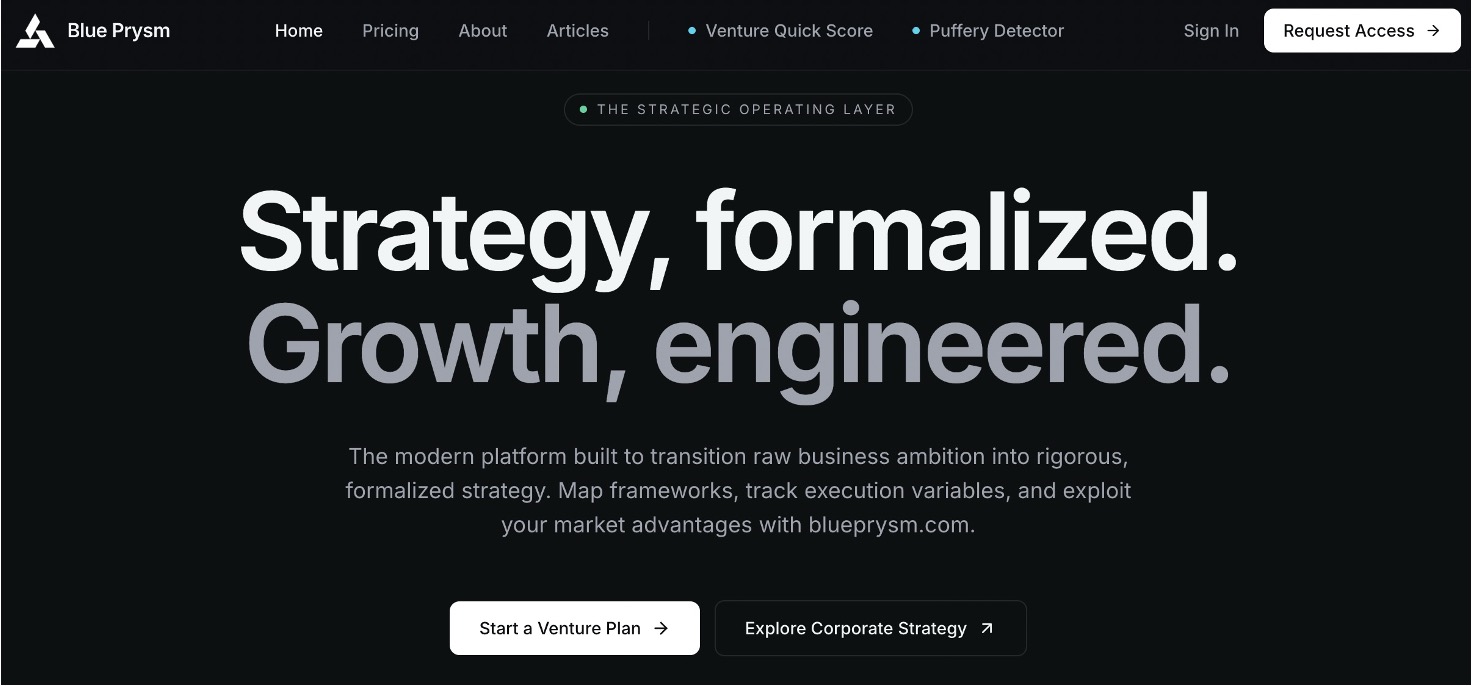
If you want a structured second opinion on your current cascade before the next planning cycle starts, the AI Operational Audit walks through where your OKR ownership is breaking down and where it’s actually working. Teams that want facilitation support for the compressed cascade workshop itself can also look at Corporate & Growth Strategy engagements built for exactly this kind of planning cycle. Platform access starts at $30 per month or $299 per year on the Starter plan, with Pro and Enterprise tiers available for teams running OKRs across multiple departments. Book a workshop or start with the audit, and see where your cascade actually stands.
Sources
This article draws on field research and practitioner frameworks rather than a single source. The OKR Institute’s alignment guidance backs the failure-mode data and the alignment board concept. Jeff Gothelf’s work on OKR lineage supports the translate-don’t-copy rule. Rally’s OKR hierarchy documentation grounds the timeline benchmarks, and Profit.co’s model comparison informs the decision framework in the third section.
FAQ
What Are the 5 Elements of OKR?
An OKR program typically runs on five elements: the Objective itself, two to three Key Results, a named owner, a defined cadence for check-ins, and a scoring or confidence rating updated regularly. Skipping the owner or the cadence is the fastest way to let an otherwise solid OKR quietly stall.
Can You Give an Example of a Cascading Goal?
A company objective like “become the top choice for mid-market buyers in our category” might cascade into a sales team contribution objective: “shorten our mid-market sales cycle,” with key results around demo-to-close time and win rate against named competitors. The team writes its own KRs rather than inheriting the company’s revenue number directly, which is the difference between cascading and contribution alignment.
What Are Common OKR Mistakes?
The most common mistakes are copying key results into lower-level objectives instead of translating them, letting the cascade drag on for weeks, and skipping horizontal dependency mapping between teams. Each of these shows up repeatedly in the OKR Institute’s field research on why cascades break down.
What Is a Good OKR Example?
A strong OKR pairs an ambitious but specific objective with measurable key results tied to owners, not just metrics. “Improve customer retention” paired with “reduce 90-day churn from 8% to 5%, owner: retention lead” works because it names a person accountable for the number, not just a target on a slide.
Does Blue Prysm Help With OKR Implementation?
Blue Prysm’s platform supports OKR and KPI tracking alongside its strategy framework library, and its AI Operational Audit can assess where an existing cascade is losing ownership. Current pricing for platform access is listed on the Blue Prysm pricing page, starting with the Starter plan.