


TL;DR:
- Data security protects sensitive business information from unauthorized access, theft, or damage, ensuring operational integrity and compliance. It impacts financial stability, customer trust, regulatory status, operational continuity, and competitive advantage. Implementing layered controls based on confidentiality, integrity, and availability secures data, promotes growth, and aids strategic decision-making.
Data security is defined as the practice of protecting sensitive business information from unauthorized access, theft, or damage to preserve operational integrity and meet legal obligations. For business leaders, why secure data matters is not an abstract IT question. It is a direct financial and strategic concern. The global average cost of a data breach now sits at $4.4 million, a figure that threatens the viability of small and midsize businesses outright. Regulations like GDPR, HIPAA, and SOC 2 are no longer background compliance noise. They are prerequisites for contracts with enterprise and government clients in 2026.
Why does secure data matter to your business?
The importance of data security shows up in five distinct business dimensions, and each one carries real consequences.
- Financial exposure. Phishing attacks alone cost businesses an average of $4.8 million per incident. Intellectual property theft runs $178 per record stolen. These are not theoretical risks. They are line items that can wipe out a year of margin.
- Customer trust. At least 375 million individuals in the U.S. were impacted by data breaches in 2025. More telling: 53% of customers switch providers when their personally identifiable information is compromised. Lose the data, lose the customer.
- Regulatory compliance. GDPR fines can reach 4% of global annual revenue. HIPAA penalties run up to $1.9 million per violation category per year. SOC 2 certification is now a standard gate in enterprise procurement processes.
- Operational continuity. A breach does not just cost money at the moment of impact. Downtime, forensic investigation, legal response, and remediation can consume weeks of leadership bandwidth.
- Competitive positioning. Companies that demonstrate strong data governance win deals faster and retain clients longer. Security credentials are becoming a sales asset, not just a legal requirement.
The benefits of secure data extend well beyond avoiding disaster. They create a measurable floor under your business that competitors without strong data practices simply do not have.
How do the core principles of data security protect business information?
The industry organizes data protection around three foundational principles, collectively called the CIA triad: confidentiality, integrity, and availability. Understanding each one helps you ask the right questions of your IT team and vendors.
- Confidentiality means only authorized users can access sensitive information. Encryption, role-based access controls, and multi-factor authentication are the primary tools here. A breach of confidentiality is what makes headlines.
- Integrity means data is accurate and has not been tampered with. Checksums, audit logs, and version control protect integrity. A payroll system with corrupted records or a manipulated financial report represents an integrity failure, not just a security one.
- Availability means authorized users can access data when they need it. Redundant backups, disaster recovery plans, and uptime monitoring protect availability. Ransomware attacks target this principle directly by locking businesses out of their own systems.
Modern businesses face a compounding challenge here. Cloud adoption, SaaS proliferation, and remote work have dramatically expanded the attack surface. Continuous, context-aware protection has replaced perimeter security as the standard. A firewall at the office edge means very little when your team accesses customer data from three continents via six different SaaS tools.
Pro Tip: Map every location where sensitive data lives before you build a security program. Most businesses discover they have two to three times more data exposure than they assumed.

How do businesses practically implement data security?
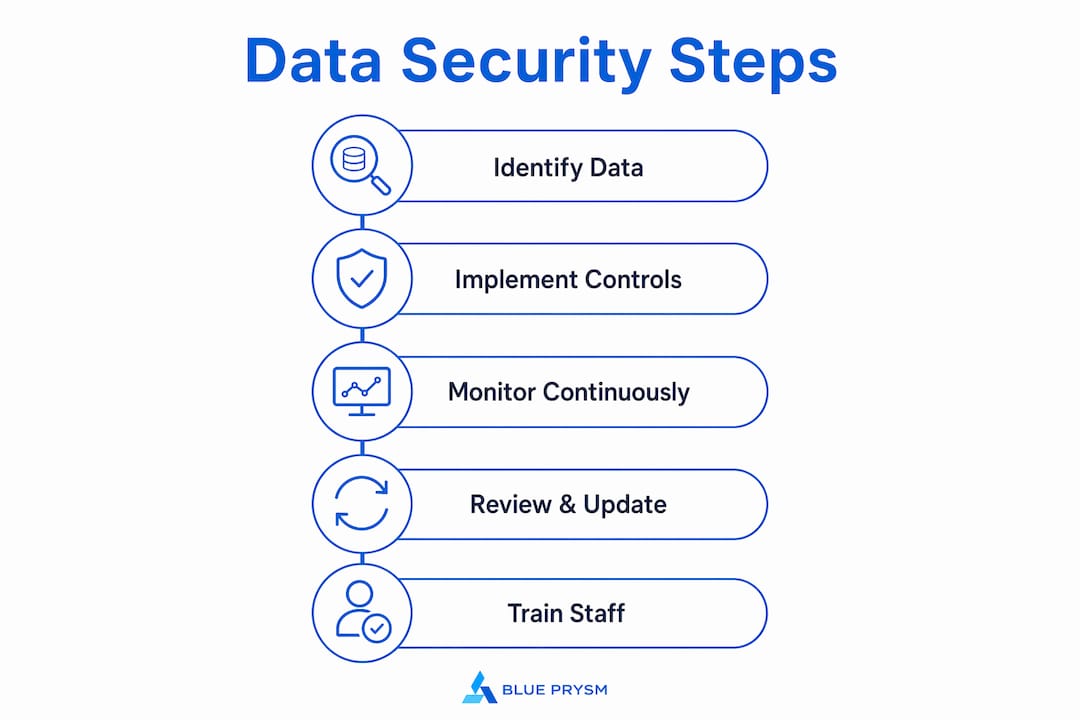
Knowing the principles is one thing. Putting them into practice requires a layered approach that covers technology, governance, and culture.
Technical controls that actually work
The foundational technical measures are encryption at rest and in transit, network monitoring, endpoint protection, and firewall configuration. These are table stakes. What separates secure organizations from vulnerable ones is the application of least privilege access. Individual credentials and least privilege access prevent attackers from moving laterally through systems after an initial breach. Shared accounts are one of the most common and most avoidable vulnerabilities in mid-market businesses.
Governance and certification
| Governance Layer | What It Covers | Business Impact |
|---|---|---|
| Security policies | Acceptable use, incident response, data classification | Reduces human error risk |
| Employee training | Phishing awareness, password hygiene, reporting protocols | Addresses the leading breach vector |
| SOC 2 certification | Third-party audit of security controls | Accelerates enterprise sales cycles by shortening due diligence |
| Compliance audits | GDPR, HIPAA, industry-specific reviews | Avoids regulatory penalties |
SOC 2 certification deserves special attention. It is not just a compliance checkbox. It is a sales tool. Prospects with security review requirements move through procurement faster when you can hand them a current SOC 2 report.
Emerging approaches worth knowing
Zero Trust architecture assumes no user or device is trusted by default, even inside the network. AI-driven threat detection identifies anomalous behavior patterns before a breach escalates. These are not futuristic concepts. They are being deployed by mid-market companies right now, and the cost of entry has dropped significantly.
Pro Tip: Avoid the perimeter-only trap. If your entire security strategy depends on keeping attackers out, you have no plan for when they get in. Build detection and response capabilities alongside prevention.
What strategic value does data security bring beyond protection?
The most forward-thinking leaders have stopped treating data security as a cost center. Harvard Business Review framed it directly in May 2026: strong data security is not just defense. It is a growth strategy that builds customer trust and market differentiation.
Think about what that means operationally. A business with documented security controls and active compliance certifications can pursue enterprise contracts that competitors without those credentials cannot even bid on. Security becomes a filter that removes competition.
“Companies demonstrating high data protection standards enhance digital trust, improving loyalty and competitive resilience.” — SGS, 2026
The role of privacy in business intelligence strategy is also shifting. Customers and partners now evaluate vendors on data ethics as part of standard due diligence. Businesses that treat data protection as a strategic asset rather than a legal obligation build durable loyalty that is genuinely hard to replicate. That is the kind of competitive advantage that shows up in retention rates and net promoter scores, not just in avoided fines.
Boards should hear data security framed as a strategic initiative that reduces operational, financial, and legal risk while enabling faster innovation. That framing changes the budget conversation entirely.
Key takeaways
Securing business data is the single most direct way to protect revenue, retain customers, and qualify for growth opportunities that require compliance credentials.
| Point | Details |
|---|---|
| Financial risk is concrete | A single breach averages $4.4 million in costs, threatening SMB viability outright. |
| Customer trust is fragile | 53% of customers leave providers after a data breach involving their personal information. |
| Compliance opens doors | SOC 2, GDPR, and HIPAA compliance are now prerequisites for enterprise and government contracts. |
| CIA triad is the framework | Confidentiality, integrity, and availability guide every practical data security decision. |
| Security drives growth | Strong data governance shortens sales cycles and builds competitive advantages that last. |
Data security is a leadership decision, not an IT ticket
Here is my honest frustration with how most business leaders approach data security: they treat it like a support function. They delegate it entirely to IT, approve a budget line, and move on. That mindset is the actual vulnerability.
I have worked with executives who discovered their biggest compliance gap was not a technical failure. It was a cultural one. Employees sharing credentials, leadership bypassing access controls for convenience, no one owning the incident response plan. The technology was fine. The governance was absent.
The shift I advocate for is simple but uncomfortable. Data security belongs in your strategic planning cycle, not your IT ticket queue. When you frame it as business insurance with a measurable return, the conversation changes. You stop asking “how much does this cost?” and start asking “what does this protect?” Those are very different questions, and they lead to very different decisions.
The leaders who get this right in 2026 will not just avoid breaches. They will close deals faster, retain customers longer, and build organizations that partners and investors actually trust. That is not a soft benefit. That is a compounding strategic advantage.
— Colin Bowdery
How blue prysm helps you protect and use data strategically
Blue Prysm is built for business leaders who understand that data is both an asset and a liability, and who want tools that treat it accordingly.
The Market Analysis Platform from Blue Prysm gives strategy teams real-time market intelligence with compliance-conscious data handling built in. You get the competitive insight you need without creating new exposure. For leaders who want to go deeper on data-driven strategy with real-world examples, Blue Prysm’s resource library covers exactly how SMEs are turning secure data practices into measurable wins. Explore the platform and see how elite-level strategic intelligence can work for your business without the consulting fees or the compliance headaches.
FAQ
What is the average cost of a business data breach?
The global average cost of a data breach is approximately $4.4 million, according to IBM’s 2025 Cost of a Data Breach Report. For small and midsize businesses, that figure is often existential.
Why is data protection vital for regulatory compliance?
Frameworks like GDPR, HIPAA, and SOC 2 carry significant financial penalties for non-compliance and are now standard requirements for enterprise and government contracts. Compliance is both a legal obligation and a business qualification.
What are the core data security best practices for smbs?
The most effective practices include encryption, least privilege access with individual credentials, employee training on phishing, and pursuing SOC 2 certification. These measures address the most common breach vectors at a cost accessible to mid-market businesses.
How does data security support business growth?
SOC 2 certification shortens enterprise sales cycles by reducing security due diligence time. Strong data governance also builds customer loyalty and opens contract opportunities that competitors without credentials cannot access.
What is the CIA triad in data security?
The CIA triad stands for confidentiality, integrity, and availability. These three principles form the foundation of every data security program and guide decisions on encryption, access controls, backups, and monitoring.