


TL;DR:
- Loss analysis helps businesses understand why they lose deals and use data to improve future outcomes.
- Structured techniques like buyer interviews and financial models provide clearer insights than internal surveys or assumptions.
Loss analysis is the systematic process of examining why a business loses deals, revenue, or operational output, then using that data to make better decisions going forward. Most leaders treat losses as a post-mortem exercise. The ones who win treat it as a feedback loop. Structured loss analysis techniques, from win-loss interview programs to forensic financial models, give you the clarity to stop repeating the same mistakes and start closing the gaps that actually matter.
What are the core loss analysis methodologies?
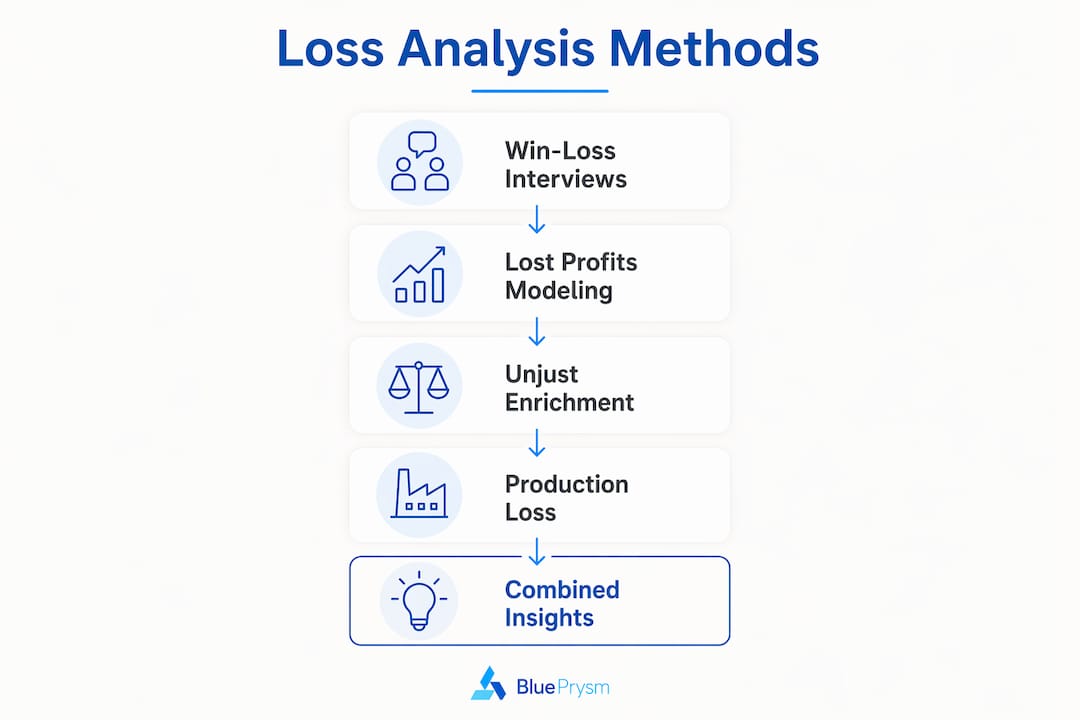
Four distinct methodologies cover the full range of business loss scenarios. Each serves a different purpose, and the best programs use more than one.

Win-loss analysis focuses on buyer interviews. You go directly to the people who chose you or rejected you and ask why. This is the most direct form of financial loss assessment for sales teams.
Lost profits modeling is the forensic accounting approach. It uses the “but-for” scenario to calculate what revenue would have been without a disrupting event. But-for profit equals hypothetical revenue minus incremental costs. This method is standard in litigation and contract disputes.
Unjust enrichment and diminution in value are two alternative financial models. Unjust enrichment measures what a counterparty gained at your expense. Diminution in value measures the drop in asset worth caused by a specific event. Choosing the right model depends on the specific facts and legal context.
Production loss analysis identifies the gap between potential and actual output in operations. It categorizes causes and helps prioritize where to focus improvement efforts first.
| Methodology | Primary Use | Key Input |
|---|---|---|
| Win-loss interviews | Sales and GTM strategy | Buyer feedback |
| Lost profits modeling | Litigation, contract disputes | Financial records, forecasts |
| Unjust enrichment | Legal and competitive claims | Counterparty financials |
| Production loss analysis | Operations and capacity planning | Output data, downtime logs |
Pro Tip: Never rely on a single methodology. Triangulating buyer interviews, internal CRM data, and call recordings produces far more accurate loss reasons than any one source alone.
How do structured win-loss programs improve sales decisions?
Most sales teams think they know why they lose deals. They are almost always wrong. 85% of closed-lost CRM data is inaccurate. Reps attribute losses to price because it is the easiest answer, not the real one.
A structured win-loss program fixes this by going directly to buyers through third-party interviews. Here is how to build one that actually works:
- Set clear goals. Define what decisions the program will inform. Are you fixing a product gap, a pricing problem, or a messaging failure? Vague goals produce vague insights.
- Conduct third-party buyer interviews. Buyers speak more honestly to a neutral interviewer than to your sales rep. Aim for 15–20 interviews per quarter to generate statistically meaningful patterns.
- Use laddering techniques. When a buyer says “price,” ask why price mattered. Then ask why that mattered. Laddering uncovers that price actually drives fewer than 20% of losses when probed properly, even though 62% of buyers cite it unprompted.
- Triangulate your data. Cross-reference buyer interviews with rep reports and recorded sales calls. Patterns that appear across all three sources are your real loss drivers.
- Distribute findings to decision-makers. A win-loss report that sits in a shared folder changes nothing. Route findings directly to product, marketing, and sales leadership with specific recommendations.
Organizations running structured programs for two or more years show measurable win rate improvement in 84% of cases. Programs with 15–20 quarterly interviews see win rates climb by 15–25% over two years. That is not a marginal gain. That is a compounding advantage.
Pro Tip: Treat win-loss analysis as a sales feedback mechanism, not a blame exercise. The goal is to change future behavior, not to assign fault for past losses.
What are the key financial modeling techniques for quantifying loss impact?
The but-for scenario is the foundation of every credible lost profits calculation. You define what the business would have earned without the disrupting event, then subtract actual earnings. The difference is your damages figure. Sound but-for analysis requires pre-disruption trends, defensible assumptions, and transparent methodology.
The discount rate is where most financial loss assessments go wrong. When projecting future losses to present value, the rate you choose matters enormously. A difference between 8% and 12% discount rates creates a 30–40% variance in total present-value damages over a 10-year projection. That is not a rounding error. It is the difference between a defensible claim and one that falls apart under cross-examination.
| Discount Rate | 10-Year PV of $1M Annual Loss | Variance vs. 8% |
|---|---|---|
| 8% | ~$6.71M | Baseline |
| 10% | ~$6.14M | ~8.5% lower |
| 12% | ~$5.65M | ~15.8% lower |
- Lost profits work best when you can demonstrate a clear causal link between the disruption and the revenue decline.
- Unjust enrichment applies when a counterparty directly profited from your loss.
- Diminution in value fits asset-based claims where the event reduced the market value of a specific asset.
Pro Tip: Document every assumption in your financial model. Transparency in assumptions is what separates a credible damages analysis from one that gets dismissed.
How can organizations apply loss analysis to operational efficiency?
Production loss analysis gives operations leaders a structured way to see where capacity is bleeding. The method maps the gap between what a facility or team could produce and what it actually produces, then categorizes the causes. Equipment downtime, changeover time, and quality defects each show up as distinct loss categories. Once categorized, you can rank them by impact and address the biggest drains first.
On the financial risk side, proactive loss mitigation strategies change recovery outcomes dramatically. Proactive outreach in the first 30 days of financial delinquency significantly increases capital recovery compared to delayed action. Judicial foreclosures average 762 days and cost $50,000–$80,000. Non-judicial processes resolve faster and cost far less. The math on early intervention is not subtle.
Forbearance agreements typically run 30–90 days and give distressed borrowers or partners a structured path to recovery. They preserve the relationship and protect capital at the same time. Smart asset loss solutions follow the same logic: intervene early, use data to prioritize, and avoid the cost of full default.
Loss ratio metrics give risk and insurance teams a comparable tool. A rising loss ratio signals that claims or operational failures are outpacing premiums or revenue. Tracking it monthly turns a lagging indicator into an early warning system.
Key takeaways
Effective loss analysis combines buyer interviews, financial modeling, and operational data to produce decisions that actually change outcomes.
| Point | Details |
|---|---|
| CRM data is unreliable | 85% of closed-lost CRM records are inaccurate; use third-party buyer interviews instead. |
| Laddering beats surface answers | Price drives fewer than 20% of losses when probed; laddering reveals the real decision drivers. |
| Discount rate choice is critical | An 8% vs. 12% rate creates a 30–40% variance in 10-year present-value damages. |
| Early mitigation cuts costs | Proactive outreach in the first 30 days of delinquency recovers more capital than delayed action. |
| Programs compound over time | 84% of organizations running win-loss programs for 2+ years show measurable improvement. |
Why most leaders are still doing this wrong
I have reviewed loss programs across dozens of organizations, and the pattern is almost always the same. Leaders want the data, but they do not want to be uncomfortable with what it says. So they run internal surveys, ask their reps to fill in CRM fields, and call it a loss review. That is not analysis. That is confirmation bias with a spreadsheet.
The shift that actually moves the needle is accepting that your internal team cannot objectively assess why you lost. Buyers tell third-party interviewers things they will never tell your sales rep. A prospect who chose a different vendor because your onboarding looked chaotic will tell your rep it was “budget.” They will tell a neutral interviewer the truth.
The same principle applies to financial loss modeling. Leaders focus on historical revenue because it feels concrete. But the but-for scenario requires you to make a defensible argument about what would have happened. That is uncomfortable. It requires judgment, not just data. The leaders who get this right treat their assumptions as a hypothesis to be tested, not a conclusion to be defended.
Loss analysis done well is not a report. It is a decision-making system. You build it, feed it continuously, and let it change how you sell, operate, and allocate capital. The organizations that treat it as a one-time exercise get one-time results.
— Colin Bowdery
How Blue Prysm turns loss data into forward strategy
Running a credible loss analysis program requires more than good intentions. You need structured data collection, multi-source synthesis, and a way to turn raw findings into decisions your team will actually act on.
Blue Prysm’s competitive intelligence platform pulls real-time market signals and buyer behavior data into a single view, so your loss reviews are built on current intelligence, not stale CRM entries. The AI-powered market research tools help teams structure win-loss data collection and surface patterns across deals, segments, and time periods. For leaders who want to go deeper, the strategy library includes 95+ frameworks, including structured loss review templates, to formalize your process without hiring a consulting firm.
FAQ
What is loss analysis in business?
Loss analysis is a structured methodology for examining why a business loses deals, revenue, or operational output. It uses data from buyer interviews, financial models, and operational records to identify patterns and drive better decisions.
How accurate is CRM data for win-loss analysis?
CRM data is highly unreliable for loss analysis. Research shows 85% of closed-lost CRM records are inaccurate, which is why third-party buyer interviews are the standard for credible win-loss programs.
What is the but-for scenario in financial loss assessment?
The but-for scenario calculates what revenue or profit would have been without a specific disrupting event. It is the central analytical judgment in lost profits modeling and requires defensible assumptions grounded in pre-disruption trends.
How long does it take to see results from a win-loss program?
Organizations running structured win-loss programs for two or more years see measurable improvement in 84% of cases. Programs conducting 15–20 quarterly interviews typically see win rates improve by 15–25% over that period.
What is production loss analysis?
Production loss analysis identifies and quantifies the gap between potential and actual output in an operation. It categorizes causes such as downtime, changeover, and quality defects, then prioritizes which to address for the greatest efficiency gain.