


TL;DR:
- Handling objections effectively turns prospect concerns into sales wins by focusing on trust-building and understanding the true issues. Using a five-step process—listening, acknowledging, clarifying, reframing with value, and confirming—helps resolve objections and advance deals. Preemptive qualification and tailored responses to common objection types reduce losses and increase confident sales conversations.
Handling objections is the skill that separates reps who close from reps who follow up forever. Formally called objection management, it is the process of responding to and resolving prospect concerns so a conversation can move toward a decision. 40–60% of sales opportunities end in “no decision,” and most of those losses trace back to unresolved objections. The professionals who win consistently treat every objection as a buying signal, not a rejection. They use a five-step objection handling framework built on listening, acknowledging, clarifying, reframing, and confirming. That process is the backbone of this guide.
What are the most common types of objections in sales?
Most sales objections map to four categories under the BANT model: Budget, Authority, Need, and Timing. Knowing which category you are dealing with tells you which response strategy to reach for first.
Here is how each category typically shows up in conversation:
- Budget: “We don’t have the funds right now.” This usually means the business case has not landed yet, not that money is unavailable.
- Authority: “I need to run this by my manager.” The real buyer is not in the room.
- Need: “We’re already handling this internally.” The prospect does not yet see a gap your solution fills.
- Timing: “Let’s revisit this next quarter.” The priority is low, or there is internal friction you have not uncovered.
- Competitor: “We’re already working with someone else.” Differentiation is the challenge here.
The harder skill is distinguishing a genuine objection from a polite brush-off. A brush-off sounds like “just send me some information.” A genuine objection names a specific concern. Brush-offs rarely convert without a direct follow-up question. Genuine objections, when handled well, often accelerate the deal.
Objections frequently mask deeper concerns beyond what the prospect states out loud. A “price” objection often hides a lack of internal buy-in or fear of implementation failure. Your job is to find the real issue before you respond to the stated one.
How does the five-step framework work in real time?
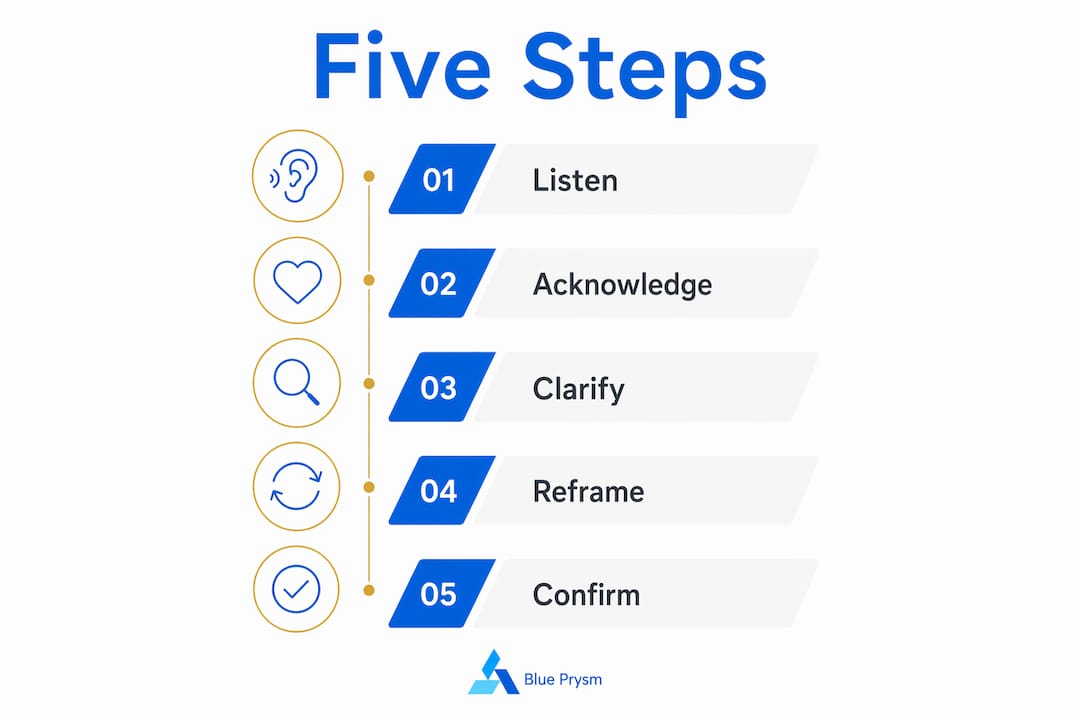
The consensus approach among professionals is a five-step process. Each step has a specific purpose, and skipping any one of them usually makes the objection worse.
-
Listen and pause. Let the prospect finish without interrupting. Then wait. A pause of 2–3 seconds after an objection prompts the buyer to keep talking, which often surfaces the real concern hiding behind the stated one.
-
Acknowledge. Validate the concern without agreeing or arguing. Phrases like “That’s a fair concern” or “I hear you” build rapport. Misusing “I understand” can sound dismissive, so choose your words deliberately.
-
Clarify the root cause. Ask one open question to confirm you understand the real issue. “What’s driving that concern?” or “Can you help me understand what’s behind the timing?” are both effective. Do not assume you know the answer.
-
Reframe with value. Address the actual concern with evidence, not a scripted rebuttal. Tie your response to the prospect’s specific pain point. A value reframe beats a price cut every time because it shifts the conversation from cost to consequence.
-
Confirm resolution. Ask directly: “Does that address your concern?” Do not move forward until you get a clear yes. Unconfirmed objections resurface at the worst possible moment, usually right before signature.
Pro Tip: Write down the three objections you hear most often. Draft a value reframe for each one. Practice it out loud until it sounds natural, not rehearsed. Your response time and confidence will both improve.
How can you preempt objections before they arise?

The best objection is the one that never happens. Rigorous qualification methods like MEDDPICC and BANT exist precisely to surface potential blockers early, before they derail a late-stage deal.
Preemptive tactics that consistently reduce objection volume include:
- Map all stakeholders early. If you only know one contact, you are one “I need to check with my boss” away from a stalled deal. Identify every decision maker and influencer in the first two meetings.
- Address common objections in your pitch. If price always comes up, build a ROI frame into your opening. If timing is a recurring issue, establish urgency with data before the prospect raises it.
- Qualify on pain, not just fit. A prospect who fits your ideal customer profile but feels no pain will not buy. Confirm that the problem is real, felt, and prioritized before investing in a full sales cycle.
- Time your outreach correctly. Reaching a prospect during a budget freeze or post-merger chaos creates objections that have nothing to do with your product. Market timing matters.
Pro Tip: Build a “pre-mortem” into your deal reviews. Ask: “What objection could kill this deal, and have we addressed it yet?” This one question surfaces hidden risks before they become lost deals.
How should you respond to each objection type?
Each objection category requires a different response strategy. Using the wrong approach on the right objection is just as damaging as ignoring it.
| Objection type | Core response strategy |
|---|---|
| Budget | Reframe around cost of inaction; avoid discounting, which erodes credibility |
| Authority | Ask who else needs to be involved; request a multi-stakeholder meeting |
| Need | Clarify the pain point with questions; demonstrate fit with a specific use case |
| Timing | Agree on a concrete next step with a date; quantify the cost of delay |
| Competitor | Acknowledge the relationship; differentiate on outcomes, not features |
Budget objections frequently signal that the business case has not justified the expense priority, not that funds are unavailable. Reframe the conversation around what inaction costs the business. For authority objections, the goal is not to go around the contact but to bring the right people into the room together. For competitor objections, stay diplomatic. Attacking a competitor’s product rarely works and often backfires.
Common mistakes that kill objection handling
Most objection handling fails not because of bad technique but because of bad habits that are easy to miss in the moment.
- Rushing to respond. Jumping in before the prospect finishes signals that you were not really listening. It also means you are responding to what you expected, not what they actually said.
- Dismissing the objection. Phrases like “That’s not really an issue” or “Most people feel that way at first” minimize the prospect’s concern and break trust fast.
- Using silence wrong. Silence after your response is powerful. Silence after their objection, used as a pause, is a tool. Silence used to avoid a hard question is avoidance.
- Skipping confirmation. Moving forward without asking “Does that address your concern?” leaves objections alive under the surface.
“Objection handling is not about winning an argument. It is about maintaining trust long enough for the buyer to make a confident decision. Treat every objection as an invitation to educate, not a challenge to defeat.”
Recognize when an objection is actually a signal of misalignment. If the same objection comes back three times after three different responses, the deal may not be the right fit. Knowing when to step back is as important as knowing how to push forward. Build a personal objection-response library by logging every objection you hear and the response that worked. That library compounds over time.
Key takeaways
Effective objection management turns buyer hesitation into trust by following a structured process, qualifying rigorously, and responding to the real concern beneath the stated one.
| Point | Details |
|---|---|
| Objections are buying signals | A prospect raising concerns is still engaged; silence is the real danger sign. |
| Use the five-step framework | Listen, acknowledge, clarify, reframe with value, and confirm resolution every time. |
| Qualify early to prevent late objections | MEDDPICC and BANT surface blockers before they derail a late-stage deal. |
| Match your response to the objection type | Budget, authority, need, timing, and competitor objections each require a different approach. |
| Build a response library | Log every objection and effective response; that catalog becomes your competitive edge. |
What I’ve learned from years of watching deals die at the finish line
The most common mistake I see executives make is treating objection handling as a closing tactic. It is not. It is a trust-building discipline that runs through the entire sales conversation, not just the final meeting.
The reps who consistently win are not the most persuasive. They are the most patient. They pause when every instinct says to respond. They ask one more clarifying question when they think they already know the answer. That discipline is what separates a 40% close rate from a 60% one.
Viewing objections as buying signals rather than barriers keeps reps engaged and opens up opportunities that defensive responses close off. The prospect who pushes back hard on price is telling you they are seriously evaluating the purchase. The one who says nothing and goes quiet is the one you have already lost.
Preemptive qualification is where I put most of my attention now. If you map stakeholders, confirm pain, and address common objections in your pitch before they surface, you spend less time firefighting and more time closing. That shift alone changes how a pipeline feels to manage.
— Colin Bowdery
How Blue Prysm helps sales teams get ahead of objections
Sales teams that lose deals to unresolved objections usually have an intelligence problem, not a technique problem. They do not know enough about the buyer’s market, competitive pressures, or internal priorities to address concerns before they surface.

Blue Prysm’s AI-powered market research tools give sales managers and executives the buyer and market context they need to preempt objections at every stage of the pipeline. The competitive intelligence platform tracks competitor moves in real time, so your team walks into every conversation knowing exactly how to differentiate. The strategy library includes 95+ frameworks, including BANT and MEDDPICC templates, built for teams that want structure without the consulting bill. Better intelligence means fewer surprises and more confident conversations.
FAQ
What is handling objections in sales?
Handling objections, formally called objection management, is the process of responding to and resolving prospect concerns during a sales conversation. The goal is to address the real issue behind the stated concern and move the deal forward.
What are the five steps of objection handling?
The five steps are: listen and pause, acknowledge the concern, clarify the root cause, reframe with value, and confirm resolution. Skipping any step typically causes the objection to resurface later.
Why do so many sales opportunities end without a decision?
40–60% of sales opportunities end in “no decision,” most often because objections were left unresolved or the prospect never felt confident enough to commit.
How do you handle a budget objection without discounting?
Reframe the conversation around the cost of inaction rather than the price of your solution. Budget objections usually signal that the business case has not been made compellingly, not that funds are genuinely unavailable.
What is the difference between a genuine objection and a brush-off?
A genuine objection names a specific concern, such as price or timing. A brush-off is vague, like “just send me some information.” Brush-offs require a direct follow-up question to determine whether real interest exists.