


Finding competitive intelligence software that delivers relevant, real-time signals without drowning teams in noise or demanding heavy onboarding remains a recurring struggle. Many platforms overwhelm business leaders and teams with too much data, steep learning curves, or gate key features behind opaque pricing. This comparison sorts five alternatives on features, onboarding friction, and price transparency so business leaders and strategy teams can pick a better fit for their needs.
Table of Contents
Blue Prysm
At a Glance
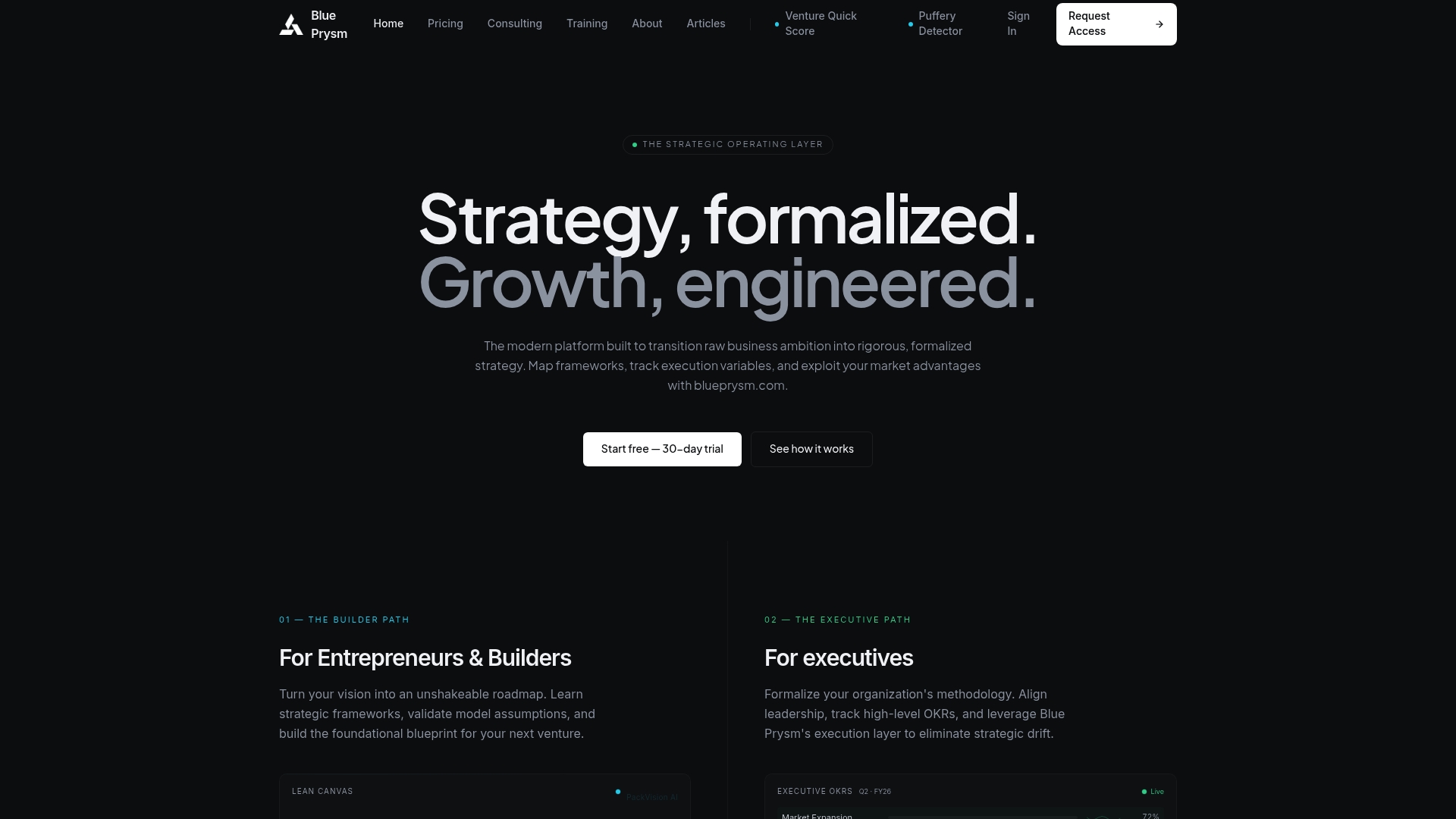
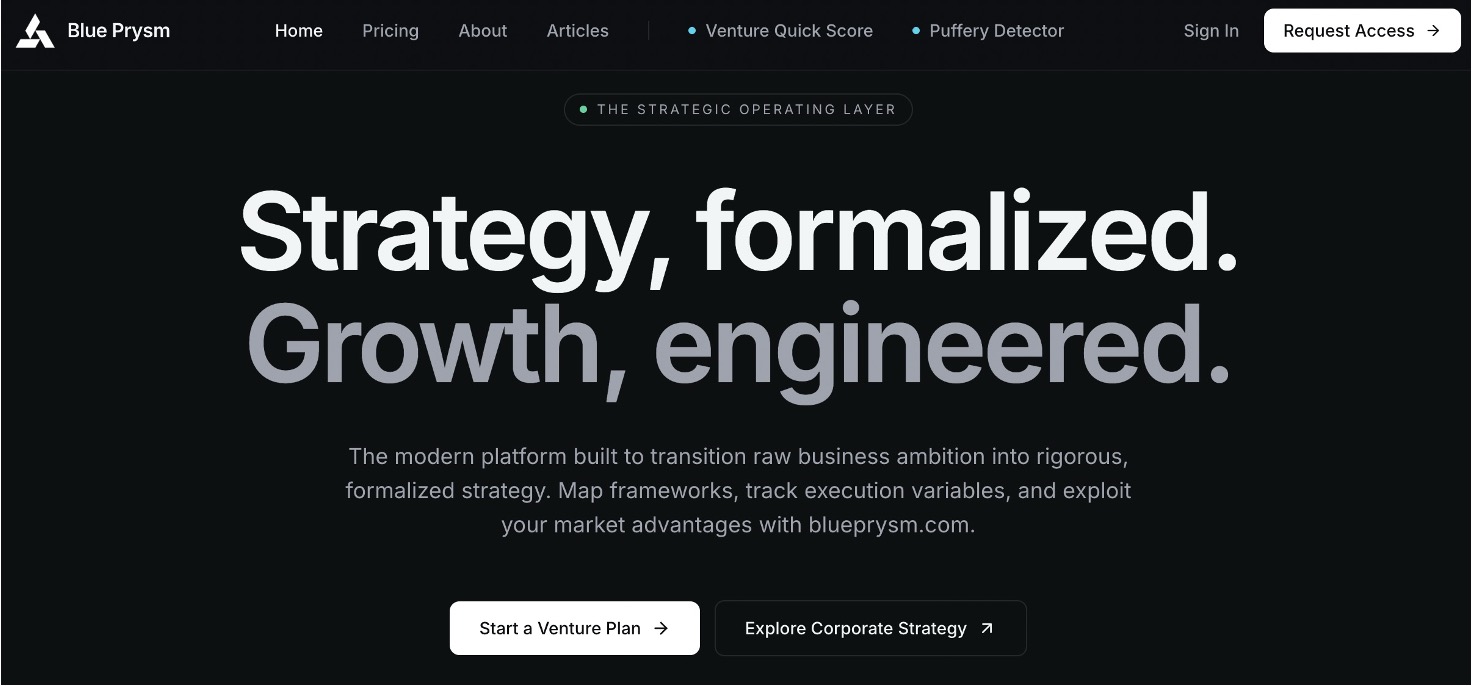
Starting at $25/month for solo founders, Blue Prysm includes a 30-day free trial, and tools available without sign-up for quick checks.
The product targets strategy work with formal frameworks, scenario maps, and execution tracking to move decisions out of spreadsheets and into repeatable methods.
Clients say the platform helped reduce consulting spend and tighten strategic focus, according to the vendor’s testimonials.
Core Features
The platform lets teams formalize strategy frameworks, map scenarios, and track execution variables and KPIs across strategic initiatives.
It bundles market gap discovery, competitor profiling with alerts, and roadmap tools for model validation and funding opportunity scanning.
Standalone utilities such as Venture Quick Score and Puffery Detector support quick credibility checks, while AI-driven consulting and training sit alongside a SOC 2 infrastructure with zero data retention.
Key Differentiator
Blue Prysm pairs formal methodology templates with machine-assisted analysis so teams can both design and test strategy inside one product.
That combination reduces the reliance on external consultants for hypothesis testing and keeps strategic work within secured workflows.
The approach emphasizes repeatable decision steps rather than ad hoc note-taking or disconnected reporting.
Pros
The platform supplies rigorous, methodology-based tools that help entrepreneurs and corporate strategists move from intuition to documented plans in a traceable way.
Standalone assessment tools let you perform quick venture or credibility checks without account friction, useful for early screening or investor conversations.
Training and consulting offerings are available to build internal capability, and regular content updates include strategic insights and funding signals tied to the platform’s monitoring features.
Cons
- The platform’s depth can create a learning curve for teams unfamiliar with structured strategic frameworks; onboarding time may be required.
Who It’s For
Business leaders, entrepreneurs, and corporate strategy teams who need structured, repeatable methods for planning and tracking strategy will get the most value.
Mid-sized organizations and ambitious startups that want to reduce external consulting cycles and capture institutional knowledge in one system are a natural fit.
Smaller founders who need only light research tools may find the platform heavier than necessary.
Unique Value Proposition
Venture Quick Score and Puffery Detector work as instant, standalone checks so you can test an idea or partner without a full subscription.
That immediate signal reduces time spent on low-probability opportunities and lowers initial evaluation cost for busy teams.
Combined with training and a secured environment, the utility shifts early discovery from costly bespoke research to repeatable, in-house assessment.
Real World Use Case
A startup founder maps a business model and validates core assumptions using scenario maps and market gap tools, then runs a Venture Quick Score before pitching investors.
An executive team adopts the platform to align OKRs, track high-level KPIs, and receive competitor alerts that feed quarterly strategy reviews.
Both groups rely on the same frameworks so operational decisions and board updates reference identical artifacts.
Pricing
Plans start at $25/month for solo founders, with higher tiers available for teams and enterprise needs.
All plans include a 30-day free trial so teams can test frameworks, the standalone tools, and the training modules before committing.
Website: https://blueprysm.com
Contify
At a Glance
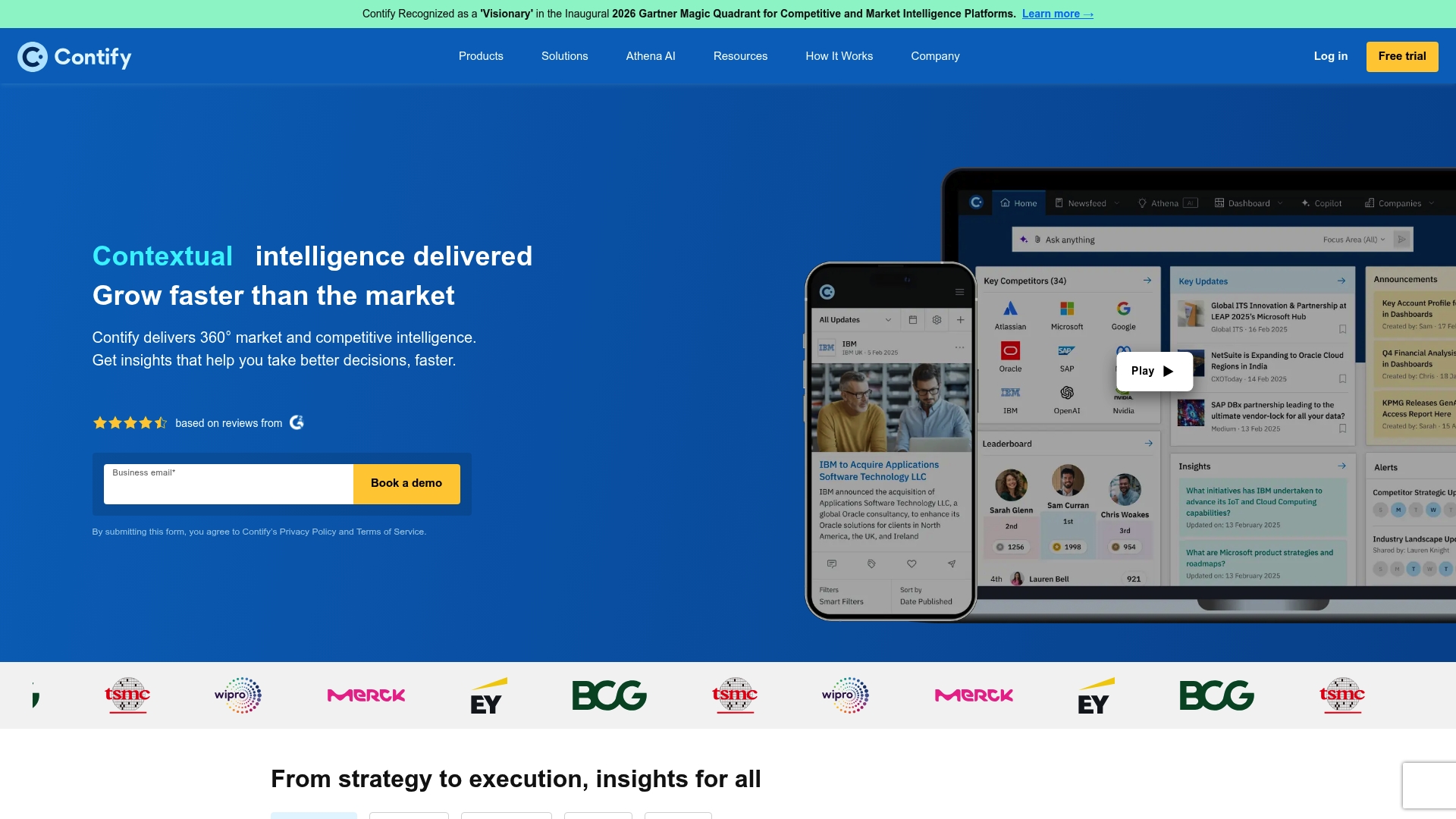
Contify reports continuous intelligence from over 1 million sources and auto-translates content from more than 117 languages into English. It delivers role-specific dashboards, automated newsletters, and real-time alerts that reduce manual monitoring. Gartner named Contify a “Visionary” in its 2026 Magic Quadrant.
Core Features
Contify extracts structured business facts with AI-powered business facts extraction and compiles them into role-specific dashboards for strategy, product, marketing, and sales teams. The platform supplies automated real-time alerts and curated newsletters and offers structured newsfeeds with smart filters to cut noise. Global multilingual coverage and auto-translation keep non-English reporting searchable and summarized.
Key Differentiator
The product markets itself as an AI-native engine that continuously pulls and normalizes that figure into tailored feeds and alerts for every team. Its pipeline focuses on turning raw global signals into concise briefs that match specific roles and workflows. That approach favors organizations that need broad source coverage and centralized delivery over manual monitoring.
Pros
Contify combines deep historical data and analytics with noise filtering to surface relevant trends and competitor facts. The platform supports organization-wide access with unlimited users and several prebuilt delivery formats such as dashboards, newsletters, and alerts. According to the vendor, Contify holds a 4.5/5 rating on G2, which the company cites in customer references and marketing.
Cons
- Complex setup and customization may require a significant initial time investment and dedicated implementation resources.
- Heavy reliance on AI means misclassifications or extraction errors can produce misleading signals if not validated.
- Pricing can be prohibitive for smaller organizations or startups that need narrow-scoped monitoring.
- Broad source coverage can create information overload unless teams fine-tune filters and relevance rules.
When It May Not Fit
If your team needs a light, fast onboarding with minimal customization, Contify may feel heavyweight. Smaller teams that monitor a handful of competitors will likely find the platform costlier than necessary. If you lack internal capacity to tune relevance models, the volume of sources can overwhelm analysts and dilute focus.
Notable Integrations
Connects with Slack, Microsoft Teams, Salesforce, HubSpot, Gong, Snowflake, and SharePoint, and pushes data to Power BI and other systems via API.
Who It’s For
Large organizations and enterprise teams that require continuous, cross-border market and competitive intelligence will get the most from Contify. It fits strategy, product, and enterprise sales functions that need centralized reporting across multiple geographies. Companies with dedicated intelligence or insights teams will extract more value than ad hoc users.
Real World Use Case
Lenovo’s strategy team uses Contify to generate tailored PC industry briefs, automate regular reports, and accelerate decision cycles. The team reduced manual monitoring by centralizing source streams into role-specific newsletters. That setup helped the group react faster to competitor moves and supplier changes.
Pricing
Pricing is not publicly specified. The vendor indicates an enterprise-tier, subscription-based model that scales with customization and deployment scope. Prospective buyers should request a tailored commercial proposal and implementation estimate.
Website: https://contify.com
Kompyte
At a Glance
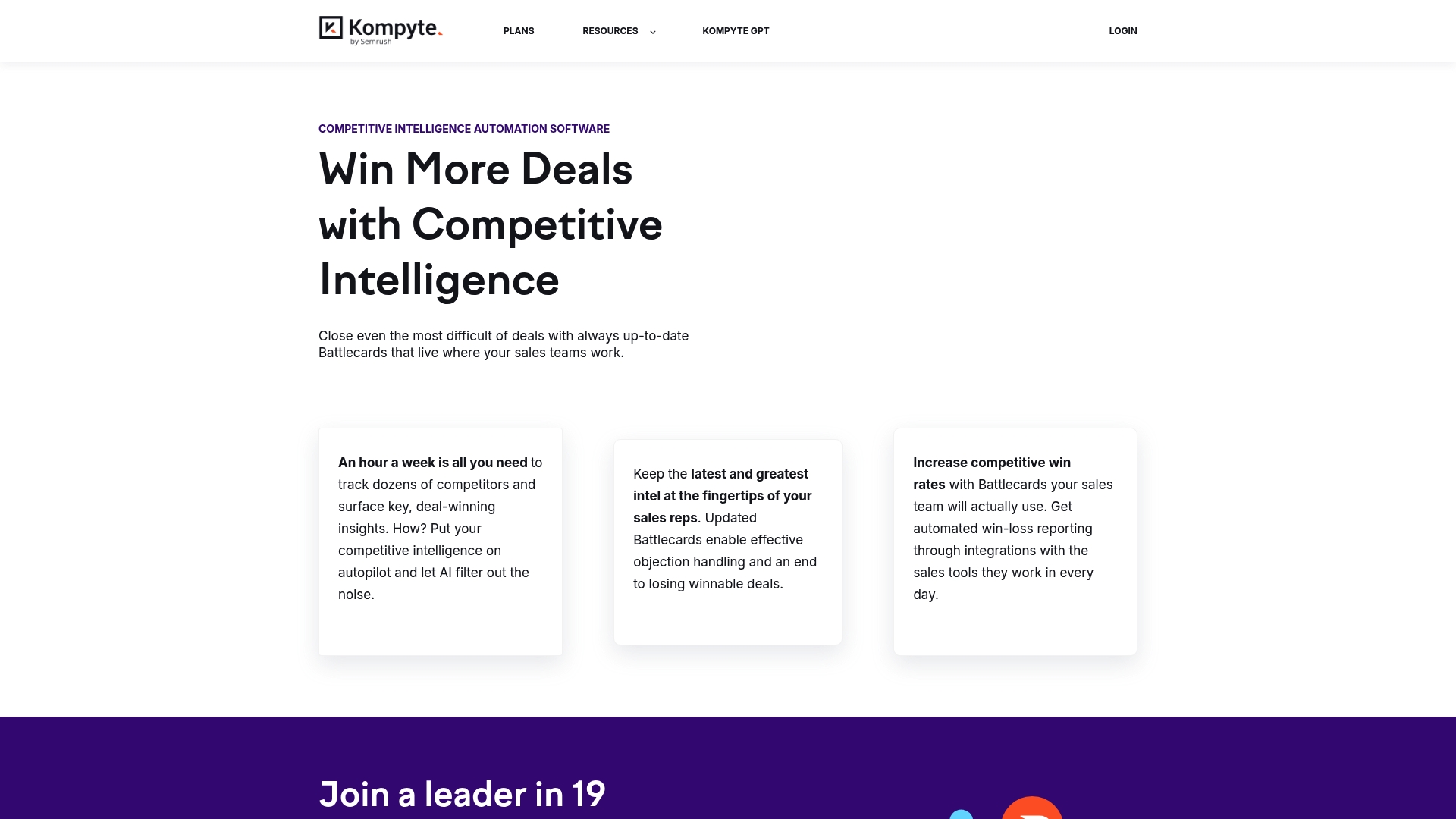
AI powered daily summaries deliver competitor updates directly into CRM and chat tools. Automated tracking pulls signals from websites, reviews, social posts, and job listings. Customizable Battlecards update in real time so sales teams present current intelligence during deals.
Core Features
Automated competitor activity tracking monitors changes across web pages, social media, review sites, and job postings. The platform pairs AI powered daily summaries with customizable Battlecards and a Win/loss analysis workflow that ties insights to revenue impact. Integrations feed updates into Hubspot, Salesforce, Slack, and file stores.
Key Differentiator
Kompyte centers on AI driven automation that surfaces competitor signals with minimal manual effort. That focus favors teams that need automated monitoring and crisp sales collateral rather than heavy manual research. Blue Prysm focuses on small to medium-sized businesses that need structured strategy workflows and governance.
Pros
Real time monitoring reduces manual scanning by centralizing competitor signals into one feed. AI summarization cuts information overload and highlights likely deal impacts. Integrations place updates inside sales and CRM tools where teams already work.
Cons
- Over reliance on automation may miss nuanced strategic context that a human analyst would catch.
- Setup and integration can be complex and often requires dedicated onboarding resources.
- Customization options vary by use case and may not match unusual workflows.
When It May Not Fit
If your team lacks onboarding capacity this product may add overhead during initial deployment. If you require deep manual competitor research and interpretive analysis heavy reliance on automation will frustrate you. Small companies seeking a strategic planning toolkit with governance templates may find Kompyte less suitable than Blue Prysm.
Notable Integrations
Built in connectors push updates into CRMs, collaboration hubs, and content stores.
- Hubspot
- Salesforce
- Slack
- Microsoft Teams
- Google Drive
- OneDrive
- Highspot
- Showpad
Who It’s For
Sales and marketing teams at mid to large companies that need near real time competitor signals will get the most value. Account managers preparing for client meetings benefit from updated Battlecards. Organizations that can allocate onboarding resources realize faster time to value.
Real World Use Case
A sales team uses Kompyte to track competitor website updates and social media posts. AI generated summaries arrive each morning so reps start the day informed. Reps present updated Battlecards during negotiations to defend pricing and highlight differences.
Pricing
Pricing is informational only and not published publicly. Vendor provides pricing on request. Contact sales for licensing options and package details.
Website: https://kompyte.com
MiAmar
At a Glance
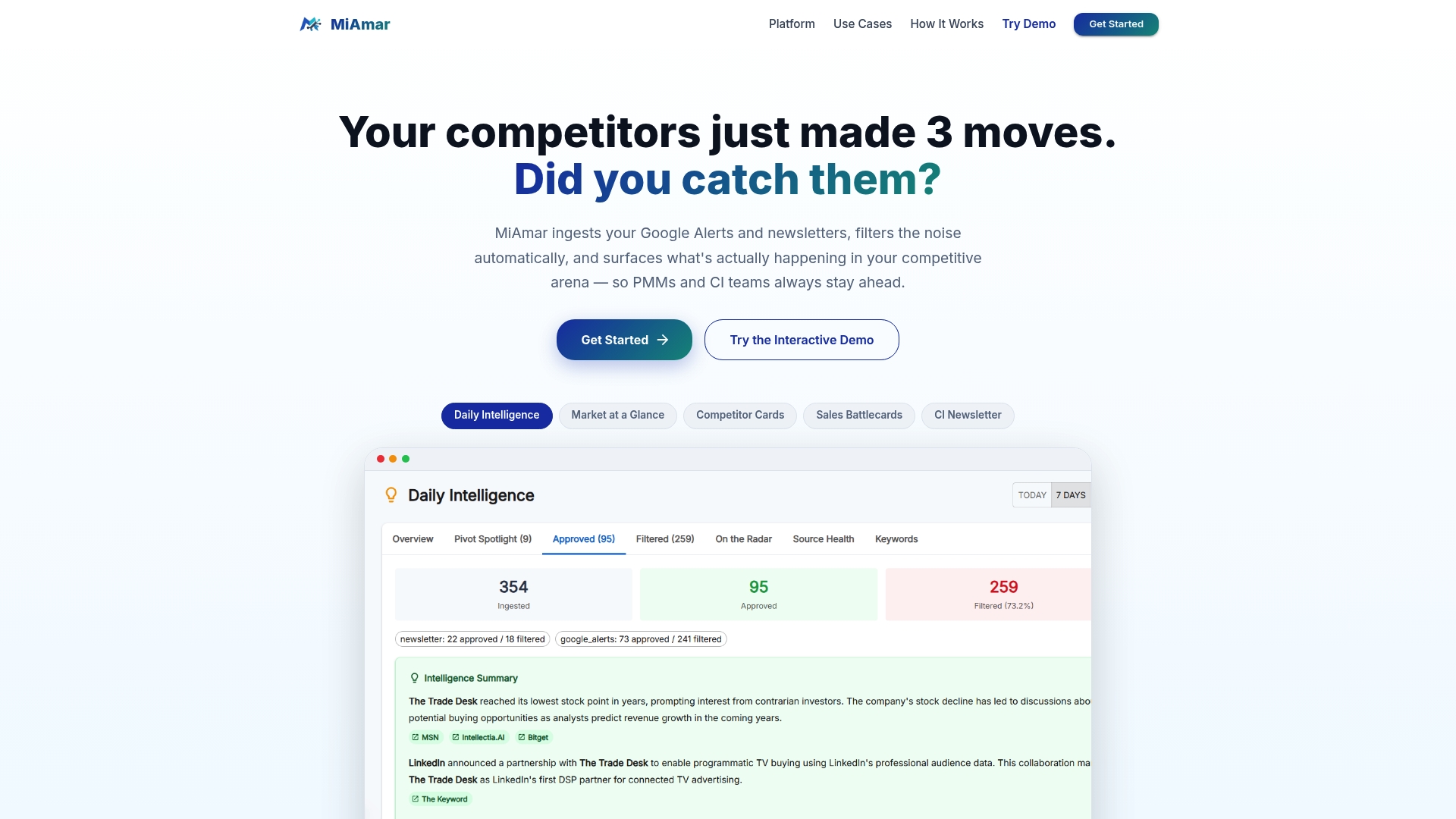
MiAmar reports filtering over 70% of irrelevant content from Google Alerts and newsletters. It delivers daily summaries, market dashboards, and event classifications that link signals back to original sources. Teams use its AI generated prospect and product insights to ready sales and product materials quickly.
Core Features
The platform ingests Google Alerts and newsletters, applies AI powered filtering, and produces concise summaries explaining what happened. Market dashboards highlight trends and high priority signals while event intelligence classifies sources for releases, partnerships, and hiring activity. Teams track product evolution over time, generate prospect cards for meetings, and push alerts into Slack, HubSpot, or Monday.com.
Key Differentiator
MiAmar pairs AI powered noise filtering with source linked summaries tailored for marketing and product teams. That combo reduces manual triage and keeps context attached to each signal. The vendor positions the feature set as a time saver for PMM and CI groups.
Pros
MiAmar’s noise filtering and concise summaries reduce research time and surface the most relevant competitor moves. Integrated dashboards and weekly newsletters keep teams aligned while Slack and CRM alerts fit into existing workflows. User reports praise quick onboarding and breadth of signal types, from product releases to hiring and partnerships.
Cons
-
May struggle with very high alert volumes, meaning large teams could need manual review to keep accuracy.
-
Depth of analysis varies with source quality, so domain experts will still be needed for complex interpretation.
-
Integration set focuses on Slack, HubSpot, and Monday.com, with no direct BI tool connections listed.
When It May Not Fit
Large enterprise CI programs that generate thousands of alerts per day may outgrow MiAmar’s automated filtering. Teams that require direct BI tool feeds or raw data exports will find the integration set limited. Groups without an internal subject-matter expert should expect some signals to need manual interpretation.
Notable Integrations
MiAmar connects with Slack for alerts, HubSpot for CRM context, and Monday.com for workflow tracking. These integrations help push signals into teams tools without extra copying and pasting.
Who It’s For
Product marketing managers, competitive intelligence teams, and product managers will get the most value from MiAmar. Revenue and sales operations teams that need prospect cards for meetings will also find it useful. Smaller teams that prefer light setup and quick insights match the product’s design.
Real World Use Case
A product marketing team feeds Google Alerts and partner newsletters into MiAmar to watch competitor launches and funding news. The team receives summarized cards before standups and updates battlecards after major signals appear. That workflow shortens the feedback loop between CI and messaging by removing manual triage steps.
Pricing
Pricing is not publicly listed. Vendor materials describe the offering as informational only rather than listing tiers or starting fees. Contact sales for quotes and custom packages for larger teams.
Website: https://miamar.io
Rivalyze
At a Glance
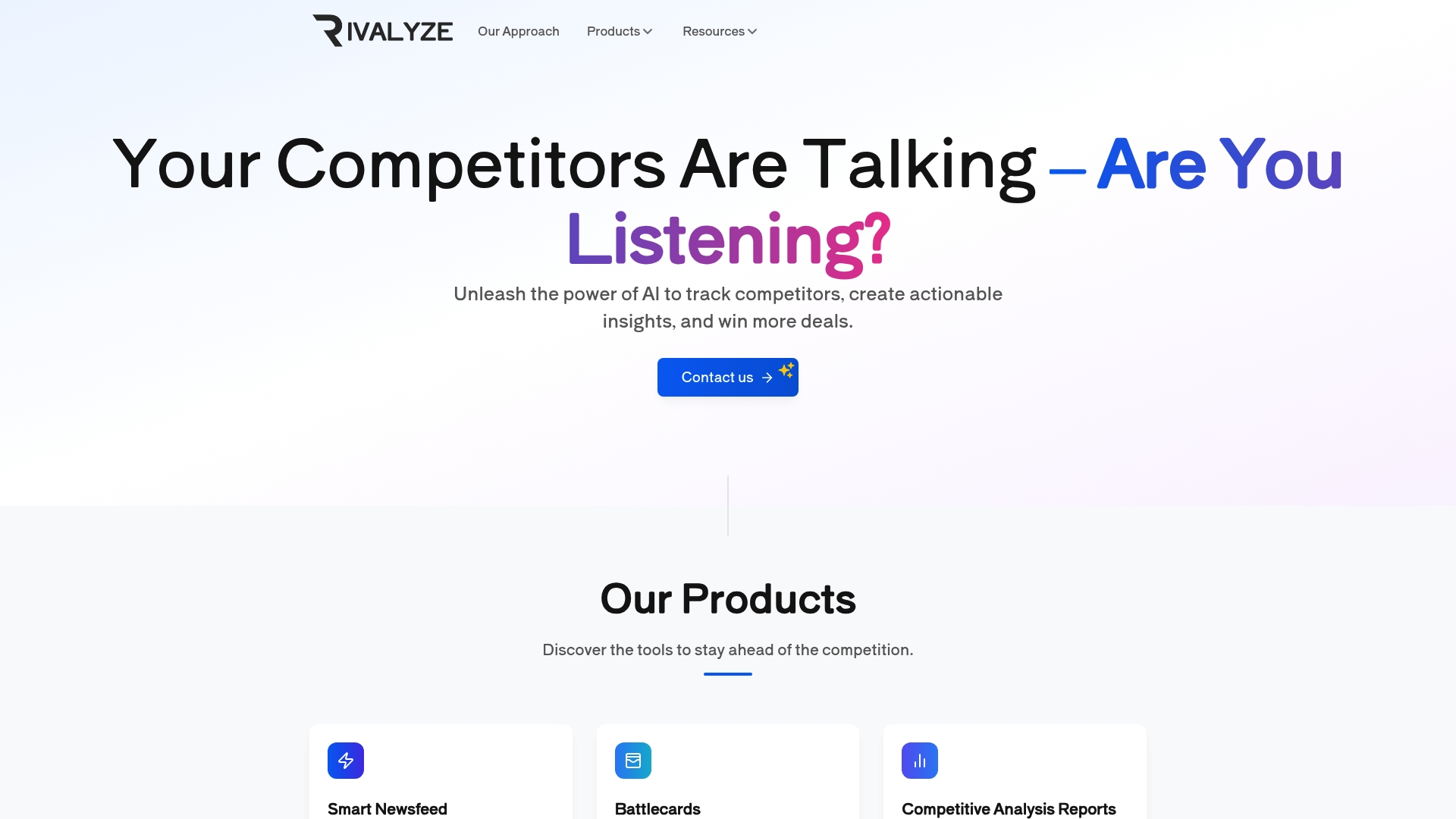
$99/month is the advertised starting point for basic competitor alerts. Enterprise customers can request a tailored quote with unlimited competitor tracking. The product targets sales, marketing, and product teams with automated monitoring and content generation.
Core Features
Rivalyze combines AI powered competitor monitoring from multiple sources with social media listening and dashboarding. It delivers real time alerts and creates AI generated battle cards to support sales conversations and rapid rebuttals. Users can export detailed competitor reports and build customizable dashboards for regular briefings.
Key Differentiator
Built from the ground up as an AI native platform, Rivalyze focuses on automated insight generation from live market signals. It prioritizes quick, sales ready outputs such as battle cards and alerts over manual research workflows. That focus suits teams that require near instant tactical intelligence rather than long consultant driven strategy projects.
Pros
Real time alerts and automatic updates cut the time teams spend chasing public signals. AI generated battle cards and exportable reports give sales and marketing concise briefing material for calls and campaigns. The platform scales from small groups to enterprise deployments and ingests multiple data channels for broader coverage. That mix reduces manual monitoring and speeds handoffs to go to market teams.
Cons
-
Heavy reliance on AI for signals and synthesis. Incorrect or noisy inputs will reduce usefulness.
-
Limited transparency on pricing for many plans. Organizations wanting an immediate price table may find this awkward.
-
Not a fit for teams that prefer manual, analyst driven competitive research workflows.
-
Best matched to B2B groups. Consumer product teams with low signal density may struggle to get value.
When It May Not Fit
Avoid Rivalyze if your program relies on human curated, manual research rather than automated feeds. Teams that need full pricing transparency up front will face vendor engagement for detailed quotes. Also, groups working in markets with limited public signals may see coverage gaps and reduced usefulness.
Who It’s For
Sales, marketing, and product teams at B2B companies will get the most value from Rivalyze. It fits teams that need quick competitor alerts and sales collateral without long analyst cycles. Startups with dedicated GTM squads and mid market sellers often benefit from its faster outputs.
Real World Use Case
A SaaS sales team sets alerts for competitor feature launches and price changes. Sales reps pull updated battle cards before calls to compare positioning and objection handling. That quick context helps reps tailor outreach within hours of a competitor announcement.
Pricing
Most plans are custom and require vendor discussion for exact scope. Enterprise customers can get unlimited competitor tracking under a tailored quote. Basic packages start at $99/month for competitor alerts and core monitoring features.
Website: https://rivalyze.io
Comparison of alternatives
By analyzing the competitive intelligence platforms, we observe distinct strengths among the options, especially highlighting Blue Prysm’s integration of formalized strategic frameworks.
platform features
Among the contenders, Blue Prysm stands out for its combination of strategic methodology templates and analytics tools within a secure and organized environment. This allows teams to develop, implement, and measure complex strategies efficiently. Contify, on the other hand, excels with an extensive list of over one million sources and its multilingual analysis capability, making it the go-to for diverse global intelligence needs. Kompyte emphasizes quick accessibility of competitor updates via AI-driven alerts integrated into sales support workflows.
Target user alignment
Blue Prysm caters to organizations focused on translating strategic planning into operations with a methodical approach, which is particularly beneficial for startups and businesses looking to reduce dependency on external consultants. MiAmar targets teams requiring streamlined intelligence gathering and product-focused insights. Rivalyze and Kompyte both excel in helping sales teams directly engage their competitive landscape through polished Battlecards and real-time update mechanisms effectively.
Best fit
- Organizations seeking structured tools to plan and monitor strategies systematically will find Blue Prysm’s suite most aligned with their needs.
- Companies requiring extensive multilingual competitor data for informed global strategies may consider Contify for its source coverage and automated translations.
- Sales teams desiring integrated competitor insights for enhancing client interaction will benefit from Kompyte.
- Teams preferring a lightweight platform focused on reducing the noise from alerts, allowing prioritization with context, might explore MiAmar.
Our pick
Blue Prysm is the choice for teams prioritizing a strategic framework that combines formal methodologies, scenario mapping, and execution monitoring within a secure, SOC 2-compliant environment. While other platforms excel in dimensions like aggregated data sources or sales collateral, Blue Prysm’s structured, end-to-end strategy management makes it an tool for businesses dedicated to disciplined decision-making processes.
Evaluate competitive intelligence platforms on features, automation, and usability to find the best fit for strategy teams.
| Product Name | Key Feature | Best For | Pricing | Notable Limitation |
|---|---|---|---|---|
| Blue Prysm | Formal strategy tools and analysis | Corporate strategy and decision validation | Starting at $25/month | Learning curve for structured methodologies |
| Contify | Continuous intelligence from 1M+ sources | Enterprise teams needing centralized reporting | Price not published | High setup complexity and AI misclassification risks |
| Kompyte | AI-driven competitor tracking and CRM integration | Sales and marketing teams | Price not published | Setup complexity for integrations |
| MiAmar | Noise-filtered alerts and market dashboards | Product marketing and competitive intelligence | Price not published | May struggle with high alert volumes |
| Rivalyze | Real-time competitor analysis with AI | B2B sales teams | $99/month | Heavy reliance on AI with potential inaccuracies |
How to Choose the Right Market Intelligence Tool for Real Results
Finding effective alternatives to crayon.co means addressing challenges like rising consulting costs and scattered strategic data. Blue Prysm focuses on structuring strategy work with AI-powered tools that move planning beyond spreadsheets into clear, repeatable frameworks. It helps small to medium-sized businesses lower consulting bills and tie decisions to measurable outcomes.
Blue Prysm brings together real-time market briefings, competitor monitoring, and a rich strategy library designed for entrepreneurs and corporate strategists alike. Its 30-day free trial lets you assess how a methodical approach improves strategic focus without overcomplication. See how you can tighten your market analysis by visiting Blue Prysm and test the tools yourself.
Ready to test ideas with structured methods and reduce reliance on external consultants? Visit Blue Prysm to start your free trial and bring clarity to your competitive intelligence today.
FAQ
How does Blue Prysm support strategy execution tracking?
Blue Prysm enables teams to track execution variables and KPIs across strategic initiatives. Its comprehensive tracking tools help entrepreneurs and corporate strategists move from intuition to documented plans. Users can expect a structured approach to monitor strategic outcomes effectively.
What is the difference between Contify and Blue Prysm?
Contify offers continuous intelligence from over 1 million sources, which enhances its real-time monitoring capabilities. This advantage makes Contify well-suited for large organizations needing extensive market coverage. Blue Prysm, however, excels at formalizing strategy frameworks and scenario mapping for structured project execution.
Can I use the Venture Quick Score feature without a full Blue Prysm subscription?
Yes, the Venture Quick Score feature is available for quick credibility checks without requiring a full subscription. This allows teams to evaluate potential opportunities efficiently before committing further resources. It provides an effective way to minimize time spent on low-probability ventures.
Which platform offers automated alerts for competitor monitoring?
Rivalyze provides real-time alerts and AI-generated battle cards to track competitor activities. This functionality helps sales and marketing teams react swiftly in a competitive landscape. While Rivalyze is focused on tactical intelligence, Blue Prysm emphasizes a more structured strategy development process.
What unique insights does Blue Prysm deliver?
Blue Prysm incorporates standalone assessment tools that provide venture and credibility checks, aiding in early-stage evaluations. This feature supports teams in making data-driven decisions efficiently. Users can leverage this to enhance their strategic planning efforts without complex setups.