


TL;DR:
- A marketing brief template is a concise, structured document that defines campaign objectives, target audience, key messages, and deliverables. It prevents scope creep and misalignment by providing a clear, collaborative plan that is regularly referenced and updated throughout the campaign. Successful briefs are short, specific, and built with the team, integrating AI tools for better automation and insights.
A marketing brief template is a structured, one-to-three-page document that defines a campaign’s objectives, audience, key messages, and deliverables before any work begins. Without one, teams operate on gut feeling and verbal agreements, which is exactly how budgets blow up and campaigns miss the mark. 62% of marketing leaders prefer a one-page strategic summary over lengthy traditional documents for daily execution. That preference reflects a hard truth: clarity at the start saves everyone time, money, and frustration later.
What key sections should a marketing brief template include?
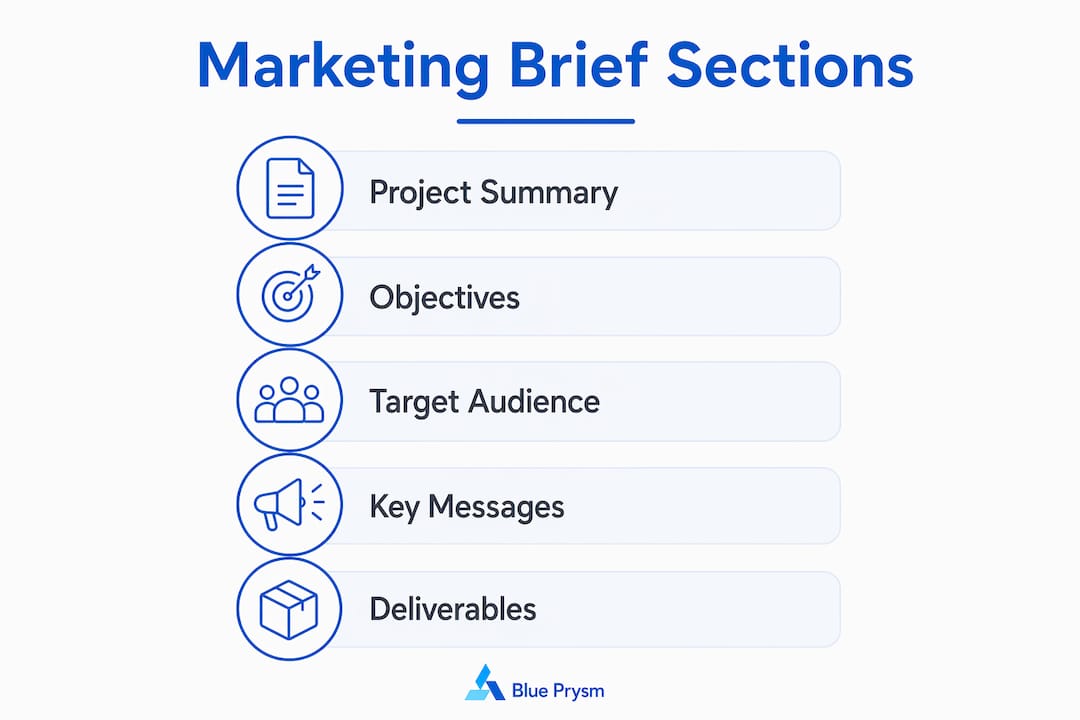
A well-structured brief covers eight core sections: project summary, objectives, target audience, key messages, deliverables, budget, timeline, and approvals. Each section does a specific job. Skip one, and you create a gap that someone will fill with assumptions.
The project summary is a two-to-three sentence description of what the campaign is and why it exists. Objectives must be measurable. “Increase brand awareness” is not an objective. “Generate 500 qualified leads from LinkedIn ads by September 30” is. The target audience section should describe a real person, not a demographic bucket. “Marketing directors at B2B SaaS companies with 50–200 employees” is useful. “Business professionals aged 25–45” is not.
Key messages define what the campaign says and why it matters to the audience. Deliverables list every output: landing pages, ad creatives, email sequences, and social posts. Budget and timeline set the boundaries that keep scope in check. Approvals define who signs off at each stage, which prevents the endless revision loop that kills deadlines.
| Section | Purpose |
|---|---|
| Project summary | Describes the campaign context and business rationale |
| Objectives | States measurable goals with specific metrics and deadlines |
| Target audience | Defines the specific person the campaign speaks to |
| Key messages | Outlines the core claims the campaign must communicate |
| Deliverables | Lists every output expected from the project |
| Budget | Sets financial boundaries and allocation priorities |
| Timeline | Maps milestones and final delivery dates |
| Approvals | Names decision-makers and sign-off requirements |
Pro Tip: Write the objectives section last. Once you have defined your audience, messages, and deliverables, the right metrics become obvious.
How does a marketing brief differ from a creative brief?
These two documents are not interchangeable, and confusing them causes alignment delays and scope creep on nearly every project where the distinction is ignored. The marketing brief answers “what and why.” The creative brief answers “how to communicate it.”
A marketing brief is a strategic document. It covers business goals, campaign rationale, audience insight, and success metrics. It is written for account leads, brand managers, and media planners. A creative brief is a directive for designers, copywriters, and art directors. It covers tone of voice, visual direction, messaging hierarchy, and communication style. Handing a creative team a marketing brief and expecting them to produce on-brand work is like giving a contractor a building permit and expecting architectural drawings.
The sequence of documents in a well-run campaign follows a clear order:
- Client brief. The client communicates their business problem and desired outcome to the agency or internal team.
- Marketing brief. The marketing team translates the client brief into a campaign strategy with defined goals, audience, and budget.
- Creative brief. The creative team receives the marketing brief and builds a communication plan focused on execution and messaging.
- Production brief. The production team receives the creative brief and manages the technical delivery of assets.
Each document feeds the next. Skipping steps or merging documents creates the exact misalignment that causes campaigns to stall.
Best practices for writing an effective marketing brief
Most effective briefs are one to three pages. Longer briefs get skimmed or ignored, which defeats the entire purpose of writing one. Brevity is not laziness. It is discipline.

SMART goals are the standard for objectives: specific, measurable, achievable, relevant, and time-bound. Vague goals like “increase brand awareness” are the single most common reason briefs fail at execution. Replace them with metrics, timelines, and defined audience segments every time.
Structured, machine-readable fields for objectives, audiences, and deliverables allow AI tools to parse the brief and generate task lists automatically. This is not a future consideration. Teams using AI-assisted project management tools in 2026 need briefs formatted for both human readers and automated workflows.
Common pitfalls to avoid:
- Writing objectives that cannot be measured at campaign end
- Describing the audience in demographic terms only, without behavioral or psychographic context
- Leaving the approvals section blank, which creates bottlenecks at every revision stage
- Treating the brief as a hand-off document rather than a living reference throughout the campaign
- Allowing scope changes without updating the brief, which makes the original document useless
Pro Tip: Every brief needs a single-minded proposition: one sentence that states the core message the campaign must land. If you cannot write it in one sentence, the brief is too broad.
How to use a marketing brief template effectively within your team
A brief only works if the team builds it together before the project starts. Filling it out solo and emailing it to the group is not a briefing process. It is a memo.
Run a brief review session with all key stakeholders before any creative or media work begins. This session surfaces conflicting assumptions early, when they are cheap to fix. Teams that skip formal written briefs and rely on verbal agreements consistently face budget overruns and mid-campaign debates about what was actually agreed. The written brief is the single source of truth that prevents those conversations.
Practical steps for applying the template:
- Share a draft brief with stakeholders at least five business days before the project kickoff
- Require written sign-off from each approver listed in the approvals section
- Store the approved brief in a shared location accessible to every team member and agency partner
- Review and update the brief at each major campaign milestone, not just at the start
- Use the brief as the reference document when evaluating scope change requests
Integrating the brief with project management tools and AI platforms turns it from a static document into an active workflow driver. When objectives and deliverables are structured correctly, AI tools can generate task assignments, flag timeline conflicts, and surface reporting gaps automatically.
Key Takeaways
A marketing brief template works only when it is specific, collaboratively built, and treated as a living document throughout the campaign.
| Point | Details |
|---|---|
| Keep it short | Briefs longer than three pages get ignored; one page is the daily execution standard. |
| Use SMART objectives | Every goal needs a metric, a deadline, and a defined audience segment. |
| Separate the two briefs | Marketing briefs cover strategy; creative briefs cover execution. Never merge them. |
| Build it with the team | A brief written alone and emailed out is a memo, not a briefing process. |
| Make it machine-readable | Structured fields allow AI tools to parse objectives and generate tasks automatically. |
Why I think most marketing briefs are broken before they start
I have reviewed hundreds of briefs across agencies, in-house teams, and early-stage companies. The pattern is almost always the same. The brief was written by one person, reviewed by no one, and treated as a formality rather than a working document. By week three of the campaign, nobody can find it.
The real problem is not the template. It is the belief that a brief is a starting gun rather than a compass. I have seen campaigns with beautifully formatted briefs that still failed because the objectives were never revisited after the first week. The brief said “launch by Q2” and the team hit that date, but the audience targeting had shifted and nobody updated the document. The creative team kept executing against a brief that no longer reflected reality.
The teams I have seen get this right treat the brief as a contract. They update it when scope changes. They reference it in every status meeting. They use it to push back on requests that fall outside the agreed deliverables. That discipline is what separates campaigns that finish on budget from ones that spiral. If you want high-performing marketing teams, start by building a brief culture, not just a brief template.
— Colin Bowdery
Blue Prysm’s tools for smarter marketing briefs
Writing a strong brief is the first step. Filling it with accurate market data is what makes it worth executing.
Blue Prysm gives marketing leaders and business owners access to real-time market intelligence that feeds directly into brief development. The Market Analysis Platform surfaces competitor positioning, audience behavior shifts, and category trends so your objectives are grounded in current data, not last quarter’s assumptions. The AI-powered research tools help teams define target audiences with specificity and build messaging frameworks backed by evidence. When your brief starts with real intelligence, the campaign has a much higher chance of finishing where it was supposed to.
FAQ
What is a marketing brief template?
A marketing brief template is a structured document that defines a campaign’s objectives, audience, key messages, deliverables, budget, and timeline before work begins. It aligns all stakeholders around a shared plan.
How long should a marketing brief be?
Effective briefs run one to three pages. Briefs longer than three pages are typically skimmed or ignored, which undermines the alignment they are meant to create.
What is the difference between a marketing brief and a creative brief?
A marketing brief covers business goals and campaign strategy. A creative brief directs execution, covering tone, messaging style, and visual direction for creative teams.
What makes a marketing brief fail?
Vague, unmeasurable objectives and undefined audiences are the leading causes of brief failure. Without SMART goals and a specific audience description, teams cannot execute with confidence.
How do I write a marketing brief for a digital campaign?
Start with a clear objective tied to a measurable digital metric, such as cost per lead or conversion rate. Then define the audience, channels, key messages, and deliverables, and get written sign-off from all stakeholders before work begins.