


TL;DR:
- Strategic decision making involves long-term, high-stakes choices that shape an organization’s future and require careful analysis.
- Organizations that embed structured processes and continuous monitoring gain a competitive advantage by aligning efforts and adapting to change.
Strategic decision making is the process of choosing a course of action that sets the long-term direction of an organization, typically with major financial stakes, high uncertainty, and no easy way to reverse course. These are not the decisions you make before a Monday morning standup. They are the ones that keep executives up at night and shape where a company stands five years from now. Getting this process right separates organizations that grow with intention from those that react to circumstances they never saw coming.
What is strategic decision making, and how is it different?
Most decisions you make at work are operational. They are routine, short-term, and reversible. Strategic decisions are a different category entirely. They set long-term direction with a typical horizon of 3–10 years, involve board-level stakeholders, and carry major financial consequences. A bad operational decision costs you a week. A bad strategic decision can cost you the company.

The table below shows how the three decision types differ in practice.
| Dimension | Strategic decisions | Operational decisions |
|---|---|---|
| Time horizon | 3–10 years or more | Days to months |
| Reversibility | Low | High |
| Financial impact | Major resource commitment | Routine budget |
| Who decides | Board, C-suite | Managers, team leads |
| Uncertainty level | High | Low to moderate |
Strategic decisions also shape mission, vision, and competitive positioning. Entering a new market, acquiring a company, or pivoting a product line are all examples of strategic decisions. They set precedents that ripple through every layer of the organization for years.
Key characteristics that define a strategic decision:
- Novel and complex. No existing playbook covers it cleanly.
- Precedent-setting. The choice becomes a reference point for future decisions.
- Resource-intensive. Capital, talent, and time are committed at scale.
- Stakeholder-wide. The outcome affects customers, employees, investors, and partners.
What are the core steps in the strategic decision-making process?
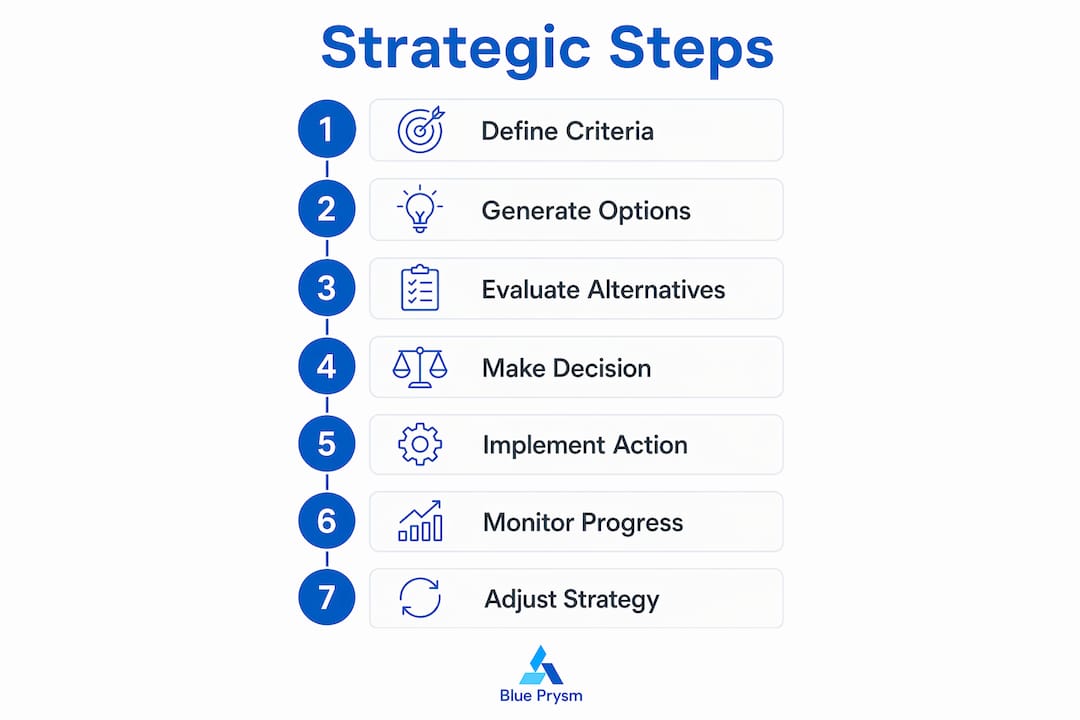
The strategic decision-making process follows seven recognized stages. Each stage builds on the last, and skipping one is where most execution failures begin.
- Define the strategic issue. Name the problem or opportunity with precision. Vague problem statements produce vague strategies.
- Analyze the internal and external environment. Use tools like SWOT analysis, Porter’s Five Forces, or PESTLE to map what you control and what you don’t. This is where real data replaces gut feeling.
- Generate multiple alternatives. Resist the urge to commit to the first option that sounds good. Generating at least three distinct paths forces the team to think beyond the obvious.
- Establish evaluation criteria. Decide in advance what “good” looks like. Criteria might include ROI threshold, time to market, risk tolerance, or alignment with core mission.
- Evaluate and select the best alternative. Score each option against your criteria. This is where cognitive discipline matters most, because confirmation bias will push you toward the option you already prefer.
- Develop and implement an action plan. Translate the chosen direction into specific tasks, owners, timelines, and budgets. A strategy without an execution plan is just a slide deck.
- Monitor progress and adjust. Track results against your success metrics. Adapt when the environment shifts.
Pro Tip: Write your evaluation criteria before you generate alternatives. Teams that set criteria afterward unconsciously reverse-engineer them to justify the option they already favor.
This seven-step framework is not a one-time exercise. Strategic decision making is a recursive and discontinuous process. You will loop back, revise assumptions, and restart phases as new information arrives. That is not failure. That is how it works.
How do modern challenges and biases affect strategic decisions?
The environment in 2026 makes strategic decisions harder than they were a decade ago. Rapid AI expansion and geopolitical complexity have compressed timelines and multiplied the variables leaders must account for. The trap many teams fall into is waiting for certainty that never arrives.
Over-reliance on intuition increases vulnerability to cognitive bias. Anchoring, confirmation bias, and groupthink are the three most common offenders in boardrooms. Each one quietly distorts the analysis before a decision is even framed.
“Balancing data-driven insights with timely leadership decisions is critical to avoid paralysis by analysis. The leaders who win are those who make courageous ‘big bets’ with incomplete information, then validate those bets through ongoing scenario planning rather than waiting for perfect data.”
Harvard Business Review, 2025
Practical ways to counter bias and complexity:
- Run pre-mortems. Before committing, ask: “If this fails in two years, what went wrong?” It surfaces blind spots before they cost you.
- Use scenario planning. Build three futures: best case, base case, and worst case. Stress-test your decision against all three.
- Separate data gathering from decision making. Assign one team to analysis and a separate group to evaluation. It reduces the echo chamber effect.
- Set a decision deadline. Ambiguity is expensive. A decision made at 80% confidence and adjusted later outperforms one delayed indefinitely.
Pro Tip: Treat every major strategic decision as a hypothesis, not a mandate. Define in advance what evidence would cause you to change course. Teams that do this adapt faster when conditions shift.
How can organizations apply strategic decisions to gain competitive advantage?
Knowing the process is not enough. The organizations that pull ahead are the ones that embed the process into how they actually operate, not just how they plan.
Formalized strategic decision processes improve resource allocation, risk management, and responsiveness to market shifts. The key word is “formalized.” Ad hoc strategy sessions produce ad hoc results.
The most common failure point is the “strategic gap.” This is what happens when success metrics are not cascaded from the executive level down to operational teams. The C-suite has a clear picture of the goal. The teams executing the work do not. The result is misaligned effort, wasted resources, and a strategy that looks good on paper but stalls in practice.
| Common pitfall | What it costs you | How to fix it |
|---|---|---|
| No cascaded metrics | Teams work toward the wrong goals | Translate strategy into team-level KPIs |
| No feedback loops | You miss early warning signs | Schedule monthly strategy reviews |
| One-time planning | Strategy becomes stale | Treat planning as a continuous cycle |
| Intuition over data | Bias drives the decision | Require data evidence for each option |
Connecting short-term action to long-term vision requires ongoing monitoring and adjustment. The organizations that do this well use business decision tools and strategic frameworks to keep the process structured and repeatable. AI-powered platforms are increasingly central to this work, giving teams real-time market data and competitive intelligence that manual research simply cannot match.
Key Takeaways
Strategic decision making is a structured, iterative process that requires defined criteria, cascaded metrics, and continuous feedback to translate long-term vision into competitive results.
| Point | Details |
|---|---|
| Strategic vs. operational | Strategic decisions span 3–10 years and involve board-level commitment; operational decisions are routine and reversible. |
| Seven-step process | Define the issue, analyze the environment, generate alternatives, set criteria, select, implement, and monitor. |
| Bias is the hidden risk | Cognitive biases like anchoring and groupthink distort decisions before analysis even begins. |
| The strategic gap | Failing to cascade success metrics to operational teams is the most common reason strategies stall. |
| Treat decisions as hypotheses | Build in checkpoints to validate or revise your strategy as new information arrives. |
The part nobody talks about in strategy sessions
I have sat in enough strategy sessions to know the real problem is rarely a lack of frameworks. Most leadership teams know about SWOT. They have heard of Porter’s Five Forces. The problem is that they treat the decision as the finish line when it is actually the starting gun.
The hardest part of strategic decision making is not the analysis. It is the discipline to monitor what happens after the decision, admit when the hypothesis was wrong, and adjust without ego getting in the way. I have watched organizations spend six months building a beautiful strategy document, present it to the board, and then never revisit it until the next annual planning cycle. By then, the market has moved and the strategy is a historical artifact.
The other gap I see constantly is the distance between the executive team’s clarity and the operational team’s confusion. Leaders think the strategy is obvious. Frontline teams are guessing. That distance is where competitive advantage goes to die. The fix is not a longer strategy document. It is clearer metrics, more frequent check-ins, and the willingness to say “we were wrong” before the cost becomes irreversible.
— Colin Bowdery
Blue Prysm makes the strategic decision-making process faster and cleaner
Strategic decisions require real data, not assumptions. Blue Prysm’s market analysis platform gives strategy teams real-time market intelligence, so the analysis phase of your decision process is grounded in current reality, not last quarter’s reports.
Blue Prysm also provides AI-powered competitive intelligence tools that track market shifts automatically, so your team spends less time gathering data and more time evaluating options. For teams that want a structured starting point, the platform includes access to 95+ proven strategy frameworks covering everything from SWOT to scenario planning. If you are serious about closing the gap between strategy and execution, Blue Prysm is built for exactly that.
FAQ
What is strategic decision making in simple terms?
Strategic decision making is the process of choosing a direction for an organization that affects its long-term success, typically involving high stakes, significant resources, and considerable uncertainty.
How does the strategic decision-making process differ from operational decisions?
Strategic decisions have a 3–10 year horizon, involve board-level stakeholders, and set organizational precedents. Operational decisions are routine, short-term, and easily reversed.
What are the biggest risks in strategic decision making?
Cognitive biases like confirmation bias and groupthink are the most common risks. Combining structured data analysis with defined evaluation criteria reduces their impact significantly.
What is the “strategic gap” and why does it matter?
The strategic gap occurs when executives set a direction but fail to translate it into clear metrics for operational teams. This misalignment is one of the leading causes of strategy execution failure.
How do AI tools support strategic decision making?
AI tools provide real-time market data, competitive tracking, and scenario modeling that reduce the time spent on manual research and improve the quality of analysis at each stage of the decision process.