


TL;DR:
- Daily briefings provide concise, structured summaries that help teams make decisions quickly and confidently. They eliminate information overload by delivering role-specific signals proactively and connect seamlessly to existing meeting routines. Consistent use and verification of AI-generated content are essential to maximize their effectiveness and maintain credibility.
A daily briefing is a structured, concise summary that delivers the specific information a team needs to make decisions and act with confidence. Most business professionals spend 20–30 minutes every morning scanning inboxes, dashboards, and news feeds just to figure out what matters. That is not a workflow. That is a tax on your attention. The case for why use daily briefings comes down to one idea: you should enter every meeting already knowing what changed, what it means, and what to do about it.
Why use daily briefings to cut through information overload
The average professional drowns in inputs before 9:00 AM. Newsletters, Slack threads, market alerts, and industry news all compete for the same limited cognitive bandwidth. A well-designed briefing collapses that chaos into a single, focused read.
AI-powered briefings save over 80% of the time professionals spend gathering daily information, compressing 20–30 minutes of scanning into under 5 minutes. That is not a minor efficiency gain. That is 20 minutes of deep thinking returned to your morning, every single day.
The inefficiencies a good briefing eliminates are predictable and painful:
- Duplicate alerts from overlapping sources covering the same story
- Irrelevant industry news that has no bearing on your specific market position
- Raw data dumps with no interpretation or context
- Missed signals buried under low-priority content
- Decision delays caused by waiting for someone else to surface the right information
The contrast with traditional information gathering is stark. Scanning a dashboard requires you to pull information toward you. A briefing pushes the right signals to you before you even ask. That shift from reactive to proactive is where the real productivity gain lives. For tech leaders tracking software development trends, this kind of filtered delivery is the difference between leading a conversation and catching up to one.
What makes a daily briefing effective?
Structure is not optional. A briefing without a defined format becomes a newsletter, and newsletters get skimmed and forgotten. A well-structured business brief limits itself to 1–3 pages with 3–5 distinct sections. That constraint is the point. It forces editorial discipline.

Editorial discipline means deciding what to leave out. The power of a briefing lies in deliberate exclusion, not exhaustive inclusion. Every item that makes it into the briefing should pass one test: does this change what we do today?
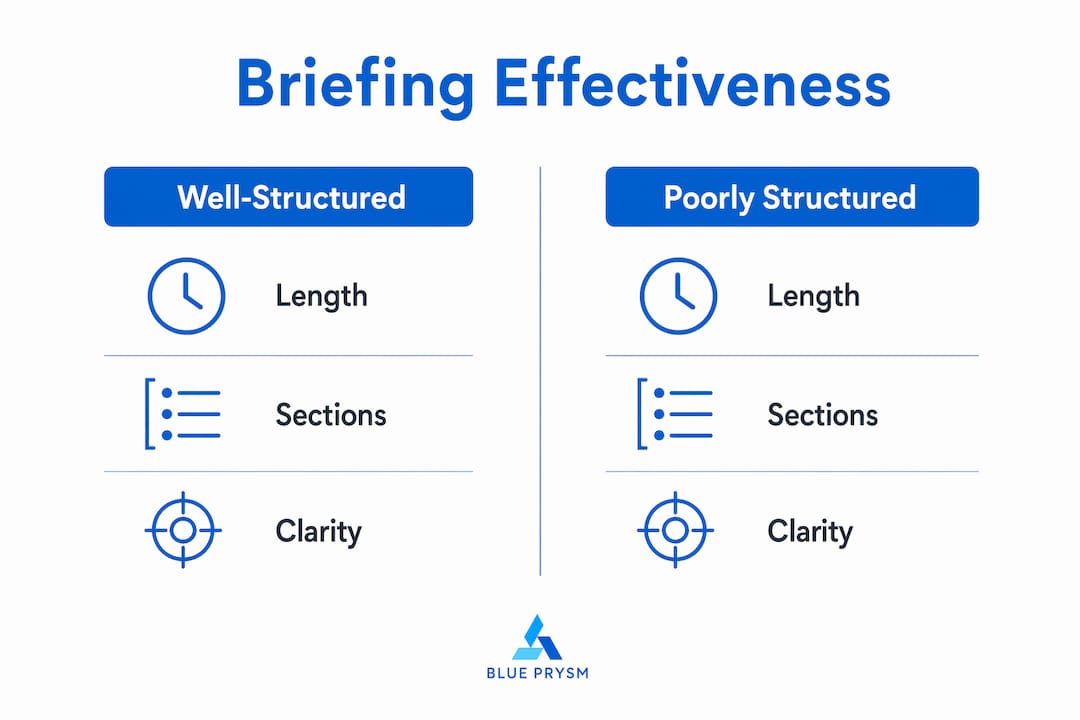
The table below shows the difference between a briefing that works and one that wastes everyone’s time.
| Element | Well-structured brief | Poorly structured brief |
|---|---|---|
| Length | 1–3 pages, 3–5 sections | Unlimited, no clear sections |
| Signal type | Filtered, role-specific | Raw feeds, unfiltered |
| Observation vs. opinion | Clearly separated | Mixed together |
| Action orientation | Each item links to a decision | Items listed without context |
| Delivery | Consistent time, consistent format | Ad hoc, varies daily |
Separating factual observations from opinion builds team trust and prevents misinterpretation of data. When a briefing mixes “our competitor launched a new pricing tier” with “this is a threat to our Q3 pipeline,” it conflates fact with analysis. Keep them in separate sections. Let readers form their own initial read before you offer interpretation.
Pro Tip: Spend 20 minutes on implications for every 5 minutes you spend reviewing raw signals. The briefing’s real value is not what happened. It is what you should do because of what happened.
How to integrate briefings into team workflows
A briefing that sits in an inbox and never gets discussed is a report, not a decision tool. The integration step is what separates teams that use briefings well from teams that abandon them after two weeks.
Briefings tied to existing meeting rituals become repeatable decision systems. The briefing stops being a document and starts being the opening move of every productive conversation. Here is how to make that happen:
- Anchor the briefing to a fixed meeting. Attach it to your morning stand-up or weekly leadership sync. The briefing arrives before the meeting, not during it.
- Assign a briefing owner. One person is responsible for confirming the briefing went out and flagging anything that needs immediate attention before the meeting starts.
- Open every meeting with a 3-minute briefing review. Not a full read-through. A verbal summary of the top two or three signals and their implications.
- Log decisions triggered by the briefing. Track which briefing items led to a changed plan, a new priority, or a deferred decision. This creates a feedback loop that improves future briefings.
- Review the briefing format quarterly. What sections are consistently skipped? Cut them. What questions keep coming up that the briefing does not answer? Add a section.
Recurring cadence matters more than most teams realize. A briefing read once is informative. A briefing read every day for 90 days builds pattern recognition. Your team starts to notice when something is missing, when a trend is accelerating, and when a signal that looked minor last week is now a real problem.
How AI makes daily briefings personal and precise
AI does not just speed up briefing creation. It changes what a briefing can be. A human curator can monitor dozens of sources. An AI system monitors thousands simultaneously, filters by role-specific priorities, and delivers only what is relevant to the person reading it.
The push delivery model is the key architectural difference between AI briefings and traditional dashboards. Dashboards wait for you. AI briefings find you. That distinction reduces missed signals and lowers the cognitive load of staying informed.
The practical benefits of AI-powered briefings include:
- Role-based filtering so a product manager sees different signals than a CFO
- Source prioritization that weights trusted publications over noise
- Automatic summarization that condenses long reports into two-sentence takeaways
- Trend detection that flags when a topic is accelerating across multiple sources
Pro Tip: Start with 3 sources and ruthlessly cut anything that does not change a decision. Over-configuration is the fastest way to recreate the information overload you were trying to escape.
One critical discipline: always audit AI-generated summaries by tracing cited numbers back to their original sources. AI systems can hallucinate data points, and a single fabricated statistic in a leadership briefing destroys months of credibility. Verification is not optional. It is the price of using AI in a high-stakes context.
Key Takeaways
Daily briefings reduce information overload, improve team alignment, and produce better decisions when they follow a fixed structure, separate fact from opinion, and connect directly to meeting rituals.
| Point | Details |
|---|---|
| Time savings are measurable | AI briefings cut daily information gathering from 30 minutes to under 5 minutes. |
| Structure drives signal density | Limit briefings to 3–5 sections and 1–3 pages to maintain focus and clarity. |
| Separate fact from opinion | Keeping observations and analysis in distinct sections builds team trust. |
| Tie briefings to meetings | Anchoring briefings to recurring rituals turns them into decision-making tools. |
| Audit AI outputs | Always verify AI-generated numbers against original sources to protect credibility. |
The discipline most leaders skip
I have watched smart leadership teams invest in briefing tools and then completely undermine the value by treating the briefing like a newsletter. They skim it, file it, and walk into the meeting cold anyway. The tool was not the problem. The habit was.
The teams that get real value from daily briefings share one trait: they treat the briefing review as non-negotiable preparation, not optional reading. They spend more time on implications than on the signals themselves. They ask “what does this mean for us this week?” before they ask “what happened?” That mindset shift is harder than choosing the right format or the right AI tool.
The other trap I see constantly is over-engineering the briefing before the habit is established. Leaders spend two weeks configuring sources, debating section headers, and designing templates. Then the briefing goes out once, nobody discusses it in the meeting, and the whole thing quietly dies. Start with something embarrassingly simple. Three sections. Two sources. One fixed time. Build the ritual first, then refine the content.
Briefings only matter when they change decisions. If you cannot point to a specific choice your team made differently because of what was in the briefing, the briefing is decoration. That is the honest test, and most teams are not applying it.
— Colin Bowdery
What Blue Prysm’s briefing tools do differently
Most briefing tools give you a feed. Blue Prysm gives you a market research platform built to deliver role-specific intelligence that connects directly to your strategic priorities. The AI scans thousands of sources, filters by what matters to your business, and delivers a structured briefing your team can act on before the first meeting of the day.
Blue Prysm integrates with the workflows you already use, so the briefing becomes part of your morning rhythm rather than another tab to open. You can see a sample intelligence briefing to understand exactly what your team would receive. For small and mid-sized businesses that cannot afford a full-time research team, this is the practical alternative that actually gets used.
FAQ
What is a daily briefing in a business context?
A daily briefing is a short, structured summary of the key information a team needs to make decisions that day. It typically covers market signals, competitive updates, and priority items in 3–5 focused sections.
How long should a daily briefing be?
A well-structured briefing runs 1–3 pages with no more than 3–5 sections. Longer briefings lose signal density and get skimmed rather than read.
Why use market briefings instead of dashboards?
Briefings use a push delivery model that surfaces critical signals proactively. Dashboards require active engagement, which means important signals get missed when teams are busy.
How do I build a daily briefing my team will actually use?
Anchor the briefing to a fixed meeting, assign one owner, and open every session with a 3-minute verbal review. Teams that discuss briefings in meetings use them consistently. Teams that only read them rarely do.
Can AI replace a human briefing editor?
AI handles source scanning and summarization at a scale no human can match, but human editorial judgment is still needed to verify accuracy and set priorities. Always audit AI outputs against original sources before distributing to leadership.