


If you’re a senior leader who needs to shape strategy and get it executed, prioritize a short, live executive program built around the case method, taught alongside a real peer cohort. That’s what separates programs that change how you think from ones that just fill a certificate on your LinkedIn. Executive programs like the Executive Program in Corporate Strategy at Chicago Booth work because they force you to defend your thinking against people who run different businesses than you do, in real time, with real stakes.
The rationale is simple: diagnostic skill, peer pressure testing, and implementation focus matter more than lecture content you could get from a book. A cohort of finance, retail, and manufacturing executives will poke holes in your strategy that your own team never would.
Before you enroll in anything:
- Pull the how-to-choose checklist further down this page and score any program you’re considering against it.
- Confirm the program includes a live case component, not just recorded video modules.
- Ask whether your employer will fund it before you fall in love with a specific school.
TL;DR:
- Live, case-based executive programs with peer debate provide diagnostic testing that recorded modules cannot replicate effectively.
- C-suite leaders benefit most from residential or live-online formats that include diverse, cross-industry cohorts for real-time strategy challenge.
- The major post-program risk is failing to implement frameworks into measurable actions, making practical projects and outcome tracking essential.
- Costs vary widely from several thousand dollars for online courses to tens of thousands for in-person residencies, depending on time commitment and format.
- Pairing program learning with AI-enabled platforms ensures ongoing application, turning frameworks into continuous, actionable strategic change.
Types of Strategy Training Programs and How to Match One to Your Role
Not every strategy training program is built for the same seat at the table. Here’s how the main formats break down and who actually benefits from each one.
- Residential executive programs. Multi-week, in-person programs at business schools like Stanford or Chicago Booth immerse you with faculty and a diverse cohort for days at a stretch. The Stanford Graduate School of Business Executive Program in Strategy and Organization blends strategic management with organizational design, and the networking alone often justifies the price tag for C-suite attendees.
- Live-online or blended executive formats. These keep the synchronous case discussions and cohort interaction but cut the travel. IMD’s approach to strategic thinking uses coach-led sessions with assignments and feedback loops, which suits VPs and directors who can’t disappear for two weeks straight.
- Short online certificates and self-paced courses. These cost less and demand less time, but you lose the peer pressure-testing that makes executive programs valuable. Fine for building vocabulary; weak for developing judgment.
- Corporate in-house programs. Group enrollment for your leadership team, customized to your industry. Strong for alignment across a management layer; weaker on outside perspective since everyone in the room already agrees with each other.
C-suite leaders generally get more out of residential or live-online formats. Mid-level leaders building strategic fluency can start with a certificate and graduate to something more immersive later.
What Top Executive Strategy Programs Actually Teach
Strip away the marketing copy and most respected programs converge on five things.
- Industry analysis and competitive positioning. Wharton’s strategic management curriculum covers value chain design and positioning frameworks that let you see where your margin actually comes from.
- Corporate strategy decisions. Scope, portfolio choices, and M&A trade-offs, taught through cases where the “right” answer isn’t obvious until you’ve argued it out with peers.
- Strategy execution and governance. This is where most companies fail, and the better programs know it. Faculty spend real time on the gap between deciding on a strategy and actually making it happen.
- Strategic foresight and scenario planning. Programs like Oxford’s Executive Strategy Programme now treat strategy as an iterative playbook you revise constantly, not a five-year document you write once and file away.
- AI and technology in decision-making. Leading programs increasingly teach executives to use real-time signals and AI-driven scenario testing rather than quarterly spreadsheet updates.
Pro Tip: Ask any program’s admissions team how much class time goes to a live case discussion versus recorded lecture. If they can’t give you a straight percentage, that tells you something.
How to Choose the Right Strategy Training Program
Start with the job you actually need done. Are you trying to build diagnostic capability (why is this business model underperforming?), execution governance (how do we make strategy stick?), or portfolio strategy (what should we stop doing)? Your answer should drive the program you pick, not the school’s name recognition.
Run any candidate program through this checklist:
- Does the cohort match your seniority? A room full of mid-level managers won’t challenge a VP the way a mixed C-suite cohort will.
- Is there genuine industry diversity in the room, or is everyone from your own sector?
- Do faculty have real operating experience, or are they purely academic?
- Is there a practical project tied to your actual business, not a generic case study?
- Does the program measure outcomes, or just hand out a certificate at the end?
Ask enrollment teams directly: “How much of this is live case discussion versus lecture?” “What’s the average seniority and industry mix of the last three cohorts?” “Can you share where past participants work now?”
Red flags that should stop you cold: no practical project, vague language about “outcomes” with no specifics, and no peer interaction built into the format. If a program can’t tell you what its last cohort actually built or changed, walk away.
| Criteria | What to look for | Dealbreaker if missing |
|---|---|---|
| Case method | Live, discussion-based cases with peer debate | Passive video lectures only |
| Cohort mix | Cross-industry, matched seniority level | Homogeneous group, wrong seniority level |
| Faculty | Operating experience plus academic credentials | Pure theory, no practitioner background |
| Practical project | Tied to your real business challenge | Generic template exercise |
| Outcome measurement | Tracked alumni results or follow-up data | No mention of what happens after graduation |
To justify the spend to your employer, frame the ROI around a specific deliverable: a revised market-entry plan, a governance structure for quarterly strategy reviews, or a portfolio decision framework you’ll bring back and use within 90 days.
Costs, Time Commitment, and What You Actually Walk Away With
Budget expectations vary enormously by format. Short self-paced online courses typically run in the low thousands of dollars, while in-person executive residencies at schools like Chicago Booth can run into the tens of thousands once you include travel and lost billable time.
Time commitment tracks cost. Expect anywhere from a few hours a week for self-paced certificates to full multi-day residencies with 12-hour class days.
Watch these before you sign:
- Whether you receive a certificate of completion, continuing education units, or a formal executive credential your employer’s HR system will actually recognize.
- Whether the program publishes any information on what alumni do after graduation, not just glossy quotes.
- Whether tuition includes materials, coaching, or follow-up sessions, or if those are extra.
Applying and Getting Your Employer to Pay for It
Most executive programs run rolling admissions with deadlines tied to cohort start dates, so apply at least six to eight weeks ahead of your target session. Group enrollment, where three or more people from your company apply together, often unlocks a tuition discount and gives your L&D team more leverage in negotiations.
When you request funding, build your case around three things:
- Objectives. What specific strategic capability gap does this close?
- Deliverables. What will you bring back? A framework, a plan, a governance model?
- KPIs. How will your manager know it worked six months later?
Ask about deferred payment plans or split scheduling (two shorter modules instead of one long residency) if operational disruption is the sticking point.
How Blue Prysm Turns Program Learning Into Daily Practice
A great executive program gives you frameworks. It doesn’t give you a system for using them every week once you’re back at your desk. That’s the gap Blue Prysm closes.
Blue Prysm pairs AI-powered market analysis with automated competitor tracking and a strategy library built from more than 50 frameworks, so the case methods and positioning tools you just learned don’t sit in a binder. You turn them into a live roadmap.
- Execution dashboards track the OKRs and KPIs your program pushed you to define.
- Automated competitive intelligence briefings replace the quarterly spreadsheet update with real-time signals.
- Strategy templates mirror the frameworks taught in top programs, so you apply them the same week you learn them.
…*
| Point | Details |
|---|---|
| Frameworks stay theoretical without a system | Blue Prysm’s strategy library turns classroom concepts into templates you use the same month |
| Execution tracking closes the implementation gap | OKR and KPI dashboards keep the strategy from Chicago Booth or Wharton from dying in a slide deck |
Career Outcomes and ROI After Strategy Training
The honest answer is that ROI depends heavily on what you do with the training, not just which school’s name is on the certificate. Executives who complete programs emphasizing diagnostic capability and execution governance tend to report the clearest career movement, because they leave with something concrete to point to: a revised go-to-market plan, a new portfolio framework, a governance process they built and implemented.
Programs built around passive content consumption, by contrast, tend to produce weaker outcomes. Nobody gets promoted for finishing a video series. What moves the needle is the practical project you complete during the program and the visible change you drive afterward.
The Chicago Booth Executive Program in Corporate Strategy and similar programs structure around this exact insight: faculty and program designers treat diagnostic capability, the ability to figure out why a model is failing and set implementable priorities, as the single highest-value outcome a participant can walk away with. That’s a very different goal from “learn strategic vocabulary,” and it should shape how you evaluate your own return.
If you’re weighing the investment, ask candidates one blunt question during your decision process: “What will I be able to do differently at work in 90 days that I can’t do now?” Programs that answer with a specific deliverable, not a vague promise of “strategic thinking,” are the ones worth the tuition.
What Past Participants Actually Say
Participant feedback across leading executive strategy programs converges on a few consistent themes, even though the schools themselves are quite different. The most frequently cited value driver is peer interaction across industries. Participants in programs like IMD’s strategic thinking course consistently point to cross-industry peer debate as the moment where a stuck strategic problem finally clicked, not the lecture content itself.

The second theme is disappointment with programs that skimp on live interaction. Alumni of purely self-paced online certificates report finishing with vocabulary but not judgment, because there was no one in the room to argue with. That distinction shows up again and again in program reviews: the format matters as much as the content.
A third theme, less discussed but worth knowing: participants who complete a practical project tied to their actual business report far higher satisfaction than those who worked through generic templates. Interactive, synchronous case work with cross-industry peers produces more durable behavior change than passive modules, largely because coaching and applied assignments force you to test the idea against your own real numbers before you leave the room.
Treat any program’s testimonial page with a healthy dose of skepticism if it only quotes generic enthusiasm (“life-changing,” “incredible experience”) without naming a specific project, deliverable, or measurable change. The programs worth your money produce alumni who can tell you exactly what they built.
Matching Your Program Choice to Your Career Goals
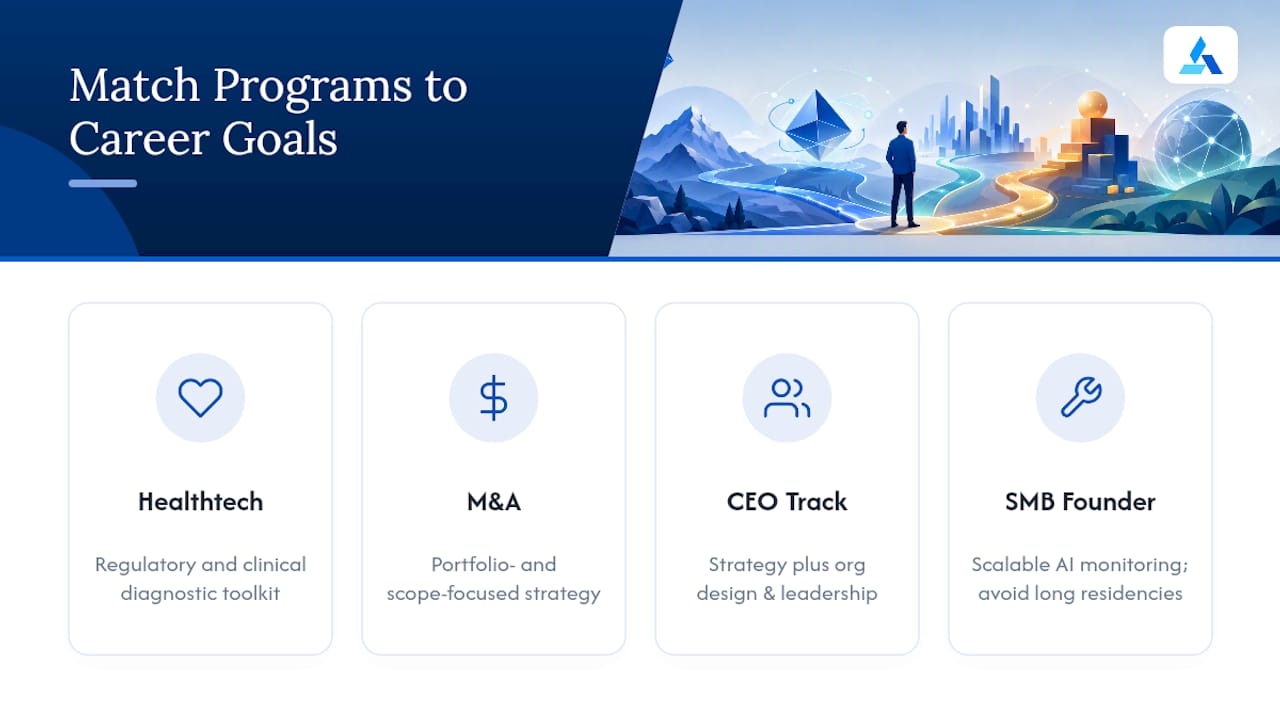
Your industry and your career stage should drive program selection more than brand name recognition. A healthtech executive facing regulatory complexity and clinical stakeholders needs a different diagnostic toolkit than a retail COO managing supply chain volatility. This is where generic “best of” lists fail readers: they rank programs on prestige, not fit. A useful parallel comes from healthtech leadership development, where closing clinical leadership gaps requires the same diagnostic muscle top strategy programs teach, applied to an entirely different regulatory and stakeholder environment.
If you’re aiming for a corporate strategy or M&A role, prioritize programs with heavy portfolio and scope curriculum, the kind Wharton’s strategic management offering covers in depth. If your ambition is a general management or eventual CEO track, look for programs blending strategy with organizational design and leadership, closer to what Stanford’s executive program delivers. If you’re an SMB founder or operator, the calculus shifts again: you likely don’t need a six-week residential immersion. You need scalable, AI-augmented monitoring tools that let you test scenarios quickly without over-engineered corporate frameworks built for companies ten times your size.
Whatever you choose, tie the decision back to a specific role or decision you’re preparing for, not a vague sense that “strategic thinking” would be good to have. Programs deliver the most value when you walk in already knowing which problem you’re trying to solve.
Why the Standard Advice on Strategy Training Misses the Point
Most guidance on choosing a strategy program treats it like a one-time purchase: pick the best school, get the certificate, done. That’s backward. The research consistently points to the same finding: the implementation gap, the failure to translate strategy into actual organizational change, is the biggest risk executives face after training, not before it. Programs spend real time on governance and measurable pilots precisely because so many participants finish a great course and then change nothing.
The overrated part of executive education is prestige. The underrated part is what happens in the 90 days after you leave the classroom. A Stanford or Wharton credential looks good on a resume, but it does nothing for your business if the frameworks stay in a binder. What actually works is treating strategy training as the start of a capability, not the finish line: pair the classroom experience with a system that keeps the diagnostic habits alive week over week.
If you take one thing from this, prioritize programs with a real practical project, and pair whatever you learn with a tool that keeps you executing after the certificate arrives. That combination, not the school’s ranking, is what determines whether the investment pays off.
— Colin Bowdery
Keep Learning Alive After the Program Ends
Executive programs give you frameworks for a few weeks. Blue Prysm gives you a system for using them every week after, without needing a five-figure consulting retainer to keep the momentum going.
Where a residential program hands you a case study and a binder, Blue Prysm gives you real-time market analysis and automated competitor tracking that update continuously, so the positioning work you did in class doesn’t go stale by next quarter. The platform’s strategy library of more than 50 frameworks mirrors what top programs teach, and its competitive intelligence tools automate the monitoring work a junior analyst would otherwise spend hours on each week.
If you just finished a strategy program, or you’re weighing whether to invest in one, see how the pieces fit together on the Blue Prysm platform and start turning your next strategic decision into a tracked, measurable roadmap instead of a slide deck that gathers dust.
Key Takeaways
The most effective strategy training combines a live executive program using the case method with a continuous AI-enabled platform that keeps the learning active after graduation.
| Point | Details |
|---|---|
| Prioritize live case-based formats | Peer-tested strategy work surfaces blind spots that self-paced video courses cannot. |
| Match seniority to cohort mix | C-suite leaders benefit most from cross-industry residential or live-online programs. |
| Watch for the implementation gap | The biggest post-program risk is failing to translate frameworks into measurable change. |
| Budget realistically | Costs vary widely, with online certificates typically costing several thousand dollars, while in-person executive residencies at top schools are considerably more expensive. |
| Extend learning with Blue Prysm | Blue Prysm’s execution dashboards and strategy library keep program frameworks active week over week. |
Sources
- Executive Program in Corporate Strategy – Executive Education | Chicago Booth
- Strategic Management: Competitive & Corporate Strategy | Wharton
- Strategic Thinking – Online Course in Business Strategy | IMD
- Oxford Executive Strategy Programme | Saïd Business School
- Executive Program in Strategy and Organization | Stanford Graduate School of Business
FAQ
What Are the 5 C’s of Strategy Implementation?
Definitions vary across programs, but a common version covers clarity of objectives, capability, culture, coordination, and continuous measurement of results.
What Are Some Good Courses on Strategy?
Programs like Chicago Booth’s Executive Program in Corporate Strategy, Wharton’s Strategic Management course, and Stanford’s Executive Program in Strategy and Organization are widely respected for combining the case method with senior-level peer cohorts.
What Are the 5 P’s of Strategic Thinking?
A commonly cited framework describes strategy as Plan, Ploy, Pattern, Position, and Perspective, five different lenses for understanding how strategy actually forms in an organization.
How Do I Train Myself to Think Strategically?
Practice diagnosing why current results fall short of goals, test your reasoning against people outside your industry, and use a system like Blue Prysm to track market signals and competitive shifts continuously rather than reviewing them once a quarter.
Should I Choose an In-Person or Online Strategy Program?
In-person and live-online formats with real case discussion tend to produce stronger results than self-paced online courses, because peer debate is where most of the actual learning happens.