


A resource allocation model is a structured framework, whether a policy, a process, or a mathematical optimizer, that maps your objectives and constraints to actual allocation decisions. You reach for one whenever staffing, budgeting, or scheduling decisions get too complex for gut instinct alone. The goal is always one of a few outcomes: better utilization, higher throughput, fairer distribution, or tighter strategic alignment.
TL;DR:
- Most organizations rely on hybrid models combining centralized control with decentralized decision-making to balance consistency and speed.
- Accurate resource allocation requires formalizing objectives and constraints, then choosing suitable algorithms like linear or integer programming based on relationship types.
- Decision-making models should match the situation’s data quality and urgency, with a clear assignment of final authority to prevent stalling.
- Pilot tests using past demand data help identify issues and refine models before full implementation, reducing costly errors.
- Stale inputs, poor governance, and decision ambiguity are the main causes of resource allocation failures that undermine model effectiveness.
What Types of Resource Allocation Models Exist?
Every organization eventually invents its own name for what is really one of a handful of established approaches. Knowing the taxonomy saves you from reinventing a framework that already has a name, a literature, and a set of known failure modes.
The first split is directional. Top-down models start with leadership setting targets and cascading budgets or headcount downward. Bottom-up models let teams submit requests that roll up into a plan. Top-down moves faster and keeps strategy aligned; bottom-up captures ground-level reality but takes longer to converge.
The second split is about flexibility:
- Fixed allocation locks resources to a project or department for a set period, which works well when demand is predictable, like a fixed manufacturing line.
- Variable allocation reassigns resources continuously based on live demand, common in cloud computing and staffing pools.
- Hybrid models fix a baseline and leave a flexible pool for reallocation, which is how most mid-size companies actually run budgets.
The third split is governance. Centralized models put one team or system in charge of every allocation call, which produces consistency but creates a bottleneck. Decentralized models push authority to local managers, trading some consistency for speed. Industry explainers on resource allocation frame this alongside capacity planning and forecasting as the operational backbone most companies actually run on.
How Does the Resource Allocation Process Actually Work?
Academic work on allocation systems breaks the process into four components that hold up whether you are staffing a hospital or scheduling cloud compute. The resource allocation process formalizes as: defining the problem, configuring the mapping, handling runtime requests, and running an orchestrator that applies optimization logic.
- Formalize the problem. State the objective (minimize cost, maximize throughput, balance workload) and the constraints (budget ceiling, headcount, deadlines).
- Configure and map. Translate that objective into rules: which resources can serve which demands, and under what conditions.
- Handle the runtime request. A project, team, or system asks for resources, and the model checks availability against the configuration.
- Run the orchestrator. This layer applies the actual optimization or heuristic logic and executes or queues the decision.
Once a problem is formalized this way, many allocation questions reduce to a math problem. Linear programming handles cases where relationships between variables are proportional. Integer programming applies when you cannot allocate half a person or a fraction of a machine. Non-linear programming covers cases like diminishing returns on marketing spend. A survey of allocation algorithms traces this formal treatment back to Koopman’s 1953 work and catalogs dozens of algorithmic approaches built since.
One distinction practitioners lean on constantly: slack is unused time in a schedule, while surplus is excess capacity relative to a tight constraint. Confusing the two leads to burnout, because a manager sees “surplus” headcount and assigns more work, not realizing that capacity was slack meant to absorb variability, not a resource to spend.
Which Decision-Making Model Should Drive Your Allocation Choices?
The framework you pick to allocate resources matters less than the decision process behind it. A brilliant optimization model run by a committee with no clear authority still produces slow, contested outcomes. Decision-making models give you five contexts to choose from:
- Rational model. Full analysis of every option before deciding. Fits high-stakes, low-time-pressure calls, like annual capital budgeting, where data is rich and mistakes are costly.
- Bounded rationality (satisficing). Pick the first option that is good enough rather than exhaustively optimal. This wins whenever speed matters more than precision, and it often outperforms exhaustive analysis when data is incomplete anyway.
- Intuitive model. Pattern-matching from experience, useful for experienced managers making fast staffing calls during a crisis.
- Vroom-Yetton model. A decision tree of seven yes/no questions that tells you whether a decision should be autocratic, consultative, or fully collaborative.
- Creative model. Departs from precedent entirely, appropriate when past allocation patterns clearly are not working and you need a genuinely new structure.
Match the model to your data quality and time pressure, then write down who has final say and what happens if that person is unavailable. Ambiguity here, not the math, is what actually breaks allocation systems.
How Do You Choose and Pilot a Resource Allocation Model?
Selecting a model starts with six honest questions, not a framework name you read in a case study.
- What are you actually optimizing for? Cost, speed, fairness, and strategic alignment often pull in different directions.
- How much does your situation change week to week? High volatility favors variable or hybrid models over fixed ones.
- How good is your data? Optimization algorithms need clean, current inputs; if your data is stale, a simpler rule-based model will outperform a sophisticated one running on bad numbers.
- How often do you need to reallocate? Daily staffing needs a different cadence than annual budgeting.
- Who needs to be involved, and how fast do they need an answer? This determines your decision model from the list above.
- What is your tolerance for a bad call? Higher stakes justify more analysis time; lower stakes reward speed.
Once you have answers, pilot before you commit. Scope one team or one budget line, choose two or three metrics (utilization rate, service-level compliance, variance from plan), run the model against one or two realistic scenarios, and set a review date before you launch, not after.
Pro Tip: Run your pilot against last quarter’s actual demand data first. If the model would have made a worse call than what you actually did, fix the configuration before you touch live resources.
What Do You Need to Implement a Model in Practice?
Choosing a model is the easy part. Making it run day to day means picking an orchestration pattern and feeding it real data.
- Rule-based dispatch applies fixed if-then logic, cheap to build and easy to audit, but brittle when conditions change.
- Optimization engines solve for the best outcome given constraints, better for complex trade-offs but requiring clean, current data.
- Event-driven runtimes reallocate continuously as conditions shift, which modern orchestration research treats as superior to periodic manual reallocation because it catches drift before it compounds.
Whichever pattern you choose needs the same inputs: current capacity, availability, cost, utilization rates, and enough historical data to detect trends. Tooling generally falls into four categories: workforce management systems for scheduling, PPM or portfolio tools for project-level allocation, optimization engines for the mathematically complex cases, and decision-intelligence platforms for scenario testing and monitoring. A workforce management guide on preventing unnecessary overtime shows how the data-input problem plays out concretely at the staffing level. Before you go live, confirm integration points and who owns governance review when the model drifts from reality.
What Goes Wrong With Resource Allocation Models?
Three failure patterns show up again and again. Decision ambiguity tops the list. Nobody knows who has final say, so decisions stall or get relitigated. Defining the decision process and documenting fallback authority up front fixes most of this.
- Stale data quietly poisons optimization models that assume current inputs.
- Over-optimization locks you into last quarter’s assumptions right when strategy needs to shift.
- Weak governance and communication mean stakeholders stop trusting the model’s output, even when it is right.
Pro Tip: Assign one person to own “model freshness,” checking input data quality on a fixed schedule, separate from whoever owns the allocation decisions themselves.
Where AI-Powered Decision Intelligence Fits Into Allocation
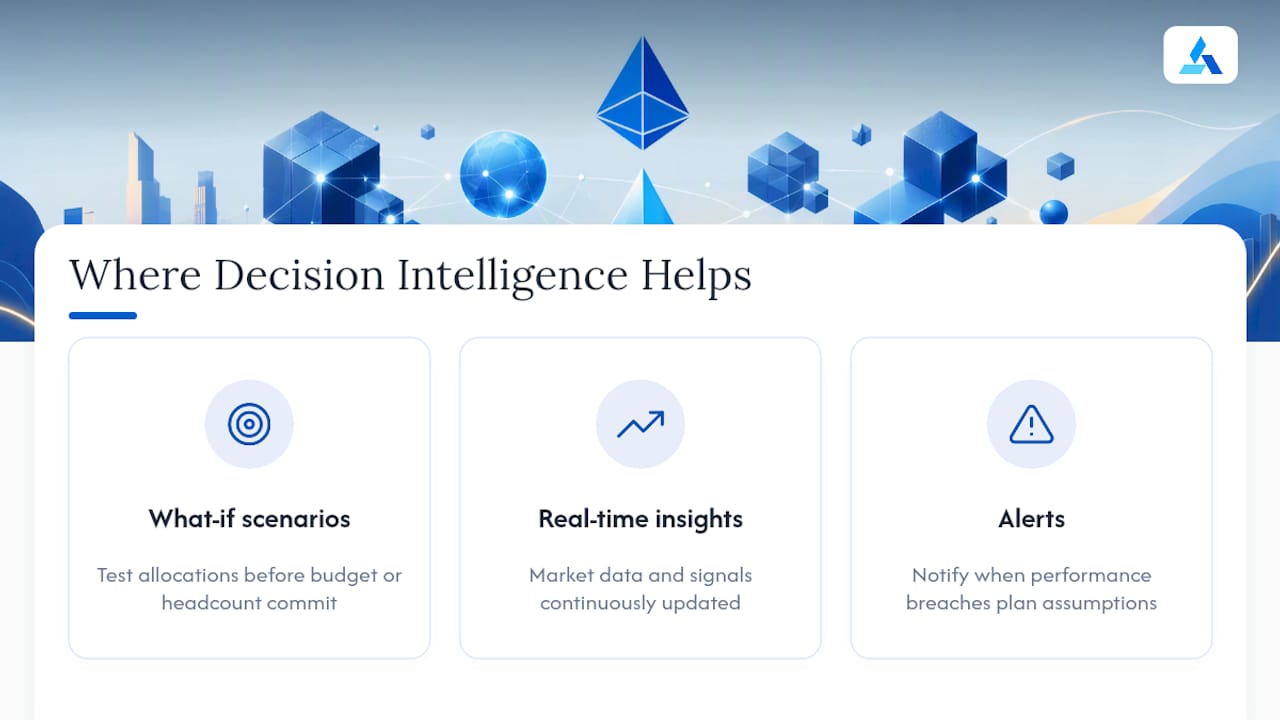
Most allocation models fail not from bad math but from stale assumptions nobody revisits. That is the gap decision intelligence tools are built to close. Blue Prysm’s real-time market insights and AI-powered decision making tools let teams run “what-if” scenarios against an allocation plan before committing budget or headcount, then set alerts when actual performance breaches the plan’s assumptions. That is decision intelligence doing what a spreadsheet cannot: catching drift while it is still cheap to fix.
Where to Go for Deeper Reading
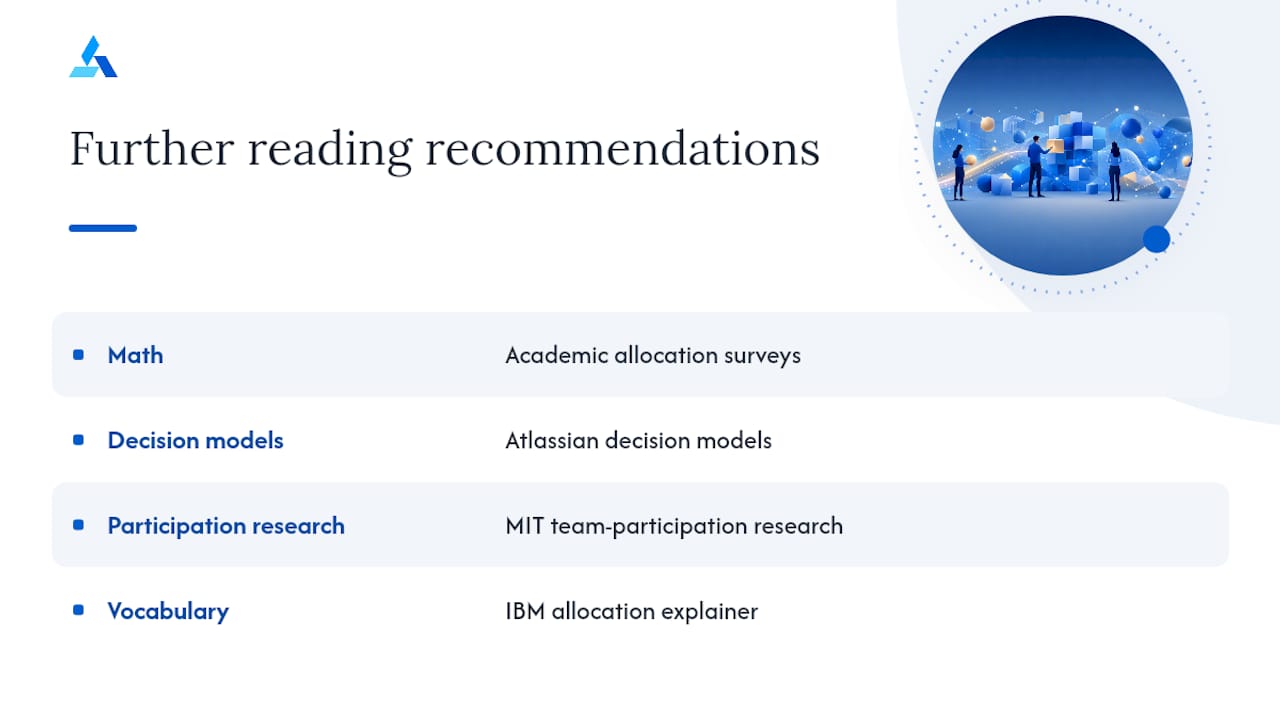
For the math, start with academic surveys on allocation algorithms. For decision governance, Atlassian’s decision-making models and MIT’s team-participation research are worth your time. For operational vocabulary, IBM’s resource allocation explainer covers the business fundamentals well.
Get Strategic Allocation Support From Blue Prysm
Everything in this article points to the same conclusion: the model matters less than whether you can see your assumptions clearly and test them before you commit real budget. This is a valuable capability for small and mid-sized businesses that cannot justify a full consulting engagement every time a resourcing decision gets complicated.
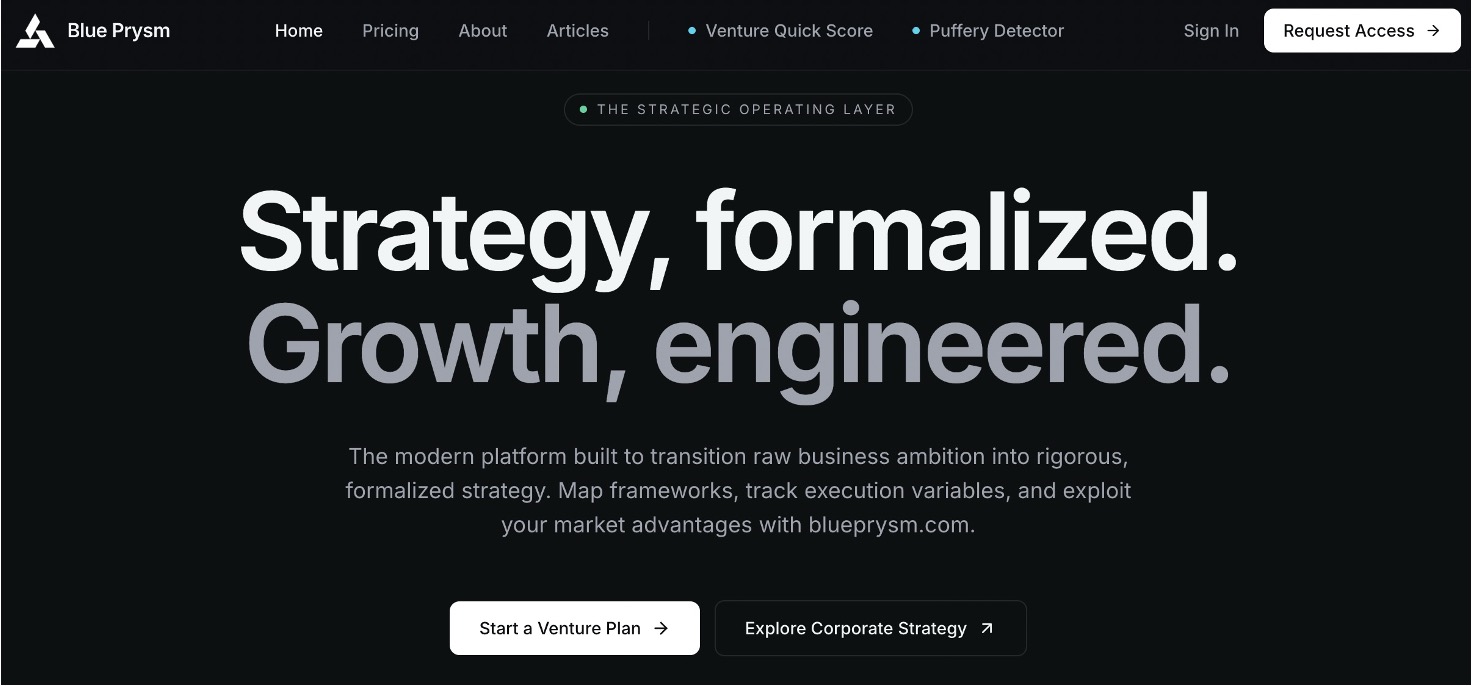
Instead of building an allocation model from scratch or hiring outside help every time priorities shift, you get real-time market insights, competitor tracking, and a strategy framework library with more than 50 templates built for exactly this kind of decision. The market analysis platform lets you run scenario comparisons and set monitoring alerts so you catch a drifting allocation plan before it costs you a quarter’s budget, not after. If you are staffing, budgeting, or planning a roadmap and want to test your assumptions before you commit resources, see how it works and start a trial today.
Sources
- Resource allocation process and orchestration (Springer)
- Decision-making models (Atlassian)
- Decision-making models and team participation (MIT HR)
- What is resource allocation? (IBM)
FAQ
What Are the Different Types of Resource Allocation?
The main types split along three lines: top-down versus bottom-up planning, fixed versus variable versus hybrid flexibility, and centralized versus decentralized decision authority. Most organizations blend these, using a hybrid model with centralized budget caps and decentralized day-to-day allocation.
What Are the Four Phases of the Resource Allocation Process?
The four phases are formalizing the allocation problem, configuring the mapping between resources and demands, handling runtime allocation requests, and running the orchestrator that applies optimization logic.
What Are the Three Types of Allocations?
Definitions vary by source, but a common version splits allocations into fixed (locked for a set period), variable (reassigned continuously based on demand), and hybrid (a fixed baseline plus a flexible pool).
What Are the Different Theories of Resource Allocation?
The main decision-making theories are the rational model, bounded rationality (satisficing), the intuitive model, the Vroom-Yetton model, and the creative model, each suited to different combinations of time pressure, data quality, and stakes.
How Do I Know If I Need an Optimization Algorithm or a Simple Rule?
Use optimization (linear, integer, or non-linear programming) when your problem has many interacting constraints and reliable data; use rule-based logic when data is thin, conditions change fast, or the cost of a suboptimal call is low.