


A strategic roadmap is the working document that turns a strategy into a sequence of initiatives, owners, and milestones your team actually executes against, serving as an internal alignment tool. Its real value isn’t the visual, it’s the alignment: everyone knows what matters this quarter, who owns it, and how you’ll know it’s working. The rest of this guide walks through the components, the build process, the workshop format, and the governance rhythm that keeps it alive.
TL;DR:
- A strategic roadmap should include clear objectives, initiative owners, time buckets, milestones, and KPIs to ensure alignment and measurable progress.
- Building the roadmap involves defining outcomes, assessing capabilities, grouping themes, mapping initiatives, and setting milestones with integrated review schedules.
- Regular reviews at weekly, monthly, and quarterly intervals are essential to keep the roadmap accurate and responsive to changing market conditions.
- Using evidence from real-time market research and competitor tracking shortens the diagnosis phase and improves prioritization.
- Most roadmaps fail due to lack of updates, unclear ownership, or drifting into feature lists, not because the underlying strategy is weak.
What Is Strategic Roadmapping, and When Do You Need It?
Strategic roadmapping is the discipline of translating a company’s strategic direction into a sequenced, visual plan of initiatives with owners, timeframes, and success measures attached. It’s not the same animal as a business plan. A business plan is an external, text-heavy document built for investors, lenders, or board approval. A strategic roadmap is an internal, visual operating tool, and according to Cambridge’s Institute for Manufacturing (IfM), it functions as the bridge between long-term vision and the actual sequence of initiatives, milestones, and owner assignments that get you there. It’s a living document, not a plaque you hang on the wall once a year.
You reach for a roadmap when you’re translating a new strategy into cross-functional action, launching a major initiative that spans multiple departments, or kicking off a new planning cycle (annual or quarterly). You don’t reach for one to list every feature your product team wants to ship this year. That’s a backlog, not a roadmap.
Three misconceptions cause most of the damage:
- Treating the roadmap as a feature list rather than a strategic narrative tied to outcomes.
- Building it once and never touching it again, even as market conditions shift.
- Assuming a roadmap replaces detailed execution plans, when it should sit one level above them.
Get the strategic planning fundamentals right first, then let the roadmap sequence what that strategy demands.
What Components Belong in Every Strategic Roadmap?
A roadmap without the right structural elements is just a pretty timeline. Four components make it functional rather than decorative.
Strategic objectives and themes anchor everything else. These are the two or three outcomes the organization is actually chasing this cycle, grouped into themes (market expansion, operational efficiency, product innovation) so initiatives don’t float around unattached to purpose.
Initiatives and owners turn the objective into work. Each initiative needs one accountable owner, not a committee, and a short description of the action, not a task list. IfM’s roadmapping framework insists that a roadmap answer six fundamental questions: why, what, how, when, who, and where. Skip the “who” and the initiative drifts.
Time buckets, milestones, and dependencies give the roadmap its shape. Quarters work better than exact dates because they preserve intent without locking you into a calendar that reality will break within six weeks.
KPIs, risks, and assumptions close the loop. Every initiative needs a way to measure progress and a documented assumption or risk that, if wrong, changes the plan.
- Objectives and themes (the “why”)
- Initiatives with named owners (the “what” and “who”)
- Time buckets, milestones, and dependencies (the “when”)
- KPIs, risks, and assumptions (the proof it’s working)
Pro Tip: Write dependencies explicitly, even the awkward ones. An initiative that quietly depends on another team’s headcount plan will fail silently if nobody names that link on the roadmap itself.
How Do You Build a Strategic Roadmap Step by Step?
A roadmapping process that skips steps produces a roadmap that looks complete and functions like wallpaper. IfM’s S‑Plan methodology breaks the work into a sequence that typically runs five to seven steps, and each one earns its place.
- Define outcomes. Start with the two or three measurable results the organization needs this cycle, not a wish list of ambitions.
- Assess current-state capabilities. Be honest about what your team can actually execute given current staffing, budget, and technology. This step is where most roadmaps quietly get realistic.
- Identify strategic themes. Group related outcomes into three to five themes so initiatives have a home and leadership can talk about progress at a glance.
- Prioritize and map initiatives. Assign each initiative an owner, note its dependencies, and place it in a time bucket, usually a quarter.
- Set milestones. Break each initiative into checkpoints that prove progress before the finish line, not just at it.
- Assign KPIs and a review cadence. Every initiative gets a metric and a date someone checks it.
- Publish views and start governance. Release the roadmap in the formats each audience needs, then begin the recurring review rhythm.
This sequence works because it forces structural thinking before task thinking. As strategic planning research from Gartner points out, strategic plans that never connect to executable, measurable initiatives tend to fail once market conditions get volatile, and volatility is the normal state of business now, not the exception. A step-by-step planning approach applied consistently is what separates a roadmap that survives contact with reality from one that gets quietly abandoned by March.
How Do You Run a Roadmapping Workshop That Actually Works?
Roadmaps built by one strategist in a spreadsheet almost always miss dependencies that a cross-functional group would catch in the first ten minutes. That’s why IfM’s S‑Plan approach is workshop-based, and it’s why the process itself, not just the finished document, produces the alignment you’re after.
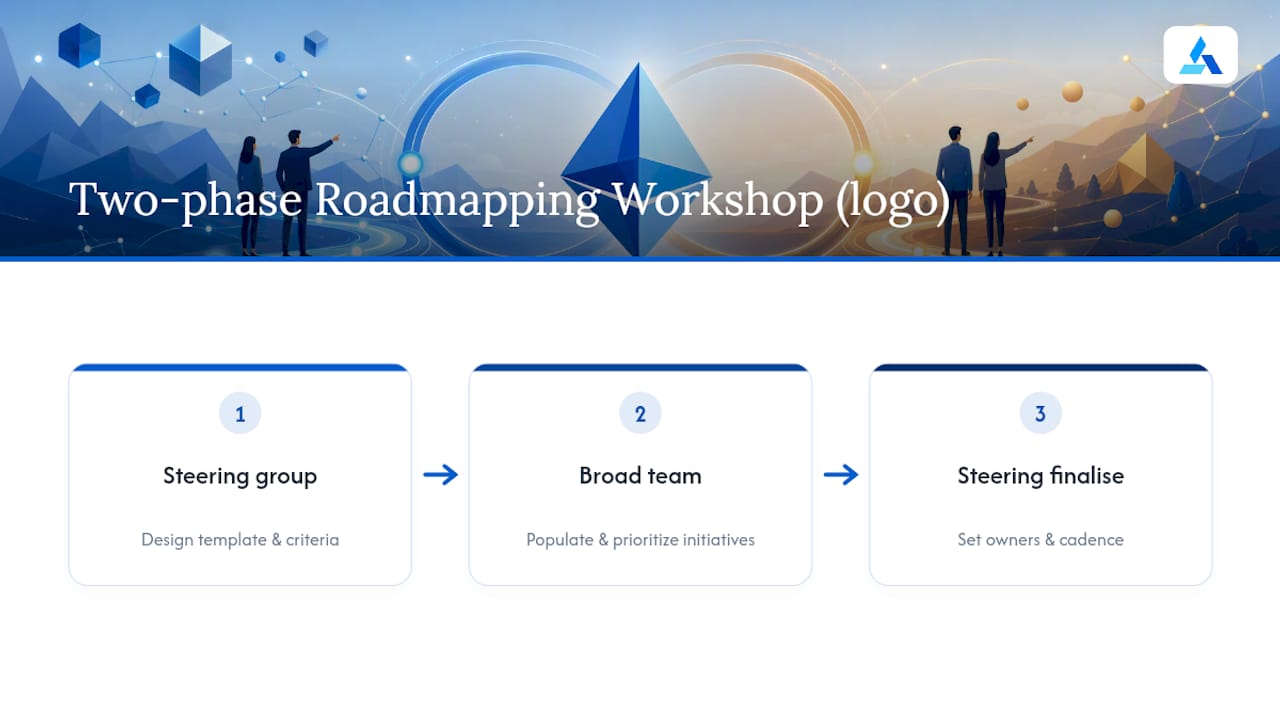
A workshop with a moderate number of participants tends to hit the sweet spot: broad enough to represent every function that owns a piece of the strategy, small enough to actually reach decisions in a day. A useful structure splits the work in two phases. A small steering group first designs the template and success criteria. Then a broader cross-functional group populates and prioritizes initiatives, with the steering group finalizing owners and cadence afterward. That balances speed against representation instead of sacrificing one for the other.
Good facilitation reduces bias by asking every function to nominate its own initiatives before the group prioritizes collectively, rather than letting the loudest voice in the room set the agenda. Expect the workshop to produce a draft roadmap, named owners, a handful of hard decisions, and a documented list of open risks nobody resolved yet. That last item matters. A workshop that ends with zero open risks probably wasn’t honest.
How Often Should You Review and Update a Strategic Roadmap?
A roadmap that never gets reviewed is a roadmap that’s already wrong. The fix is a KPI structure paired with a review cadence that actually gets followed.
Pick leading indicators for initiatives still in motion (adoption rate, pipeline built, features shipped) and lagging indicators for themes you’re judging on outcome (revenue growth, retention, market share). Mixing the two lets you catch problems early instead of discovering them in a regular report.
- Weekly team scorecards to catch initiative-level slippage early.
- Monthly summaries that roll individual initiatives up to theme-level progress.
- Quarterly leadership reviews where accelerate, pause, or stop decisions actually get made as part of a recurring cadence.
Practical guides on strategic roadmapping consistently recommend this three-tier cadence because it matches the pace at which most initiatives actually change. Owners enforce the rhythm: without a named person accountable for showing up to the review with real numbers, the cadence collapses within two cycles.
One structural insight worth building into your governance: the highest-value change most companies make isn’t a new tool, it’s introducing a quarterly operating rhythm with three to five focused priorities, reviewed on schedule rather than whenever someone remembers.
What Common Mistakes Turn a Roadmap Into a Wish List?
Most failed roadmaps don’t fail because the strategy was wrong. They fail because the roadmap itself was built badly.
The best practices are almost boring in their simplicity: limit yourself to a handful of objectives per cycle, assign one owner per initiative (never a committee), use time buckets instead of hard dates, and write dependencies down explicitly instead of assuming everyone already knows them.
- Turning the roadmap into a feature backlog instead of a strategic narrative.
- Skipping governance, so nobody ever revisits or updates the plan.
- Leaving initiatives without a named, accountable owner.
- Ignoring dependencies until they surface as missed deadlines.
The fix for feature creep is discipline about altitude. A roadmap operates one level above execution. Keep task-level detail, ticket assignments, and sprint planning in a separate execution plan, and let the roadmap stay focused on strategic sequencing. Review strategic planning best practices if you find your roadmap creeping toward a project management tool in disguise.
Pro Tip: If a stakeholder asks “where’s the roadmap for X feature,” that’s your signal the roadmap has drifted into backlog territory. Redirect feature-level questions to the execution plan and keep the roadmap at the theme level.
Which Roadmap Views and Templates Should You Actually Use?
Different stakeholders need different altitudes of the same information, and trying to serve all of them with one view is how roadmaps become cluttered and unreadable.
Leadership needs an executive theme-level view: three to five strategic themes, high-level progress, no operational noise. Delivery teams need a cross-functional swimlane view that shows which function owns what, running in parallel lanes so cross-team dependencies are visible at a glance. Everyone benefits from a milestone or timeline view that marks the checkpoints proving progress along the way.
- Executive theme view for board and leadership updates.
- Swimlane view for delivery teams coordinating across functions.
- Milestone or timeline view for tracking checkpoint progress.
- Modular templates that let you swap time buckets without rebuilding the whole structure.
For tools, you’re choosing between visual roadmap builders, portfolio management platforms, and lightweight templates in Sheets or Slides. Commerce-focused roadmapping guidance consistently ties roadmap items back to owners, milestones, and KPIs across all three formats, and Venngage’s strategic roadmap templates offer a reasonable starting point if you’re building your first version from scratch. Start simple; add tooling complexity only once the process itself is working.
How Does AI-Powered Research Improve Roadmap Prioritization?
Most roadmapping stalls at the evidence stage. Teams spend weeks arguing over which initiative deserves priority because nobody has current, credible market data in the room. That’s the gap AI-powered research tools are built to close, and it’s the piece most roadmapping guides skip entirely.
Real-time market insights and competitor tracking shorten the diagnosis phase dramatically, so a workshop opens with evidence already assembled rather than three people googling competitor pricing pages the night before. A strategy framework library standardizes how initiatives get evaluated, so a SWOT or Porter’s Five Forces assessment doesn’t look different every time a different manager runs it.
A workable flow looks like this: gather market and competitive evidence, run the roadmapping workshop with that evidence already loaded, score initiatives against consistent criteria, then push the prioritized roadmap into an execution dashboard for the review cadence described above.
- Evidence gathering shortens the diagnostic phase before the workshop even starts.
- A shared framework library keeps initiative scoring consistent across teams and cycles.
- Execution dashboards connect the roadmap directly to the KPI review rhythm.
An Editor’s Take on Why Most Roadmaps Never Get Used
Here’s the uncomfortable truth about strategic roadmapping: most roadmaps aren’t bad because the strategy behind them was weak. They’re bad because nobody built in a mechanism to revisit them. A roadmap without a quarterly rhythm is a slideshow, not a tool. The organizations that get real value from roadmapping treat the quarterly review as sacred, not optional, and they use evidence, not opinion, to decide what gets promoted, paused, or killed. A platform like Blue Prysm exists precisely for that gap between good intentions and a document nobody opens after the kickoff meeting.
— Colin Bowdery
Turn Roadmapping Evidence Into a Living Plan With Blue Prysm
A strategic planning platform replaces the guesswork that kills most roadmaps before they reach a second quarter. Instead of hiring a consultant to hand you a static deck, you get AI-powered market research tools that surface competitive and market evidence directly inside your planning workflow, so your workshop starts with facts instead of assumptions.
Teams typically use Blue Prysm to pull real-time competitor tracking and market analysis into the roadmap-building phase, score initiatives against a library of more than 50 strategy frameworks, and then track progress on an execution dashboard tied to the KPIs the roadmap set. That closes the loop between the plan and the quarterly review cadence this guide walks through above, without needing a separate consulting engagement every time priorities shift. If you’re building or refreshing a strategic roadmap this quarter, see how the platform fits into your planning cycle and start your evidence gathering before your next workshop, not after it.
Sources
FAQ
What Does Strategic Roadmap Mean?
A strategic roadmap is a living, internal tool that converts long-term business strategy into a sequenced set of initiatives, milestones, and owners, according to IfM Engage. It’s built to be updated regularly, not filed away after one planning cycle.
What Are the 5 Stages of Strategic Planning?
Common frameworks describe five stages: setting goals, analyzing the current environment, formulating strategy, implementing it through initiatives like a roadmap, and monitoring results to adjust course. The exact labels vary by framework, but the sequence from analysis to execution to review holds consistently.
How Many Steps Does the IfM Roadmapping Process Use?
IfM’s S‑Plan methodology typically runs five to seven steps: defining outcomes, assessing current capabilities, identifying themes, mapping initiatives with owners, setting milestones, and establishing KPIs with a review cadence.
How Often Should a Strategic Roadmap Be Reviewed?
A three-tier cadence works best: weekly team scorecards, monthly theme-level summaries, and quarterly leadership reviews where initiatives get accelerated, paused, or stopped based on evidence, as Coursera’s roadmapping guide recommends.
Can AI Tools Speed Up Roadmap Development?
Yes. Tools that supply real-time market insights and competitor tracking, like Blue Prysm’s market analysis platform, shorten the evidence-gathering phase that normally delays roadmapping workshops by days or weeks.