


Use automated AI-enabled competitor pricing tracking with margin guardrails, then run a short pilot before rolling it out across your catalog. Pick a representative sample of SKUs, turn on daily monitoring, and set a hard price floor before you let anything reprice automatically. AI-driven platforms exist precisely to make this workable for teams without a dedicated pricing analyst on staff.
TL;DR:
- Automated AI-driven pricing tracking should monitor at least 50 to 200 SKUs daily with a predefined price floor to prevent margin erosion.
- Key metrics include price position, share of assortment, promotion frequency, MAP compliance, and margin impact, requiring twelve months of historical data for accuracy.
- Running a pilot with clear success criteria helps identify technical or operational issues before full implementation, ideally lasting two to six weeks.
- Setting strict governance rules with margin floors, approval thresholds, and audit logs is essential to avoid margin loss from uncontrolled automation.
- Using a specialized platform like Blue Prysm, which combines real-time analysis and strategic templates, streamlines setup and provides actionable market insights.
What Is Competitor Pricing Tracking and Why Does It Matter?
Competitor pricing tracking is the continuous monitoring of rival prices, product variants, active promotions, and stock availability across the SKUs that compete with yours. It is not a once-a-quarter spreadsheet exercise. Done right, it runs daily, catches a flash sale before it drains your weekend margin, and flags when a competitor quietly goes out of stock on your best-selling variant.
The payoff shows up in four places: protected margins, higher conversion on price-sensitive listings, faster detection of MAP violations, and sharper assortment decisions about what to stock versus retire. Manual tracking cannot deliver any of that at scale. A human checking twenty competitor product pages once a week misses the Tuesday-night price drop that costs you Wednesday’s sales. That gap is exactly why automation and AI product matching have become standard rather than optional, according to industry guidance on automating competitive intelligence with APIs and AI agents.
What this actually buys you in practice:
- Real-time visibility into price moves the moment they happen, not days later
- Automated flags on MAP violations before a brand partner notices first
- Data to justify markdown timing instead of guessing based on gut feel
- A defensible record of competitor behavior over time, not a single snapshot
What Features Should You Require From Tracking Software?
Not every tool on the market does this well, and the differences show up fast once you’re managing more than a few dozen SKUs. Before you sign anything, run the vendor’s pitch through a simple filter: does the feature list solve a real operational problem, or does it just sound good in a demo?
Here’s the checklist that separates a usable tool from a pretty dashboard:
- AI product matching that works off GTIN, UPC, or EAN codes, not just fuzzy title matching, which breaks on bundle listings and private-label variants
- Daily monitoring cadence at minimum, with historical price archives going back over an extended period to separate a real strategy shift from a Black Friday blip
- Alerting and integrations that reach you where you already work: webhooks, Slack, and Google Merchant Center syncing are now baseline expectations, not premium add-ons
- Repricing controls with floors and ceilings, so an automated rule never quietly sells your bestseller at a loss
- Scalability across feeds and channels as your catalog grows past the pilot stage
Vendor pages across the category, including Pricefy, consistently list AI matching, dynamic repricing, alerts, and feed integrations as the baseline feature set buyers should expect. Treat anything short of that list as a red flag, not a budget option.
Pro Tip: Ask any vendor for their AI matching accuracy rate on a sample of your own SKUs before you buy, not their marketing average. A tool that matches 95% of national brands can still fail badly on private-label goods, and that’s where your margin bleeds fastest.
How Do You Set Up a Competitor Pricing Tracking Pilot?
Running a pilot beats a full rollout for one simple reason: you find out what breaks before it costs you real money. Here’s a sequence that fits inside a two to six week window.
- Select 50 to 200 pilot SKUs that represent your commoditized, high-competition lines, and define success upfront as a specific margin lift or conversion change, not a vague “better visibility.”
- Map your catalog to competitor SKUs using GTINs where you have them and AI matching to fill the gaps. Centric Software’s guidance on competitor price monitoring emphasizes that normalized data is what makes the rest of the process trustworthy.
- Configure your monitoring cadence, exclusion rules, and price floors before a single alert goes live.
- Integrate with your storefront and channel feeds, whether that’s Shopify, Magento, or Google Merchant Center, so pricing data and monitoring live in the same system, per Price2Spy’s integration guidance.
- Start analytics-only. Watch price deltas and alerts for two to three weeks before you turn on any automated repricing, and scope that automation narrowly at first.
- Evaluate results against your defined metrics, then decide whether to widen the SKU set or add repricing rules.
Which Metrics Actually Tell You Something?
Raw price data is noise until you turn it into a handful of specific numbers you check on a schedule. These are the ones worth building a dashboard around:
- Price position: the percent of your SKUs priced above, at, or below the market median, plus your median price delta against competitors
- Share of assortment: how much of the competitive category you actually cover, a useful proxy for share-of-voice when direct visibility data isn’t available
- Promotion detection and price volatility: how often competitors run promotions and how sharply prices swing week to week
- MAP compliance rate: the percentage of monitored resellers holding to your minimum advertised price
- Margin impact tests: time-series comparisons that separate a genuine competitive response from ordinary market noise
Vendor guidance in the pricing-software category recommends holding at least twelve months of historical price data before drawing conclusions from any of these metrics. A three-week price swing might be a genuine strategy shift, or it might just be someone else’s inventory clearance. Without history, you can’t tell the difference, and you’ll end up chasing a price that was never going to stay that low.
How Do You Govern Automated Repricing Safely?
Automation without guardrails is how a good pricing tool turns into a margin problem. The fix isn’t more caution, its clearer rules written down before you need them.
A workable governance model usually has three layers: a margin floor no automated rule can cross, an approval tier for any price move above a defined percentage, and channel-specific rules since your Amazon pricing rarely should mirror your direct-to-consumer site. Build an alert playbook that separates what triggers automatic action from what requires a human to sign off, and keep an audit trail of every automated price change so you can trace a bad week back to its cause.
- Set a non-negotiable margin floor before any automation touches live prices
- Require human approval on price changes above a set threshold, not just below it
- Assign one owner for policy reviews, typically a pricing manager working with merchandising
- Log every automated change with a timestamp and triggering rule for later audit
Pro Tip: Review your governance rules monthly for the first quarter of any rollout. Competitor behavior shifts, and a rule set that made sense in January can quietly start costing you margin by March.
Why an AI-Powered Competitive Intelligence Platform Matters
Every checklist item above points to the same conclusion: this only works with a platform built to handle it, not a shared spreadsheet three people forget to update. Blue Prysm’s competitive intelligence tools give small and mid-sized retail teams real-time market insights and automated competitor tracking, paired with a strategy library built for teams without a full-time pricing analyst.
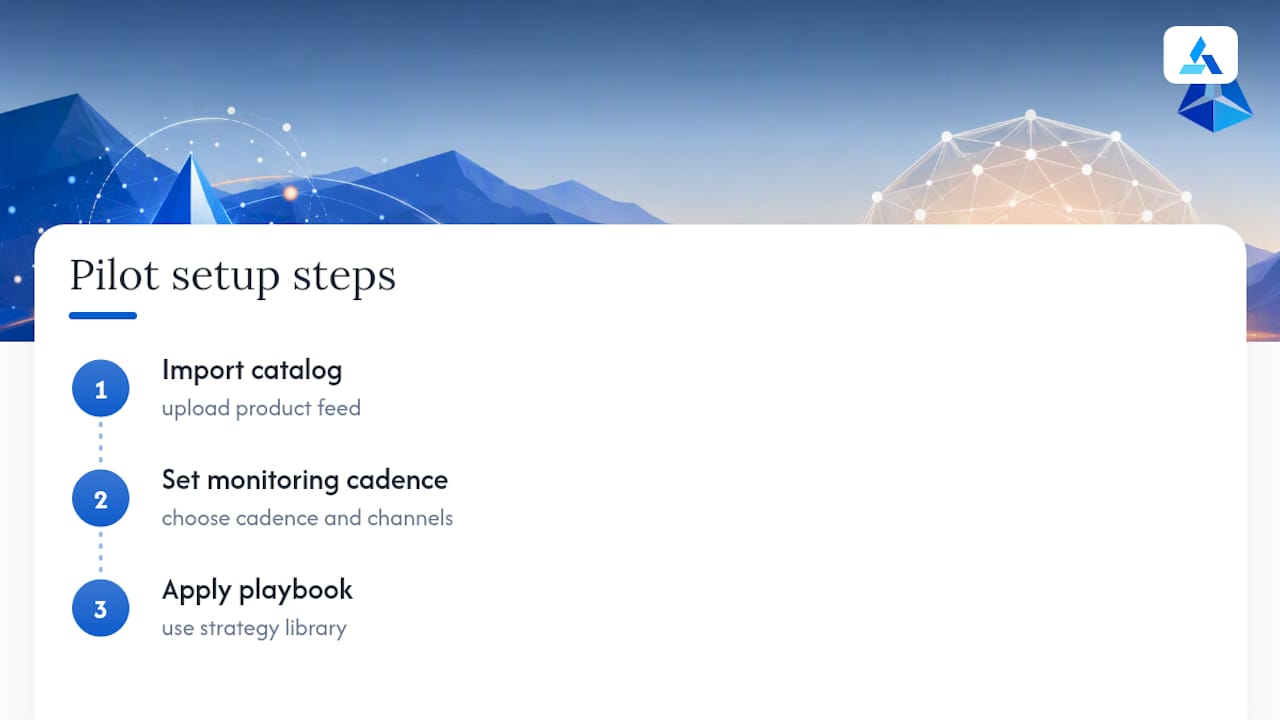
The practical starting point looks like the pilot above: import your catalog, set your monitoring cadence, and pull a playbook from the strategy library instead of building your governance model from scratch. That combination, automated tracking plus a ready-made strategic framework, is what separates a platform from a dashboard.
When Should Price Tracking Be Your Top Priority?
Price tracking earns its keep fastest on commoditized lines with heavy promotional churn, where a two-day lag means a lost sale. On differentiated or branded lines, longitudinal brand tracking matters more than matching every price move. Chase price too aggressively on the wrong line and you’ll win the sale while eroding the margin that made the product worth selling in the first place.
— Colin Bowdery
Blue Prysm: Pilot-Ready Competitive Intelligence for Pricing Teams
This type of platform is an alternative to hiring a pricing analyst or running competitive research by hand, built specifically for retail and ecommerce teams that need real answers, not another dashboard nobody logs into. Such platforms typically combine real-time market analysis, automated competitor tracking, and a business strategy framework library with multiple templates, so a pricing decision doesn’t stall waiting for someone to build a model from scratch.
A pilot with Blue Prysm starts the same way the playbook above describes: import a sample of your catalog, set your monitoring cadence, and see the competitive picture take shape within days rather than weeks. Explore the market research tools built for exactly this kind of pilot, and see what a working competitive intelligence setup looks like before you commit to a full rollout.
Where to Go for More on Automated Pricing Intelligence
For a deeper technical view of automation architecture, review this guide on automating competitive intelligence with AI agents. Buyers evaluating specific vendors should also check independent product reviews before signing a contract. For technology-sector monitoring workflows, 42voice’s pricing page offers a useful comparison point on alerting design.
Sources
- How to automate competitive intelligence with APIs and AI agents
- Competitor Price Monitoring & Repricing Software — Pricefy
- Price2Spy® – Competitor price monitoring
FAQ
What Are the Best Tools for Tracking Competitor Prices?
The strongest tools combine AI product matching on GTIN or UPC codes with daily monitoring, historical price archives, and integration with your storefront platform. Blue Prysm’s competitive intelligence tools add strategy context on top of raw price data, which matters once you move past simple monitoring into decision-making.
What Are the 5 C’s of Pricing?
Definitions of the “5 C’s” vary by source, and no single standard version applies universally across retail. Rather than force-fit an unreliable acronym, focus on the concrete factors that matter: cost, competitor pricing, customer demand, channel differences, and your own margin targets.
How Do You Compare Competitors’ Pricing?
Compare using price position (the percent of your SKUs priced above, at, or below the market median) and price delta, normalized against matched products using GTINs or AI-driven matching rather than manual title comparison, as Centric Software’s methodology recommends.
Can You Give an Example of Competitor-Based Pricing?
A retailer selling a commoditized electronics accessory might set its price at the market median once daily monitoring shows three major competitors converging on the same range, adjusting within a preset floor rather than matching every fluctuation automatically.
How Often Should Competitor Prices Be Monitored?
Daily monitoring is the practical minimum for commoditized or high-promotion categories, with at least twelve months of historical data retained to separate genuine strategy shifts from short-term promotional noise.