


TL;DR:
- Democratizing strategic insights provides all stakeholders with trusted, self-service data access for faster decision-making.
- Effective implementation depends on governance, data literacy, and cultural change, not just technology.
Democratizing strategic insights is the practice of giving every stakeholder, regardless of technical skill, governed access to trusted data and intelligence for faster, more confident decisions. The industry term for this is data democratization, and it goes far beyond simply opening up a dashboard. Right now, 25% of business users abandon their data questions because analysis takes too long, and 20% guess answers because the data is simply out of reach. That is not a data problem. That is a leadership problem. And the organizations that solve it first are the ones that will outpace their competitors in 2026.
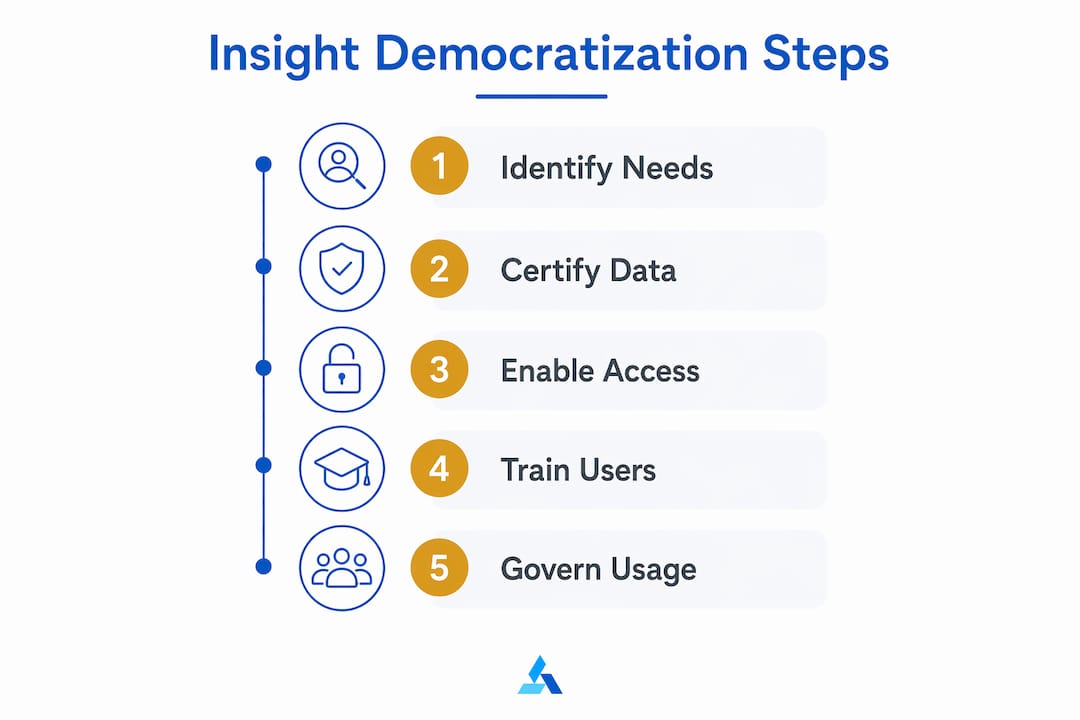
Why democratize strategic insights across your organization
The core argument for democratizing strategic insights is straightforward: decisions made on real data beat decisions made on gut feeling, every time. But the real competitive advantage is speed. When your marketing lead, your product manager, and your supply chain director can all pull trusted answers without filing a ticket to the data team, your organization moves faster than one that cannot.

True democratization rests on four core pillars: a data catalog for discovery, a business glossary for shared vocabulary, strong governance to maintain accuracy, and self-service tools that allow non-technical queries. Each pillar matters. Remove one and the whole structure weakens.
There is also a critical distinction most leaders miss. Democratizing read access means users can explore and query data. Democratizing write access means users can modify or create data records. These are not the same thing, and conflating them is how organizations create chaos. The goal is governed read access at scale, not a free-for-all.
- Data catalog: Lets users discover what data exists and where it lives.
- Business glossary: Defines shared terms so “revenue” means the same thing in finance as it does in sales.
- Governance framework: Certifies which datasets are trustworthy and who owns them.
- Self-service querying: Allows natural-language questions without SQL or Python skills.
Pro Tip: Avoid “democratized confusion” by certifying your most-used datasets first. When users know which data is approved and which is experimental, trust in the system grows instead of eroding.
How does democratizing insights transform decision-making?
The most visible impact is the shift from reactive firefighting to proactive leadership. When insights are locked inside a central data team, every department waits in line. Marketing waits for campaign performance data. Product waits for user behavior reports. Customer service waits for churn signals. That queue creates lag, and lag creates bad decisions.
Dissolving that bottleneck changes the dynamic entirely. Consider a mid-sized e-commerce company where the customer service team previously waited two weeks for a monthly churn report. Once they had governed self-service access to real-time data, they identified a shipping delay pattern within 48 hours and flagged it to operations before it became a crisis. That is the difference between insight as a report and insight as a reflex.
- Break down silos. When marketing, product, customer service, and supply chain share a common data layer, coordination happens naturally instead of through endless meetings.
- Embed insights in existing workflows. Embedding insights into tools people already use reduces context switching and removes friction from adoption.
- Free your analysts. AI-native platforms shift analysts from answering routine queries to high-value work like forecasting and scenario modeling.
- Reduce recurring data requests. Governed self-service analytics speeds decisions and minimizes debates caused by inconsistent metrics.
“The organizations winning in 2026 are not the ones with the most data. They are the ones where the most people can act on it.”
What are the pitfalls of democratizing strategic insights?
The biggest trap is treating democratization as a technology purchase. Buy the tool, deploy the dashboard, declare victory. This approach fails consistently. Many democratization initiatives collapse because the cultural and literacy foundations were never built. Users abandon dashboards they do not trust, and distrust spreads fast.
Low data literacy is the silent killer here. A sales manager who misreads a cohort analysis and draws the wrong conclusion does not just make one bad call. They share that conclusion in a leadership meeting, and suddenly a flawed interpretation becomes organizational strategy. That is not a hypothetical. It happens in companies of every size.
Poor governance causes “democratized confusion,” where competing KPI definitions erode confidence in the entire data layer. If finance defines “active customer” differently than product does, every cross-functional conversation becomes an argument about numbers instead of a conversation about strategy.
The other common failure is the “dashboard graveyard.” Organizations procure analytics tools, build dozens of reports, and then watch adoption flatline because no one trained users, no one maintained the dashboards, and no one connected the data to decisions that actually mattered to those users.
Pro Tip: Start your democratization effort in one focused business unit with high query volume and a clear ROI metric. Early wins in a contained area build the credibility and momentum needed to scale across the enterprise.
Which strategies best support democratizing insights in 2026?
The technology landscape has shifted decisively toward AI-native platforms that accept natural-language queries. This matters because it removes the single biggest skill barrier: the requirement to write code. A brand manager can now ask “Which markets showed the fastest growth last quarter?” and get a trusted answer in seconds, without involving a data engineer. For SMEs especially, this changes what is operationally possible. Blue Prysm’s AI-driven insights approach reflects exactly this shift.
Unified data and AI platforms consolidate fragmented data systems into a single governed layer. Fragmentation is the root cause of competing metrics. When your CRM, your financial system, and your web analytics all feed into one certified data layer, the “which number is right?” argument disappears.
Certified data pathways and feedback loops between data teams and business users are the operational model that makes this sustainable. Data teams certify datasets. Business users query them. When users find gaps or errors, they flag them back to the data team. The system improves continuously rather than decaying over time.
| Dimension | Traditional Workflow | Democratized Workflow |
|---|---|---|
| Data access | Submit ticket, wait days | Self-service query in minutes |
| Skill required | SQL or analyst dependency | Natural-language interface |
| Consistency | Competing metric definitions | Shared certified business glossary |
| Analyst role | Reactive reporting | Proactive forecasting and modeling |
| Decision speed | Weekly or monthly cycles | Real-time or daily cycles |
For leaders exploring AI-powered decision making, the priority in 2026 is not acquiring more data. It is building the governed infrastructure that makes existing data usable by everyone who needs it.
Key takeaways
Democratizing strategic insights delivers competitive advantage only when governance, data literacy, and self-service access are built together, not treated as separate initiatives.
| Point | Details |
|---|---|
| Four pillars are non-negotiable | Data catalog, business glossary, governance, and self-service tools must all be in place for true democratization. |
| Governance prevents confusion | Certified datasets and shared definitions stop competing metrics from undermining decision confidence. |
| Culture beats technology | Tool procurement without data literacy training leads to dashboard abandonment and eroded trust. |
| Start focused, then scale | Launching in one high-query business unit creates early ROI and the momentum needed for enterprise-wide adoption. |
| AI lowers the skill barrier | Natural-language querying platforms make governed self-service accessible to non-technical users across every department. |
The uncomfortable truth about insight democratization
I have watched organizations spend six figures on analytics platforms and end up worse off than before. Not because the technology was bad. Because leadership treated the rollout as an IT project instead of a change management initiative.
The pattern is always the same. A platform gets deployed. A handful of power users adopt it. Everyone else keeps emailing the data team. Six months later, the platform is “underperforming” and someone is shopping for a replacement.
The organizations that get this right treat democratization as an ongoing product, not a one-time deployment. They assign ownership. They run data literacy workshops. They build feedback loops between analysts and business users. They celebrate the first time a non-technical team member pulls their own insight and acts on it without asking for help.
My honest advice: before you buy another tool, audit your data culture. Ask your department heads what data they wish they had access to and why they do not have it today. The answers will tell you whether your problem is technology or trust. Most of the time, it is trust. Fix that first, and the technology becomes an accelerant instead of a liability.
— Colin Bowdery
How blue prysm helps you democratize strategic insights
Blue Prysm is built specifically for the business leaders and executives who know they need better intelligence but cannot justify a six-figure consulting engagement to get it.
The platform delivers governed, AI-powered access to market research tools and competitive intelligence designed for teams without dedicated data scientists. Real-time market briefings, competitor monitoring, and a structured strategy library give your team the insight infrastructure that enterprise organizations spend millions building. Blue Prysm makes it accessible without the overhead. If you are ready to see what governed self-service intelligence looks like in practice, explore the sample intelligence briefing and see exactly what your team would be working with.
FAQ
What is democratized insights in plain terms?
Democratized insights means giving every team member governed, self-service access to trusted data and intelligence, without requiring technical skills like SQL or data engineering. The goal is faster, more consistent decisions across the organization.
Why do most insight democratization efforts fail?
Most failures trace back to treating democratization as a technology purchase rather than a cultural change. Without data literacy training and strong governance, users abandon dashboards and revert to guesswork.
What is the fastest way to start democratizing strategic insights?
Start with one business unit that has high query volume and a clear ROI metric. Early wins in a focused area build credibility and create the momentum needed to scale across the enterprise.
How does governance prevent “democratized confusion”?
A certified business glossary and approved datasets ensure that terms like “revenue” or “active user” mean the same thing across every team. Without this, competing definitions create metric disputes that slow decisions instead of accelerating them.
Do small businesses benefit from democratizing insights?
Small and mid-sized businesses benefit most because they lack dedicated analyst teams. AI-native platforms with natural-language querying give SME leaders direct access to the same quality of intelligence that larger organizations pay analyst teams to produce.