


TL;DR:
- Strategic automation aligns automation initiatives with clear business goals to achieve significant cost reductions and high ROI. It begins with documentation and standardization, then layers automation tools while emphasizing governance and ownership. Proper sequencing and continuous management allow organizations to sustain automation benefits and adapt to market changes.
Strategic automation is defined as a coordinated, enterprise-wide approach to deploying automation technologies so that every process improvement directly serves a business objective. This goes far beyond scheduling reports or auto-sending emails. The real definition of strategic automation treats automation as a decision-making partner, not just a cost-cutting tool. Businesses that get this right see 20–30% operating cost reductions with ROI ranging from 100–430% and payback within 1–8 months. That kind of return does not come from automating random tasks. It comes from aligning every automation initiative with a clear business goal.
What is strategic automation built on? Core components explained
Strategic automation does not start with software. It starts with process clarity. Before any technology gets deployed, the underlying process must be documented, standardized, and stable. Skipping process standardization produces what practitioners call “smarter chaos,” where automation scales dysfunction rather than efficiency. That is the trap most organizations fall into.
Once the foundation is solid, the technology stack builds in layers:
- Process documentation and standardization: Map every workflow before touching automation tools. Identify decision points, exceptions, and handoffs.
- Workflow automation: Rules-based tools handle repetitive, predictable tasks like data entry, approvals, and notifications.
- Robotic process automation (RPA): Software bots replicate human actions across existing systems without requiring system integration.
- AI and machine learning: Structured workflow automation combined with AI reasoning creates intelligent automation capable of handling complexity without human intervention.
- Orchestration platforms: These connect individual automation tools into a unified system with centralized monitoring and governance.
Governance is the layer most executives underestimate. You need clear ownership of each automated process, defined performance metrics, and a review cadence. Without governance, automation programs fragment into disconnected tools that nobody maintains.
Pro Tip: Before selecting any automation tool, score each candidate process on three criteria: frequency, rule-based predictability, and strategic impact. Only automate processes that score high on all three.

What measurable ROI can businesses expect from strategic automation?
The numbers on strategic automation are not fluffy projections. They are documented outcomes from real implementations.
| Metric | Typical Result |
|---|---|
| Operating cost reduction | 20–30% |
| ROI range | 100–430% |
| Payback period | 1–8 months |
| Worker time reclaimed | 20–30% of weekly hours |
| Hours saved per week | ~15 hours on average |
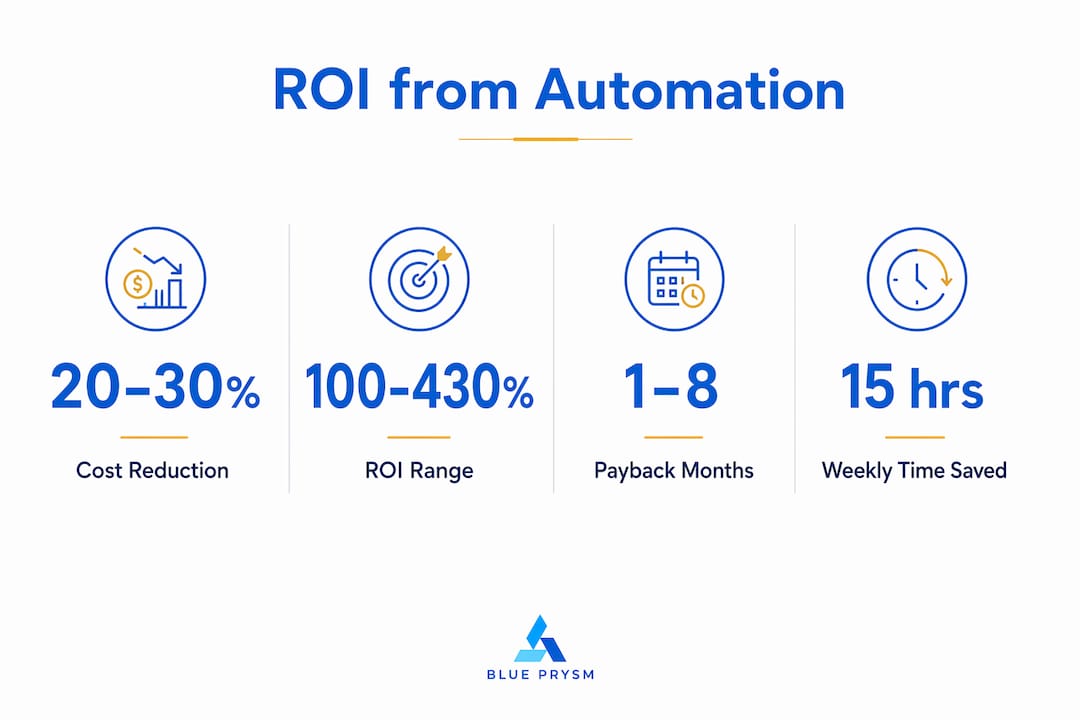
Automation of knowledge work frees 20–30% of worker time, enabling executives and their teams to focus on decisions that actually require human judgment. That shift compounds over time. When your finance team stops spending Monday mornings pulling reports, they start spending that time on analysis that moves the business forward.
Businesses save an average of 15 hours weekly through systematic automation, primarily by eliminating manual reporting and data reconciliation. Fifteen hours per week across a team of ten is 7,800 hours per year redirected toward higher-value work.
Rapid ROI in SMBs is achievable by layering automation gradually over existing tools, improving productivity measurably within weeks. You do not need a complete system overhaul. You need a disciplined sequence.
How does automation-augmentation change the executive’s role?
The most important shift in strategic automation thinking right now is the move from displacement to augmentation. The automation-augmentation framework helps executives balance AI-driven automation with human workforce capabilities. It is not a binary choice between “automate everything” and “keep humans in the loop.” It is a spectrum with four strategic positions:
- Augmentation-led: Automation handles data gathering and pattern recognition. Humans make all final decisions.
- Hybrid: Automation handles routine decisions within defined parameters. Humans handle exceptions and strategy.
- Supervised displacement: Automation handles full process execution. Humans monitor and intervene when needed.
- Full displacement: Automation handles end-to-end execution with minimal human involvement.
Most mid-market businesses operate best in positions 1 and 2. Full displacement works for commodity processes like invoice matching or inventory reordering. It fails badly for anything requiring contextual judgment, relationship management, or ethical reasoning.
“Automation is evolving from a tool for execution to a strategic partner informing real-time business strategy.” — The New Relationship Between Automation and Strategy
This evolution matters for executives because it changes what you are actually managing. You are no longer managing people doing tasks. You are managing a system of automated processes, human judgment, and AI-powered intelligence that together produce strategic outcomes.
Pro Tip: Map your automation portfolio against the four augmentation positions quarterly. Processes that were correctly placed in position 2 last year may be ready for position 3 today as your data quality and AI models mature.
One risk executives consistently underestimate is automation fatigue. When teams see automation as a threat rather than a tool, adoption collapses. Governance must include a change management component, not just a technical one.
How can organizations implement strategic automation without scaling chaos?
Implementation is where good strategy dies. The sequence matters more than the tools you choose.
- Start with documentation. You cannot automate what you have not mapped. Spend two weeks documenting your ten highest-volume processes before evaluating any software.
- Standardize before automating. Remove exceptions and edge cases from the process first. Automate the clean version, then build exception handling separately.
- Build structured automation first. Deploy rules-based workflow automation before introducing AI. This gives you a stable baseline and measurable performance data.
- Layer AI on top of proven workflows. Once your rules-based automation is running cleanly, add AI reasoning to handle complexity and improve decision quality.
- Assign clear ownership. Every automated process needs a named owner responsible for performance, exceptions, and iteration.
Effective strategic automation requires ongoing governance, ownership clarity, and staff buy-in to avoid fragmentation and fatigue. This is not a one-time project. It is a continuous lifecycle. Organizations that treat automation as a deployment event rather than an operating model consistently underperform those that build it into their management rhythm.
Automation enables near-real-time monitoring and strategic responsiveness, increasing organizational agility far beyond what slow annual planning cycles can deliver. When your systems surface market signals automatically, you respond in days instead of quarters. That is a genuine competitive advantage, and it is available to businesses of any size that build the right foundation. Explore decision-making best practices to see how governance and automation work together in practice.
Key Takeaways
Strategic automation delivers its highest returns when automation initiatives are directly tied to business objectives, governed continuously, and layered in the right sequence.
| Point | Details |
|---|---|
| Define before deploying | Document and standardize every process before selecting any automation tool. |
| ROI is real and fast | Businesses report 100–430% ROI with payback periods as short as one month. |
| Augmentation beats displacement | Most organizations perform best when automation handles data and humans handle decisions. |
| Governance is non-negotiable | Every automated process needs a named owner, metrics, and a review cadence. |
| Sequence determines success | Build rules-based automation first, then layer AI on proven, stable workflows. |
Why most automation programs stall at year two
I have watched organizations launch automation programs with genuine enthusiasm, hit their first-year targets, and then quietly plateau. The pattern is almost always the same. They automate the easy stuff, declare victory, and stop treating automation as a living system that needs active management.
The uncomfortable truth is that strategic automation is not a project with a finish line. The organizations I have seen sustain compounding returns treat their automation portfolio the way a fund manager treats an investment portfolio. They review it regularly, retire underperforming processes, and reallocate capacity toward higher-value opportunities. They also invest in AI-driven competitive advantage as a continuous capability, not a one-time implementation.
The second failure mode is cultural. When automation is positioned as headcount reduction, teams protect their manual processes. When it is positioned as a way to reclaim time for work that actually matters, adoption accelerates. The framing is a leadership decision, and it determines whether your program scales or stalls.
My honest advice: pick one high-volume, high-frustration process in your organization right now. Document it, clean it up, and automate it within 90 days. The confidence that comes from one real win is worth more than any roadmap presentation.
— Colin Bowdery
How Blue Prysm fits into your automation strategy
Strategic automation requires real-time market intelligence to stay aligned with business goals. Without current data on competitors, market shifts, and emerging risks, even well-built automation programs optimize for yesterday’s priorities.
Blue Prysm gives executives the competitive intelligence tools to monitor markets automatically and feed those signals directly into strategic decisions. The platform combines real-time market briefings, structured strategy frameworks, and competitor monitoring in one place, without the consulting fees that typically gate this kind of intelligence. For teams building or scaling a strategic automation program, Blue Prysm’s market analysis platform provides the continuous strategic intelligence layer that keeps automation aligned with where the market is actually heading.
FAQ
What is the simplest definition of strategic automation?
Strategic automation is the practice of aligning automation technologies with specific business objectives so that every automated process contributes to measurable strategic outcomes, not just operational efficiency.
How is strategic automation different from regular automation?
Regular automation targets individual tasks in isolation. Strategic automation coordinates automation across the organization, with governance, ownership, and direct ties to business goals.
What processes should businesses automate first?
Prioritize high-frequency, rule-based processes with clear inputs and outputs, such as invoice processing, reporting, and data reconciliation. These deliver the fastest ROI and build the foundation for more complex automation.
How long does it take to see ROI from strategic automation?
Documented payback periods range from 1–8 months, with businesses reporting ROI of 100–430% when automation is implemented in a structured, sequenced approach.
What is the biggest risk in implementing strategic automation?
The biggest risk is automating unstable or poorly documented processes. Skipping standardization produces scaled inefficiency rather than scaled productivity.