


TL;DR:
- Validating a new idea involves quickly testing business viability through customer behavior and economic data.
- Using structured experiments and asking about past actions helps prevent costly assumptions based on false confidence.
New idea validation is the disciplined process of proving a business concept’s viability through real customer behavior and economic evidence before building any full product. Entrepreneurs and business leaders who skip this step routinely waste months and significant capital on products nobody wants. The industry term for this practice is “concept testing,” and it sits at the heart of every sound go-to-market strategy. Explaining new idea validation clearly matters because the trap is not ignorance. It is false confidence. You feel the idea in your gut, your friends say it sounds great, and you start building. That gut feeling is not data.
What are the core steps of new idea validation?
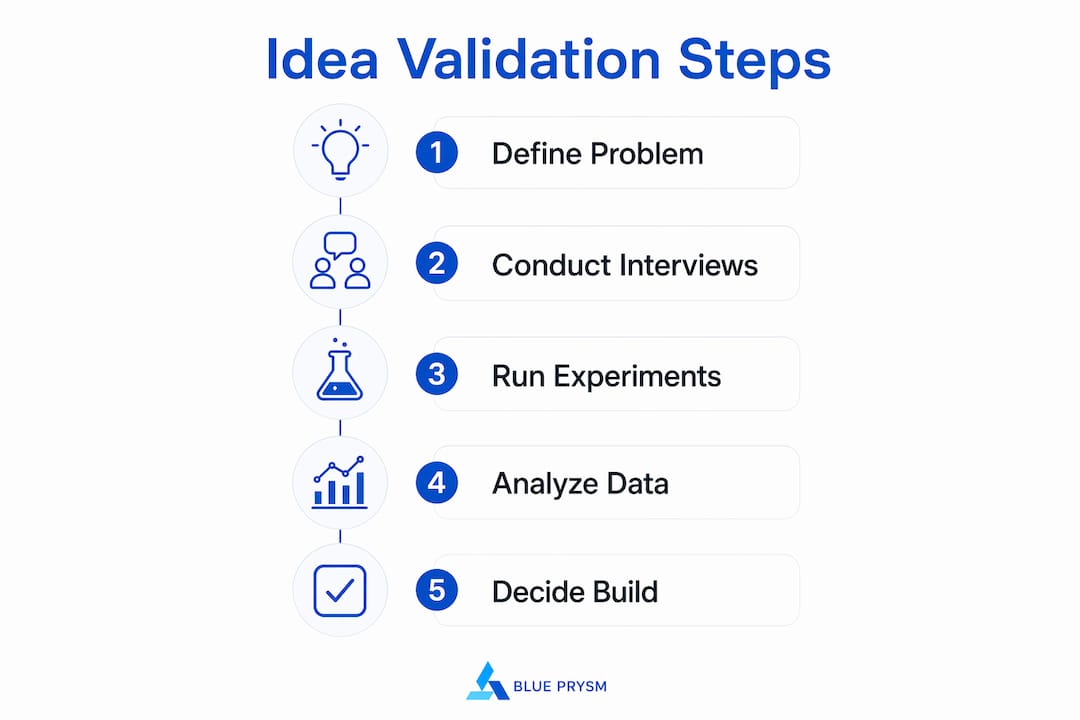
Validation is a structured process, not a long research project. A complete five-step validation can be finished within an afternoon, with each step requiring 30–60 minutes of focused effort. That means you have no excuse to skip it.
-
Frame clear, testable assumptions. Write down exactly who your buyer is, what problem they have, and what you are offering. Vague assumptions produce vague results. Be specific: “Freelance designers earning under $100K per year struggle to invoice clients on time because they lack a simple billing workflow.”
-
Talk to real potential buyers. Focus every conversation on past behavior, not future intentions. Ask what they currently do, not what they would do. This distinction is everything.
-
Verify the problem is painful, recurring, and real. A problem that happens once a year and causes mild frustration is not a business. You need a problem that costs people time, money, or sleep on a regular basis.
-
Test solution demand with minimal experiments. Landing pages, pre-sales, and pilot commitments all generate behavioral evidence. Industry standards require at least five confirmed customer commitment signals, like pre-orders or deposits, before you proceed to build. Fewer than two “yes” responses in five conversations signals a pricing or offer problem.
-
Assess unit economics. Calculate your customer acquisition cost (CAC), cost to serve, and sustainable pricing before writing a single line of code.
Pro Tip: Set a hard deadline before you start. Give yourself two weeks maximum for the full validation cycle. Open-ended timelines invite rationalization.
How do behavioral interview techniques improve validation accuracy?
The biggest mistake founders make is asking hypothetical questions. “Would you pay $50 a month for this?” feels like research. It is not. Hypothetical questions trigger social desirability bias, meaning people tell you what they think you want to hear rather than what they actually do.
The Mom Test methodology, developed by Rob Fitzpatrick, fixes this problem with one rule: ask about past behavior, not future intentions. The name comes from the idea that even your mom will mislead you if you ask the wrong questions. Ask her “Would you use my app?” and she says yes. Ask her “When did you last pay for a tool that solved this problem?” and you get the truth.
Effective interview prompts look like this:
- “Walk me through the last time you dealt with this problem.”
- “What did you try to fix it? How much did that cost you?”
- “How often does this happen in a typical month?”
- “What would happen if you did nothing about it?”
Prompts to avoid include anything starting with “Would you,” “Could you imagine,” or “Do you think you might.” These questions produce polite noise, not signal. You want to distinguish genuine commitment from friendly encouragement.
Pro Tip: Aim for 5–10 buyer conversations per customer segment. Saturation happens fast when your segment and problem are well defined. Quality beats volume every time.
What minimal experiments can entrepreneurs run to test demand?
Talking to buyers tells you about the problem. Experiments tell you about demand for your solution. These are two different things, and you need both. Fake-door and concierge tests produce behavioral evidence rather than opinions, which makes them far more reliable than surveys or interviews alone.
Here are the most effective low-cost experiments:
- Landing page smoke test. Build a one-page site describing your solution and drive cold traffic to it. A conversion rate above 3% signals real market interest. Below 1% means poor fit. This benchmark applies to cold traffic, not warm referrals.
- Fake-door test. Add a “Sign Up” or “Buy Now” button to a page for a product that does not exist yet. Track click-through rates. Clicks are behavioral evidence of intent.
- Pre-sales and deposits. Asking someone to pay, even a small amount, is the strongest validation signal available. A verbal “yes” costs nothing. A $50 deposit costs something real.
- Concierge delivery. Manually deliver the solution yourself before automating anything. If customers accept and return, the solution works.
| Experiment | Cost | Speed | Evidence strength |
|---|---|---|---|
| Landing page smoke test | Low | 1–3 days | Medium |
| Fake-door test | Very low | 1–2 days | Medium |
| Pre-sale or deposit | Low | 1–2 weeks | High |
| Concierge delivery | Medium | 1–4 weeks | Very high |
For a deeper look at invention validation steps that apply across industries, the process mirrors what works for tech startups: evidence first, building second.
How does economic viability testing determine whether to build?
Customer interest without economic viability is a hobby, not a business. Unit economics testing must confirm that your sustainable pricing covers your cost to serve and your CAC within an acceptable payback window.
The key metrics to check:
- CAC to LTV ratio. A minimum 3:1 ratio of customer lifetime value to acquisition cost is the industry standard for a sustainable business. Failing this test is often an immediate kill signal.
- Cost to serve. What does it actually cost to deliver your solution to one customer? Include time, tools, and support.
- Realistic addressable market. Focus on your 18-month addressable market, not your Total Addressable Market. TAM numbers look impressive in pitch decks and mean almost nothing for early-stage decisions.
- Pricing conversations. Ask buyers what they currently pay for alternatives. Real payment history is more reliable than stated willingness to pay.
Setting kill criteria in advance is the discipline that separates founders who act on data from those who rationalize their way into bad investments. Decide before you test: “If fewer than three buyers commit within two weeks, we stop.” Write it down. Hold yourself to it.
Pro Tip: Run your numbers through Blue Prysm’s Venture Quick Score to get an AI-powered read on your unit economics before you commit to building.
Key Takeaways
Idea validation is the process of gathering behavioral evidence to make a go or no-go decision before committing significant time and capital to building a product.
| Point | Details |
|---|---|
| Validation is fast | A complete five-step process can be done in an afternoon or two weeks maximum. |
| Behavioral questions beat hypotheticals | Ask about past actions and real payments, not what buyers say they would do. |
| Experiments produce real evidence | Pre-sales and concierge tests outperform surveys as demand signals. |
| Economics must work before you build | A CAC to LTV ratio below 3:1 is a kill signal, regardless of customer interest. |
| Kill criteria prevent emotional bias | Set your stop thresholds before testing so data drives the decision, not hope. |
The uncomfortable truth about killing ideas early
I have watched founders spend eight months building a product that three customer conversations would have killed in a week. The emotional cost of that is real. The financial cost is worse. What I have learned, working with early-stage teams across multiple sectors, is that killing an idea cheaply is a success, not a failure. The validation process exists to give you permission to stop.
The trap most founders fall into is confusing interest with demand. Someone says “That sounds cool” and the founder hears “I will pay for that.” Those are completely different statements. Polite enthusiasm is not a business signal. A deposit is. I have seen this mistake made by experienced executives just as often as first-time founders. It is not a beginner error. It is a human one.
Validation is also not a one-time event. The best founders treat it as a continuous discipline. They test pricing assumptions again after launch. They re-validate when entering new segments. They treat every major product decision as a new hypothesis to test. That mindset is what separates leaders who build businesses from those who build products.
— Colin Bowdery
How Blue Prysm supports faster, smarter validation
Validation moves faster when you have real market data behind your assumptions. Blue Prysm’s market analysis platform gives entrepreneurs real-time buyer and competitor insights that replace weeks of manual research. You can size your realistic addressable market, track competitive signals, and stress-test your pricing assumptions before your first customer conversation.

Blue Prysm’s market research tools are built specifically for founders and business leaders who need evidence fast. The platform connects you to the data that makes validation decisions defensible, not just directional. If you are serious about testing a new concept before committing resources, Blue Prysm gives you the infrastructure to do it right.
FAQ
What is new idea validation?
New idea validation is the process of testing a business concept through real customer behavior and economic evidence before building a full product. Concept testing before development prevents building products no one wants.
How many customer conversations do I need to validate an idea?
Aim for 5–10 conversations per customer segment. Patterns emerge quickly when your target segment and problem are clearly defined.
What is the strongest validation signal available?
A pre-sale or deposit is the strongest signal. Verbal interest costs the buyer nothing; a real payment proves genuine demand.
What does a successful landing page test look like?
A conversion rate above 3% on cold traffic indicates real market interest. Below 1% signals poor problem-solution fit and warrants a pivot before building.
When should I kill a new idea?
Set kill criteria before you test. If fewer than five buyers commit with a concrete signal like a deposit or pre-order, treat that as a no-go and move on.