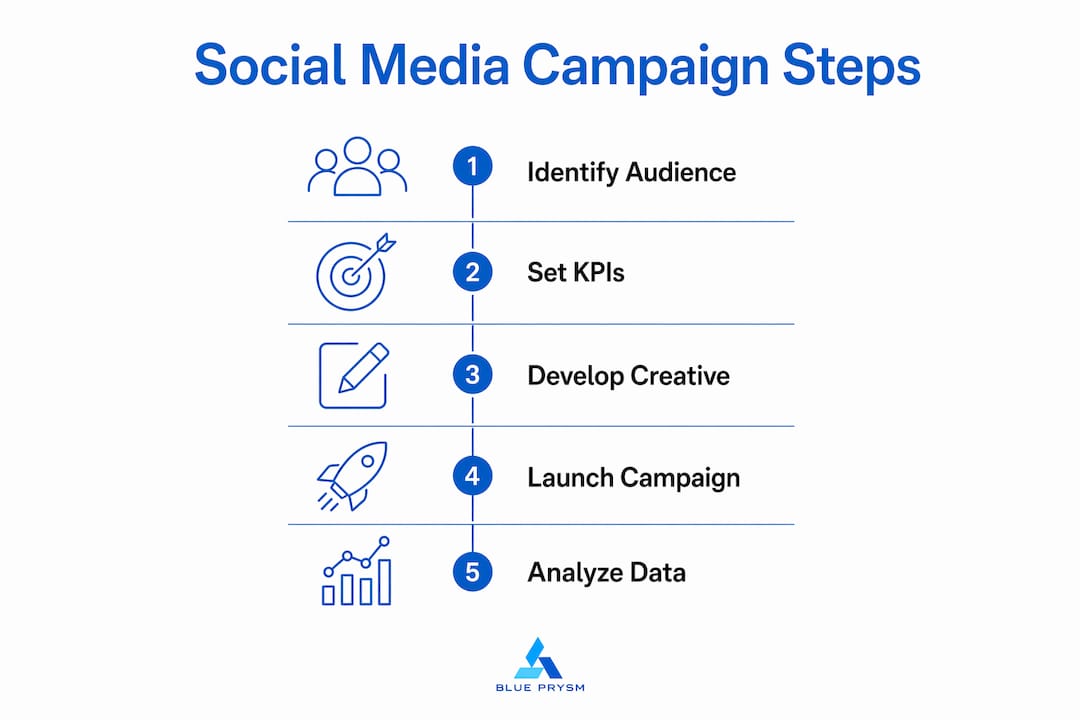
A social media campaign is a coordinated, goal-driven marketing effort executed across one or more social platforms within a defined timeframe to achieve measurable results. Not a content calendar. Not a posting streak. A campaign has a start date, an end date, a specific objective, and dedicated creative assets built around that objective. The difference between a campaign and routine posting is the same as the difference between a sales pitch and small talk. One is structured to move people.
The best social campaigns share a few non-negotiable traits:
- A crystal-clear goal tied to a business outcome (awareness, conversions, community growth, behavior change)
- Audience targeting that goes deeper than demographics, addressing specific desires, frustrations, or cultural moments
- Dedicated creative assets, hashtags, or influencer partnerships built for the campaign
- A defined timeline with sequenced content, not a single post
- KPIs set before launch, not reverse-engineered after
- A mix of organic and paid distribution, optimized continuously
Brands like LEGO, Dove, and the ALS Association have proven that the most memorable social media promotions are not the most expensive ones. They are the most specific. The sections below break down exactly how to build, run, and measure campaigns that earn real results in 2026.
What makes a social media campaign actually succeed?
Most campaigns fail at the planning stage, not the execution stage. They start with a vague brief (“let’s grow awareness”) and end with a dashboard full of impressions that nobody can connect to revenue. The fix is not a bigger budget. It is better architecture.
Audience identification and segmentation is where everything starts. Knowing your audience’s age range is table stakes. Knowing which cultural moment they are living through right now, what frustrates them about your category, and what they share with their friends, that is the insight that makes a campaign land. Campaigns that focus on measurable behavioral goals and audience-specific desires consistently outperform those built around vanity metrics.

Goal setting and KPIs need to be specific before a single asset is created. Awareness campaigns track impressions, reach, and share of voice. Conversion campaigns track clicks, leads, and purchases. Engagement campaigns track comments, shares, and saves. Picking the wrong metric for your goal type is how teams end up celebrating a viral post that drove zero sales.
The remaining elements that separate high-performing campaigns from forgettable ones:
- Platform selection: Choose platforms where your audience already spends time, not where you feel comfortable posting. A B2B product launch belongs on LinkedIn. A Gen Z beverage brand belongs on TikTok.
- Budget allocation: Organic content builds credibility. Paid amplification scales reach. The most effective social media strategies blend both, using paid to amplify what is already working organically.
- Creative development: Authenticity beats polish. Audiences increasingly skip highly produced ads in favor of content that feels native to the feed. Mimicking user-generated content style, including phone-shot video, improves engagement and trust.
- Content sequencing: A priming post warms the audience up. A hero announcement carries the main message. Reminder posts sustain momentum. Social proof posts convert the fence-sitters.
- Engagement strategy: Campaigns that invite participation, through hashtags, challenges, or co-creation, generate far more earned reach than broadcast-only approaches.
Pro Tip: Set your KPIs and benchmarks before you write the creative brief. If you cannot describe what “success” looks like in a single sentence with a number attached, the campaign is not ready to launch.
The main types of social media campaigns you should know
Not every campaign type fits every goal. Choosing the wrong type is like hiring a sprinter to run a marathon. Here is how the major categories break down and when to use each.
-
Brand awareness campaigns introduce your brand to new audiences or reinforce your values to existing followers. The primary metric is visibility, not conversion. Dove’s Real Beauty work is the canonical example: years of consistent messaging that shifted how an entire category thinks about beauty standards.
-
Engagement campaigns prioritize interaction over reach. Comments, shares, saves, and participation mechanics (polls, challenges, duets) are the currency. Spotify Wrapped is the gold standard here. Every December, personalized data and shareable content drive mass user-generated content and app re-engagement simultaneously.
-
Lead generation campaigns use gated content, sign-up incentives, or direct response ads to collect contact information. These live primarily on LinkedIn and Meta, where lead-gen form ads reduce friction between interest and conversion.
-
Product launch campaigns run in three phases: a teaser to build anticipation, a launch-day push to drive conversions, and sustained post-launch promotion to maintain momentum. Adidas executes this playbook consistently, using influencer seeding before launch day to build organic buzz before paid amplification kicks in.
-
Influencer marketing campaigns work best when the creator is already aligned with the campaign’s theme, not just hired to hold a product. Dove’s #ShareTheFirst campaign partnered with Bebe Rexha specifically because she had spoken openly about body image pressures, making her participation feel credible rather than transactional.
-
User-generated content (UGC) campaigns activate your community to create content featuring your brand. This builds social proof, fuels authentic storytelling, and gives your team a library of real content to amplify. Olipop’s organic trend approach and Calvin Klein’s casting choices both demonstrate how UGC can outperform brand-produced content at a fraction of the cost.
-
Community-building campaigns focus on turning existing customers into advocates. These are long-running, relationship-oriented efforts. LEGO Ideas, where fans submit and vote on new set designs, is a masterclass in community-driven brand loyalty that generates product ideas and content simultaneously.
-
Cause and behavior-change campaigns apply commercial marketing techniques to drive social action. The ALS Ice Bucket Challenge is the most cited example in history, and it works because the ask was simple, social, and emotionally resonant.
Campaigns often overlap. A product launch can incorporate UGC mechanics. A cause campaign can drive brand awareness. The key is knowing which type anchors your strategy before you layer in secondary objectives.
Inspiring social media campaign examples for 2026
The campaigns below are not here because they went viral. They are here because each one demonstrates a specific principle you can actually use.
| Campaign | Brand | Platform | Objective | Key Tactic | Result |
|---|---|---|---|---|---|
| Pitbull Concert Ambush | Currys | TikTok, Instagram | Product awareness | UGC-style phone content, fan culture infiltration | 2 million organic views and 600 million global earned media impressions |
| #ShareTheFirst | Dove | Instagram, TikTok | Authenticity movement | Creator activation, celebrity partnership, OOH | over a billion impressions and more than a million engagements |
| ALS Ice Bucket Challenge | ALS Association | Facebook, YouTube, Instagram | Fundraising and awareness | Participatory challenge, celebrity amplification | $115M raised for ALS research |
| Spotify Wrapped | Spotify | Instagram Stories, X | Re-engagement and UGC | Personalized annual data, shareable cards | Mass organic sharing, annual cultural moment |
| #SleepyGirlMocktail | Olipop | TikTok | Organic trend amplification | Riding an existing trend, no paid media | Viral reach driven entirely by community participation |
| #FireballFriday | Fireball | TikTok, Instagram | Community and brand loyalty | Recurring weekly UGC prompt | Sustained engagement cadence, growing brand community |
Currys and the $7,000 Pitbull play
This one deserves more than a table row. Currys needed to promote a worldwide travel adapter with a tiny production budget. Their social team noticed fans were already dressing as Pitbull (aka Mr. Worldwide) at his concerts and posting the videos. So they dressed a colleague in a purple Currys-branded suit, gave out free adapters in the crowd, and shot everything on a phone to match the UGC style of their feeds. The caption read like a creator’s voice, not a brand’s press release. The result was over 2 million organic views on their own channels and 600 million global earned media impressions, all from a modest production budget and zero paid media spend. The lesson is not “go to concerts.” It is: find where your audience already is, embed yourself authentically, and let the content feel like it belongs in the feed.
Dove’s #ShareTheFirst
Dove’s research found that a significant number of women globally spend considerable time analyzing photos of themselves before posting. That single insight became the campaign’s entire foundation. By recruiting 111 global creators and partnering with Bebe Rexha to share unedited first photos, Dove turned a statistic into a movement. Post-campaign, girls who saw the content were 6 points less likely to delete and retake a photo if it did not look perfect. Purchase intent among girls rose 17 points to 83%. That is behavior change, not just brand awareness.
The ALS Ice Bucket Challenge
The ALS Ice Bucket Challenge raised over $115 million in the summer of 2014 through a mechanic so simple it sounds obvious in retrospect: dump ice water on yourself, post it, challenge three friends. Over 17 million people participated. The campaign worked because the ask was low-effort, the social pressure was built into the mechanic, and celebrity participation (Taylor Swift, Eminem, David Beckham) gave it cultural legitimacy without requiring a celebrity budget.
Pro Tip: Shoot your next campaign content on a phone, not a camera rig. Polished production signals “advertisement” to a feed full of UGC. Audiences swipe past ads; they stop for content that looks like something a real person made.
Why businesses actually run social media campaigns
The honest answer is not “to get likes.” The real purposes are more specific, and the ones that matter most connect directly to revenue or measurable behavior change.
- Brand awareness: Getting your name in front of people who have never heard of you, at scale, without a sales pitch attached.
- Engagement and community: Building a group of people who actively interact with your brand, not just passively follow it.
- Conversions: Driving specific actions: purchases, sign-ups, downloads, or inquiries.
- Behavior change: Shifting how people think or act, which is the core of social marketing as a methodology. Social marketing focuses on behavior change; social media is simply one channel that supports it.
- Earned media: Creating content so shareable that other people and publications amplify it for free, as Currys demonstrated.
- Brand advocacy: Turning satisfied customers into vocal supporters who recruit new ones without being asked.
The intangible benefits compound over time. A brand that consistently runs campaigns aligned with its values builds consideration and trust that paid ads alone cannot buy. Dove’s perceptions of championing inclusivity rose 9 points to 88% after #ShareTheFirst, and its standing up for important issues metric surged 14 points to 89%. Those numbers show up in purchase decisions months and years later.
The trap most marketers fall into is measuring campaigns against vanity metrics: impressions, follower counts, and raw likes. These feel good in a slide deck and mean almost nothing in a board meeting. The metrics that matter are engagement rate, sentiment shifts, conversion rate, cost per acquisition, and earned media value. Track what connects to a business outcome, and you will never have to justify your social budget again.
How AI and real-time data change the way you run campaigns
Running a social campaign without real-time data is like driving with your eyes closed and checking the map at the end. You might get somewhere, but you will not know why, and you cannot repeat it.
AI changes the equation in three concrete ways. First, it accelerates audience segmentation. Instead of building personas from quarterly surveys, AI-powered tools analyze behavioral signals continuously, identifying which audience segments are responding to which creative angles in real time. Second, it enables integrating organic content with paid campaigns using A/B testing and segmentation driven by live data, which maximizes reach without wasting budget on content that is not working. Third, it surfaces competitor movements before they become threats, giving you time to adjust positioning or timing rather than reacting after the fact.
The practical problems AI solves in campaign management are worth naming directly:
- Ad misalignment: Serving the wrong creative to the wrong audience segment because targeting was set manually at launch and never updated.
- Wasted budget: Continuing to spend on underperforming ad sets because the reporting cadence is weekly, not hourly.
- Delayed reactions: Missing a trend window because the team did not see it until it was already saturating the feed.
Blue Prysm’s market analysis platform addresses exactly these problems for small and medium-sized businesses that cannot afford a full-time data science team. Real-time market intelligence, competitor tracking, and a strategy library in one place means your campaign decisions are grounded in current data, not last quarter’s gut feeling. For marketers who want to go deeper on the analytics side, the 2026 guide to social media and analytics covers the specific tools and measurement frameworks worth building into your workflow.
Pro Tip: Do not wait until a campaign ends to look at the data. Set a mid-campaign review at the halfway point and give yourself permission to reallocate budget toward what is working. The brands that win are the ones that treat campaigns as living experiments, not finished products.
The balance between organic authenticity and paid reach is where most teams get it wrong. Organic content builds the credibility that makes paid content believable. Paid content scales the reach that organic content cannot achieve alone. AI-powered insights tell you which organic posts have the signal strength to justify paid amplification, so you are not just boosting posts randomly and hoping for the best.
What Blue Prysm can do for your next campaign
Most marketing teams are not short on ideas. They are short on the market intelligence to know which ideas are worth executing, and the competitive context to know how to position them. That is the gap Blue Prysm fills.
The AI-powered research tools at Blue Prysm give marketing professionals and business owners the kind of real-time audience and competitor intelligence that used to require an agency retainer. You get market insights, competitor tracking, and a library of proven strategy frameworks, all in one platform built for teams that need to move fast without guessing.
If you are planning a campaign for Q3 or Q4 2026 and want to build it on actual data rather than assumptions, Blue Prysm is worth a look.
Key Takeaways
The most effective social media campaigns combine a specific behavioral goal, deep audience insight, and a continuous optimization loop that adjusts creative and spend in real time.
| Point | Details |
|---|---|
| Campaigns beat routine posting | A campaign has a defined goal, timeline, and dedicated assets; everyday posting does not. |
| Authenticity drives engagement | Phone-shot UGC-style content outperforms polished production in social feeds. |
| Behavior change is the real goal | The best campaigns shift what people do, not just what they think about a brand. |
| AI closes the data gap | Real-time segmentation and A/B testing prevent wasted budget and missed trend windows. |
| Measure what connects to revenue | Engagement rate, sentiment shifts, and conversions matter; raw impressions alone do not. |
FAQ
What is a social media campaign?
A social media campaign is a coordinated set of marketing actions executed across one or more social platforms within a defined timeframe to achieve a measurable business objective. It differs from everyday posting by having a specific goal, dedicated creative assets, and defined KPIs set before launch.
What is an example of a social media campaign?
The ALS Ice Bucket Challenge is one of the most cited examples: a participatory, celebrity-backed campaign that raised over $115 million for ALS research through a simple, shareable mechanic that over 17 million people joined. Currys’ Pitbull concert ambush is a more recent example, generating over 2 million organic views and 600 million global earned media impressions on a $7,000 budget.
What are the main types of social media campaigns?
The core types are brand awareness, engagement, lead generation, product launch, influencer marketing, user-generated content, community building, and cause or behavior-change campaigns. Most real-world campaigns blend two or more types depending on the objective.
What is the 3-3-3 rule in social media?
The 3-3-3 rule recommends grabbing attention in the first three seconds, delivering key value within three minutes, and following up within three days to maximize campaign impact. It is particularly relevant for video content and lead nurturing sequences.
How do you measure whether a campaign is working?
Track metrics that connect to your stated goal: impressions and share of voice for awareness, engagement rate and sentiment for community campaigns, and conversions and cost per acquisition for direct response. Set benchmarks before launch and review performance at the midpoint, not just at the end.