

TL;DR:
- A strategic toolkit is a set of frameworks leaders use to diagnose, decide, and execute strategy effectively. Using a small, well-chosen core of three to five tools aligned with each stage improves decision quality and organizational alignment. AI-enabled platforms like Blue Prysm enhance real-time data integration, shorten planning cycles, and support dynamic, connected strategy work.
A strategic toolkit is a compact, purpose-driven set of frameworks leaders use to diagnose competitive situations, make informed choices, and drive organizational delivery. The single most practical next step: pick a few complementary tools from the core frameworks below, then operationalize them with OKRs and a KPI dashboard so your strategy doesn’t die in a slide deck.
TL;DR — Start this week:
- Audit which frameworks your team already uses (honestly), then close the gaps across analysis, choice, and execution.
- Pull a free starter template from the Blue Prysm strategy library or MIT Sloan’s toolkit page and run a 60-minute leadership session before Friday.
What a strategic toolkit actually is — and why leaders who skip one pay for it
Think of a strategic toolkit not as a binder of frameworks you dust off once a year, but as the repeatable operating system for how your leadership team thinks. It’s the structured collection of frameworks, methods, templates, and metrics that turns strategy from a quarterly offsite into consistent, measurable work.
The value isn’t in having more tools. It’s in having the right ones for your current situation. A well-assembled toolkit improves decision quality by forcing structured thinking, improves alignment by giving every team member the same analytical language, and accelerates execution by reducing the “what do we do next?” friction that kills momentum between planning and delivery.
Who benefits most? Organizations at an inflection point: a startup moving from product-market fit to scaling, an SMB entering a new market, or an established company facing a disruptive competitor. The toolkit pays for itself fastest when the cost of a bad strategic call is high and the time available to make it is short.
A complete toolkit typically spans four categories:
- Analysis tools — scan the environment and diagnose competitive position (SWOT, PESTLE, Porter’s Five Forces)
- Strategy and choice tools — evaluate options and make directional decisions (scenario planning, portfolio matrices, VRIO)
- Execution tools — translate decisions into operational plans (OKRs, value chain analysis, key success factors)
- Tracking tools — measure progress and course-correct (KPI dashboards, strategy maps, balanced scorecard)
Pro Tip: Treat your toolkit as a dynamic set of lenses, not a static checklist. The goal, as Oxford’s strategy research puts it, is judgmentful selection — choosing the right framework for the situation, not running every tool out of habit.
How the four tool categories map to your strategy lifecycle
Most strategy breakdowns happen because leaders use analysis tools when they need execution tools, or skip the choice phase entirely and jump from diagnosis to delivery. Understanding which category does what — and when — is important.

| Category | Primary Output | When to Run | Typical Tools |
|---|---|---|---|
| Analysis & Environment | Competitive position map, threat/opportunity register | Diagnose phase — before any strategic choice | SWOT, PESTLE, Porter’s Five Forces |
| Strategy & Choice | Prioritized strategic options, scenario outcomes | Decide phase — after diagnosis, before committing resources | Scenario planning, portfolio matrices, VRIO |
| Execution & Delivery | Initiative roadmap, OKR set, accountability structure | Deliver phase — after strategic direction is set | OKRs, value chain, key success factors |
| Tracking & Learning | Performance dashboard, variance analysis | Ongoing — weekly/monthly review cadence | KPI dashboards, strategy maps, balanced scorecard |
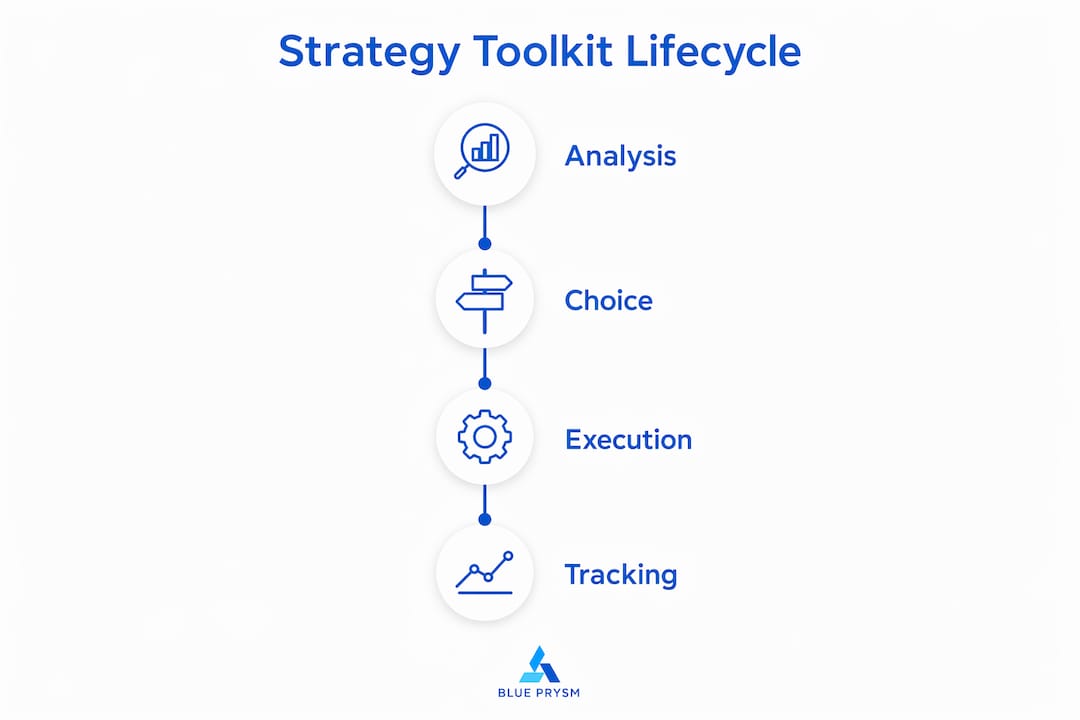
Research from Aston University confirms this lifecycle mapping: Porter’s Five Forces and PESTLE are best suited to the analysis phase, scenario planning is most valued for strategic choice, and key success factors are the dominant implementation-phase tool. Using them out of sequence is like running a post-mortem before the project starts.
One-line use-cases to make this concrete:
- Analysis: Run a PESTLE scan before entering a new geographic market to surface regulatory and economic risks.
- Choice: Use scenario planning to stress-test your pricing strategy against three plausible demand futures.
- Execution: Draft OKRs for each business unit that trace directly back to the strategic priorities the scenario planning surfaced.
- Tracking: Build a KPI dashboard that shows weekly progress against those OKRs so the leadership team can course-correct, not just report.
The core frameworks you need to know — and when to use each one
Explaining strategic toolkits without walking through the frameworks themselves is like explaining a recipe without listing the ingredients. Here’s a compact reference for each essential framework.

SWOT (Strengths, Weaknesses, Opportunities, Threats)
One-sentence definition: a structured internal/external audit that surfaces your competitive position in four quadrants. Best for: annual planning kickoffs and pre-acquisition due diligence. Starter prompt: “List three things we do better than any competitor, three things customers complain about, three market shifts we could exploit, and three threats that could cut revenue by 20% in 18 months.” Run it in 30–45 minutes with your leadership team using a shared whiteboard. Note: experienced practitioners rarely rely on SWOT alone — it’s a starting point, not a conclusion.
PESTLE (Political, Economic, Social, Technological, Legal, Environmental)
A macro-environment scan that forces you to look outside your industry. Best for: market entry decisions, annual environmental reviews, and regulatory risk assessments. How-to: assign one team member per dimension, give them 20 minutes to surface the top three factors, then synthesize into a ranked risk/opportunity register.
Porter’s Five Forces
Analyzes competitive intensity through five structural forces: rivalry, buyer power, supplier power, threat of substitutes, and threat of new entrants. Best for: understanding industry attractiveness before committing capital. The HBS framework overview is the canonical reference. How-to: rate each force high/medium/low, then identify which two forces most constrain your margins and build your strategy around neutralizing them.
VRIO (Value, Rarity, Imitability, Organization)
A resource-based lens that asks whether your capabilities are a genuine source of competitive advantage. Best for: capability audits before a new product launch or market expansion. How-to: list your top five capabilities, score each against the four VRIO criteria, and invest only in the ones that score “yes” on all four.
Value Chain Analysis
Maps every activity from inbound logistics to after-sales service and identifies where you create — or destroy — value. Best for: cost reduction programs and differentiation strategy. How-to: walk each activity and ask, “Does this step make the customer willing to pay more, or does it just add cost?”
Scenario Planning
Builds two to four plausible futures based on key uncertainties and tests your strategy against each. Aston’s research shows scenario planning is highly valued for strategic choice even though it isn’t the most-used tool. Best for: long-horizon decisions (3–5 years) and high-uncertainty environments. Starter pack: identify your two highest-impact, highest-uncertainty variables, build a 2×2 matrix, and write a one-page narrative for each quadrant. Blue Prysm’s scenario testing guide walks through this step by step.
Portfolio Matrices (BCG Growth-Share, GE-McKinsey)
Allocate resources across a portfolio of business units or products based on market attractiveness and competitive strength. Best for: multi-product companies deciding where to invest, hold, or divest.
OKRs (Objectives and Key Results)
Translate strategic priorities into measurable quarterly commitments. Best for: bridging the gap between strategy design and daily operations. Two-minute drafting prompt: “What is the one outcome this team must achieve this quarter? What three metrics would prove we got there?” OKRs are the connective tissue between your strategy map and your KPI dashboard.
Strategy Maps
A visual representation of cause-and-effect relationships across financial, customer, process, and learning perspectives. The balanced scorecard, developed by HBS Professor Robert Kaplan and David Norton, pairs with a strategy map to track non-financial variables alongside financial ones. Best for: communicating strategy to the full organization in a single page.
KPI Dashboards
Real-time or near-real-time views of the metrics that matter most to your strategic objectives. Best for: weekly leadership reviews and board reporting. The key discipline: every KPI on the dashboard must trace back to an OKR, which traces back to a strategic priority. If it doesn’t, cut it.
How to choose the right tools for your organization
The most common toolkit mistake isn’t picking the wrong framework. It’s picking too many and using none of them well. Cambridge’s strategy research is direct on this: selective adoption improves outcomes, and there’s a persistent gap between what business schools teach and what managers find valuable in practice.
Use these diagnostic questions to map your situation to the right tool set:
- Where are you in the strategy cycle? If you’re diagnosing, start with PESTLE and Porter’s Five Forces. If you’re deciding, add scenario planning. If you’re delivering, OKRs and key success factors are your priority.
- How much data do you actually have? VRIO and value chain analysis require honest internal data. If your data is thin, start with SWOT and PESTLE — they work with qualitative inputs.
- What’s your time horizon? Scenario planning earns its cost on decisions with 3–5 year consequences. For a 90-day sprint, OKRs and a KPI dashboard are enough.
- What’s your team’s analytical capability? A team new to structured strategy work should start with SWOT and OKRs before layering in Porter’s Five Forces or portfolio matrices.
By organization type, a practical starting set:
- Early-stage startup: SWOT + Jobs-to-Be-Done + OKRs. Keep it lean; you’re still learning what the business is.
- Growing SMB (10–200 employees): PESTLE + Porter’s Five Forces + scenario planning + OKRs + KPI dashboard. This is the core five that covers diagnosis, choice, and delivery.
- Established enterprise: Full lifecycle toolkit with portfolio matrices, value chain, strategy maps, and a formal balanced scorecard. Add AI-enabled simulations for scenario testing at scale.
Red flags that your toolkit is broken:
- Your SWOT lives in a slide deck that nobody references between planning cycles.
- Analysis tools and execution tools are owned by different teams with no shared data.
- You have 12 strategic priorities. (You have none.)
- The KPI dashboard measures activity, not outcomes.
How to implement a strategic toolkit without it dying in week three
Most toolkits fail not because the frameworks are wrong, but because nobody owns the rollout. Here’s a practical three-stage implementation model.
Stage 1: Pilot (Weeks 1–4)
Select one business unit or team. Choose 2–3 tools that match your current strategy phase. Run a half-day workshop to introduce the frameworks, populate the first templates, and assign owners. The goal is a working prototype, not perfection.
Stage 2: Scale (Weeks 5–8)
Review pilot outputs with leadership. Identify what worked, what was skipped, and why. Extend to two additional teams. Introduce OKRs as the connective layer between analysis outputs and delivery plans. MIT Sloan’s strategy toolkit is explicit that strategy fails more often in execution than in design — this is the stage where that failure typically happens, so governance matters.
Stage 3: Embed (Weeks 9–12)
Integrate toolkit outputs into existing planning rhythms (quarterly business reviews, board packs, team standups). Assign a toolkit owner who maintains templates, runs training for new team members, and updates the tool set as the strategy evolves.
Governance roles (keep it simple):
- Executive sponsor — sets the mandate and removes blockers
- Toolkit owner — maintains templates, schedules reviews, tracks adoption
- Analytics owner — keeps the KPI dashboard current and connected to OKR data
- Team champions — one per business unit, runs local workshops and flags friction
Sample 12-week pilot timeline:
| Week | Activity | Owner | Resource Input |
|---|---|---|---|
| 1–2 | Tool selection and template setup | Toolkit owner | 4–6 hours |
| 3–4 | Pilot workshop and first analysis run | Sponsor + team | Half-day workshop |
| 5–6 | OKR drafting session | Team champions | 2-hour leadership meeting |
| 8 | KPI dashboard build and baseline | Analytics owner | 8–12 hours |
| 9–10 | Scale to second team; review pilot outputs | Toolkit owner | 3–4 hours |
| 12 | Embed into quarterly review cycle | Sponsor | Standing agenda item |
For SMBs running AI-driven strategy work, this timeline compresses significantly when platforms automate data collection and framework population.
Where to find templates and starter resources you can use today
You don’t need to build templates from scratch. Here’s where to go:
- MIT Sloan Management Review toolkit — covers strategy development and execution with practitioner-tested frameworks and worksheets. Strong on the design-to-execution bridge.
- Harvard Business School Online — free primers on five core frameworks including the balanced scorecard and value stick. Good entry point for teams new to structured strategy.
- Aston University research paper — the academic backbone for toolkit composition and tool-usage frequency data. Download it for the tool-mapping heatmap alone.
- Blue Prysm strategy library — 95+ framework templates including SWOT, Porter’s Five Forces, and business model canvas, with mini-worksheets you can copy directly into a planning session.
- Blue Prysm scenario testing guide — practical tips for running a scenario workshop, including a one-week sprint pack.
For immediate downloads, prioritize these three:
- A one-page strategy map template (MIT Sloan or Blue Prysm library)
- A scenario planning 2×2 workshop pack (Blue Prysm scenario guide)
- An OKR starter template with a two-minute drafting prompt (HBS or Blue Prysm library)
Free vs. platform-backed templates: Free templates from MIT Sloan and HBS are excellent for one-off workshops. Platform-backed templates (like those in Blue Prysm) connect to live market data, auto-populate competitive inputs, and keep your assumptions consistent across frameworks — which matters once you’re running multiple tools simultaneously. The trade-off is setup time vs. ongoing automation. For a one-time strategy session, free is fine. For a quarterly planning cadence, the automation pays for itself.
What the research actually says about toolkit size and AI’s role
Here’s where most guides get it wrong: they present 20 frameworks and imply you should use all of them. The Aston research is more honest. An optimal core toolkit comprises around ten strategy tools, with most managers effectively using three to five simultaneously.
That’s not a limitation. That’s a feature. A compact, well-chosen toolkit used consistently outperforms a sprawling one used sporadically. The discipline is in the selection, not the accumulation.
The more significant shift is what AI does to how leaders apply these tools. Modern AI-enabled platforms can convert multi-week planning work into single-sitting, interactive exercises by populating frameworks with live data, running simulations across multiple scenarios, and visualizing dependencies between tools. What used to take a strategy team three weeks of data gathering now takes an afternoon.
The practical takeaway for leaders:
- Adopt a compact core of 3–5 tools that span the full lifecycle (analysis → choice → execution → tracking).
- Use AI-enabled platforms to run scenario simulations and stress-test assumptions faster than any manual process allows.
- Link your tools so data flows between them: PESTLE outputs feed scenario parameters; scenario outputs feed portfolio decisions. This prevents the data silos that make most strategy work inconsistent.
- Treat AI in strategy as a way to shorten the analysis-to-decision cycle, not as a replacement for the judgment that frameworks require.
Key Takeaways
A strategic toolkit works only when it spans the full strategy lifecycle — analysis, choice, execution, and tracking — and is kept to a compact, consistently used core of 3–5 frameworks.
| Point | Details |
|---|---|
| Optimal toolkit size | Most managers effectively use three to five tools; four was the most common number in practitioner surveys. |
| Lifecycle mapping matters | Use Porter’s Five Forces and PESTLE for diagnosis, scenario planning for choice, and OKRs for delivery. |
| Execution is where strategy dies | OKRs, strategy maps, and KPI dashboards are the connective tissue between design and daily operations. |
| AI compresses planning cycles | AI-enabled platforms convert multi-week planning work into single-sitting exercises by automating data collection and simulations. |
| Blue Prysm as a starting point | Blue Prysm’s strategy library and market research tools give SMBs a platform-backed alternative to building templates from scratch. |
The mistake most leaders make when they pick up a toolkit
The conventional wisdom says the problem with strategic toolkits is that leaders don’t use enough of them. That’s backwards. The real problem is that leaders use too many, too loosely, with no line-of-sight from the analysis to the decision to the measurable outcome.
We’ve seen leadership teams run a SWOT, a PESTLE, a Porter’s Five Forces, and a balanced scorecard in the same quarter — and still walk out of the planning cycle with no clear strategic priority and no OKRs. The frameworks became the work, rather than the means to the work. That’s a trap that looks like rigor from the outside.
The research from Cambridge and Aston both point to the same corrective: selective adoption. Pick the tools that match your current phase, use them well, and connect their outputs. A PESTLE that doesn’t feed your scenario planning is just a slide. A scenario plan that doesn’t feed your OKRs is just a story.
Where Agentic AI genuinely changes the game is not in replacing this judgment — it’s in removing the data-gathering friction that causes leaders to skip the analysis phase entirely. When a platform can run a competitive scan and populate your PESTLE in minutes rather than days, you actually do the analysis instead of approximating it from gut feel. That’s the real advantage, and it’s why tools like Blue Prysm’s market analysis platform are worth evaluating before your next planning cycle, not after.
The other thing worth saying plainly: most organizations don’t need external consultants to build a toolkit. They need a clear framework for selection, a governance structure that assigns ownership, and a platform that keeps the data connected. Bring in outside help for the first scenario planning workshop if your team is new to it — but own the toolkit yourself.
Blue Prysm gives your toolkit a live data layer
Most strategic toolkits stall because the analysis is static. You run a PESTLE in January, and by March the market has shifted — but nobody updates the assumptions because updating them manually takes days your team doesn’t have.
Blue Prysm solves that specific problem. Its market research tools pull real-time competitive and market data directly into your framework templates, so your PESTLE, Porter’s Five Forces, and scenario parameters stay current without a dedicated research team. The Agentic AI layer can run a strategy hypothesis test — stress-testing your pricing or market entry assumptions across multiple disruption scenarios — in a single sitting.
For SMBs running their first structured toolkit, the strategy library gives you 95+ framework templates with mini-worksheets ready to use in a leadership session this week. For teams already running OKRs, the platform connects your strategic analysis outputs to your delivery metrics so the line-of-sight from diagnosis to dashboard is automatic, not manual. Request a demo at blueprysm.com/how-it-works and see how a 90-minute pilot session works in practice.
Useful sources and further reading
The sources below back the claims in this article and are worth bookmarking for your next planning cycle:
- Aston University — Strategy Toolkits research paper — the most cited academic source on toolkit composition, tool-usage frequency, and the recommended core of ten tools. Download the tool-mapping heatmap.
- MIT Sloan Management Review — Developing and Executing Strategy Toolkit — practitioner-tested frameworks and worksheets with a strong focus on bridging strategy design to execution. Free access.
- Harvard Business School Online — Strategy Frameworks and Tools — accessible primers on five core frameworks including the balanced scorecard. Good starting point for teams new to structured strategy.
- Cambridge — Tools for Strategy — academic treatment of the gap between taught frameworks and practitioner-valued tools; supports the selective adoption argument.
- Oxford — A Strategy Toolbox — the source for treating toolkits as dynamic lenses rather than static checklists.
- Blue Prysm strategy library — 95+ framework templates with mini-worksheets for immediate use in planning sessions.
- Blue Prysm — Examples of strategic frameworks — supplementary case examples across different framework types, useful for team training.
- Blue Prysm — AI-powered decision making guide — practical guidance on running AI-assisted decision sessions and governance structures.
For adjacent AI productivity tools that complement a strategic toolkit, the TouchZen AI productivity roundup covers lightweight apps worth pairing with your planning workflow.
FAQ
What is a strategic toolkit?
A strategic toolkit is a curated set of frameworks, methods, and templates — such as SWOT, PESTLE, and OKRs — that leaders use to diagnose competitive situations, make strategic choices, and drive organizational execution. Aston University research recommends a core of around ten tools, with most managers effectively using three to five at any one time.
How many strategy tools should you use at once?
Most managers use three to five tools simultaneously, with four being the most common number cited in practitioner surveys. Using more than five without clear lifecycle mapping tends to produce analysis without decisions.
What are the 4 pillars of strategy?
The four pillars map directly to the toolkit lifecycle: analysis (diagnosing your environment), choice (selecting a strategic direction), execution (translating decisions into plans), and tracking (measuring progress and adjusting). Each pillar requires different tools — PESTLE for analysis, scenario planning for choice, OKRs for execution, and KPI dashboards for tracking.
What are the 5 P’s of strategy?
Henry Mintzberg’s 5 P’s define strategy as Plan, Pattern, Position, Perspective, and Ploy. In toolkit terms, they’re most useful as a diagnostic lens during the analysis phase to check whether your stated strategy matches your actual behavior — a common gap that SWOT and value chain analysis can surface.
How does Blue Prysm support strategic toolkit adoption?
Blue Prysm’s platform connects real-time market data to framework templates, automates competitive scans, and lets teams run scenario simulations in a single session rather than over multiple weeks. Its strategy library provides 95+ ready-to-use framework templates for SMBs starting their first structured planning cycle.