


Intelligence converts data into measurable business growth by accelerating revenue, improving capital allocation, raising operational efficiency, and increasing strategic speed under uncertainty. Those four pathways are not theoretical. A systematic review of BI adoption studies published between 2019 and 2025 documented cases where fully adopted, user-aligned BI produced productivity gains of up to 93% and profit increases of up to 65%. That is not a rounding error. It is what happens when intelligence stops being a reporting function and starts acting as the operating system for decisions.
The role of intelligence in business growth is structural, not cosmetic. When you build a formal intelligence capability, you change how your organization senses market shifts, interprets signals, and responds before competitors do. Blue Prysm’s platform is one applied example of this: Agentic AI that automates competitive briefings, tracks market signals in real time, and feeds those outputs directly into strategy workflows, so leaders spend time deciding rather than digging.
What leaders should expect from a mature intelligence function:
- Revenue acceleration through faster identification of high-value segments and pricing opportunities
- Efficiency gains by eliminating manual reporting, reducing person-dependency, and cutting decision latency
- Better capital allocation by grounding investment decisions in validated market data rather than gut feeling
- Faster strategic response when regulatory shifts, competitor moves, or demand signals emerge
What does “intelligence” actually mean for your business?
The word gets used loosely, and that looseness costs money. Leaders who conflate a dashboard with a strategic intelligence function end up investing in the wrong layer. Here is a clean separation of the four types you need to understand before you spend a dollar.
Business Intelligence (BI) is the structured collection, storage, and visualization of historical and current operational data. Think revenue by product line, customer acquisition cost by channel, or inventory turns by SKU. BI answers “what happened?” and “what is happening now?” Its primary audience is operations and finance managers who need accurate, timely reporting to run the business day-to-day.
Strategic Intelligence (SI) operates at a different altitude. It synthesizes signals from the external environment, including regulatory shifts, macroeconomic trends, technology disruptions, and competitive dynamics, to answer “what should we do next?” SI is designed for C-suite and board consumption. Research from the King’s Centre for the Study of Intelligence makes the point plainly: organizations without formal SI functions are more likely to experience groupthink and get blindsided by fast-moving events, because their leaders are relying on news-cycle information rather than curated, “so what” analysis.
Market and Competitive Intelligence (MI/CI) is the continuous monitoring of customers, competitors, and market conditions. It feeds both BI and SI but focuses specifically on external actors: what competitors are pricing, which segments are growing, where demand is shifting. The output is usually a competitive briefing or market map that informs GTM strategies and product roadmaps.
Decision Intelligence (DI) is the newest layer. It wraps analytics, behavioral science, and automation around specific decision workflows, so that the right insight reaches the right person at the right moment in the decision process. DI does not just report; it recommends and, in Agentic AI implementations, it can trigger a playbook automatically.
Pro Tip: Place BI outputs with operations and finance managers. Place SI and CI outputs with the CEO, board, and strategy leads. Mixing the two audiences creates information overload at the top and strategic confusion at the operational level. The signal, implication, and recommended action must be calibrated to the decision layer receiving it.
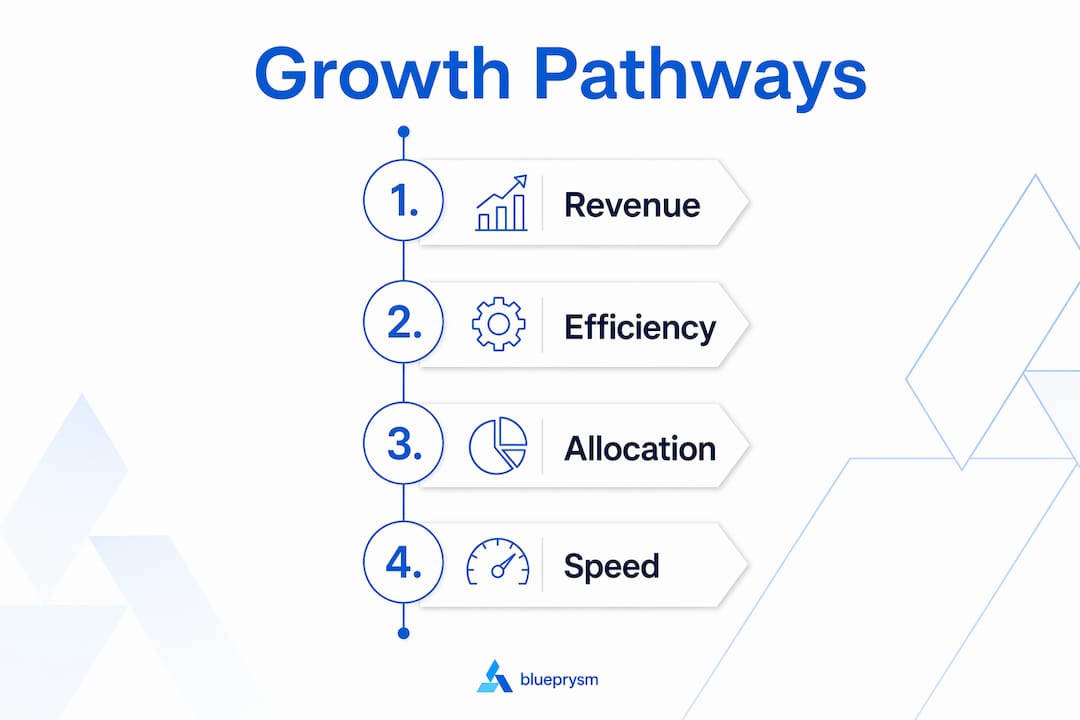
How intelligence drives growth: four pathways that actually move the needle
The mechanism matters as much as the outcome. Knowing that intelligence “improves decisions” is not enough to justify a budget line. Here is how each pathway converts insight into dollars or time saved, and which intelligence type primarily feeds it.
Revenue acceleration
Market and competitive intelligence identifies high-value customer segments, unmet demand, and pricing white space before competitors act. The mechanism: CI surfaces a signal (a competitor exits a segment, a demographic shows rising engagement), SI interprets the strategic implication, and the sales or marketing team executes a targeted GTM play. A company that spots a competitor’s pricing retreat two weeks before the market does can capture share at full margin rather than discounting defensively.

BI feeds this pathway too, by showing which existing customers have the highest lifetime value and lowest churn risk, so acquisition spend concentrates where it compounds.
Efficiency and cost relief
BI’s most immediate payoff is eliminating the manual reporting tax. A financial-sector case study comparing manual reporting, PL/SQL-based reporting, and a full BI solution showed measurable improvements in report access speed, internal sharing, and error rates at each step. The real win was not just speed; it was freeing analysts from data wrangling so they could spend time on interpretation. That shift alone changes the economics of an intelligence function.
Allocation quality
Capital allocation decisions, which markets to enter, which products to fund, which headcount to add, are where bad intelligence is most expensive. Strategic intelligence reduces allocation errors by grounding those decisions in validated external data rather than internal advocacy or the loudest voice in the room. When you can show the board a market-sizing model built on real demand signals rather than a TAM estimate from a pitch deck, the quality of the conversation changes.
Strategic speed under uncertainty
This is the pathway most leaders underestimate. Research framing intelligence as strategic infrastructure shows that the firms gaining the most from AI-enabled competitive intelligence are not necessarily the ones with the best models. They are the ones that have embedded intelligence outputs into operating decisions so that response time compresses. When a regulatory change lands or a competitor launches, an intelligence-ready organization already has a pre-built scenario and a decision owner. Everyone else is still in the data-gathering phase.
Pro Tip: Map each intelligence investment to one of these four pathways before you approve it. If you cannot articulate which pathway a new tool or hire serves, and how you will measure the outcome, it is a cost center, not a growth driver.
What does a real intelligence capability look like inside your organization?
Most SMBs have fragments: a Google Analytics account, a spreadsheet of competitor prices, a quarterly report someone builds in Excel. That is not an intelligence capability. It is a collection of data artifacts. Here is the architecture that turns fragments into a function.
Core technical components
- Data sources — internal systems (CRM, ERP, financial platforms) plus external feeds (market data, news APIs, regulatory filings, social listening)
- Ingestion and ETL — pipelines that extract, transform, and load data on a defined schedule or in real time, with validation rules that catch errors before they reach analysts
- Storage and warehouse — a centralized repository (cloud data warehouse or lakehouse) where data is queryable and auditable
- Analytics and models — descriptive, diagnostic, predictive, and prescriptive layers; augmented analytics tools that automate data prep and surface anomalies
- Visualization and reporting — dashboards and briefings calibrated to each audience layer (operational dashboards for managers, executive summaries for C-suite)
- Distribution and briefings — the delivery mechanism: who gets what, when, in what format, and with what recommended action attached
Intelligence maturity stages
| Stage | Label | What it looks like |
|---|---|---|
| 1 | Ad hoc | Reports built on request; no standard sources; heavy person-dependency |
| 2 | Integrated | Centralized data warehouse; standard dashboards; manual competitive monitoring |
| 3 | Automated | Scheduled pipelines; automated reporting; basic CI briefings; reduced manual effort |
| 4 | Predictive | Machine learning models for forecasting; scenario planning tools; proactive alerts |
| 5 | Decision-integrated | Intelligence embedded in decision workflows; Agentic AI triggers playbooks; full feedback loops |
Most SMBs sit at Stage 1 or 2. The goal for a 90-day pilot is to reach Stage 3 on at least one high-leverage decision domain.
Maturity checklist:
- Do you have a single source of truth for revenue, customer, and cost data?
- Are competitive signals collected systematically, or only when someone remembers to look?
- Do your dashboards reach the C-suite in a format they can act on, or do they require interpretation by an analyst?
- Are reports built by one person who would be a single point of failure if they left?
- Do you have any predictive models, even simple ones, informing your planning cycle?
If you answered “no” to three or more of these, you are at Stage 1 or 2, and the efficiency pathway alone justifies moving forward.
How to build an intelligence function in 90 days
The trap most leaders fall into is buying a platform before they have defined the question. Intelligence investments fail not because the technology is wrong but because the organizational scaffolding is missing. Here is a sequenced roadmap.
Days 0–30: Foundation
- Appoint an intelligence sponsor at the VP or C-suite level. This person owns the function’s mandate and escalation path. Without executive sponsorship, intelligence outputs get ignored.
- Run a data audit. Catalog every data source the business currently uses, who owns it, how often it is updated, and what decisions it informs. You will find gaps and redundancies.
- Define one high-leverage question. What is the single decision that, if made better, would have the largest revenue or cost impact in the next 90 days? That question becomes the pilot’s north star.
- Assess current person-dependency. Identify every report or analysis that lives in one person’s head or one person’s spreadsheet. That is your fragility map.
Days 31–60: Pilot
- Stand up a minimal data pipeline for the pilot question. You do not need a full data warehouse to start. A clean, validated feed into a visualization tool is enough to prove value.
- Deliver a first intelligence briefing to the C-suite. Format: headline finding, strategic implication, recommended action, confidence level, and data source. One page. No jargon.
- Assign roles. At minimum: an intelligence lead (owns the function), a data engineer or analyst (builds and maintains pipelines), and an analytics translator (converts outputs into decisions). In an SMB, one person may wear two of these hats.
- Establish a feedback loop. After each briefing, ask decision-makers: Was this useful? Did it change anything? That feedback shapes the next cycle.
Days 61–90: Scale and govern
- Automate the pilot pipeline so it runs without manual intervention.
- Expand to a second decision domain using the same process.
- Set governance basics: data quality standards, access controls, source vetting criteria, and an audit cadence.
- Measure pilot ROI against the KPIs defined in step 3 of the foundation phase.
Cost shape for SMBs: Cloud data warehouse costs (Snowflake, BigQuery, or Databricks) are consumption-based and can start under $500 per month for a small data footprint. BI visualization tools range from free tiers to a few hundred dollars per month. The largest cost is usually people: an analytics translator or intelligence lead. Platforms like Blue Prysm compress this cost by bundling market analysis, competitor tracking, and automated briefings into a single subscription, reducing the headcount required to reach Stage 3.
Common failure modes:
- Buying a platform before defining the question
- No executive sponsor, so outputs sit unread
- Trying to boil the ocean in month one instead of running a focused pilot
- Treating intelligence as an IT project rather than a strategy function
- Skipping the feedback loop, so the function drifts from what decision-makers actually need
Pro Tip: For SMBs that cannot modernize core systems immediately, Agentic AI layered over legacy data can provide cross-system intelligence without a full rip-and-replace. You get the output of a unified system without the 18-month migration project.
How do you know if your intelligence function is actually working?
Measuring intelligence ROI is where most organizations go soft. They track outputs (number of reports produced, dashboard views) rather than outcomes (decisions changed, revenue influenced). Here is a KPI framework tied to the four value pathways.
KPI table: leading and lagging metrics
| Value pathway | Leading metric | Lagging metric |
|---|---|---|
| Revenue acceleration | Time-to-insight on new market signals | Revenue growth from intelligence-led campaigns |
| Efficiency | Report build time (hours per cycle) | Analyst hours freed per month |
| Allocation quality | Decision lead time (days from signal to decision) | Capital misallocation rate (% of investments underperforming plan) |
| Strategic speed | Time from external event to briefing delivery | Competitive response time (days to counter a competitor move) |
Track at least one leading and one lagging metric per pathway you are investing in. Leading metrics tell you the function is working. Lagging metrics tell you it is creating value.
Practical measurement methods for SMBs:
- Pre/post comparison: Measure the same metric (report build time, decision lead time) before and after implementing a new intelligence process. Simple, credible, and easy to present to a board.
- Lift studies: For intelligence-led marketing campaigns, compare conversion rates in segments where intelligence was applied versus segments where it was not.
- Decision audit: Quarterly, review five major decisions and ask: Was intelligence used? Did it change the outcome? What was the estimated value of that change?
What a one-page executive intelligence report should contain
A good executive briefing is not a data dump. It has five elements:
- Headline impact — the single most important finding this cycle, stated in one sentence
- Strategic implication — what this means for the business in the next 30–90 days
- Recommended action — a specific, owner-assigned next step
- Confidence level — high, medium, or low, with a one-line rationale
- Next steps and open questions — what the intelligence team will monitor or investigate next
If your current reporting does not include all five, it is informing rather than advising. There is a difference.
What are the biggest risks in building an intelligence function?
Building an intelligence capability without governance is like installing a fire alarm with no batteries. The infrastructure looks right, but it will not work when you need it.
Top operational risks:
- Person-dependency: One analyst owns all the pipelines and institutional knowledge. They leave, and the function collapses. Automated, auditable pipelines are the fix.
- Information overload: Leaders receive too many signals with no prioritization. The result is analysis paralysis, not better decisions. Intelligence must be strategically placed, not just aggregated, so the right insight reaches the right decision layer.
- Signal noise: Low-quality data sources generate false signals that erode trust in the function. Once a leader acts on a bad signal and gets burned, rebuilding credibility takes months.
- Model drift: Predictive models trained on historical data degrade as market conditions change. Without monitoring, a model that was accurate six months ago may be actively misleading today.
- Bias in source selection: If your competitive intelligence only monitors the competitors you already know about, you will miss the disruptors coming from adjacent categories.
Governance checklist:
- Define data quality standards for every source (freshness, completeness, accuracy thresholds)
- Assign a named owner for each data pipeline and briefing
- Establish role-based access controls so sensitive competitive data does not circulate beyond its intended audience
- Set a quarterly audit cadence to review source quality, model performance, and briefing relevance
- Create a clear escalation path: which findings go directly to the CEO or board, and who makes that call?
Pro Tip: Run a “red team” exercise on your intelligence function every six months. Ask a skeptic on your leadership team to challenge the top three findings from the last quarter. If the function cannot defend its sources and methodology, it is not ready for high-stakes decisions.
What role does AI actually play in scaling intelligence?
AI does not replace an intelligence function. It scales one that already has the right process architecture underneath it. That distinction matters because a lot of leaders buy AI tools expecting them to create intelligence from scratch, and they are disappointed when the output is noisy or irrelevant. Research confirms that AI capability predicts competitive intelligence effectiveness only when it is embedded in CI processes and routines, not when it operates as a standalone tool.
With that framing in place, here is where AI genuinely earns its place:
High-value AI use cases across the intelligence lifecycle:
- Automated collection: AI agents monitor news feeds, regulatory databases, competitor websites, and social platforms continuously, flagging relevant signals without human curation effort
- NLP summarization: Large language models condense lengthy reports, earnings calls, or regulatory filings into executive-ready summaries in minutes rather than hours
- Predictive scoring: Machine learning models score leads, forecast demand, or flag churn risk based on behavioral patterns that humans would not detect manually
- Agentic AI for briefings and playbook triggers: The most advanced application. An Agentic AI system detects a predefined signal (a competitor drops pricing by more than 10%, a regulatory filing appears), generates a briefing, and triggers a pre-approved response playbook, all without waiting for a human to notice the signal. Blue Prysm’s Agentic AI layer at agentsente.blueprysm.com operates on this model.
- Augmented analytics: AI-assisted data preparation, anomaly detection, and visualization reduce the time from raw data to insight, compared with traditional BI workflows
Where human judgment must stay in the loop:
- Interpreting ambiguous signals where context and organizational knowledge matter
- Making final decisions on high-stakes capital allocation or strategic pivots
- Validating model outputs before they trigger irreversible actions
- Assessing source credibility for novel or unverified data streams
Guardrails for responsible AI use in intelligence:
- Set confidence thresholds: AI-generated briefings should carry a stated confidence level, and low-confidence outputs should require human review before distribution
- Require data provenance: every AI output should be traceable to its source data
- Schedule periodic human review of model assumptions and training data
- Prioritize explainability: if your leadership team cannot understand why the model flagged a signal, they will not act on it
Pro Tip: The advantages of AI-driven insights compound fastest when you treat AI as an analyst’s assistant, not a replacement. The analyst’s job shifts from data gathering to interpretation and decision support, which is where human judgment creates the most value.
What does the research actually say about intelligence and firm performance?
The evidence base for intelligence-driven growth is stronger than most practitioners realize, and it is worth knowing the specifics before you walk into a budget conversation.
A systematic review covering BI adoption studies from 2019 through 2025 found that organizations fully adopting and aligning BI to user needs reported productivity gains of up to 93% and profit increases of up to 65% in select cases. Those are ceiling figures from high-adoption environments, not averages, but they establish the upper bound of what is possible when the function is built correctly.
A separate empirical study published in the Journal of Intelligence Studies in Business found that AI capability predicts CI effectiveness with a path coefficient of β = 0.62 (p < .001), and CI effectiveness in turn predicts corporate growth with β = 0.51 (p < .001). The implication is direct: AI without CI process integration delivers weak results. CI without AI scales poorly. The combination, embedded in organizational routines, is what drives growth.
Research on employee BI experience adds a third dimension. Empirical work shows that employee BI experience materially moderates the relationship between BI infrastructure and organizational performance. Technology alone is insufficient. Training, adoption, and embedding intelligence outputs into daily workflows predict success more reliably than the sophistication of the tooling.
Blue Prysm in practice: A typical SMB using Blue Prysm’s platform starts with the market analysis module to answer one high-leverage question, such as which competitor segments are underserved or where pricing pressure is building. The platform’s 50+ strategy templates provide a structured framework for translating that analysis into a roadmap. Automated competitive intelligence briefings replace the manual monitoring that would otherwise require a dedicated analyst. Within a 30–90 day pilot, leaders typically have a validated market position, a competitor tracking cadence, and a set of OKRs tied to the intelligence outputs, all without hiring a full intelligence team.
Three research-backed takeaways to apply immediately:
- Embed intelligence outputs into existing decision workflows rather than creating a separate reporting layer. Adoption follows utility.
- Invest in training before tooling. Employee BI experience is a stronger predictor of performance impact than the platform itself.
- Start with cost-effective intelligence focused on one high-leverage question. Pilots that try to answer everything answer nothing.
Key Takeaways
Intelligence creates measurable business growth through four pathways: revenue acceleration, efficiency, allocation quality, and strategic speed, and the organizations that sustain those gains treat intelligence as permanent infrastructure, not a one-off project.
| Four value pathways | Intelligence drives growth through revenue acceleration, efficiency, allocation quality, and strategic speed under uncertainty.
| Evidence base | BI adoption studies report productivity gains up to 93% and profit increases up to 65% in fully aligned implementations. |
| AI requires process | AI predicts CI effectiveness (β = 0.62) only when embedded in CI routines; standalone AI tools deliver weak strategic results. |
| 90-day pilot approach | Start with one high-leverage question, appoint an executive sponsor, and measure pre/post outcomes before scaling. |
| Blue Prysm fit | Blue Prysm’s Agentic AI platform bundles market analysis, competitor tracking, and strategy templates for SMBs, compressing the time and headcount needed to reach intelligence maturity Stage 3. |
30–90 day checklist for leaders:
- Days 0–30: Appoint an intelligence sponsor; run a data audit; define one high-leverage pilot question; map person-dependencies
- Days 31–60: Stand up a minimal data pipeline; deliver a first executive briefing; assign intelligence roles; establish a feedback loop
- Days 61–90: Automate the pilot pipeline; expand to a second decision domain; set governance basics; measure pilot ROI against pre-defined KPIs
The uncomfortable truth about intelligence investments
There is a pattern worth naming. Leaders who invest in intelligence and see no return almost always made the same mistake: they bought a tool and called it a strategy. They stood up a dashboard, pointed at it in a board meeting, and waited for growth to follow. It does not work that way.
The organizations that get real value from intelligence, the ones where it genuinely changes decisions and compounds over time, treat it as a cultural shift first and a technology investment second. They appoint a sponsor who has skin in the game. They define the question before they select the platform. They measure outcomes, not outputs. And they are ruthless about cutting intelligence that does not connect to a decision.
The shiny-object problem is real in this space. Every year brings a new category of tool promising to “unify your data” or “surface hidden insights.” Most of them are solving a data engineering problem, not a strategy problem. The test is simple: can you trace a line from this tool’s output to a specific decision that changed, and from that decision to a revenue or cost outcome? If not, it is infrastructure spending dressed up as strategy.
On Agentic AI specifically: the capability is real and the use cases are compelling, but the guardrails matter. An Agentic AI system that triggers a competitive response playbook without a human review step is a liability, not an asset. The right model is human-in-the-loop for high-stakes decisions, with automation handling the sensing, summarizing, and alerting. That is where AI-powered intelligence for business strategy earns its place: compressing the time from signal to briefing, not replacing the judgment that follows.
The leaders who get this right are not the ones with the biggest data budgets. They are the ones who ask better questions.
Blue Prysm gives SMB leaders a faster path to intelligence maturity
Most SMBs cannot afford to hire a dedicated intelligence team, build a custom data warehouse, and run a six-month implementation before seeing any return. That is the traditional consulting model, and it is priced for enterprises. Blue Prysm is built for the leader who needs the output of that capability without the overhead.
The platform’s Agentic AI engine handles automated market analysis, competitor tracking, and briefing generation, so your team spends time on decisions rather than data collection. The market analysis platform delivers real-time insights calibrated to your competitive context. The strategy library gives you 50+ frameworks, from SWOT to Porter’s Five Forces, so you are not starting from a blank page. Execution dashboards and OKR tracking close the loop between intelligence and action.
For leaders ready to run a 30–90 day pilot, the starting point is straightforward: pick your high-leverage question, connect your primary data sources, and let the platform surface the first briefing. For teams that want a faster start with expert guidance, Blue Prysm’s AI strategy consulting option pairs the platform with a white-glove engagement to accelerate setup and pilot KPI selection.
Start your pilot at blueprysm.com or book a consulting session to define your first high-leverage intelligence question.
Useful sources
The sources below are the primary research and practitioner references cited in this article. They are selected for methodological rigor (systematic reviews, empirical studies, and expert practitioner analysis) rather than promotional content.
| Source | Type | Best used for |
|---|---|---|
| Business Intelligence Impact: Systematic Review, IJ-ICT | Systematic review (2019–2025) | Quantifying BI productivity and profit impact; justifying investment |
| AI and Competitive Intelligence for Corporate Growth, JISIB | Empirical study | Understanding AI-CI integration and path coefficients to growth |
| BI Impact in Financial Sector, MDPI | Case study | Implementation evidence; automation and error reduction |
| Employee BI Experience and Performance, MDPI | Empirical study | Training and adoption planning; culture as a moderator |
| Strategic Intelligence for Executives, KCSI | Practitioner analysis | C-suite placement of intelligence; avoiding groupthink |
| AIECI and Economic Value Creation, Iberoamericanic | Qualitative comparative case study | Four value pathways; intelligence as strategic infrastructure |
| Agentic AI over Legacy Systems, SST Cloud | Technical practitioner brief | Pragmatic AI layering for SMBs without full system migration |
| Cost-Effective Intelligence Guide, Blue Prysm Blog | Practitioner guide | Pilot-first adoption; high-leverage question selection |
| Blue Prysm Market Analysis Platform | Product resource | Platform capabilities and next steps for SMB leaders |
Sources were selected to represent systematic evidence, empirical findings, and practitioner implementation guidance across the full intelligence lifecycle.
FAQ
What is the role of business intelligence in business growth?
Business intelligence converts operational data into decisions that reduce cost, accelerate revenue, and improve capital allocation. Organizations that fully align BI to user needs have reported productivity gains up to 93% and profit increases up to 65% in documented adoption studies.
What are the five components of a business intelligence capability?
The core components are data sources, ingestion and ETL pipelines, a centralized data warehouse, analytics and modeling tools, and visualization and distribution mechanisms. Each layer must be in place for intelligence to reach decision-makers reliably.
What are the five stages of business intelligence maturity?
The five stages run from ad hoc (reports on request, heavy person-dependency) through integrated, automated, and predictive, to decision-integrated, where intelligence is embedded in workflows and Agentic AI can trigger response playbooks automatically.
What is the role of AI in business growth?
AI scales an intelligence function by automating data collection, summarization, and predictive scoring, but it only drives growth when embedded in competitive intelligence processes and organizational routines. Research shows AI capability predicts CI effectiveness with a path coefficient of β = 0.62, which in turn predicts corporate growth at β = 0.51.
How does Blue Prysm help SMBs build an intelligence function?
Blue Prysm’s Agentic AI platform bundles market analysis, automated competitive intelligence briefings, a 50+ strategy framework library, and execution dashboards into a single subscription, giving SMB leaders the output of a full intelligence team without the headcount or implementation timeline of a traditional consulting engagement.