


Decision support is software and structured methods that help executives pick the best course of action by combining data, analytical models, and explainable guidance. It does not make decisions for you. It structures messy problems, runs the numbers on competing options, and surfaces the reasoning so you can own the call. For SMB leaders using AI-enhanced platforms, that distinction matters: you stay in charge, and the system amplifies your judgment rather than replacing it.
Every effective decision support system integrates three components:
- Database management (DBMS): the data foundation that ingests internal and external sources
- Model management: the analytics, optimization, and simulation engine
- Dialogue/UI layer: the interface that delivers explainable recommendations executives can actually act on
Pro Tip: Before evaluating any platform, pilot the dialogue layer first. If you cannot trace a recommendation back to its inputs in under two minutes, the tool will not get adopted.
What do decision support systems actually do for your team?

The outputs executives should expect are concrete: ranked options with supporting rationale, what-if scenario results, resource-allocation tradeoffs, and competitor alert briefings. These are not dashboards you scroll through after a meeting. They are inputs you bring into the meeting.
In practice, a CEO might use a DSS on Monday morning to run three pricing scenarios before a board call. A CFO uses it mid-quarter to model headcount tradeoffs against revenue targets. A head of strategy pulls a competitor briefing before a GTM planning session. The decision cycle compresses from days to hours.
DSS is especially valuable for strategic and tactical decisions that are lower frequency but higher consequence, where the cost of a wrong call is real and modeling time pays off. These are not the operational decisions your systems already automate. They are the ones where gut feeling and a spreadsheet have historically been your only tools.
How the three DSS components work together
The canonical DSS architecture centers on three integrated components, and understanding how data flows between them helps you ask sharper questions of any vendor.
- Ingest: Raw data enters the DBMS from internal systems (CRM, ERP, financials) and external sources (market data, competitor signals, industry benchmarks).
- Model: The model management layer runs analytical routines, optimization algorithms, and simulations against that data.
- Explain and act: The dialogue/UI layer translates model outputs into ranked recommendations, scenario comparisons, and explainability artifacts that executives can interrogate and act on.
| Component | Executive question it answers | Sample output |
|---|---|---|
| Database management | “What data do we have and is it reliable?” | Unified data pipeline, KPI registry |
| Model management | “What are the likely outcomes of each option?” | Scenario forecasts, optimization scores |
| Dialogue/UI layer | “Why is this the recommended path?” | Ranked options with variable weights shown |
Modern AI decision support platforms add MLOps and explainability layers on top of this foundation, so the system can version models, flag when a model drifts, and show executives exactly which variables drove a recommendation.
How does DSS differ from the BI tools you already use?
Business intelligence tells you what happened. Decision support tells you what to do next and why. That is not a subtle upgrade; it is a fundamentally different job.
Your BI stack produces descriptive reports: revenue by region last quarter, churn rate this month, pipeline by stage. Useful, but backward-looking. A DSS moves from descriptive analytics toward prescriptive recommendations and what-if scenario gaming. It takes the same data and asks: given these trends, which of three pricing moves produces the best margin outcome under each demand scenario?
The functional differences to test during a vendor demo:
- Does it generate a ranked recommendation, or just a chart?
- Can you change an assumption and see the outcome update in real time?
- Does it show you why it ranked option A above option B?
- Is there an action layer that connects the recommendation to your OKRs or execution plan?
Pro Tip: Ask the vendor to show you a “why” explanation for their top recommendation. If they show you another chart instead of a variable-weight breakdown, you are looking at BI with a new label, not a true DSS.
Why SMBs should care: benefits and real use cases
The primary business outcomes are faster decisions, fewer costly errors, and a repeatable strategy process that does not live inside one person’s head. For SMBs, that last point is underappreciated. When your strategy lives in the CEO’s gut, it does not scale and it does not survive leadership transitions.
Concrete use cases where DSS pays off for SMB teams:
- Scenario planning: Model three revenue trajectories before committing to a hiring plan
- Pricing optimization: Test price elasticity assumptions against margin targets before a product launch
- Resource allocation: Compare ROI across competing initiatives when budget is constrained
- Competitor tracking: Receive automated briefings on competitor moves and market shifts so GTM timing is based on signals, not guesses
- Go-to-market timing: Combine market readiness data with internal capacity to pick the right launch window
DSS platforms that formalize KPIs and decision criteria into an interactive system reduce decision inconsistency and raise organizational alignment. The CFO and the head of product are working from the same scenario, not competing spreadsheets.
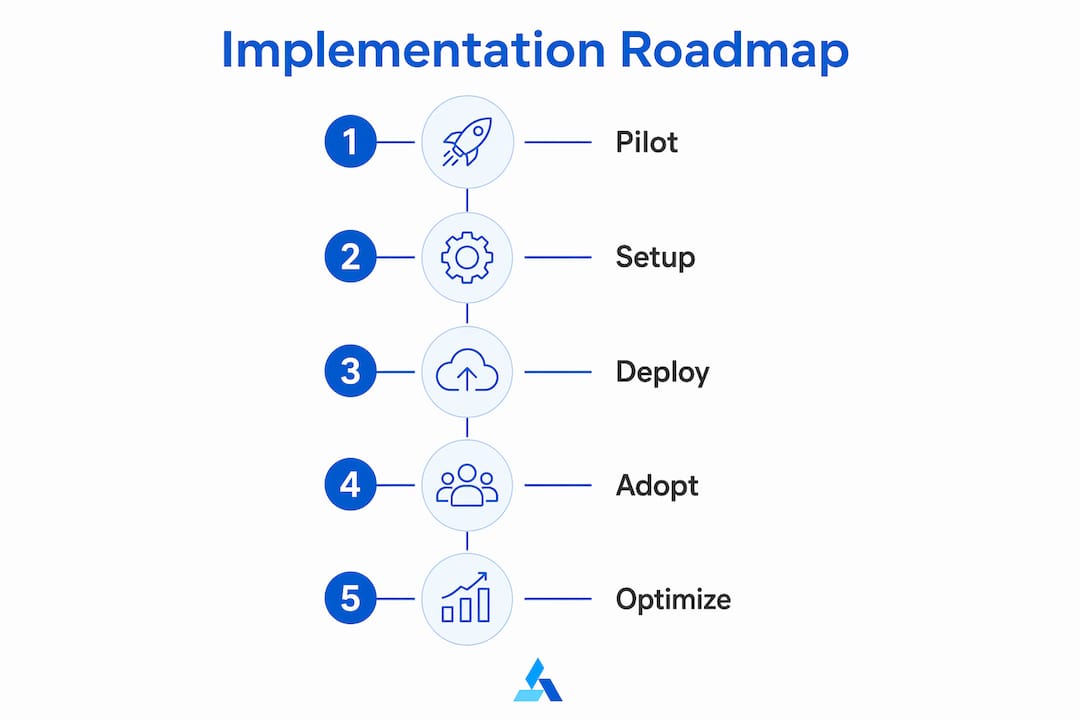
How to implement decision support: a practical roadmap
Answer first: the minimum viable pilot is one decision domain, one clear question, two to three data owners, and one success metric. Do not try to boil the ocean.
Preconditions before you start:
- Standardize your core KPIs across teams (revenue, margin, churn, CAC at minimum)
- Audit data hygiene in the domain you plan to pilot; clean data pipelines are mandatory before reliable outputs are possible
- Secure executive sponsorship at the CEO or COO level
- Map integration requirements to your existing CRM, ERP, or data warehouse
| Phase | Timeline | KPIs to track |
|---|---|---|
| Pilot | — | Decision cycle time, adoption rate, data coverage |
| Scale | — | Error/rework reduction, revenue lift, cost avoidance |
| Optimize | — | ROI calculation, model accuracy, strategic alignment score |
Cost buckets vary by scope, but expect internal implementation time, platform licensing, and consulting or change management support as the three main line items. Change management is the one SMBs most often cut and most often regret.
Risks and vendor questions you should not skip
DSS amplifies decisions, which means it also amplifies bad inputs. The core risks are data quality, model bias, black-box recommendations, vendor lock-in, and security exposure. None of these are reasons to avoid DSS. They are reasons to go in with your eyes open.
Key risks to evaluate:
- Data quality: Garbage in, garbage out. A DSS built on inconsistent KPIs produces confident-sounding wrong answers.
- Model bias: Historical data encodes past decisions. If your past pricing favored one segment, the model will too, unless you audit it.
- Black-box recommendations: Executives will not trust what they cannot explain. Explainability is a mandatory adoption requirement, not a nice feature.
- Vendor lock-in: Ask about data portability and API openness before signing.
- Security and privacy: Confirm where your data is stored, who can access it, and what the breach notification SLA is.
Questions to ask every vendor: How do you handle data lineage? Can you show me an explainability artifact for a recommendation? What is your model versioning and governance process? What are the integration costs beyond the license fee? Understanding model-agnostic approaches to AI architecture can help you evaluate whether a vendor’s stack is flexible or locked to one engine.
Include change management and adoption as explicit line items in your evaluation scorecard. A platform nobody uses is not a DSS; it is an expensive dashboard.
How Blue Prysm maps to the DSS architecture for SMBs
Blue Prysm’s platform aligns directly with the three-component DSS model, built for the SMB executive workflow rather than enterprise IT teams.
- Data layer (DBMS): Real-time market analysis and automated competitive intelligence briefings feed a continuously updated data foundation
- Model layer: AI models score opportunities, run scenario comparisons, and surface ranked strategic options across pricing, GTM, and resource decisions
- Action/explainability layer: A strategy library with 95+ frameworks, OKR and KPI tracking, and execution dashboards translate model outputs into decisions executives can own and explain to their boards
“The most common failure we see in SMB strategy isn’t a lack of data. It’s the absence of a structured process for turning data into a decision. Blue Prysm is designed to close that gap — not by automating the call, but by making the reasoning visible and the options comparable.”
Key Takeaways
Decision support systems give SMB executives a structured, repeatable process for turning data into defensible decisions, and the three-component architecture (data, model, action) is what separates a true DSS from a BI dashboard.
| Point | Details |
|---|---|
| DSS amplifies judgment | It structures problems and surfaces reasoning; executives own the final call. |
| Three components are non-negotiable | DBMS, model management, and a dialogue/UI layer must all be present and integrated. |
| Clean data comes first | Standardize KPIs and audit data hygiene before deploying any modeling layer. |
| Explainability drives adoption | If executives cannot trace a recommendation to its inputs, they will not trust or use it. |
| Blue Prysm for SMB pilots | Blue Prysm maps all three DSS components to SMB workflows, with a strategy library and execution dashboards built in. |
The gap most SMBs never close
The honest observation from watching SMB strategy initiatives play out: most teams already have enough data. What they lack is a structured way to reason about it together. A DSS does not solve a data problem. It solves a reasoning problem, and that is a harder sell internally because it requires admitting that your current decision process is ad hoc.
The leaders who get the most out of decision support are the ones who embed it into a recurring review cadence, tie every recommendation to an OKR, and treat the explainability artifact as a required deliverable before any major call. That discipline is what separates a DSS that gets used from one that gets abandoned after the pilot.
If you are sponsoring a DSS initiative, your job is not to pick the best tool. It is to create the conditions where the tool gets used consistently. That means owning the change management, not delegating it.
Blue Prysm gives SMB executives a faster path to a working pilot
Most SMB teams spend the first three months of a DSS initiative just trying to agree on which data to trust. Blue Prysm’s market analysis platform shortens that runway by combining real-time market data, automated competitor tracking, and a 95+ framework strategy library into a single platform built for executive workflows, not IT projects. You get scenario testing, OKR tracking, and explainable recommendations without standing up a data warehouse first.
The next step is straightforward: run one decision through the platform before your next quarterly review. Blue Prysm’s team can scope a pilot around a single strategic question your leadership team is already debating. Request a demo at blueprysm.com/market-analysis-platform and have a working pilot scoped within a week.
Useful sources
- Decision support system — Wikipedia: Foundational overview of DSS history, types, and architecture; useful for definitional grounding.
- Decision Support Systems — foundational paper: Original academic framing of the three-component architecture and implementation preconditions.
- Decision Support System | IEEE Technology Navigator: IEEE-sourced definition covering semistructured and unstructured decision problems.
- What is a DSS? — TechTarget: Practical enterprise definition covering types and business applications.
- Decision Support System — Investopedia: Business-oriented summary of DSS purpose, outputs, and management use cases.
- AI Decision Support Systems — SPD Technology: Practitioner guide to AI-specific layers including explainability and MLOps requirements.
- Decision Support System — Qlik: Covers the shift from descriptive BI to prescriptive DSS and scenario gaming.
- Blue Prysm — How It Works: Platform architecture overview mapping DSS components to SMB executive workflows.
FAQ
What is decision support in simple terms?
Decision support is a system that combines your data, analytical models, and explainable guidance to help executives choose the best course of action. It structures the problem and surfaces the reasoning; the leader makes the final call.
How does a DSS differ from business intelligence?
BI describes what happened. A DSS recommends what to do next, runs what-if scenarios, and explains why one option ranks above another. The shift is from descriptive to prescriptive analytics.
What are the three core components of a decision support system?
Every effective DSS integrates a database management system (data foundation), a model management layer (analytics and simulation), and a dialogue/UI layer that delivers explainable recommendations executives can act on.
When does decision support make sense for an SMB?
DSS pays off most on high-consequence, lower-frequency decisions: pricing strategy, resource allocation, scenario planning, and GTM timing. For routine operational decisions, standard automation is usually sufficient.
How does Blue Prysm support decision support for SMBs?
Blue Prysm maps directly to the three DSS components, combining real-time market analysis, AI-driven scenario modeling, and a 95+ framework strategy library with OKR tracking and execution dashboards built for SMB executive teams.
Recommended
- Master the business decision making process for smarter growth – Articles & Blogs
- Unlock the power of decision intelligence for SMEs – Blue Prysm – Articles & Blogs
- Decision-making best practices for smarter business moves – Blue Prysm – Articles & Blogs
- Examples of Business Decision Tools for Smarter Strategy