


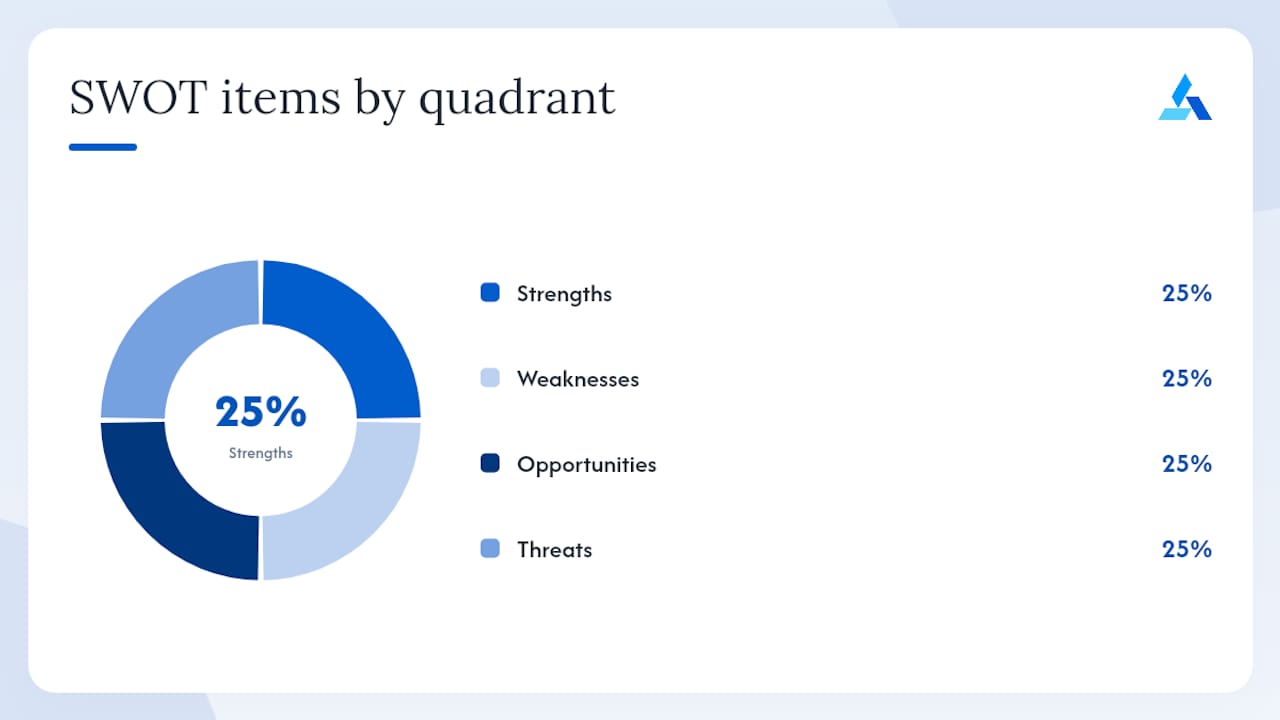
Your startup SWOT analysis list should cover eight core items across four quadrants: team depth and IP (strengths), runway and skill gaps (weaknesses), underserved market segments and partnership channels (opportunities), and regulatory shifts plus well-funded competitors (threats). That is the minimum viable grid. Run it in a 60–90 minute workshop this week, assign one owner per item, and you have a working strategy document, not a slide deck nobody reads.
Here is a quick-start list you can drop straight into any SWOT grid:
- Strength: Founding team’s domain expertise (back it with years of experience or prior exits)
- Strength: Early traction or product-market signal (cite a retention rate, NPS, or revenue figure)
- Weakness: Runway under one year without a clear plan for the next funding round
- Weakness: Dependency on a single acquisition channel that provides the majority of leads
- Opportunity: Regulatory change opening a previously closed market segment
- Opportunity: Underserved customer cohort your top competitor ignores
- Threat: A well-capitalized incumbent moving into your category
- Threat: Key-person risk on a technical co-founder with no succession plan
Mini SaaS micro-SWOT example:
| Quadrant | Item |
|---|---|
| Strength | Onboarding converts significantly higher than the category average, as measured via Mixpanel |
| Weakness | No dedicated customer success function; churn rising past month 3 |
| Opportunity | Mid-market segment willing to pay substantially more than the current SMB base |
| Threat | An incumbent announced a competing feature recently at a major conference |
Pro Tip: Assign a single “SWOT owner” before the session ends. That person’s job is to schedule the next review and track whether each item moved. Without an owner, the grid collects dust.
What a startup SWOT analysis actually solves (and when to run one)
SWOT stands for Strengths, Weaknesses, Opportunities, and Threats. The internal half (strengths and weaknesses) reflects what your company controls today. The external half (opportunities and threats) reflects what the market is doing whether you like it or not. For a startup, that distinction matters because your internal picture changes fast and your external picture is often poorly understood.
Most early-stage founders run SWOT once, file it, and forget it. That is the wrong model. A startup SWOT should function as a living strategic document revisited at four key moments: before launch, before a fundraising round, when growth stalls, and at each quarterly planning cycle. Each moment surfaces different risks and different leverage points.
SWOT is not a competitive analysis, though the two feed each other. Competitive analysis tells you what rivals are doing. SWOT tells you whether you have the internal capacity to respond. Run them together and you get a complete picture. Run only one and you are flying with half your instruments.
Who belongs in the room and what data to bring
The right attendees for a startup SWOT workshop are: the founder(s), the product lead, the growth or marketing lead, the finance owner (even if that is the founder wearing a second hat), and at least one customer-facing team member who hears objections daily. An external advisor, a board member, or a trusted investor adds adversarial perspective that internal teams often lack.
Roles matter as much as attendance. Designate a facilitator who keeps the conversation moving and prevents the loudest voice from dominating. Assign a scribe to capture items verbatim. Identify a data owner for each quadrant who brings evidence rather than opinion.
The data to bring, drawn from due diligence readiness frameworks, includes:
- Usage and engagement metrics (DAU/MAU, activation rate, feature adoption)
- CAC and LTV estimates, even rough ones
- Customer feedback verbatims (support tickets, NPS comments, churn exit surveys)
- Current runway and monthly burn rate
- Any signed contracts, LOIs, or partnership signals
- Legal or regulatory items (pending IP filings, compliance gaps, data agreements)
Send these as a pre-read 48 hours before the session. Teams that arrive with evidence produce specific, defensible SWOT items. Teams that arrive cold produce vague ones that satisfy no investor and guide no decision.
How to score and prioritize your SWOT items
A long SWOT list with no ranking is just a list. Scoring converts it into a priority queue.
Impact × Effort (0–5 scale): Rate each item on how much impact addressing it would have (0 = negligible, 5 = company-defining) and how much effort it requires (0 = trivial, 5 = months of work). Multiply the two scores. High-impact, low-effort items go first.
Probability × Impact for external items: For opportunities and threats, replace “effort” with “probability.” A high-probability, high-impact threat demands immediate attention. A low-probability, high-impact threat goes on a watch list.
| SWOT Item | Impact (0–5) | Effort/Probability (0–5) | Score | Priority |
|---|---|---|---|---|
| Single-channel dependency (W) | 5 | 2 | 10 | Immediate fix |
| Mid-market expansion (O) | 4 | 3 | 12 | Short-term experiment |
| Incumbent feature launch (T) | 4 | 4 | 4–5 | Watch + defensive play |
| IP filing gap (W) | 3 | 2 | 6 | Schedule this quarter |
| Partnership channel (O) | 3 | 3 | 9 | 60-day experiment |
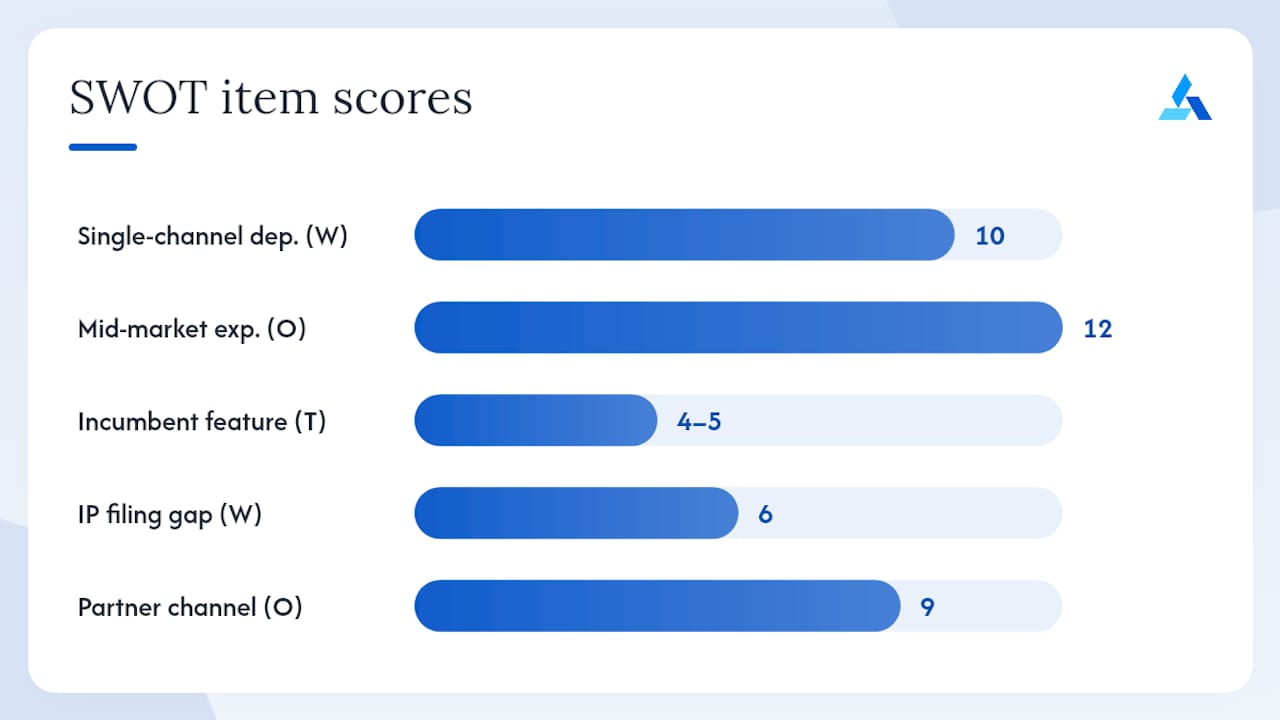
Items scoring above 10 become experiments or immediate fixes. Items scoring 5–9 go on a 90-day monitor list. Items below 5 get dropped or revisited next quarter. This keeps the team focused on what actually moves the needle rather than what feels urgent in the moment.
For SaaS startups specifically, churn-related weaknesses almost always score high because reducing churn in self-service models compounds faster than acquiring new customers.
Ready-to-use SWOT lists for four common startup types
Adapt these templates by stage. A pre-seed startup should weight weaknesses and threats heavily because the unknowns dominate. A seed-stage startup should weight opportunities and the SO plays that justify the raise. A growth-stage startup should weight threats and WT survival priorities as competition intensifies.
Templates work best when adapted rather than copied verbatim. Use these as a starting grid, then replace each item with your own evidence.
SaaS Startup
- S: Proprietary onboarding flow with measurable activation lift
- S: Founding team with prior SaaS exits
- W: No enterprise security certifications (SOC 2 pending)
- W: Single-channel acquisition (paid search)
- O: Mid-market segment with higher willingness to pay
- O: API integration partnerships with adjacent tools
- T: Incumbent adding a competing feature
- T: Rising CAC in paid channels
Marketplace Startup
- S: Supply-side density in two anchor cities
- S: Proprietary matching algorithm with measurable quality lift
- W: Demand-side CAC 4× higher than supply-side
- W: No brand recognition outside anchor markets
- O: Vertical expansion into adjacent category
- O: B2B licensing of matching technology
- T: Well-funded horizontal marketplace entering the vertical
- T: Regulatory classification risk for gig workers
Hardware Startup
- S: Patented core component with 18-month manufacturing lead
- S: Signed LOI from a distribution partner
- W: 14-month production lead time limits iteration speed
- W: COGS leaves thin margin at current volume
- O: Government procurement program opening in Q3
- O: White-label licensing to OEM partners
- T: Component supply chain concentration in one region
- T: Competing product announced at CES with lower price point
Consumer App
- S: Viral coefficient above 1.2 (organic growth loop working)
- S: Category-leading app store rating (4.8, 12,000+ reviews)
- W: Monetization not yet proven; free-to-paid conversion below 3%
- W: iOS-only; Android market untapped
- O: Creator economy partnership for content distribution
- O: Brand licensing for physical product line
- T: Platform algorithm change reducing organic reach
- T: Privacy regulation tightening data collection for ad targeting
Editable template fields:
| Field | Your Entry | Evidence Required | Score |
|---|---|---|---|
| Strength 1 | Metric or contract | ||
| Strength 2 | Metric or customer quote | ||
| Weakness 1 | Data or gap analysis | ||
| Weakness 2 | Benchmark or audit | ||
| Opportunity 1 | Market signal or research | ||
| Opportunity 2 | Customer interview or trend | ||
| Threat 1 | Competitor move or regulatory signal | ||
| Threat 2 | Risk assessment or legal review |
How Blue Prysm makes your SWOT workflow repeatable
Running a SWOT workshop once is useful. Running one every quarter, with consistent data, scoring, and experiment tracking, is what actually compounds into a competitive advantage. That is where most founding teams fall apart: the second and third SWOT sessions never happen because there is no system holding the process together.
Blue Prysm’s strategy library includes SWOT and TOWS templates founders can load directly, pre-populated with the evidence fields and scoring columns from this article. The platform’s Agentic AI tools pull automated market signals, so your external quadrant (opportunities and threats) updates between sessions rather than going stale.
The workflow looks like this: import your workshop outputs into Blue Prysm, and the Agentic AI suggests TOWS pairings based on your scored items. Each pairing becomes an experiment card with a hypothesis, a metric, and an owner assignment linked to your OKR or KPI dashboard. When conditions change, the platform flags which SWOT items need revisiting.
Before committing runway to any experiment, founders can run the Puffery Detector to strip unsupported claims from their strength list and the Venture Quick Score to rank experiments by potential impact. Both tools are available at agentsente.blueprysm.com.
Pro Tip: Use the Puffery Detector on your investor deck’s “Why Us” section before your next pitch. Founders are often shocked by how many of their stated strengths dissolve under scrutiny. Fix them before the investor does.
[Author credentials: Colin Bowdery, ]
Key Takeaways
A startup SWOT analysis list produces real outcomes only when every item is evidence-backed, scored for impact, and converted into an owner-assigned experiment within 48 hours of the workshop.
| Point | Details |
|---|---|
| Eight core items minimum | Cover two items per quadrant: team/IP (S), runway/channel gaps (W), segments/partnerships (O), incumbents/regulation (T). |
| Evidence-only rule | Every SWOT item needs a metric, a customer quote, or a contract — vague claims mislead the team and fail investor scrutiny. |
| Score before you act | Use impact × effort scoring (0–5) to rank items; address scores above 10 first, monitor 5–9, drop below 5. |
| TOWS converts diagnosis to action | Cross SWOT quadrants into SO/ST/WO/WT plays; run no more than two active experiments at a time. |
| Blue Prysm keeps it repeatable | Blue Prysm’s strategy library and Agentic AI tools automate TOWS suggestions, experiment tracking, and quarterly SWOT updates. |
The part most founders skip
Most founders treat SWOT as a one-time credentialing exercise. They run it before a fundraise, show it to investors, and never look at it again. The result is a grid that accurately described the company six months ago and is now actively misleading the team.
The founders who get real value from SWOT are the ones who treat it as a feedback loop. They run the workshop, assign owners, run two experiments, measure the outcomes, and then update the grid. After three months of that cycle, the SWOT is not a snapshot. It is a record of what the company learned and what it changed because of that learning. That record is what investors actually want to see: not a polished grid, but evidence that the team responds to reality.
The TOWS matrix is where that discipline shows up most clearly. When a founder can say “We identified this threat in Q1, we ran a defensive experiment in Q2, and here is the metric that moved,” that is a fundraising narrative. A static grid is not.
Blue Prysm turns your SWOT workshop into a system
Running a SWOT workshop is the easy part. The hard part is making it repeatable, keeping the data current, and ensuring the experiments you commit to actually get tracked. That is the gap between founders who use SWOT as a growth tool and those who use it as a filing exercise.
Blue Prysm gives you a pre-built SWOT and TOWS template library, automated competitive intelligence briefings that keep your threat quadrant current, and an experiment tracking dashboard that links each TOWS play to your OKRs. The Agentic AI tools at agentsente.blueprysm.com run Puffery Detector and Venture Quick Score checks so you commit runway to ideas that hold up under scrutiny, not ones that sound good in a workshop. Start your first repeatable SWOT session with Blue Prysm’s strategy framework library and run your next workshop in under 90 minutes.
Useful sources and further reading
These resources are worth bookmarking at different stages of your SWOT journey:
- How to Do a SWOT Analysis for Your Startup (With Examples) – DEV Community
- How to do a SWOT analysis of a startup | Jotform Blog
- SWOT Analysis for Startups | Practical Strategy Guide
- SWOT Analysis Examples: From Small Businesses to …
- Startup Due Diligence Checklist: 47 Must-Ask Questions
- 10 Examples of Effective SWOT Analysis for Startups
- What Is SWOT Analysis? A Complete Guide for Early-Stage Founders | KodeKam
- SWOT Analysis for Startups That Turns Insights Into Growth
FAQ
What should every startup SWOT analysis list include?
At minimum: two evidence-backed strengths (team, IP, or traction), two specific weaknesses (runway, skill gaps, or channel dependency), two external opportunities (market segments or partnerships), and two credible threats (competitors or regulatory risks). Every item needs a supporting metric or data point.
How often should a startup revisit its SWOT analysis?
Quarterly is the baseline cadence, with additional sessions before a fundraise, before launch, and whenever growth stalls for two or more consecutive months.
What is the difference between SWOT and TOWS for startups?
SWOT diagnoses your position; TOWS prescribes your moves. TOWS crosses your strengths and weaknesses against your opportunities and threats to generate four types of strategic plays: SO (growth), ST (defensive), WO (fix-first), and WT (survival).
How do you turn a startup SWOT into investor-ready evidence?
Score each item using impact × effort (0–5), assign an owner and a metric to the top-ranked items, run experiments, and document the outcomes. Investors want to see that the team responded to its own analysis, not just that the analysis exists.
Can Blue Prysm automate parts of the SWOT process?
Yes. Blue Prysm’s Agentic AI tools auto-suggest TOWS pairings from your scored SWOT items, pull competitive intelligence to keep the threat quadrant current, and track experiments against OKRs. The Puffery Detector and Venture Quick Score help founders validate strengths and rank experiments before committing resources.