
Run OKRs on five layers, not one: annual direction, quarterly goals, a mid-quarter reset, and weekly check-ins, with daily huddles reserved for teams already drowning in dependencies. That stack is what turns a quarterly document nobody reads into work you actually steer. Your next move is simple: put a planning workshop on the calendar for four weeks out, and add a recurring weekly check-in to every OKR owner’s calendar today.
TL;DR:
- Teams should implement a five-layer OKR cadence, including annual, quarterly, mid-quarter, weekly, and daily reviews, to prevent drift and improve tracking.
- A four-week planning process involving leadership framing, team drafting, dependency negotiation, and final approval ensures clearer, more accountable OKRs.
- Weekly check-ins, limited to 15-20 minutes, are crucial for maintaining momentum and catching issues early, especially when tied to a regular decision-making process.
- The mid-quarter reset is essential for re-baselining or closing at-risk key results, and it must be a documented, decision-driven event to prevent silent abandonment.
- Automating reminders, dashboards, and templates with dedicated OKR tools enhances discipline and ensures consistent adherence to the five-layer system.
What Are the Five Layers of OKR Cadence Planning?
Most OKR programs fail for a boring reason: they compress five distinct jobs into one meeting. An OKR cadence is a stack of review layers, and each layer answers a different question. Collapse them into a single quarterly review and you get drift, because nobody catches a stalled key result until it’s too late to fix.
Here’s what each layer actually owns:
- Annual: Leadership sets direction, usually once a year, and this is where the company’s North Star gets translated into a handful of strategic bets.
- Quarterly: Teams set and score OKRs on a roughly 13-week rhythm, the most common default because it’s long enough to produce real outcomes and short enough to stay honest.
- Mid-quarter: A hard decision checkpoint, typically week six or seven, where every key result gets one of a few verdicts: re-baseline it, de-scope it, escalate it, or close it.
- Weekly: A 15 to 20 minute steering meeting, attended by OKR owners, that keeps momentum visible before problems calcify.
- Daily: Reserved for teams with tight operational dependencies. For most knowledge-work teams, daily OKR talk just adds noise on top of existing stand-ups.
The weekly layer carries outsized weight. Teams that check in weekly complete roughly 43% more OKRs than teams that only review monthly or ad hoc. That gap isn’t about motivation. It’s about recoverability: a problem caught in week two is a five-minute conversation, while the same problem caught in week eleven is a scramble, or a quiet write-off.
How Do You Plan the Quarter Before It Starts?
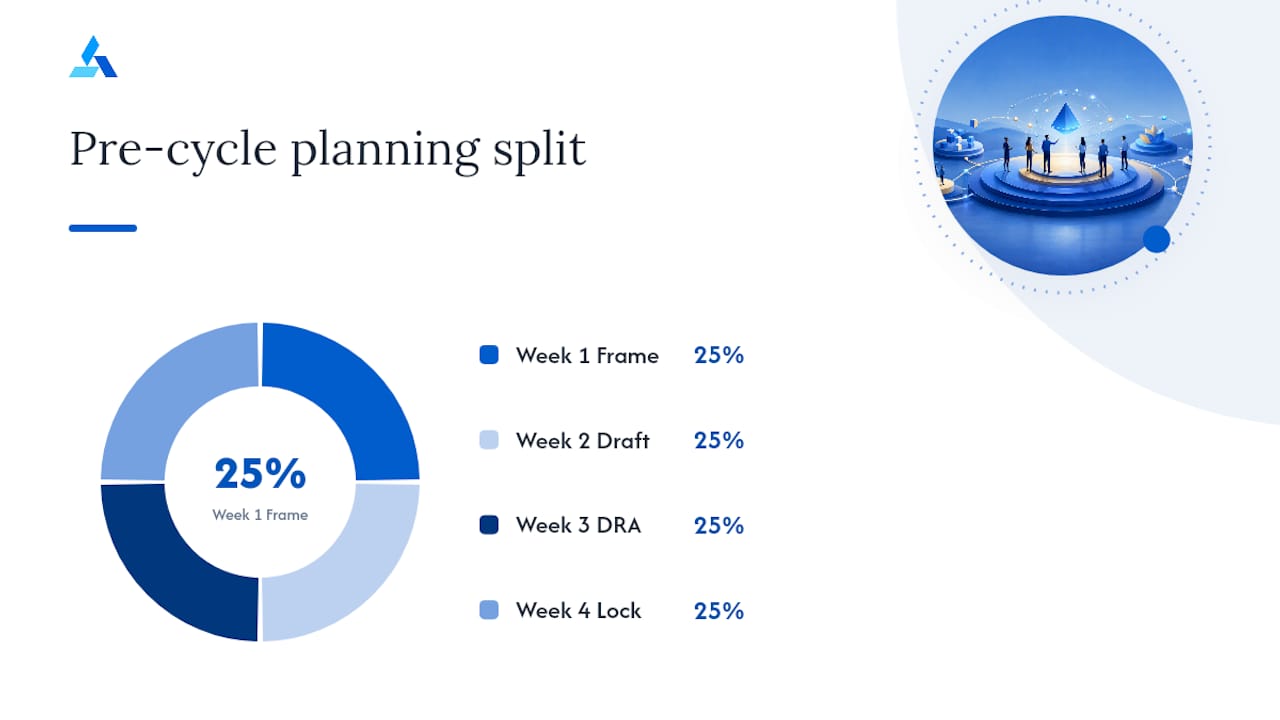
The workshop where you set OKRs is not a one-day event, and teams that treat it that way tend to produce vague, unowned goals. Leading implementation guides recommend a pre-cycle planning window of about four weeks, broken into multiple short sessions rather than one long meeting.
Here’s a practical four-week sequence:
- Week 1, leadership frames direction. Leadership shares the annual North Star and the two or three priorities that matter most this quarter. This step alone prevents half of the misalignment that shows up later, because continuous leadership framing before the quarter is one of the core behaviors that sustains OKRs over multiple cycles.
- Week 2, teams draft. Each team writes a first pass at its OKRs against that direction.
- Week 3, DRA sessions. Draft, Refine, Agree sessions surface dependencies between teams before they become week-nine surprises. This is also where an “OKR marketplace” works well: teams post draft OKRs publicly and negotiate overlaps in the open rather than in private Slack threads.
- Week 4, lock and publish. Final OKRs get agreed and published within 24 to 48 hours of the last session, while the context is still fresh.
Who needs to be in the room? Every OKR owner, plus one representative from any team with a known dependency. Skipping the dependency conversation is the single most common reason teams discover a blocked key result in week nine instead of week two. This same cascading logic applies to how you connect quarterly OKRs back to annual goals, which is covered in more detail in Blue Prysm’s guide to step-by-step business planning.
What Does a Weekly OKR Check-In Actually Look Like?
Once the quarter is live, the job shifts from planning to steering, and that requires a repeatable meeting format, not a status-update ritual that everyone dreads.
A weekly check-in should run 15 to 20 minutes, tightly:
- Each OKR owner gives a 60-second update: on track, at risk, or off track, with a confidence score.
- Blockers get named out loud, not buried in a shared doc nobody opens.
- The group agrees on the single top priority for next week, per key result.
Cross-team dependencies need a bigger forum than the weekly huddle. A biweekly or monthly coordination review, pulling in the teams whose work actually overlaps, is where you catch the kind of blocker that a single team’s weekly check-in can’t see coming.
The mid-quarter reset, typically landing in week six or seven, is the layer most teams are tempted to skip, and it’s exactly the layer that prevents key results from being quietly abandoned. Facilitate it as a forced decision, not a status meeting: for every key result at risk, the room picks one of three or four outcomes, re-baseline the target, de-scope the scope, escalate for more resources, or close it out and redirect the effort. Write the decision down against the key result immediately; a mid-quarter reset that doesn’t produce a written decision is just a longer status meeting with worse attendance.

Pro Tip: Assign one person, not the whole room, to own the written record of mid-quarter decisions. Diffuse ownership is how “we decided to escalate” quietly turns into “nobody remembers deciding anything” by week eleven.
How Should You Score and Close Out an OKR Cycle?
Scoring only works if everyone uses the same scale and the same interpretation of it. A simple 0.0 to 1.0 rubric, where 0.7 counts as a strong result and anything below 0.4 signals a miscalibrated target rather than a failure, keeps the conversation about learning instead of blame.
The retrospective that follows should produce more than a number:
- Score every key result on the 0.0 to 1.0 scale and flag which ones carry over into next quarter.
- Name the root cause behind any score under 0.4, whether that’s a bad target, a resourcing miss, or a dependency that never resolved.
- Commit to two experiments for the next cycle based on what the root-cause analysis surfaced.
Structured retrospectives turn cycle learnings into deliberate changes rather than repeated mistakes, but only if you enforce one calendar rule: finish the retrospective before you open the next cycle’s planning workshop. Running them concurrently guarantees the retrospective gets rushed. Partner resources like Gatherilla’s guide to why team retrospectives matter offer solid facilitation mechanics if your team is new to running these well.
Quarterly, Monthly, or Six-Week: Which Cadence Fits?
There’s no universal right answer here, and any article that hands you one is selling you something. Match your cadence to three factors: organizational size and complexity, how fast your market moves, and how mature your OKR program actually is.
Quarterly stays the sensible default for most teams, including early-stage OKR programs still building the muscle. Before you shorten the cycle to six weeks, exhaust the cheaper fix first, tightening your mid-cycle review and weekly check-in discipline. A shorter cycle without a disciplined mid-cycle mechanism just means you fail faster, not better.
Ask yourself:
- Does your market shift meaningfully inside 13 weeks, or is quarterly volatility mostly internal noise?
- Has your team run at least two full OKR cycles without abandoning the mid-quarter reset?
- Can leadership realistically re-frame direction more than four times a year without diluting focus?
If you answered no to any of these, keep the cycle at quarterly and fix the mechanics before you touch the calendar.
Who Built This Playbook, and What Tools Support It?
This playbook is written by Colin Bowdery, drawing on execution-rhythm patterns observed across SMB strategy teams. The mechanics above, DRA sessions, mid-quarter decision rules, structured retrospectives, are only as good as the discipline behind running them week after week, which is exactly the gap Blue Prysm’s execution dashboards and OKR tracking were built to close.
Inside Blue Prysm, that looks like automated nudges reminding owners before a check-in is due, shared dashboards that surface at-risk key results without a manual status hunt, and workshop templates pulled from the platform’s 95+ business strategy framework library. Pair this article with a confidence-score sheet and a retrospective template, both worth building into your own planning workshop, whether or not you’re using software to run it.
Why the First Two Cycles Feel Like More Meetings, Not Less
Honestly, cycle one feels like pure overhead. You’ve added a workshop, a mid-quarter reset, and a weekly check-in on top of everything already on the calendar, and it shows no payoff yet. The discipline compounds. By roughly cycle five, teams that protected the weekly check-in report a real, visible lift in completion. Protect that one meeting from scope creep for 90 days before you judge whether any of this works.
— Colin Bowdery
Automate the Cadence So It Outlasts Your Willpower
Every mechanic in this playbook, the weekly nudge, the dependency map, the mid-quarter decision log, works better when something other than human memory is enforcing it. Blue Prysm is built for exactly that gap: it turns OKR cadence planning from a discipline you have to white-knuckle through into a system that nudges owners automatically and surfaces at-risk key results before they hit the mid-quarter reset.
Inside the platform, you get automated weekly check-in reminders tied to each OKR owner, shared execution dashboards that replace the manual status hunt, and ready-to-use planning workshop templates instead of a blank whiteboard. If you’re evaluating tools to run this cadence instead of tracking it in spreadsheets, start with Blue Prysm’s market research tools and see how the platform maps to the exact five-layer stack described above. It’s a practical next step for any team tired of rebuilding the same tracker every quarter.
Sources
- OKR Cadence: How Often Should You Review Your OKRs?
- Mastering OKR Planning for Real Alignment & Execution
- OKR Cadence: Annual vs Quarterly vs Monthly — Which Is Right?
FAQ
What Are the Five Elements of OKR Cadence Planning?
The five layers are annual direction-setting, quarterly OKRs, a mid-quarter reset, weekly check-ins, and, for teams with tight operational dependencies, daily huddles. Each layer answers a different question, from long-term direction down to this week’s blockers.
What Does OKR Planning Mean?
OKR planning is the structured process of defining Objectives and Key Results for a cycle, typically run over a four-week pre-cycle window with drafting, refinement, and agreement sessions rather than a single meeting.
What Are Some Good OKR Examples?
A strong OKR pairs a qualitative, ambitious objective with two to four measurable key results tied to a number, like “Objective: Become the fastest-onboarding platform in our category” paired with “Key Result: Reduce average onboarding time from 14 days to 5 days.” Vague key results without a number rarely survive a mid-quarter reset.
Are OKRs Still Relevant?
Yes, when the cadence around them is disciplined. Teams that maintain a weekly check-in rhythm complete roughly 43% more OKRs than teams that let reviews slip to monthly or ad hoc, which suggests the framework’s relevance depends far more on execution rhythm than on the framework itself.