

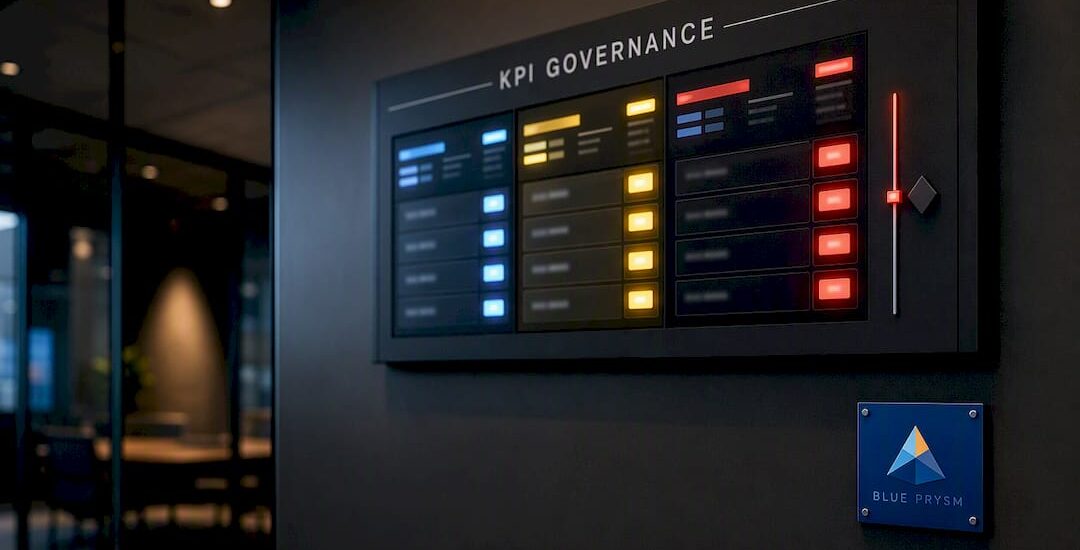
KPI governance is the system of ownership, thresholds, and escalation rules that decides who acts when a metric moves. It is not a dashboard and it is not a reporting habit. If you do one thing this quarter, appoint a named owner for every KPI on your executive scorecard and tie each one to a specific strategic objective. Without that, you have numbers on a screen, not governance.
TL;DR:
- Effective KPI governance requires assigning a named owner, clear authority, and predefined decision rights for each metric, not just tracking numbers.
- Thresholds must include specific escalation patterns with time-bound actions, such as amber and red alerts, to prompt timely decisions.
- Limit to five to seven high-level KPIs per organizational level, pairing leading and lagging indicators aligned with strategic objectives to avoid distractions.
- Governance reviews should occur weekly to monthly with a fixed agenda, ensuring decisions are logged, actions are taken, and thresholds are recalibrated regularly.
- AI can speed pattern recognition and interdependency detection but must still be governed by human review, transparency, and testing before acting on insights.
What Kpi Governance Actually Means (and What It Is Not)
Most companies confuse a metric with a KPI. A metric is anything you can count. A KPI is a metric someone has agreed to be accountable for, with a target attached to a decision. That distinction is the entire difference between KPI governance and ordinary reporting: reporting shows you a number, governance tells you who owns it and what happens when it breaks.
Real KPI governance rests on four components:
- Ownership — a named individual, not a department, accountable for the result.
- Authority — that owner can actually change the levers driving the number.
- Decision rights — a predefined answer to “who decides what happens next” when a KPI misses.
- Data authority — one canonical source for the number, so nobody argues about whose spreadsheet is right.
Without those four, KPI reviews collapse into what researchers at MIT Sloan Management Review describe as compliance theater: teams present metrics, nod at variances, and change nothing. Governance exists specifically to stop that.
Why Boards and Compliance Teams Should Care Now
Executive attention is a scarce resource, and it does not scale with your KPI count. Research on board effectiveness from Harvard Business Review found that the boards making the sharpest decisions are the ones with clear practices for what gets escalated and when, not the ones tracking the most metrics.
The concentration problem: Most executives meaningfully engage with only two or three KPIs at a time, no matter how many appear on the scorecard. MIT Sloan Management Review points to this as the core argument for a lean, governed scorecard rather than a sprawling one.
That concentration cuts both ways. When it’s managed well, a small set of governed KPIs drives fast, informed decisions. When it isn’t, a handful of stale or badly specified metrics quietly steer the whole company while nobody’s watching the other forty on the dashboard. Governance failures tend to share a pattern:
- A KPI stopped reflecting reality months before anyone noticed, because no one owned the recalibration.
- Two departments reported different numbers for the “same” metric, and no canonical source existed to settle it.
- A target was hit on paper while the underlying business problem got worse, because the KPI rewarded the wrong behavior.
The Governance Execution Cycle: A Framework You Can Run
Borrowing structure from PDCA and DMAIC, and from the Balanced Scorecard tradition of tying metrics to strategic perspectives, a workable KPI governance framework runs on six repeatable steps. A conceptual governance execution cycle integrating definition, implementation, evaluation, and risk governance backs this same structure.
- Define — write the KPI against a strategy map objective, not against whatever data happens to be easy to pull.
- Assign — name one accountable owner and record their decision rights in writing.
- Measure — lock the formula, the data source, and the collection frequency before you start tracking.
- Review — bring the KPI to the right forum on a fixed cadence, not whenever someone remembers.
- Act — trigger a predefined response the moment a threshold is breached.
- Recalibrate — retire or rebuild any KPI that no longer reflects the risk or strategy it was built to track.
The action step is where most companies quietly fail. Thresholds need a green, amber, red pattern with time bound escalation attached to each color, not just a number on a chart:
- Green — within tolerance. No action required, owner logs status.
- Amber — trending toward breach. Owner has a fixed window (commonly 5 to 10 business days) to present a corrective plan.
- Red — breached. Automatic escalation to the next governance forum, with a decision required at that meeting, not “noted for follow up.”
Handle’s model for KPI governance and accountability makes the same case: explicit ownership plus predefined thresholds plus automatic escalation is what converts a KPI from commentary into action. Review forums exist to produce one of three outputs: confirm the plan, change the plan, or change the KPI itself.
How to Choose the Right KPIs Without Drowning in Them
Start from your strategy map, never from the spreadsheet that already exists. If a metric doesn’t trace back to a stated strategic objective, it belongs in an operational report, not on a governance scorecard.
Every KPI you promote to governed status needs a complete definition before it goes live:
- Formula — the exact calculation, no ambiguity.
- Source — the one system of record for the underlying data.
- Owner — the named individual accountable for the result.
- Frequency — how often it’s measured and reviewed.
- Target — the number that defines success, and the threshold bands around it.
- Action on breach — what happens automatically when it goes amber or red.
On count: MIT Sloan Management Review points toward a governance scorecard of roughly 5 to 7 high-level KPIs per organizational level. Board level, executive level, and business unit level each get their own short list, not one long list shared across all three. Pair leading indicators (pipeline velocity, defect rates, employee attrition risk) with lagging ones (revenue, margin, churn) so you’re not just watching the scoreboard after the game ends.
Pro Tip: Write the “action on breach” field before you write the target. If you can’t specify what happens when a KPI turns red, you haven’t finished designing it, you’ve just picked a number to watch.
Building a Review Cadence That Produces Decisions, Not Slides
KPI governance lives or dies on rhythm. A metric reviewed once a year is a retrospective, not a control. The cadence that works across most mid-sized organizations follows four tiers:
- Weekly operational reviews — front-line owners check leading indicators and catch amber signals early.
- Monthly management reviews — department heads reconcile variance, confirm root cause, and approve corrective actions.
- Quarterly strategic reviews — executives assess whether KPIs still map to current strategy, not just whether targets were hit.
- Annual reset — the full governance scorecard gets rebuilt against the coming year’s strategic priorities.
Every review, at every tier, should run against the same agenda skeleton: status, variance, cause, action, owner, deadline. Six fields, no exceptions, whether it’s a 20 minute weekly stand-up or a two hour board session.
Escalation only works if it’s recorded. When a red threshold triggers a decision, log what was decided, who owns the follow-up, and by when. Handle’s accountability model calls this the difference between a KPI system that learns and one that repeats the same failure every quarter because nobody wrote down what happened last time.
What Governance-Ready KPIs Look Like in Practice
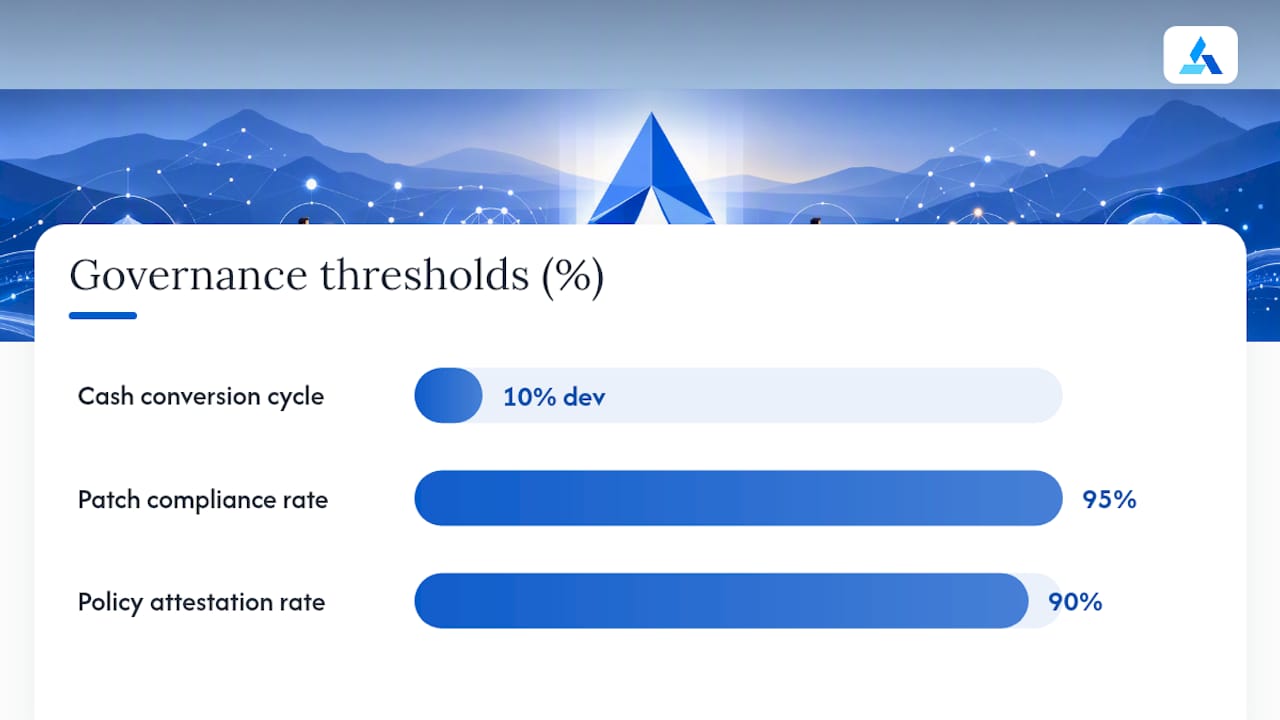
Abstract frameworks are easy to nod along to and hard to apply. Here is what governed KPIs look like once you strip out the ambiguity, organized by function:
Finance
- Cash conversion cycle: formula = DSO + DIO minus DPO, owner = CFO, reviewed monthly, red threshold at more than 10% deviation from plan.
- Gross margin by product line: owned by the finance business partner, reviewed monthly, escalated if it drops two consecutive periods.
IT and security
- Mean time to detect (leading) paired with mean time to remediate (lagging): both owned by the security lead, reviewed weekly.
- Patch compliance rate: owner = IT operations manager, red threshold below 95% on critical systems.
Compliance
- Policy attestation completion rate: owner = compliance officer, reviewed quarterly, escalated to the board if below 90%.
Operations
- On-time delivery rate (lagging) paired with supplier lead-time variance (leading): owner = operations director, reviewed weekly.
Executive attention genuinely does concentrate on only a few KPIs at a time, which is exactly why each one needs a measurable formula and a named owner instead of a vague description. A KPI nobody can calculate the same way twice isn’t governed. It’s decoration.
Dashboards That Support Decisions Instead of Just Displaying Numbers
A dashboard’s job is to answer “should someone act on this,” not to look impressive in a board deck. Klipfolio’s KPI management principles outline five elements every governed dashboard needs:
- Current value against the actual target, not a vague direction of travel.
- Variance stated explicitly, not left for the viewer to calculate.
- Trend over time, so a single bad month doesn’t look identical to a six month decline.
- Benchmark context, whether that’s prior year, industry, or plan.
- Drill-down capability to root cause, so a red KPI leads somewhere useful instead of dead-ending on a number.
Separate the governance scorecard from operational dashboards entirely. Executives and the board see the 5 to 7 KPIs that matter at their level; operational teams work from richer dashboards underneath. Both need one thing in common: a single canonical owner for the underlying data, because two teams reporting different numbers for what’s supposedly the same KPI destroys trust in the entire system faster than a missed target ever will. Some dashboard patterns built around exactly this separation are worth studying before you design your own.
Where AI Actually Helps, and Where It Needs a Leash

AI’s genuine contribution to KPI governance is speed on pattern recognition: surfacing leading signals humans would catch weeks later and mapping interdependencies between KPIs that look unrelated on separate dashboards but move together. MIT Sloan Management Review’s research is blunt about the alternative: static KPIs left unrefined create real strategic risk, because a metric that made sense a year ago can silently stop reflecting current risk.
That said, AI-generated KPI signals need the same governance discipline as any human-generated one, arguably more:
- Every AI-surfaced KPI adjustment gets human review before it changes a target or threshold.
- Model logic stays transparent enough that an owner can explain why a signal fired, not just that it did.
- New AI-driven KPIs get tested against historical data before they go live on a governance scorecard.
Pro Tip: Run the Puffery Detector on any vendor pitch that promises AI will “predict your KPIs automatically.” Adaptive KPI tooling should make interdependencies visible to a human decision-maker, not replace that decision-maker.
An approach leaning on this principle is described in AI-powered decision making guidance: AI proposes, governance disposes. For a broader look at how digital transformation programs reshape KPIs as conditions shift, Golden Path Digital’s guidance for enterprise leaders is a useful companion read.
A 90-Day Pilot to Make KPI Governance Real
Trying to govern every KPI in the company on day one guarantees failure. Run a contained pilot instead.
- Weeks 1 to 2: Name an executive sponsor and pick one business unit as the pilot ground.
- Weeks 3 to 4: Shortlist 5 to 7 KPIs mapped to that unit’s strategic priorities, and assign named owners to each.
- Weeks 5 to 6: Build the dashboard with target, variance, trend, and drill-down for every KPI on the list.
- Weeks 7 to 10: Run the first full review cycle using the six-field agenda: status, variance, cause, action, owner, deadline.
- Weeks 11 to 13: Run the second review cycle, document what worked, and fix what didn’t before scaling to a second unit.
The acceptance test is simple: did at least one review cycle produce a real decision, logged with an owner and a deadline, rather than a status update everyone quietly agreed to ignore.
The Mistakes That Quietly Kill KPI Governance
Most governance programs don’t fail loudly. They erode.
- Too many KPIs. Past 7 to 10 per level, executive attention scatters and nothing gets real scrutiny.
- Vanity metrics. Numbers that look good on a slide but trace to no strategic objective.
- Unowned KPIs. Tracked by “the team,” accountable to no one.
- Static targets. Set once, never recalibrated against changing conditions.
- Gaming incentives. A target that rewards hitting the number instead of solving the underlying problem.
The fix for each is specific: reduce the count, reassign ownership to a named individual, redesign the incentive attached to the metric, pair a lagging KPI with a leading one to catch gaming early, and put the review ritual on the calendar with the same seriousness as a board meeting. None of these require new software. They require someone willing to say no to a KPI that doesn’t earn its place on the scorecard.
Why Most Governance Programs Skip the Hard Part
Here’s the uncomfortable truth about KPI governance: almost every company already has the metrics. What they’re missing is the willingness to assign a name to a number and mean it. I’ve seen governance frameworks fail not because the KPIs were wrong, but because nobody wanted to be the person accountable when the red threshold hit. That’s not a measurement problem. That’s an organizational courage problem dressed up as a dashboard problem.
Run any executive’s favorite KPI claim through a basic puffery test: strip the adjectives, check if the number actually maps to a decision right, and see what’s left. Most of the time, what’s left is a metric someone likes looking at, not a metric anyone is governed by. The companies that get this right treat every KPI breach as a forcing function for a decision, not an item to note and move past.
AI changes the pace of this work, not its logic. It surfaces the interdependency between two KPIs faster than a human analyst would, but it still needs a governed owner to decide what to do with that insight. Skip that step, and you’ve just automated the same compliance theater at higher speed.
— Colin Bowdery
Turning This Framework Into a Working Pilot
Reading a governance framework and running one are different problems, and most executives who nod along to the six-step cycle never get past the “define” stage because they’re mapping KPIs by hand against a strategy that changed three months ago. Blue Prysm’s market analysis platform closes that gap directly: it connects your strategic roadmap to the KPIs tracking it, runs scenario testing against real-time market data, and flags when a metric’s threshold no longer matches current conditions instead of waiting for your quarterly review to catch it.

Where a traditional consulting engagement hands you a static framework and a hefty invoice, the platform keeps your governance scorecard live and lets you test “what happens if” before a KPI turns red. Start with one business unit, one strategy map, and the 5 to 7 KPIs that actually matter to it. Explore the strategy framework library for templates that map cleanly to KPI definitions, then get started with a pilot through Blue Prysm’s platform to see how scenario testing changes your next quarterly review.
Sources
- Governance for Smarter KPIs
- KPI Governance & Accountability Models: Control Performance | Handle
- KPI-anchored governance execution cycle (conceptual study)
- What makes great boards great
FAQ
What is KPI governance?
KPI governance is the system of ownership, decision rights, thresholds, and escalation rules that determines who acts when a KPI moves outside its target range, turning a measurement into a controlled decision process rather than a status report.
What are the five main KPIs?
There’s no universal list of five, since the right KPIs depend on the strategic objectives of your organization and level (board, executive, or business unit). A governance scorecard typically runs 5 to 7 KPIs per level, mixing leading and lagging indicators tied directly to strategy.
What are the four P’s of governance?
Definitions of the “four P’s” vary by source and discipline, and no single version is authoritative for KPI governance specifically. Focus instead on the four governance components that consistently matter: ownership, authority, decision rights, and data authority.
What are the five key performance indicators in government?
Public sector KPIs vary widely by agency and mandate, so there’s no fixed universal set of five. The same governance principles apply regardless of sector: each indicator needs a named owner, a clear formula, a review cadence, and a predefined action for when it breaches its threshold.
How does AI change KPI governance?
AI helps surface leading signals and interdependencies between KPIs faster than manual analysis, as MIT Sloan Management Review documents, but every AI-generated adjustment still needs human review, transparent model logic, and testing before it changes a live governance scorecard.