

TL;DR:
- A value wedge is the narrow zone where a buyer’s unconsidered need, your unique capability, and defensible proof intersect. Getting it right helps you stop competing on price and shifts focus to your distinct advantages. Blue Prysm’s platform accelerates wedge development through real-time market insights, pilot validation tools, and structured templates.
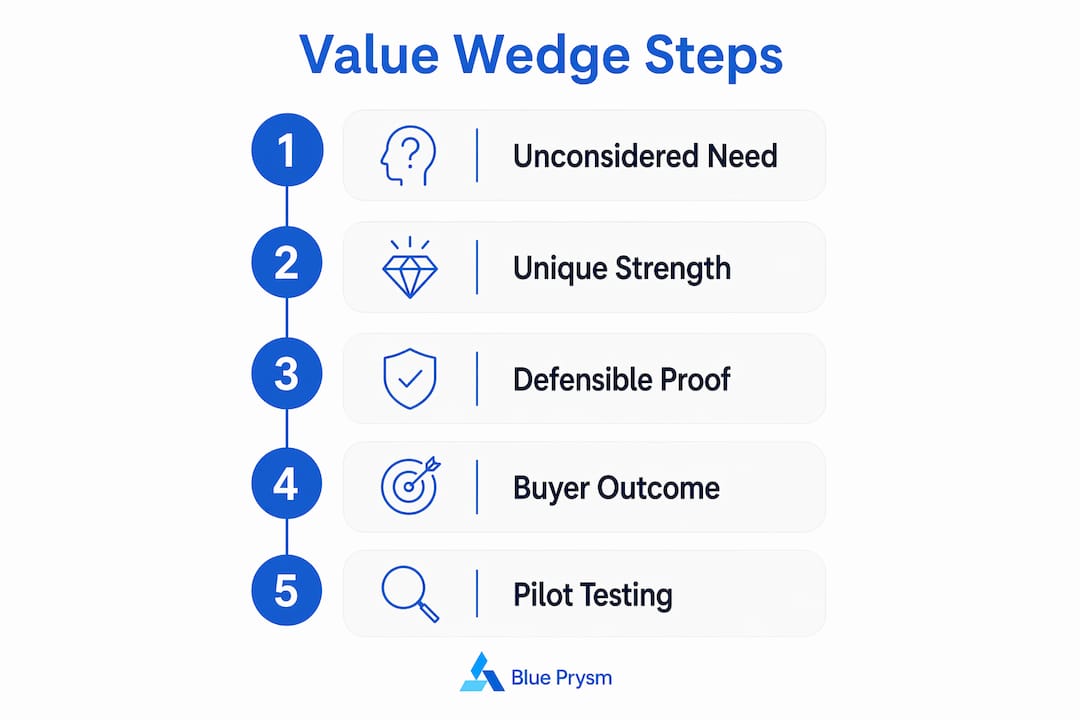
Your value wedge is the narrow intersection where a buyer’s unconsidered need, your unique capability, and defensible proof all overlap. Get that intersection right, and you stop competing on price. Get it wrong, and you sound like every other vendor in the room.

Here is what success looks like in a real deal: the buyer leans in, revises what they thought they needed, and starts asking how to move forward rather than how to compare you. That shift is the wedge working.
Quick example: A mid-market operations director is not losing sleep over “process inefficiency.” She is losing sleep because her board just asked why her team’s planning cycle takes three weeks longer than the industry median. A seller who opens with that specific gap, then shows a unique capability that closes it, then backs it with a comparable company’s result, has a wedge. A seller who opens with “our platform is flexible and easy to use” is in parity.
What is a value wedge and why does it matter for sellers?
Most sales messaging lives in what practitioners call value parity: the crowded middle where every vendor claims speed, reliability, and ROI. Buyers hear the same story from five vendors in a week. Nothing sticks.

A value wedge is the deliberate escape from that parity zone. The concept, popularized by sales strategy consultancies, describes the specific slice of your offering that is simultaneously unique to you, important to the buyer, and defensible with proof. The Harvard Business School Institute for Strategy and Competitiveness frames the underlying logic cleanly: your value proposition must answer questions your competitors cannot answer the same way, or you are competing on operational excellence alone.
The difference between a generic value proposition and a wedge is not just language. It is structure.
| Dimension | Generic value proposition | Value wedge |
|---|---|---|
| Starting point | Internal features and product roadmap | Buyer’s unconsidered need and current risk |
| Uniqueness | Claims uniqueness without proof | Tied to a capability only you can credibly own |
| Proof | Vague (“customers love us”) | Specific metric from a comparable situation |
| Buyer reaction | “Interesting, we’ll think about it” | “How soon can we run a pilot?” |
A B2B example: a software vendor selling to mid-sized manufacturers could claim “we improve operational visibility.” Every competitor says the same thing. The wedge version: “Manufacturers in your segment are losing an average of two production days per quarter to unplanned downtime caused by data gaps their current tools don’t flag. Our anomaly detection layer catches those gaps 48 hours earlier. Here’s a result from a comparable plant.” That is a wedge. Specific problem, owned capability, proof.
The three parts every defensible value wedge must include
A wedge without all three parts is just a claim. Here is what each part does and how it sounds in practice.
Part 1: The unconsidered need
This is not the problem the buyer already has on their priority list. It is the risk or gap they have not yet connected to a dollar figure or a strategic consequence. The goal is to surface unconsidered needs that materially threaten their status quo, so the buyer feels urgency they did not walk in with.
In practice: “Most of our clients in your space didn’t realize their competitive intelligence was significantly behind the market until a competitor moved and they had no early signal. Does that resonate?”
Part 2: Your unique strength
This is the capability you own that directly addresses the unconsidered need. “Unique” here means the buyer cannot get the same outcome from the next vendor on their shortlist. If they can, you are back in parity.
In practice: “We’re the only platform in this category that combines automated competitive briefings with a structured scoring model, so your team gets a ranked signal, not just raw data.”
Part 3: Defensible proof
A claim without proof is marketing copy. Proof means a specific, comparable result: a metric, a named outcome category, or a documented pilot result from a similar buyer situation. Small, well-designed pilots produce exactly this kind of defensible evidence.
In practice: “A comparable company in your segment ran a 30-day pilot and cut their strategy review cycle from 18 days to 9. Here’s the one-paragraph summary.”
Pro Tip: The logical argument alone rarely closes a deal. Buyers decide emotionally and justify with facts. During discovery, listen for the phrase that carries personal risk for the champion: “My CEO keeps asking me why…” or “We got caught flat-footed when…” That emotional driver is the fuel. The proof point is the permission slip. Pair them, and your wedge has what practitioners call emotional juice.
How do you build a value wedge from scratch?
The sequence matters. Start outside-in, not inside-out. Building a value proposition from stakeholder context and outcome mapping, rather than from your feature list, is what separates a wedge from a brochure.
Step 1: Identify the unconsidered need
- Interview three to five buyers who recently changed vendors or delayed a decision. Ask: “What finally made you act?” and “What did you not know at the start of the process that you wish you had known?”
- Map their existing KPIs. Where are they measured but underperforming? That gap is often where the unconsidered need lives.
- Ask about prior attempts: “Have you tried to solve this before? What happened?” Failed attempts reveal where the status quo is fragile.
- Use competitive signal tools to spot where the market is moving before buyers articulate it. A competitor analysis tool can surface messaging gaps and emerging buyer language your team can test.
Step 2: Attach the need to your unique strengths
- List every capability your team claims is differentiated. Then stress-test each one: can a buyer get the same outcome from a generic alternative? Cut anything that fails.
- Map the surviving capabilities directly to the unconsidered needs from Step 1. The overlap is your candidate wedge.
- Write one sentence per candidate: “Buyers in [situation] face [unconsidered need]. We address it with [unique capability]. No one else does this because [specific reason].”
Step 3: Defend with proof
- Design a compact pilot: 30 to 60 days, one measurable KPI, one buyer team, one clear success threshold.
- Document the result in two artifacts: a one-paragraph buyer story and a one-line metric summary (e.g., “reduced planning cycle by 47%”).
- Arm sellers with both artifacts before the next competitive deal.
Common mistakes to watch for during execution:
- Inside-out messaging: You started with your product features and worked backward to a buyer need. Flip the sequence.
- Fuzzy proof: “Customers see significant improvement” is not proof. A specific percentage or time-saved figure from a real pilot is.
- Overclaiming uniqueness: If three competitors can say the same thing, it is not a wedge. Go narrower until only you can own it.
- Skipping the pilot: Teams that skip the pilot phase end up defending claims with vendor case studies from different industries. Buyers notice.
How should sellers use the wedge in demos and competitive situations?
The wedge does not work if you lead with it. You have to earn the right to introduce it by first establishing the Buying Vision: the buyer’s picture of what a problem costs them and what solving it looks like. Creating that urgency first makes the wedge land as a solution rather than a pitch.
Demo script structure
Opening (Buying Vision): “Before we show you anything, let me share what we’re seeing across companies in your space. Most of them don’t realize [unconsidered need] until [consequence]. Does that match what you’re experiencing?”
Wedge introduction: “The reason we’re having this conversation is that we address that specific gap in a way that’s different from the standard approach. Here’s how…”
Proof close: “A company in a similar situation ran a pilot with us. Here’s what they measured.”
First-in vs. second-in framing
| Situation | Your goal | Tactical approach |
|---|---|---|
| First in (no incumbent) | Create the Buying Vision | Open with the unconsidered need; define what “good” looks like before showing your solution |
| Second in (displacing incumbent) | Reframe the evaluation criteria | Introduce a need the incumbent cannot address; make that need the new standard |
| Tied (feature parity perceived) | Shift to proof and risk | Lead with the pilot result; reframe the decision as “who can you trust to deliver” |
Three objection responses sellers can use immediately:
- “We already have a solution for that.” “That’s great. What I’d ask is whether it addresses [specific unconsidered need] or just the surface symptom. Here’s the gap we typically find…”
- “Your price is higher than the alternative.” “That’s fair to raise. The question is what the status quo is actually costing you. Here’s how comparable companies calculated that…”
- “We don’t see a difference between you and [category description].” “I hear that. Let me show you one specific capability and one result that I’d challenge you to find elsewhere…”
Where do most teams fail with the wedge?
The failure is almost always the same: teams build the wedge from the inside out. They start with what they sell, then reverse-engineer a buyer problem to justify it. The result is messaging that sounds like every competitor’s messaging because it is built on the same logic.
Error/fix pairs:
- Inside-out messaging → flip to outside-in. Start every wedge session with buyer interviews, not a product feature list. If you cannot name the buyer’s unconsidered need in their language, you are not ready to build the wedge.
- Fuzzy proof → run a compact pilot. A 30-day pilot with one measurable KPI produces more credibility than three years of generic case studies.
- Wedge by committee → assign a single owner. When sales, marketing, and product all “own” the wedge, no one does. One person owns the hypothesis; one team validates it.
- Static wedge → schedule quarterly reviews. Markets shift. A wedge that was defensible 18 months ago may now be table stakes.
A short case example: A B2B software team built their wedge around “ease of integration.” It tested well internally. In the field, buyers shrugged because three competitors said the same thing. The fix was not better messaging. It was going back to discovery and finding the real unconsidered need: buyers were losing an average of six weeks per year to manual data reconciliation that their current tools did not flag as a problem. The new wedge was specific, owned, and provable. Win rates on competitive deals improved within one quarter.
Organizational blockers compound the problem. Sales teams incentivized on volume have no reason to slow down for discovery. The pragmatic fix is a one-page discovery template that takes 15 minutes to complete and feeds directly into the wedge hypothesis. Make the right behavior the easy behavior.
How do you measure whether your wedge is actually working?
A wedge is a hypothesis until you measure it. Here are the metrics that tell you whether it is landing.
Attention metrics: Are buyers engaging differently? Track meeting-to-next-step conversion rate and compare wedge-led deals to standard pitches.
Buying-vision indicators: Are buyers reframing their own requirements after your demo? Track how often evaluation criteria shift in your favor after the first meeting.
Conversion lift: Compare close rates on deals where the wedge was deployed versus deals where it was not. Even a small sample of 10 to 15 deals produces a directional signal.
Time-to-decision: Wedges that create genuine urgency tend to shorten sales cycles. Track average days from first meeting to signed agreement.
Dollarized impact: Can the buyer calculate what the unconsidered need is costing them? If yes, you have a wedge. If no, you have a feature.
Pilot A/B template
| Element | Details |
|---|---|
| Hypothesis | “Deploying the wedge message in the first meeting will increase next-step conversion by X%” |
| KPI | Meeting-to-next-step rate; close rate on competitive deals |
| Sample | 10 deals per arm (wedge vs. standard pitch), same rep cohort |
| Period | 60 days |
| Success threshold | Wedge arm outperforms by a directionally meaningful margin |
| Output | One-paragraph buyer story + one-line metric summary for seller toolkit |
Statistic callout: Practitioners consistently report that converting pilot outcomes into a one-paragraph buyer story and a one-line metric summary gives sellers the two artifacts they need most in competitive deals. The story opens the demo; the metric closes the objection.
For data-driven strategy examples showing how small pilots produced buyer-facing proof points in real SMB contexts, the pattern holds: specificity beats volume every time.
How Blue Prysm operationalizes a value wedge
Here is a concrete wedge framed for Blue Prysm’s own buyer situation.
Buyer problem (unconsidered need): Most SMB executives believe their strategic planning process is “good enough” until a competitor moves and they realize their market intelligence was 60 to 90 days stale. They were not tracking the right signals, and no one told them what they were missing.
Blue Prysm’s unique capability: The platform combines real-time market analysis, automated competitive intelligence briefings, and a Venture Quick Score that ranks strategic options before a team commits resources. No traditional consulting engagement delivers that combination at the speed and cost point an SMB can absorb.
Proof approach: A structured pilot runs for 30 days. The team tracks one KPI: time from market signal to strategic decision. The output is a one-paragraph buyer story and a before/after comparison that sellers can use in the next demo.
Blue Prysm capability-to-outcome alignment
| Blue Prysm capability | Buyer outcome |
|---|---|
| Real-time market analysis | Reduces lag between market shift and strategic response |
| Automated competitive briefings | Eliminates manual competitor research from the planning cycle |
| Venture Quick Score | Ranks strategic options before resource commitment |
| 50+ strategy framework templates | Structures stakeholder alignment without external consultants |
| OKR and KPI tracking dashboards | Connects wedge pilots to measurable business outcomes |
| Puffery Detector | Flags overclaiming in messaging before it reaches buyers |
Hypothetical pilot result (illustrative, not a live case study): In a simulated 30-day pilot scenario, an SMB strategy team using Blue Prysm’s competitive intelligence and Venture Quick Score reduced their planning review cycle from 14 days to 7 and identified two competitor moves that had not yet appeared in their existing monitoring tools. This is a hypothetical illustration; real case study results are available on request through Blue Prysm’s consulting team.
For competitive strategy examples showing how companies in adjacent categories built defensible wedges, the pattern of unconsidered need plus owned capability plus proof repeats consistently.
Key Takeaways
A defensible value wedge requires three things working together: an unconsidered buyer need, a capability only you can credibly own, and proof from a real pilot that makes the claim stick.
| Point | Details |
|---|---|
| Start outside-in | Begin with buyer interviews and KPI gaps, not your product feature list. |
| Three-part structure | Every wedge needs an unconsidered need, a unique strength, and defensible proof. |
| Pilot before you scale | A 30-to-60-day pilot with one measurable KPI produces the proof sellers need in competitive deals. |
| Measure what shifts | Track meeting-to-next-step conversion and close rates on wedge-led deals to validate the hypothesis. |
| Blue Prysm accelerates the process | Blue Prysm’s market analysis, competitive briefings, and Venture Quick Score compress wedge discovery and pilot design for SMB teams. |
The organizational reality nobody talks about
Most wedge frameworks are built for a single seller with a clear buyer. The harder problem is shipping a wedge across a whole go-to-market team where sales, product, and marketing all have different incentives and different definitions of “differentiated.”
The workflow that actually works looks like this: one person in marketing or strategy owns the wedge hypothesis. They run the buyer interviews, map the unconsidered needs, and draft the three-part structure. Then they hand a one-page brief to sales for field testing. Sales does not rewrite the wedge. They test it in five to ten deals and report back on what landed and what did not. Product gets the feedback loop, not the messaging job.
Organizational checklist for wedge ownership:
- Discovery owner: marketing or strategy lead (runs buyer interviews, maps unconsidered needs)
- Pilot owner: sales enablement or a designated account executive cohort
- Proof recorder: marketing ops or CRM admin (captures pilot KPIs and buyer stories)
- Wedge guardian: whoever owns GTM strategy (reviews and updates the wedge quarterly)
Maintaining the wedge over time: Schedule a quarterly review tied to your competitive monitoring cadence. Use competitive intelligence tools to flag when a capability you claimed as unique starts appearing in competitor messaging. When that happens, the wedge needs to move left again, toward a newer unconsidered need. A wedge that stops moving becomes parity.
Blue Prysm gives your team a faster path to a defensible wedge
Wedge discovery is slow when your team is doing it manually: spreadsheet-based competitor tracking, disconnected KPI logs, and strategy reviews that happen quarterly at best. Blue Prysm compresses that cycle.
The platform surfaces unconsidered needs through real-time market research tools and automated competitive briefings, so your team is not starting discovery from a blank page. The Venture Quick Score ranks your strategic options before you commit to a pilot, which means fewer wasted cycles on wedges that will not hold up in the field. The Puffery Detector flags overclaiming in your messaging before it reaches a buyer who will call it out in a demo. And the 50+ strategy framework templates give your team a structured way to run stakeholder mapping without hiring an outside consultant for every engagement.
This is not a tool for companies. It is a tool for the person on your team who is tired of losing competitive deals to vendors who sound identical to you. Run your current value proposition through the Venture Quick Score at blueprysm.com/venture-score and find out whether you have a wedge or a parity claim.
Useful sources and further reading
The sources below back the frameworks and claims in this article. Each one adds something specific.
- Corporate Visions: Value Proposition in Sales — The three-step wedge sequence (unconsidered need, unique strength, proof) and the Buying Vision concept. The most directly applicable practitioner framework in this article.
- Rise With Drew: Discovering Your Unique Value Wedge — The value parity trap and the role of emotional juice in B2B messaging. Useful for demo scripting and discovery coaching.
- Harvard Business School ISC: Unique Value Proposition — The strategic foundation: customer, need, and relative price as the three legs of a defensible proposition. Grounds the wedge in competitive strategy theory.
- LaunchNotes: Unlocking the Power of the Value Wedge — Pilot-to-proof conversion and the two seller artifacts (buyer story + metric summary). Practical for measurement and enablement sections.
- BDA Global: What Is a Value Proposition? — Outside-in framing and stakeholder analysis as the starting point for VP development. Supports the discovery methodology.
- ScienceDirect: Toward a Comprehensive Framework of Value Proposition Development — Academic five-phase implementation framework linking firm strategy, customer needs, and execution in B2B settings. Useful for teams building a repeatable process.
- Precisely: The Value Wedge in Data Governance — A practitioner’s application of the IS/DOES/MEANS wedge model to data strategy. Useful analogy for teams in data-heavy industries.
- Blue Prysm Platform — Platform capabilities referenced in the operational example: market analysis, competitive intelligence, Venture Quick Score, and Puffery Detector. Author bio for Colin Bowdery and live case studies available on request.
FAQ
What is a value wedge?
A value wedge is the specific intersection where your offering addresses a buyer’s unconsidered need in a way that is unique to you and defensible with proof. It is the part of your value proposition that competitors cannot credibly claim.
What makes a value wedge different from a value proposition?
A value proposition describes what you offer; a value wedge is the narrow slice of that offering that is unique, important to the buyer, and backed by proof. Most value propositions live in parity; a wedge deliberately moves left of that parity zone.
What is a good example of a value wedge in practice?
A software vendor discovers that buyers in their segment lose planning time to stale competitive data. The vendor’s unique capability is automated real-time briefings. The proof is a 30-day pilot showing a 50% reduction in research time. That combination of unconsidered need, owned capability, and specific proof is a working wedge.
How do you find your value wedge?
Start with buyer interviews focused on unconsidered needs and failed prior attempts, not on your product features. Map the gaps to capabilities only you can own, then run a compact pilot to generate defensible proof. The sequence is outside-in: buyer context first, product second.
How does Blue Prysm help teams build a value wedge?
Blue Prysm’s platform surfaces unconsidered needs through real-time market analysis and automated competitive briefings, ranks strategic options with the Venture Quick Score, and flags overclaiming with the Puffery Detector, giving SMB teams the discovery and validation tools to build and test a wedge without a full consulting engagement.
Recommended
- Decision-making best practices for smarter business moves – Blue Prysm – Articles & Blogs
- 95+ Business Strategy Frameworks (SWOT, Porter’s, Canvas) | Blue Prysm
- Handling Objections in Sales: A Practical 2026 Guide
- Assess competitive advantage: practical steps for business leaders – Blue Prysm – Articles & Blogs