


TL;DR:
- Cost effective strategy development emphasizes focused, affordable plans with clear owners and validated assumptions. It relies on lean tools like AI insights and organic marketing channels to maximize results within limited budgets. Most failures stem from neglecting assumption testing and overcomplicating plans, which wastes resources and delays execution.
Cost effective strategy development is the process of building business plans that achieve maximum results while minimizing expenses through focused execution and smart resource allocation. Most executives assume that serious strategy requires a six-figure consulting engagement. That assumption is wrong, and it costs businesses real money. The lean planning models gaining traction in 2026 prove that focused, affordable strategy planning consistently outperforms bloated, expensive frameworks. This article gives you the principles, tools, and step-by-step process to build a plan that actually gets executed.
What are the core principles of cost effective strategy development?
The single most important principle is focus. Lean AI strategy engagements concentrate on 2–3 use cases with named owners, clear budgets, and executable timelines. That focus is what gets board approval and drives real implementation, not a 200-page report that sits on a shelf.
Before you write a single strategic initiative, you need three things in place:
- Clear objectives with measurable outcomes. Vague goals produce vague plans. Define what success looks like in numbers.
- An honest capacity audit. Know what your team can actually execute without burning out or hiring consultants you cannot afford.
- A connected planning stack. Free-tier live canvas tools paired with execution platforms like Asana or Notion give small teams an affordable, integrated planning environment.
The trap most executives fall into is confusing activity with strategy. Writing a 40-page plan feels productive. Identifying your three highest-impact initiatives and assigning an owner to each one actually is productive.
Pro Tip: Before your next planning session, write down the single assumption that, if wrong, would kill your plan. Then design a low-cost test to validate it within 30 days. That one exercise is worth more than most strategy workshops.

| Tool type | Example | Cost |
|---|---|---|
| Live strategy canvas | Storyflow | Free tier available |
| Project execution | Asana, Notion | Free to low-cost tiers |
| AI strategy assistant | Blue Prysm | Subscription-based |
| Market intelligence | Blue Prysm | Subscription-based |
| Framework library | Blue Prysm strategy library | Included in platform |
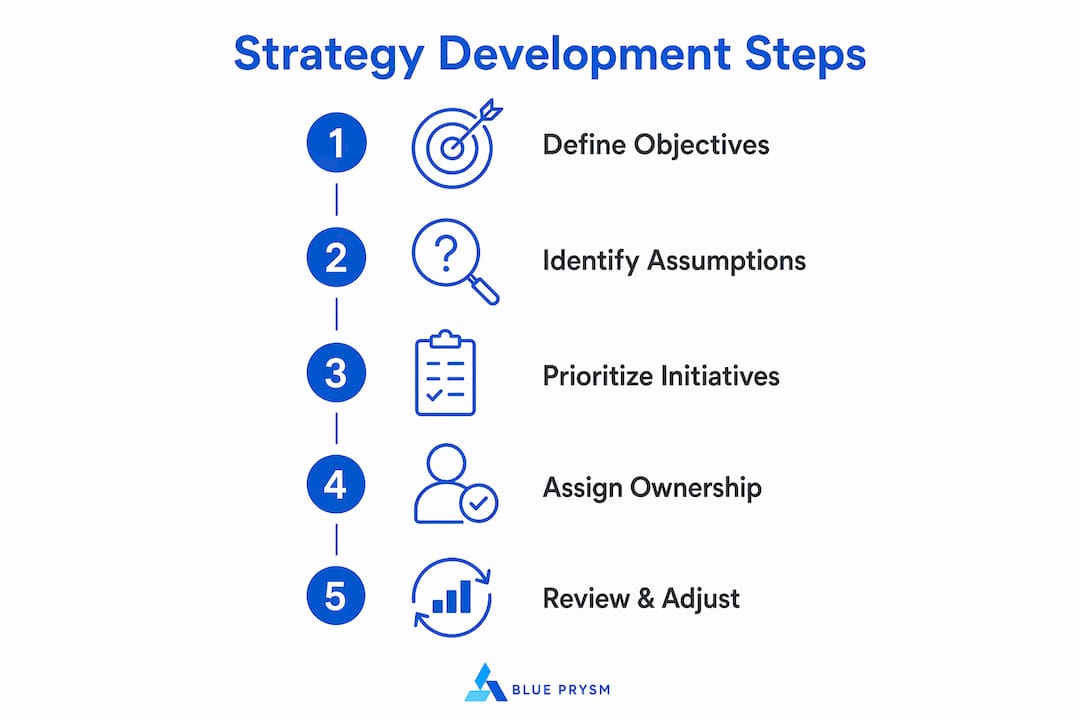
How to build a cost effective strategy: step-by-step
A structured process separates businesses that execute from those that plan endlessly. Follow these six steps to build an affordable, executable plan.
-
Define your objectives. Write 2–3 goals with specific, measurable outcomes. “Grow revenue” is not a goal. “Increase monthly recurring revenue by 15% before Q4” is.
-
Analyze your market affordably. Use AI-powered market insights to understand your competitive position without paying for expensive research firms. Real-time briefings replace weeks of manual analysis.
-
Choose 2–3 focused strategic initiatives. Resist the urge to pursue everything. Successful low-budget strategy requires scalable initiatives with dedicated ownership. Broad plans without accountability fail consistently.
-
Assign ownership and define budgets. Every initiative needs one named owner and a defined spending ceiling. No owner means no accountability. No budget ceiling means no cost control.
-
Set realistic timelines. Short strategy sprints of 30–90 days keep teams focused and allow fast iteration. Twelve-month plans with no checkpoints drift.
-
Use AI to increase efficiency. AI and automation tools reduce overhead, increase planning precision, and allow continuous iteration without adding headcount.
Pro Tip: Run your draft strategy through a simple “puffery check.” If any initiative sounds like a press release rather than a work plan, rewrite it with a specific owner, a budget, and a deadline.
| Step | Key output | Time required |
|---|---|---|
| Define objectives | 2–3 measurable goals | 2–4 hours |
| Market analysis | Competitive brief | 1–2 days with AI tools |
| Select initiatives | Prioritized initiative list | Half day |
| Assign ownership | RACI or owner list | 1–2 hours |
| Set timelines | 30/60/90-day sprint plan | 2–3 hours |
| Iterate and track | Monthly review cadence | Ongoing |
What are common challenges in cost effective strategy development?
The most common failure point is skipping assumption validation. Budget-friendly plans use short strategy sprints to isolate what could kill the business and define low-cost validation tests. Skipping this step means you spend months executing a plan built on a false premise.
Watch for these specific traps:
- Scope creep. Adding initiatives mid-cycle dilutes focus and delays execution. Lock your initiative list at the start of each sprint.
- Overreliance on consultants. External advisors add value in specific situations. Paying $300K for a strategy that your team cannot execute is not one of them.
- No tracking cadence. A plan without a monthly review is a wish list. Set a fixed review date and measure against your defined outcomes.
- Underestimating internal capacity. Executives consistently overestimate how much their teams can absorb alongside daily operations. Build buffer time into every initiative.
“The critical early phase of strategy is identifying and testing your riskiest assumptions cost effectively through quick experiments. This minimizes wasted resources and guides every priority choice that follows.”
The fix for most of these problems is the same: simplify. Cut your initiative list in half, assign clear ownership, and review monthly. Complexity is not sophistication. It is a budget drain.
How do budget-friendly marketing strategies integrate with cost effective strategic development?
Marketing is where most small businesses either waste money or leave growth on the table. The good news is that the most durable marketing channels cost time, not budget. Small businesses allocate 2%–5% of annual revenue to marketing, and organic channels consistently deliver compounding growth within that constraint.
The channels that work at low cost are well established:
- SEO. Organic search effects build over 3–6 months but produce durable traffic without ongoing ad spend.
- Email marketing. Email automation generates 30x higher ROI compared to one-off campaigns. Automated workflows nurture customers consistently without manual effort.
- Social media. Consistent posting builds channel momentum within 60–90 days. Authenticity and consistency outperform paid amplification for most SMBs.
- Referral programs. Existing customers are your lowest-cost acquisition channel. A structured referral program converts satisfaction into growth.
The key is combining organic channels for long-term compounding with targeted paid campaigns for fast, specific results. Organic and paid marketing work best together within a limited budget, each covering what the other cannot. Track ROI on every channel monthly and reallocate budget toward what performs.
Statistic callout: Email marketing automation delivers 30x higher ROI than one-off campaigns. That number means a business spending $500 per month on automated email outperforms one spending $15,000 on disconnected blasts.
Key Takeaways
Cost effective strategy development works because focused initiatives with named owners, validated assumptions, and organic marketing channels consistently outperform expensive, broad plans.
| Point | Details |
|---|---|
| Focus beats breadth | Limit strategic initiatives to 2–3 with clear owners to drive real execution. |
| Validate assumptions early | Test your riskiest assumption with a low-cost experiment before committing resources. |
| Use AI to cut planning costs | AI-powered tools replace expensive research and consulting for market analysis and iteration. |
| Organic marketing compounds | SEO and email automation deliver durable growth within a 2%–5% revenue marketing budget. |
| Review monthly, not annually | Short sprint cycles with fixed review dates keep plans alive and budgets controlled. |
Why I think most strategy budgets are spent in exactly the wrong place
I have watched executives spend $150,000 on a consulting engagement and receive a beautifully formatted document that no one on their team could execute. The consultants left. The plan gathered dust. The business kept running on gut feeling.
The uncomfortable truth is that most strategy budgets fund the creation of plans, not the execution of them. Lean AI strategy engagements, by contrast, force you to name an owner for every initiative before the engagement ends. That single constraint changes everything. When someone’s name is attached to an outcome, the plan becomes real.
I am also skeptical of the idea that more data produces better strategy. AI-driven insights improve planning accuracy, but only when executives know what question they are trying to answer. Feeding a team more market data without a clear decision framework produces analysis paralysis, not strategy. The discipline is in the question, not the data volume.
My practical advice: spend 20% of your strategy budget on planning and 80% on execution support, tracking, and iteration. That ratio feels uncomfortable to most executives. It is also the ratio that produces results.
— Colin Bowdery
How Blue Prysm fits into your planning process
Building an affordable, executable strategy is hard when you lack access to real-time market data, structured frameworks, and competitive intelligence. Most SMBs either skip those inputs entirely or pay consulting fees they cannot sustain.
Blue Prysm gives business owners and executives access to competitive intelligence software that tracks market shifts automatically, so your strategy stays grounded in current reality rather than last quarter’s assumptions. The platform also includes a library of 95+ strategy frameworks, from SWOT to Porter’s Five Forces, structured for practical use rather than academic display. If you want to see how it works before committing, the market analysis platform delivers real-time insights your team can act on immediately.
FAQ
What is cost effective strategy development?
Cost effective strategy development is the process of building focused business plans that maximize results while minimizing expenses. It relies on lean planning methods, clear ownership, and affordable tools rather than large consulting budgets.
How many strategic initiatives should a small business focus on?
Limit your plan to 2–3 initiatives per planning cycle. Lean strategy models show that focused plans with named owners are far more likely to reach implementation than broad plans with many competing priorities.
What marketing budget should small businesses allocate?
Small businesses typically allocate 2%–5% of annual revenue to marketing. Within that budget, organic channels like SEO and email automation deliver the strongest compounding returns over 3–6 months.
How does AI reduce strategy development costs?
AI tools replace expensive market research, automate competitive monitoring, and accelerate planning cycles. Platforms like Blue Prysm deliver real-time intelligence and structured frameworks at a fraction of traditional consulting costs.
What is the biggest mistake in budget-sensitive strategic planning?
The most common failure is skipping assumption validation. Building a plan without testing your riskiest assumption first leads to wasted spending and delayed execution when that assumption turns out to be wrong.