


AI market intelligence is a continuous, AI-driven layer that ingests live market data, synthesizes it into traceable insights, and routes those insights into strategic decision frameworks. That is a very different animal from a quarterly research deck. The bottom line for strategy teams: you get faster, standing awareness of competitors and demand shifts instead of a stale snapshot, and with 78% of organizations now using AI in some part of the business, treating this as optional is no longer a defensible position.
TL;DR:
- AI market intelligence provides continuous, real-time data synthesis from multiple sources, enabling faster response to demand shifts and competitor moves.
- Platforms with agentic AI can automate multi-step workflows, turning real-time signals into actionable decisions without manual intervention.
- Key evaluation criteria include data refresh rates, traceability, integration capabilities, and clear mapping of insights to decision owners.
- Starting with narrow pilots on specific use cases like competitor pricing allows teams to measure actual decision impact and build governance around deployment.
- Platforms like Blue Prysm connect live signals to strategy frameworks and execution dashboards, bridging the gap between insight and decision-making.
What Is AI Market Intelligence, Really?
Traditional market research runs on a project timeline. Someone scopes a study, a team gathers data for weeks, an analyst writes a report, and by the time it lands on your desk, the market has already moved. AI market intelligence collapses that timeline into a running pipeline: data sources feed models, models synthesize patterns, and the output routes straight into your workflow, whether that’s a Slack alert or a dashboard tied to a quarterly OKR.
The pipeline looks like this:
- Data sources: pricing pages, review sites, social chatter, transactional data, syndicated reports, first-party CRM signals
- Models: large language models and specialized classifiers that tag sentiment, extract entities, and detect anomalies
- Synthesis: pattern detection across sources, turning raw signals into a coherent narrative
- Delivery: briefings, alerts, or dashboard updates that plug into existing decision workflows
Here’s a mini example. In the old model, someone notices this weeks later during a manual competitor scan, if at all. In an AI-driven system, that price change is a signal the moment it’s scraped, it gets flagged against your own margin thresholds, and it triggers a strategy review before your sales team even fields the first customer question about it. Cadence and traceability, not just speed, are what separate the two approaches. Traditional research is reproducible in theory but rarely repeated in practice. AI market intelligence platforms live or die on whether you can trace an insight back to its source data, especially when a decision maker asks “where did this number come from?”
Why Does AI Market Intelligence Matter Now?
The honest answer is scale plus timing. The global AI market sat near $900 billion in 2026 and is projected to climb toward $3.49 trillion to $4.21 trillion by 2033 to 2035, a compound growth rate estimated between 18.7% and 30.6%. That range is wide because forecasting a market this young is inherently imprecise, but even the conservative end represents a market intelligence category growing faster than most strategy teams can currently absorb.
Adoption is no longer the frontier issue. With 78% of organizations reporting AI use in 2024 and generative AI pulling in $33.9 billion in private investment that same year, an 18.7% jump from 2023, the question has shifted from “should we adopt AI” to “which capability do we adopt first.”
What changed the stakes specifically is agentic AI. This isn’t just faster search. Agentic systems plan and execute multi-step workflows without a human clicking through every stage, and that capability is what turns a market intelligence tool into an operational intelligence layer rather than a search box with a subscription fee. Practitioners increasingly frame the buying decision this way too: the question stops being “which tool” and becomes “which platform can plan and run multi-step intelligence workflows tied to our own strategy.” That reframing matters because it changes what you should be evaluating, which we’ll get into next.
- Market growth: $900 billion in 2026, trending toward multi-trillion territory by the mid-2030s
- Adoption: 78% of organizations already using AI in some capacity
- Investment: $33.9 billion in generative AI funding in 2024 alone
- Structural shift: agentic AI moves platforms from lookup tools to continuous monitoring systems
What Can AI Market Intelligence Actually Do for You?
Strip away the marketing copy and AI market intelligence platforms tend to cluster around six practical jobs:
- Trend detection — spotting demand shifts in search behavior, social conversation, or category growth before they show up in your quarterly numbers.
- Persona synthesis — pulling behavioral and transactional data into working customer profiles that update as behavior changes, instead of a persona deck built once and forgotten.
- Competitor monitoring — tracking pricing, messaging, hiring, and product changes across rivals continuously rather than during an annual audit.
- Sentiment analysis — reading review sites, social platforms, and forums to gauge how a market feels about a category shift, not just your brand.
- Pricing intelligence — flagging competitor price moves and elasticity signals in near real time.
- Opportunity discovery — surfacing underserved segments or white space by cross-referencing demand signals against your own coverage gaps.
The capability map underneath those use cases matters just as much as the use case itself. Look for real-time feeds (not batch updates that refresh weekly), explainability (can you see why the model flagged something), pre-built connectors into your existing CRM or BI stack, workflow automation that routes insights to the right owner, and alerting that doesn’t bury you in noise.
Pro Tip: Match the capability to the team function before you shop for a platform. A CMO cares about trend detection and sentiment. A pricing analyst cares about competitor monitoring and elasticity signals. Buying one platform to satisfy every function usually means satisfying none of them well.
How Should You Evaluate an AI Market Intelligence Platform?
Most vendor pitches sound identical until you ask the right questions. Here’s what separates a platform that will actually change how your team decides from one that generates pretty dashboards nobody opens after week three.
Evaluate on these criteria:
- Data refresh rate: daily or real-time, not weekly batch pulls dressed up as “current.”
- Traceability: can every insight be traced back to its source data, in a format you could show a skeptical CFO?
- Integrations: does it connect to your existing CRM, BI tool, or project management stack, or does it live as an island?
- Security and data handling: where does your data sit, and what’s the retention policy?
- Actionability: does the output map to a decision owner and a specific next step, or does it just describe the market?
- Pricing structure: does cost scale with usage or seats in a way that matches your team size?
Red flags worth walking away from: vendors who can’t explain their data sources in plain language, platforms that can’t show you a sample output before contract signature, and any pitch that leans entirely on “AI-powered” without describing the actual workflow.
A useful integration principle worth borrowing before you run a pilot: map each AI signal to a decision owner and a one-step action. Skip this step and you end up with a stream of “insights” nobody is accountable for acting on.
For a pilot, keep the scope narrow: one use case (competitor pricing monitoring is a good starting point), a 30 to 60-day window, and three measurable outcomes: time to insight, number of decisions the tool actually enabled, and any downstream conversion or revenue signal you can attribute back to an action the platform triggered.
How Blue Prysm Approaches AI Market Intelligence
The platform was built specifically for the evaluation criteria strategy teams actually care about, not for a generic AI feature checklist. This type of platform can deliver real-time market insights and automated competitive intelligence briefings, so pricing and positioning shifts surface as they happen rather than during a quarterly review nobody has time to run properly.
Where Blue Prysm differs from a standalone monitoring tool is the strategy layer underneath it. The platform pairs live competitor tracking with a business strategy framework library of 50+ templates, so a signal doesn’t just sit in a dashboard. It routes into an OKR or a roadmap update through execution dashboards built for handoff between insight and decision. That mirrors the integration principle strategy teams should be demanding from any vendor: map the signal to a decision, not just a chart.
- Real-time market insights mapped to data refresh and actionability criteria
- Competitor tracking mapped to traceability and alerting needs
- Strategy library mapped to the “framework integration” gap most platforms leave open
- Execution dashboards mapped to closing the loop between insight and decision owner
A 90-Day Plan for Strategy Teams Ready to Move
Here’s what the conventional wisdom gets wrong about AI market intelligence: it treats adoption like a software rollout, when it’s actually a governance exercise wearing a tech disguise. Running popular vendor claims through a basic puffery filter, most “revolutionary insights engine” pitches reduce to a straightforward decision: is this signal traceable, and does someone own the action it triggers?
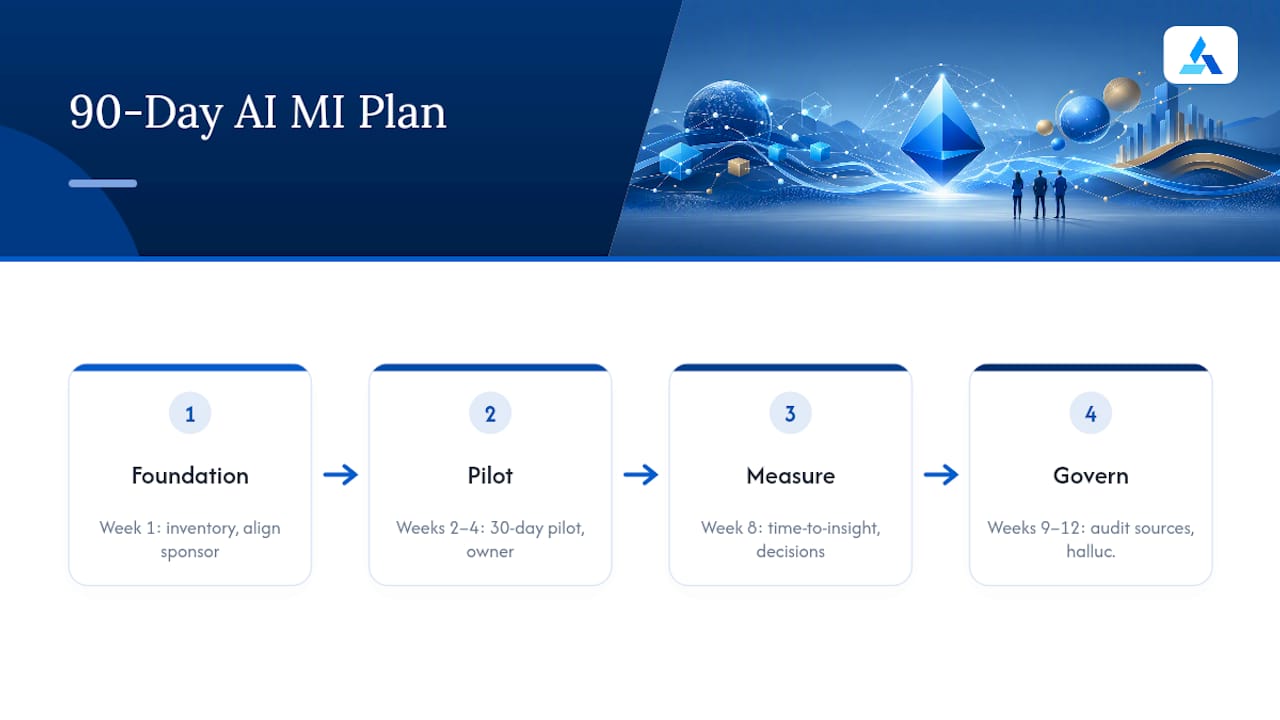
Start week one with an inventory. What market signals does your team already track manually, and where do they break down? Weeks two through four, pick exactly one use case, ideally competitor pricing or sentiment, and run a 30-day pilot with a named decision owner attached to every output. By week eight, measure time to insight and count how many real decisions the pilot enabled, not how many alerts it generated. Weeks nine through twelve, govern the risk: hallucination rates and stale data sources kill trust fast, so audit source freshness before you scale beyond the pilot. Get your executive sponsor aligned before month two, not after.
— Colin Bowdery
Ready to See AI Market Intelligence in Action?
Blue Prysm gives you what a generic AI dashboard can’t: live market signals wired directly into a strategy framework you can actually execute against, not another tab you forget to check. Where standalone monitoring tools leave you with alerts and no owner, such platforms may close that gap with execution dashboards built specifically for the handoff between insight and decision.
If you’re evaluating options, start with the market research tools built for exactly the pilot scope described above, or explore the full market analysis platform to see how competitor tracking and strategy execution connect in practice. When you request a demo, ask specifically about pilot scope, available connectors for your existing stack, and sample deliverables, the same three questions that separate a real platform from a pretty interface. Set up a demo and bring one real use case to test against your own data.
Sources
For deeper verification, review the Stanford AI Index economy report on adoption and investment, MarketsandMarkets’ AI market forecast, and Precedence Research’s market analysis on integration practices. Blue Prysm’s competitive intelligence software page covers applied use cases in more depth.
- The 2025 AI Index Report | Stanford HAI
- Artificial Intelligence (AI) Market Report 2026-2033, by Application, Geo, Tech
- Artificial Intelligence (AI) Market Companies, Size and Trends 2026-2035
FAQ
What Is AI Market Intelligence?
AI market intelligence is a continuous system that uses AI models to gather, analyze, and synthesize market data, then delivers those findings directly into strategic decision workflows rather than a one-time report.
What Are the Top AI Tools Right Now?
Rather than a fixed top-three list, the strongest AI market intelligence approaches right now combine real-time data feeds, explainable outputs, and workflow integration, capabilities that platforms like Blue Prysm build around directly rather than treating as add-ons.
What Are the Main Types of AI Used in Market Intelligence?
Market intelligence platforms typically draw on natural language processing for text and sentiment analysis, machine learning for pattern and trend detection, predictive analytics for forecasting, and increasingly agentic AI systems that plan and execute multi-step monitoring workflows on their own.
How Is AI Market Intelligence Different From Traditional Market Research?
Traditional market research delivers a static report on a project timeline of weeks or months, while AI market intelligence runs continuously, refreshing data and surfacing signals as they happen rather than after the fact.